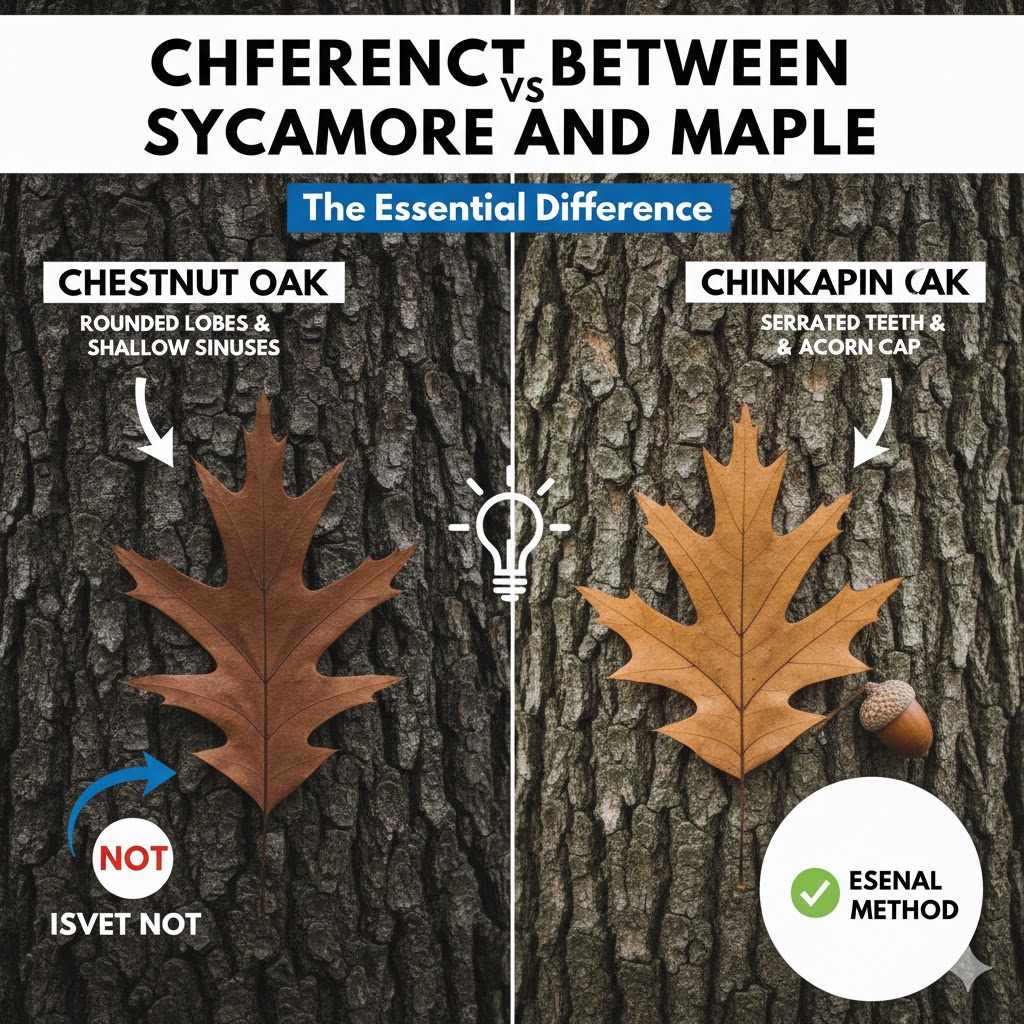
Chestnut Oak Vs Chinkapin Oak: The Essential Difference
The essential difference between Chestnut Oak and Chinkapin Oak lies in their leaves and bark. Chestnut Oak has leaves with rounded, wavy lobes and thick, deeply-ridged, dark bark. Chinkapin Oak has leaves with sharp, pointed, sawtooth-like lobes and flaky, ash-gray bark that is much thinner.
Hello, fellow makers and wood lovers! Md Meraj here, your friendly guide in the workshop. If you’ve ever stood in a forest or looked at a pile of lumber and felt a bit puzzled, you’re not alone. Telling trees apart, especially oaks, can feel like a real challenge. Two that often trip people up are the Chestnut Oak and the Chinkapin Oak. They look similar enough to cause a mix-up but are different in key ways.
It’s easy to get them confused. Their names even sound a bit alike! But knowing the difference is super helpful, whether you’re identifying trees on your property or picking the right wood for a project. Don’t worry, I’m here to make it simple. We’ll walk through the easy-to-spot clues together. By the end of this guide, you’ll be able to tell these two oaks apart with confidence. Let’s get started!
Getting to Know the Oaks: A Quick Introduction
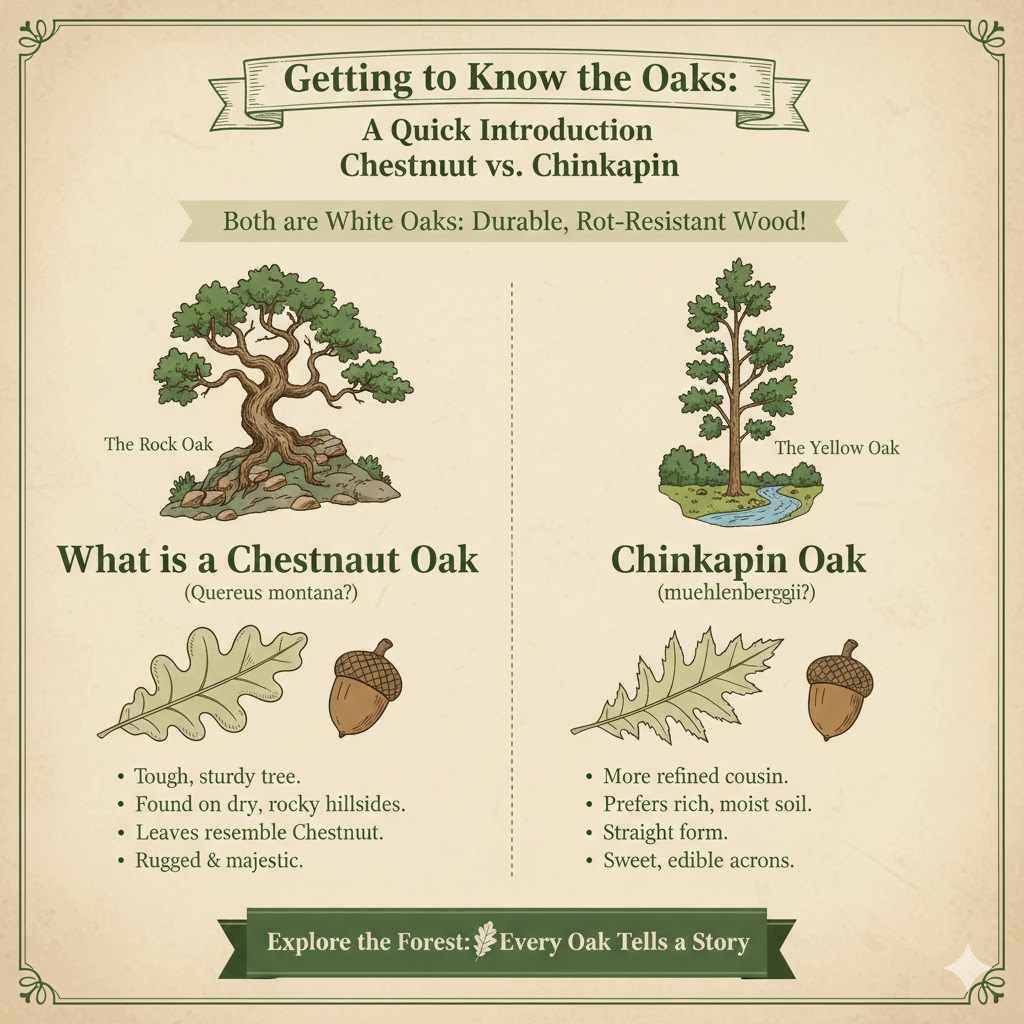
Before we dive into the differences, let’s say a quick hello to each of our oak friends. Both the Chestnut Oak and the Chinkapin Oak belong to the “white oak” group. This is an important detail for woodworkers. Trees in the white oak group generally have strong, rot-resistant wood, which makes them fantastic for all sorts of projects, especially outdoors.
What is a Chestnut Oak (Quercus montana)?
The Chestnut Oak is a tough, sturdy tree often found on dry, rocky hillsides. In fact, one of its common nicknames is the “Rock Oak” because of where it loves to grow. It’s a hardy survivor, known for its rugged and majestic appearance. Its name comes from the fact that its leaves look a little bit like the leaves of an American Chestnut tree, but as we’ll soon see, there are clear differences.
What is a Chinkapin Oak (Quercus muehlenbergii)?
The Chinkapin Oak, sometimes called Yellow Oak, is another member of the white oak family. It gets its name because its leaves look remarkably similar to the leaves of the Allegheny Chinkapin, a type of chestnut. Unlike its rock-loving cousin, the Chinkapin Oak prefers richer, moister soils often found near streams and in valleys. It’s known for its beautiful, straight form and sweet, edible acorns.
The 5 Key Differences You Can Spot in the Wild
Okay, let’s get down to the fun part: becoming a tree detective! When you’re trying to tell these two oaks apart, you just need to know what to look for. We’ll focus on five simple clues that will give you a positive identification every time.
1. Leaf Shape: The Easiest Tell
The absolute best way to tell these two apart is by looking at their leaves. It’s the most obvious clue once you know the secret.
- Chestnut Oak Leaves: Look for lobes (the bumps along the edge of the leaf) that are rounded and shallow. The edges look more wavy than pointy. Think of gentle, rolling hills. The leaf is typically widest above the middle and has a slightly leathery feel.
- Chinkapin Oak Leaves: These leaves have lobes that are sharp and pointed. They have a distinct sawtooth edge, much like a saw blade or the leaf of a true chestnut tree. Think of sharp, pointy mountain peaks. Each major vein in the leaf ends in a distinct, pointy tooth.
If you put one of each leaf side-by-side, the difference is night and day. Rounded waves versus sharp points. It’s that simple!
2. Bark Texture: The Next Best Clue
What if it’s winter and there are no leaves? No problem! The bark gives you your next big clue. Stand back and take a look at the trunk.
- Chestnut Oak Bark: This tree has very distinctive bark. It’s dark gray or almost black, very thick, hard, and deeply furrowed. The ridges are chunky and often form deep, V-shaped valleys. If you touch it, it feels solid and rough, like a rocky cliff face. This thick bark helps protect it from fire, which is common in the dry, upland areas it calls home.
- Chinkapin Oak Bark: The bark on a Chinkapin Oak is quite different. It is an ashy-gray or silvery color and is relatively thin. Instead of deep furrows, it appears flaky or shaggy, with small plates that can be peeled off. The fissures are much shallower. It has a lighter, more delicate appearance compared to the fortress-like bark of the Chestnut Oak.
3. Acorns: A Tale of Two Nuts
If it’s autumn, the acorns can seal the deal. Oak acorns consist of two parts: the nut itself and the cap that sits on top (called a cupule).
- Chestnut Oak Acorns: These acorns are usually quite large, growing up to an inch and a half long. They are oval or barrel-shaped. The cap is bowl-shaped, often warty or bumpy, and covers about one-third of the nut.
- Chinkapin Oak Acorns: These are much smaller, rarely growing over an inch long. They are dark brown to nearly black and have a thinner, bowl-shaped cap with fine gray hairs. The cap covers less than half of the nut. A key feature of Chinkapin Oak acorns is that they are known for being sweeter and more palatable than many other oak acorns.
4. Preferred Habitat: Where Do They Grow?
Sometimes, where you find a tree is just as important as what it looks like. These two oaks have very different tastes in real estate.
- Chestnut Oak: As its “Rock Oak” nickname suggests, this tree is a specialist of dry, rocky, acidic soils. You’ll commonly find it on ridges, bluffs, and poor-quality upland sites where other trees might struggle. As the U.S. Forest Service notes, it is a key species in many Appalachian forest communities.
- Chinkapin Oak: This tree is the opposite. It seeks out rich, moist, and well-drained soils. It is most happy in areas with underlying limestone, which makes the soil alkaline (the opposite of acidic). Look for it in bottomlands, along streams, and on gentle limestone slopes. It doesn’t compete well on the poor, dry sites where Chestnut Oak thrives.
5. Overall Form and Size: The Big Picture
Finally, you can look at the tree’s overall shape, or “form.” While this can vary a lot, there are some general tendencies.
- Chestnut Oak: Because it often grows in tough, rocky conditions, its form can be more rugged. On poor sites, it may be shorter with a spreading, irregular crown. In better conditions, it can become a large and impressive tree, but it often carries a look of hardy resilience.
- Chinkapin Oak: Growing in richer soil, the Chinkapin Oak often develops a more “classic” tree shape. It tends to grow tall and straight with a well-formed, rounded crown. It often presents a more stately and uniform appearance than its rugged cousin.
Comparison at a Glance: A Handy Chart
Sometimes a simple chart is the best way to remember the key points. Here’s a quick summary of everything we just covered to help you on your next walk in the woods.
| Feature | Chestnut Oak (Quercus montana) | Chinkapin Oak (Quercus muehlenbergii) |
|---|---|---|
| Leaves | Rounded, wavy lobes; no sharp points. | Sharp, pointed lobes; sawtooth edges. |
| Bark | Dark, thick, hard, with deep V-shaped ridges. | Ashy-gray, thin, flaky, with shallow fissures. |
| Acorns | Large (1-1.5 inches), oval-shaped nut; warty cap covers 1/3. | Small (under 1 inch), dark nut; thin cap covers less than 1/2. |
| Habitat | Dry, rocky, acidic soils (ridges and slopes). | Rich, moist, alkaline soils (bottomlands and limestone areas). |
| Form | Often rugged and spreading, especially on poor sites. | Typically tall, straight, and well-formed. |
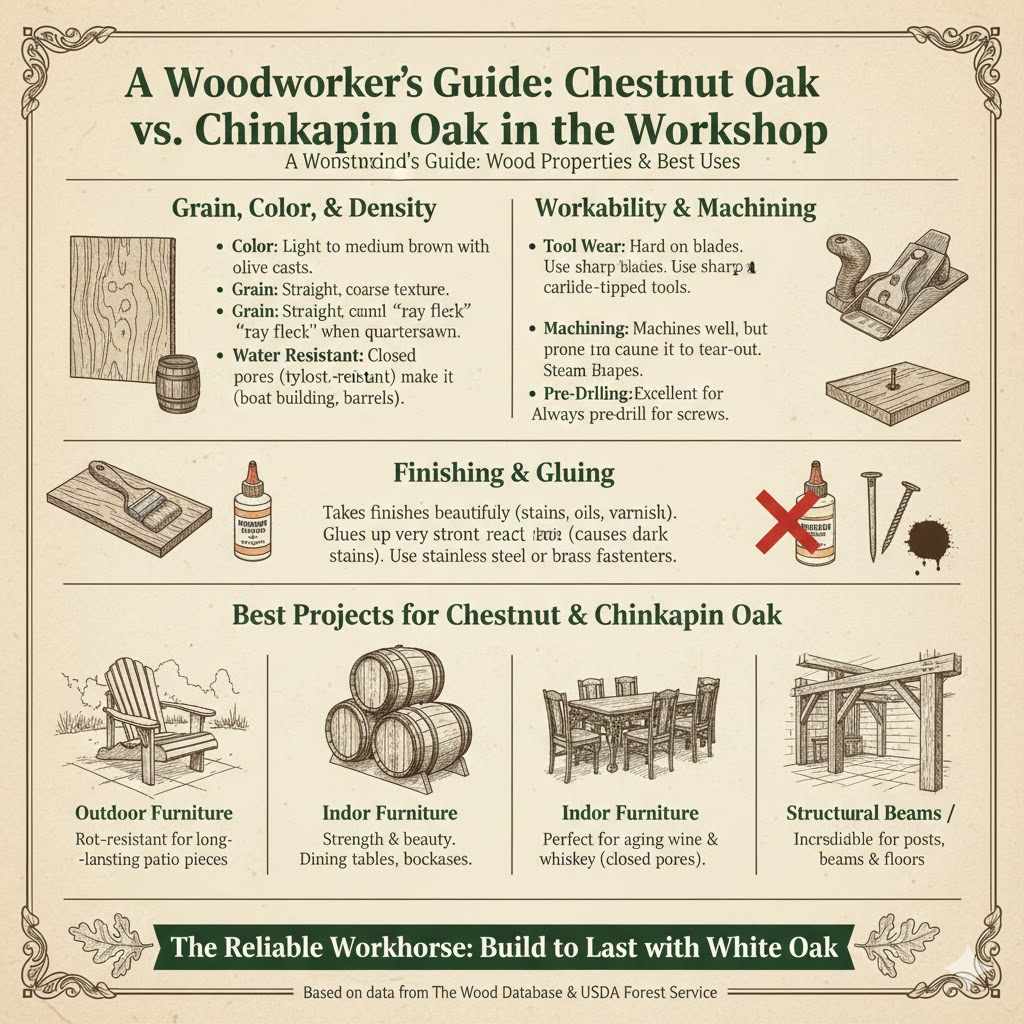
A Woodworker’s Guide: Chestnut Oak vs. Chinkapin Oak in the Workshop
As someone who loves working with wood, you might be wondering: “Okay, they’re different trees, but is their wood different?” This is an excellent question! Because both are members of the white oak group, their wood is very similar and, in the commercial lumber world, is often simply sold together as “White Oak.” However, there are some subtle points to consider for your projects.
Understanding the Wood: Grain, Color, and Density
The wood from both trees is heavy, hard, and strong. As part of the white oak group, they both have closed pores (called tyloses), which makes the wood highly resistant to water and rot. This is why white oak is prized for boat building and barrels.
Color: The heartwood of both is typically a light to medium brown, sometimes with an olive cast. The sapwood is a paler, creamy color. There isn’t a consistent, dramatic color difference between the two species that you could rely on for identification.
Grain: Both have a straight grain with the classic coarse texture of oak. When quartersawn, both will display the beautiful flecked pattern known as “ray fleck” that makes white oak so desirable for fine furniture.
Density: Both are very dense and heavy. While specific gravity can vary from tree to tree based on growing conditions, both will give you a solid, durable material for your projects.
Workability and Machining
Working with either of these oaks is a classic woodworking experience. Here’s what you can expect:
- Tool Wear: Oak is hard on blades. The high density means you should use sharp tools and expect to sharpen them more often than you would with a softwood like pine. Carbide-tipped blades are your best friend here.
- Machining: They generally machine well, but the coarse grain can be prone to tear-out, especially around knots or areas of changing grain direction. Take shallow passes with your planer and use a sharp blade in your table saw.
- Steam Bending: Being white oaks, both species are excellent for steam bending. This is the process of using steam to make wood flexible enough to bend into curved shapes for things like chair backs or decorative pieces.
- Pre-Drilling: Always pre-drill holes for screws. The wood is so dense that driving a screw directly will almost certainly cause it to split or break the screw.
Finishing and Gluing
This is where the beauty of white oak really shines. Both Chestnut and Chinkapin Oak take finishes wonderfully. Stains can be used to bring out the grain patterns, while clear finishes like varnish or oil will highlight the wood’s natural warmth. They also glue up very well, creating strong, lasting joints essential for furniture and cabinetry.
One thing to be aware of: the high tannin content in oak can react with iron. If you use steel wool or if the wood comes into contact with iron fasteners in wet conditions, it can cause a dark blue or black stain. Use stainless steel or brass fasteners for outdoor projects to avoid this.
Best Projects for Chestnut Oak and Chinkapin Oak
Because their wood is sold interchangeably as white oak, you can use either for the same projects. Here are some great ideas where this type of wood excels:
- Outdoor Furniture: Thanks to its natural rot resistance, it’s a top choice for beautiful and long-lasting patio tables, benches, and Adirondack chairs.
- Indoor Furniture: Perfect for projects that need strength and beauty, like dining tables, bookcases, desks, and bed frames. The ray flecks in quartersawn boards make for stunning cabinet doors.
- Flooring: Oak flooring is a classic for a reason. It’s incredibly durable and can withstand decades of foot traffic.
- Cooperage: White oak is the wood of choice for making barrels for aging wine and whiskey. The wood’s closed pores prevent leaks while allowing the contents to breathe.
- Structural Beams: In timber framing, the strength of white oak makes it ideal for supportive posts and beams.
According to sources like the Wood Database, the general category of White Oak (which includes both these species) is valued for its toughness and durability across all these applications.
Frequently Asked Questions (FAQ)
1. Are Chestnut Oak and Chinkapin Oak in the same oak group?
Yes, they are both members of the Quercus section Quercus, more commonly known as the white oak group. This means their wood shares key characteristics like rot resistance and water-tight pores.
2. Which oak is better for outdoor projects?
Both are excellent choices for outdoor projects due to their white oak properties. Commercially, they are sold as white oak and not separated. If you were harvesting your own, both would serve you well, but the tough nature of Chestnut Oak (growing on dry, harsh sites) might suggest it’s particularly resilient.
3. Can you eat the acorns from both trees?
Yes, the acorns from both trees are edible after the tannins have been leached out. This is typically done by boiling them in several changes of water. Chinkapin Oak acorns are known to be naturally sweeter and have lower tannin content, making them a favorite of wildlife and foragers.
4. Why is Chinkapin Oak named after a chestnut?
It’s named after the Allegheny Chinkapin (a relative of the American Chestnut) because its leaves are so similar. Both have that distinct sawtooth edge, which is very different from the rounded lobes of most other oaks.
5. Is the wood from these trees expensive?
As a domestic hardwood, white oak is more expensive than softwoods like pine but is generally affordable compared to exotic woods or premium hardwoods like walnut. It offers a fantastic balance of cost, durability, and beauty.
6. How can I tell them apart in winter without leaves?
The bark is your best clue in winter. Look for the Chestnut Oak’s dark, thick, deeply-ridged bark versus the Chinkapin Oak’s ashy-gray, thin, and flaky bark. Location is another great hint—check if you are on a rocky ridge or in a moist valley.
7. What are some good alternatives if I can’t find these woods?
Any lumber sold as “White Oak” will have nearly identical properties. Other good domestic hardwoods for similar projects include White Ash (for strength and bendability) or Hard Maple (for hardness and a lighter color).
Your Next Steps in Oak Identification
And there you have it! The mystery of the Chestnut Oak and the Chinkapin Oak is solved. It all comes down to a few simple observations. Just remember this core lesson:
Chestnut Oak = Rounded, wavy leaves and deep, rocky bark.
Chinkapin Oak = Sharp, pointy leaves and thin, flaky bark.
The best way to get good at this is to simply get outside and look at the trees around you. Take this guide with you. Find an oak and study its leaves, feel its bark, and check out where it’s growing. Before you know it, you’ll be pointing them out to friends and family like an expert.
In the workshop and in the woods, knowledge and confidence go hand-in-hand. Keep learning, stay curious, and happy woodworking!