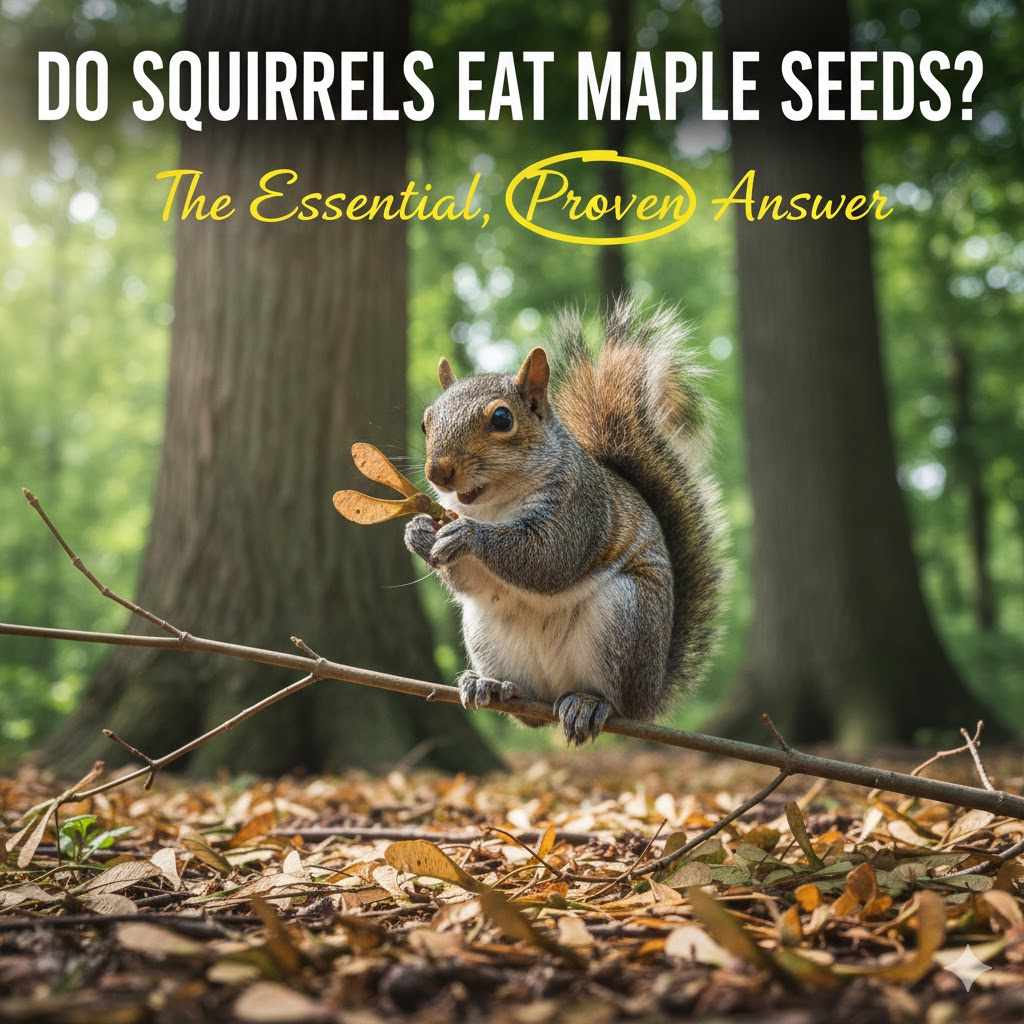
Do Squirrels Eat Maple Seeds The Essential, Proven Answer
Yes, squirrels absolutely eat maple seeds. They are a valuable, nutrient-rich food source, especially in late spring when the iconic “helicopter” seeds cover the ground. Squirrels expertly peel away the papery wing to get to the small, protein-packed seed inside, making it a regular and important part of their diet.
Have you ever watched a squirrel scamper across your lawn, grab one of those whirlybird seeds from your maple tree, and nibble away? It’s a common sight for many of us who enjoy spending time in our backyards or workshops. You might wonder if they are actually getting any food from it, or if they’re just playing. It’s a simple question, but the answer tells us a lot about these resourceful creatures.
I’m here to give you the straight, clear answer. We’ll look at exactly why squirrels love maple seeds and how they fit into their overall diet. This guide will walk you through everything you need to know, from the squirrel’s perspective. Let’s get started!
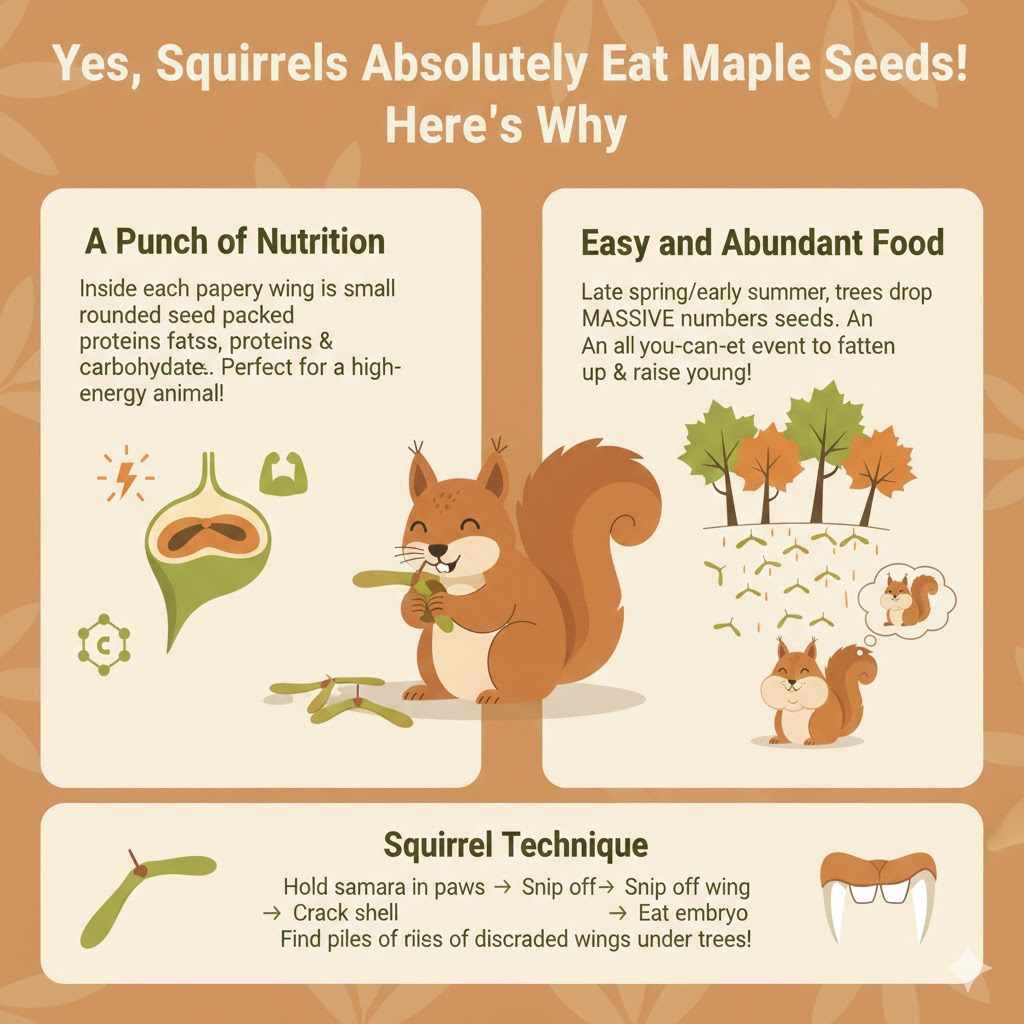
Yes, Squirrels Absolutely Eat Maple Seeds! Here’s Why.
There is no doubt about it: squirrels are big fans of maple seeds. While we might see thousands of these “helicopters,” also known as samaras, littering our lawns and driveways, a squirrel sees a buffet. These seeds are more than just a quick snack; they are a key food source that helps squirrels thrive, especially during certain times of the year.
So, what makes these little seeds so appealing? It comes down to two simple things: nutrition and availability.
- A Punch of Nutrition: Inside each papery wing is a small, rounded seed packed with energy. Maple seeds contain fats, proteins, and carbohydrates. This combination is perfect for a high-energy animal like a squirrel, fueling their daily acrobatics of climbing, chasing, and digging.
- Easy and Abundant Food: In late spring and early summer, maple trees drop a massive number of seeds. For squirrels, this is like an all-you-can-eat event. They don’t have to work hard to find food when it’s literally falling from the sky. This abundance helps them fatten up and provides a reliable food source for raising their young.
When you see a squirrel with a maple seed, watch its technique. They are remarkably efficient. A squirrel will hold the samara in its front paws, quickly snip off the thin, papery wing with its sharp teeth, and discard it. Then, it will crack open the shell of the seed pod at the end to get to the nutritious embryo inside. You can often find little piles of discarded wings under a maple tree—a sure sign that squirrels have been feasting there.
Understanding the Maple Seed (The “Helicopter”)
To fully appreciate why squirrels go after maple seeds, it helps to know a little bit about the seed itself. That spinning “helicopter” we all played with as kids is a masterpiece of natural engineering. Its official name is a “samara.”
A samara has two main parts, and squirrels are only interested in one of them.
- The Wing (or Aerofoil): This is the long, thin, papery part. It isn’t for eating. Its job is to catch the wind. When the seed drops from the tree, this wing makes it spin, a process called autorotation. This spinning slows its descent and allows the wind to carry it farther away from the parent tree. This helps the maple tree spread its seeds over a wider area, giving them a better chance to grow.
- The Nutlet (The Seed): This is the small, round, and hard bump at the base of the wing. This is the prize! It contains the embryo of a new maple tree, along with a stored supply of food (nutrients) to help it germinate and grow. This stored food is exactly what the squirrel is after.
So, when a squirrel eats a maple seed, it’s going after the nutlet. The wing is just the disposable packaging. The squirrel’s sharp incisors are perfect for gnawing through the tough outer layer of the nutlet to get to the tasty and energy-rich meal inside. It’s a great example of how animals have adapted to make the most of the resources around them.
A Squirrel’s Menu: How Maple Seeds Fit In
Squirrels are foragers with a diverse diet that changes with the seasons. They are masters at finding whatever food is plentiful at any given time. Maple seeds are a springtime staple, but they are just one part of a much larger menu.
Thinking about a squirrel’s diet is like looking at a calendar of nature. In the fall, they are busy gathering and burying hard mast like acorns and walnuts, which are high in fat and store well for the winter. These are their survival foods. When spring arrives, the world comes alive with new options. Tree buds, fresh green shoots, and, of course, maple seeds become the main course. Maple seeds are particularly important because they appear after winter stores may have run low and before the berries and fruits of summer have ripened.
Here is a simple breakdown of how maple seeds compare to other common foods in a squirrel’s diet:
| Food Source | Nutritional Value | Seasonality | Squirrel’s Use |
|---|---|---|---|
| Acorns & Walnuts | Very High (Fat, Protein) | Fall & Winter | Long-term storage (caching) for winter survival. |
| Maple Seeds | Moderate (Fat, Protein) | Late Spring & Early Summer | Eaten immediately for a quick energy boost. |
| Tree Buds & Flowers | Moderate (Vitamins) | Early Spring | An important early food source after winter. |
| Berries & Fruits | High (Sugar, Vitamins) | Summer & Fall | A sweet, high-energy treat eaten on the spot. |
| Fungi & Mushrooms | Moderate (Minerals) | Summer & Fall | An opportunistic food source, some are even dried and stored. |
As you can see, maple seeds fill a specific niche. They are the perfect “bridge” food, providing essential energy between the last of the winter nuts and the first of the summer berries. Their sheer abundance makes them a reliable meal when young squirrels are learning to forage for themselves.
Observing Squirrels and Maple Seeds: What to Look For
For anyone with a bit of curiosity and a backyard, watching squirrels interact with maple seeds can be a fascinating activity. You don’t need any special equipment—just a little patience. It’s a great way to connect with the nature right outside your door.
If you want to become a squirrel-watching expert, here are a few simple things to look for:
- The Evidence Trail: The easiest way to confirm that squirrels are eating maple seeds is to look for the leftovers. Underneath a large maple tree, especially one near a fence or branch where squirrels like to sit, you will often find a mess of discarded wings. These little papery remnants are the “wrappers” from their meal.
- The “Shucking” Technique: Watch a squirrel as it handles a samara. It will likely sit up on its hind legs, hold the seed in its front paws, and turn it over and over. You’ll see it expertly nip off the wing and then focus its attention on the nutlet, gnawing it open with precision.
- Prime Time for Dining: Squirrels are most active during the early morning and late afternoon. These are the best times to catch them in the act. They tend to be more relaxed during these cooler parts of the day.
- Caching Behavior: While squirrels often eat maple seeds on the spot, you might occasionally see one carry a seed off and bury it. This is called “caching.” They do this with acorns all the time, but less frequently with maple seeds, which don’t store as well. If you see this, you are witnessing a squirrel saving a snack for later.
Taking a few minutes to observe this simple act can be very rewarding. It’s a reminder that our yards are not just patches of grass but living ecosystems where animals are constantly working to survive and thrive.
Are All Maple Seeds the Same to a Squirrel?
Just like we might prefer one type of apple over another, do squirrels have a preference when it comes to maple seeds? While a hungry squirrel is rarely picky, there are differences between the seeds of various maple species, which can influence their choices.
Not all maple trees are the same. In North America, some of the most common types you’ll find in yards and forests are Sugar, Red, and Silver maples.
- Sugar Maple (Acer saccharum): Known for its brilliant fall colors and for producing maple syrup, the Sugar Maple has medium-sized seeds. These are a favorite for many squirrels.
- Red Maple (Acer rubrum): One of the most abundant trees in Eastern North America, the Red Maple produces smaller seeds that are available early in the spring. They provide a vital early food source.
- Silver Maple (Acer saccharinum): These trees produce some of the largest seeds, which drop in late spring. A larger seed means more food for less work, making them a very attractive meal for squirrels.
- Norway Maple (Acer platanoides): A common urban tree, the Norway Maple has large, flat seeds with wings that spread out wide. Squirrels readily eat these as well.
Generally, squirrels seem to follow a simple rule: bigger is better. A larger nutlet, like one from a Silver or Norway Maple, provides more energy. However, availability is the most important factor. Squirrels will eat the seeds of whichever maple tree is producing in their territory. For more details on identifying different maple trees, you can check out excellent resources from university extension programs, like this guide from the Penn State Extension.
The Impact of Squirrels on Maple Trees
So, we know squirrels eat maple seeds, but is this relationship good or bad for the maple tree? The answer is both. Squirrels have a complex relationship with trees that involves seed predation (eating them) and seed dispersal (spreading them).
The Good: Squirrels as Tree Planters
Squirrels are famous for their habit of burying nuts for the winter, a behavior known as “scatter-hoarding.” They bury thousands of nuts each fall in many different locations. Their memory is good, but it isn’t perfect. Many of the seeds they bury are never recovered. An uneaten buried seed is essentially a perfectly planted seed.
When a squirrel buries a maple seed or an acorn and forgets about it, that seed has a chance to germinate and grow into a new tree. In this way, squirrels act as unintentional foresters, helping to plant the next generation of trees. This dispersal is crucial for forest health, as it helps trees spread to new areas.
The Bad: Squirrels as Seed Predators
The downside, from the tree’s perspective, is that every seed a squirrel eats is one less seed that can grow into a sapling. This is called seed predation. In a given year, squirrels and other animals can consume a huge percentage of a tree’s seed crop. However, trees like maples have a strategy to overcome this: they produce an enormous number of seeds, a strategy known as “masting.” By producing far more seeds than the local animals can possibly eat, they ensure that at least some will survive to sprout.
Here’s a table that summarizes this balanced relationship:
| Squirrel Action | Positive Impact for the Maple Tree (+) | Negative Impact for the Maple Tree (-) |
|---|---|---|
| Eating Seeds Directly | None | Reduces the number of seeds available for germination (seed predation). |
| Burying (Caching) Seeds | Forgotten seeds grow into new trees, spreading the species (seed dispersal). | Some cached seeds are later recovered and eaten by the squirrel. |
| Eating Tree Buds | None | Can slightly reduce foliage or flower growth on young branches. |
For the average homeowner, the impact of squirrels on a mature maple tree is negligible. The tree is well-established, and the loss of some seeds is a natural part of the ecosystem.
What If You Don’t Want Squirrels Eating Your Maple Seeds?
While the interaction between squirrels and maple seeds is natural, there might be times when you want to discourage it. Perhaps you are trying to collect seeds to grow your own maple saplings, or maybe the squirrels are a bit too rambunctious near your home. If you want to gently nudge the squirrels away from your maple seeds, there are several humane options.
The goal should always be coexistence, not elimination. Here are a few simple and effective methods:
- Keep it Clean: The simplest solution is to remove the temptation. Regularly raking up the fallen maple seeds from your lawn reduces the available food source, encouraging squirrels to forage elsewhere.
- Use Taste Deterrents: Squirrels have a strong sense of taste and smell. They dislike the spicy heat of capsaicin, the compound that makes chili peppers hot. You can buy commercial squirrel repellents containing capsaicin or make your own by mixing cayenne pepper with water and a drop of soap. Spray it on the ground where seeds have fallen. It’s safe for the squirrels but unpleasant for their taste buds.
- Create a Diversion: You can lure squirrels away from one area by making another area more attractive. Set up a dedicated squirrel feeder in a different part of your yard, far from your maple tree. Filling it with inexpensive cracked corn or black oil sunflower seeds can keep them busy and satisfied.
- Protect Young Trees: If you are trying to grow a young maple from seed or have a newly planted sapling, you may want to protect it. You can create a small cage of wire mesh to place over the seedling until it is large enough to withstand a little nibbling.
For more ideas on dealing with squirrels in a kind and effective manner, organizations like The Humane Society of the United States offer excellent advice that respects wildlife.
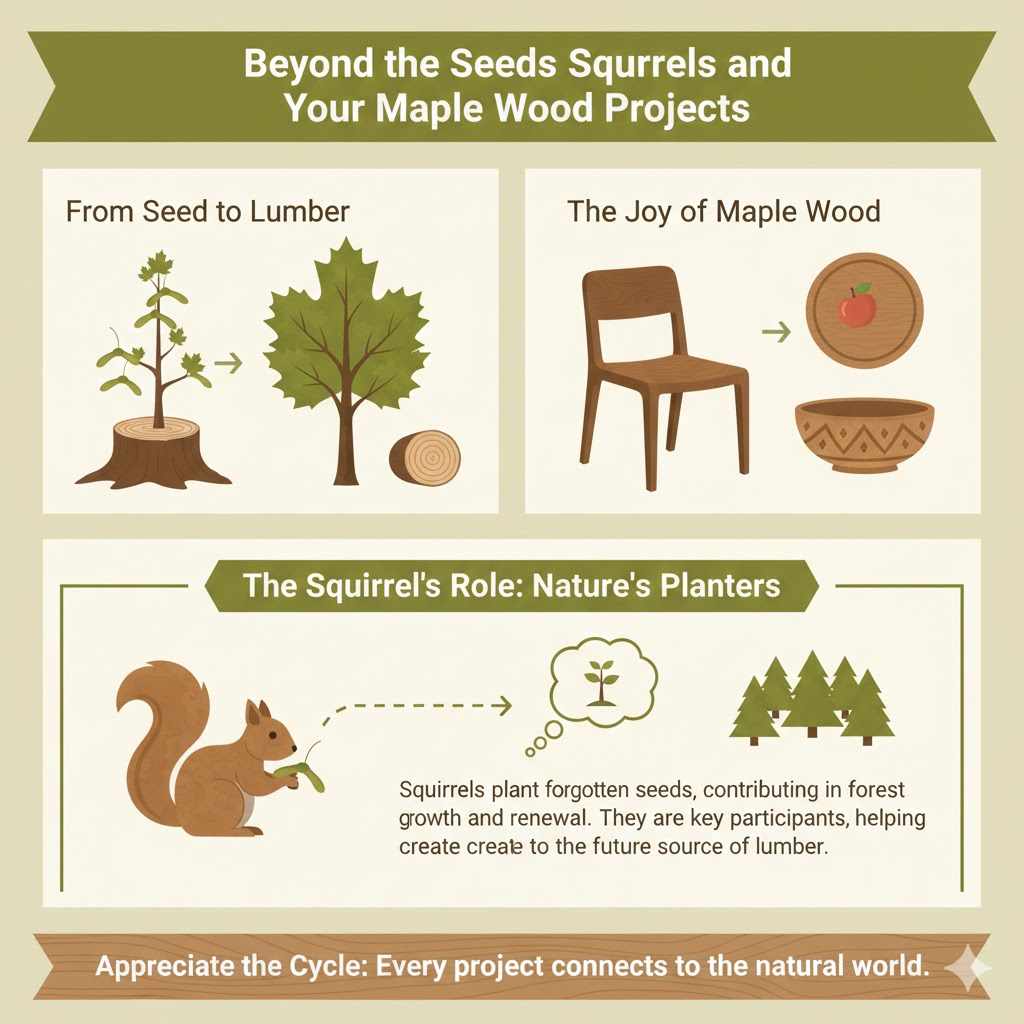
Beyond the Seeds: Squirrels and Your Maple Wood Projects
As someone who loves working with wood, I find it amazing to think about the entire life cycle of a tree. That beautiful piece of maple on your workbench started as a tiny seed, just like the ones the squirrels are eating in your yard. The squirrels, in their own way, are part of that long story.
Maple wood, especially from Sugar Maple and Red Maple, is a joy to work with. It’s strong, dense, and has a beautiful, smooth grain that is perfect for everything from furniture and cutting boards to decorative turnings. When you see a squirrel planting a forgotten seed, you are witnessing the very first step in a process that could, a hundred years from now, result in a magnificent tree that provides lumber for future woodworkers.
This connection reminds us to appreciate the materials we use. The natural world is full of these cycles of growth, consumption, and renewal. The squirrel feasting on seeds isn’t a pest; it’s a participant in the ecosystem that ultimately creates the strong, beautiful maple wood we value in our projects. So, the next time you plane a piece of curly maple, you can give a little nod to the generations of squirrels that helped that forest thrive.
Conclusion
So, do squirrels eat maple seeds? The answer is a resounding yes. It’s not just a random snack; it’s a fundamental part of their seasonal diet, providing the energy they need to thrive in the spring and early summer. They expertly strip the wings to get to the nutritious seed inside, a behavior you can easily spot in your own backyard.
This simple act is part of a much larger, beautiful cycle. By eating some seeds and burying others, squirrels play a dual role as both consumer and planter, shaping the forests around us. It’s a perfect example of how interconnected nature is.
The next time you are out in your workshop and see a flash of a bushy tail as a squirrel dashes up a maple tree, you’ll know exactly what’s happening. You are watching a small but vital part of the natural process that eventually gives us the strong, stunning maple wood we are so lucky to work with. It’s a great reminder to appreciate the small wonders of nature, right in our own backyards. Happy building!
Frequently Asked Questions (FAQ)
Do squirrels eat the whole maple “helicopter”?
No, they don’t. Squirrels are only interested in the small, round seed pod (the nutlet) at the end of the papery wing. They use their sharp teeth to quickly cut off and discard the wing before cracking open the pod to eat the nutritious seed inside.
Will squirrels eating maple seeds harm my tree?
For a healthy, mature maple tree, squirrels eating the seeds cause no harm. Maple trees produce thousands of seeds, far more than the squirrels can eat, to ensure that some will survive to sprout. This activity is a normal and healthy part of the local ecosystem.
What time of year do squirrels eat maple seeds most?
Squirrels primarily eat maple seeds in the late spring and early summer. This is when the seeds ripen and fall from the trees in great numbers, providing an abundant and easily accessible source of food.
Do squirrels prefer maple seeds over acorns?
Squirrels treat them differently. They prefer acorns and other hard nuts for long-term storage because their high fat content helps them survive the winter. Maple seeds are softer and don’t store as well, so they are typically eaten right away as a fresh, seasonal source of energy.
Are maple seeds poisonous to other animals?
Maple seeds are generally safe and nutritious for most wildlife that eats them, including squirrels, chipmunks, and some birds. It’s worth noting that while the seeds are safe, the wilted leaves of the Red Maple (Acer rubrum) can be toxic to horses.
How can I tell if squirrels are eating my maple seeds?
The clearest evidence is finding small piles of the discarded papery wings on the ground, especially under tree branches, along fences, or on a deck railing. This is the “litter” left behind after a squirrel has finished its meal.
Why do I see so many maple seeds sprouting if squirrels eat them?
Maple trees produce a massive number of seeds as a survival strategy. They create far more than all the local animals could ever consume. Additionally, squirrels often bury seeds and forget where they put them, effectively planting new trees by accident.