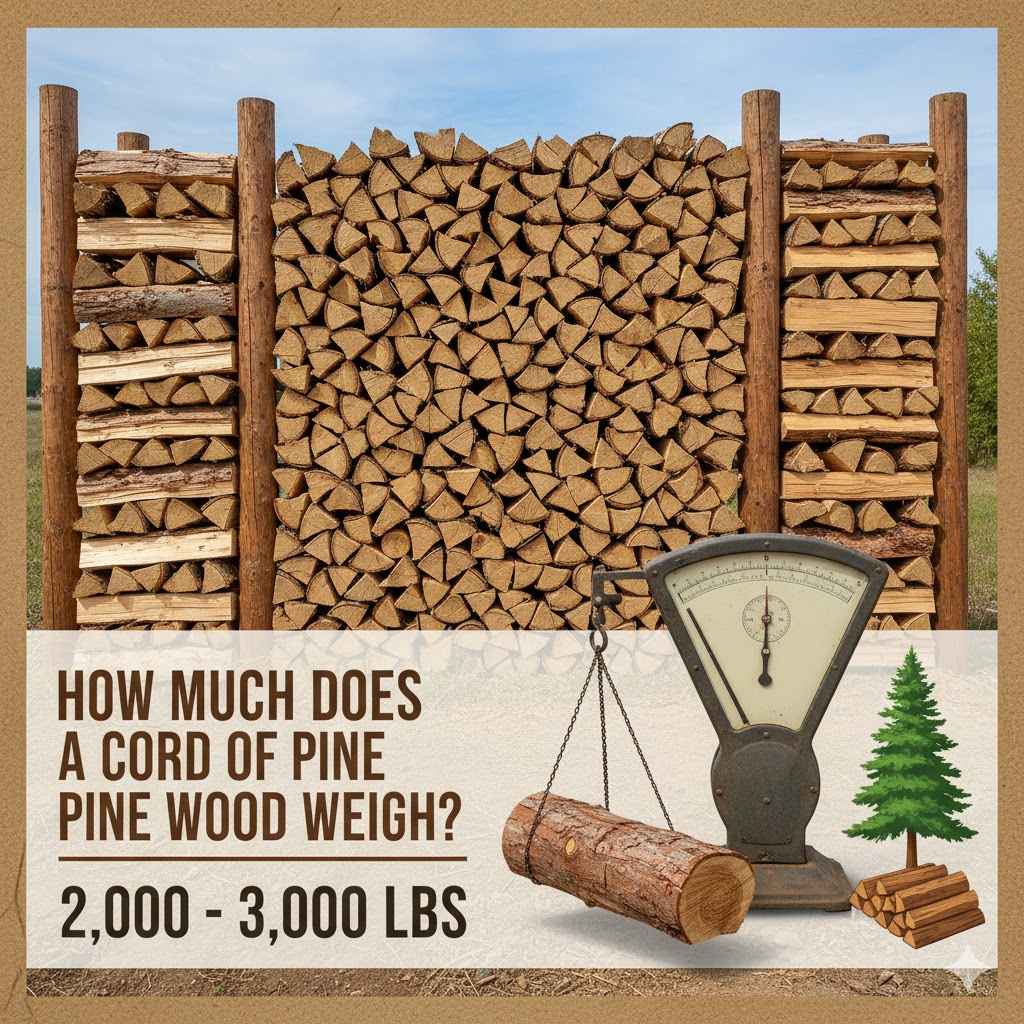
How Much Does a Cord of Pine Wood Weigh?
Figuring out how much a cord of pine wood weighs can seem tricky, especially when you’re just starting. You might see different numbers, and it’s not always clear why. This guide makes it simple.
We’ll walk through it step-by-step so you know exactly what to expect. Let’s break down what goes into that weight and how to get a good estimate.
Understanding Wood Weight Basics
The weight of wood is a really important thing to know for lots of reasons. Whether you’re buying firewood, planning a construction project, or just curious, knowing the weight helps you make smart decisions. It’s not a simple number because wood can be different.
Things like how wet the wood is and what kind of tree it came from make a big difference. This section will cover the main things that make wood heavy or light.
What is a Cord of Wood?
A cord of wood is a standard way to measure firewood. It’s a stack of wood that measures 4 feet high, 8 feet long, and 4 feet deep. This gives you a total volume of 128 cubic feet.
But, how the wood is stacked matters. If it’s loosely stacked, there will be more air between the logs, and it will take up more space. Tightly stacked wood means less air and a more solid stack.
This difference in air space affects the total weight you get for a cord.
The idea of a cord is to provide a consistent volume for buying and selling firewood. This way, buyers can have a clearer idea of how much wood they are actually getting. Without a standard measure, sellers could stack wood loosely to make it look like more, shortchanging buyers.
The 4x4x8 foot measurement is pretty standard across many regions.
Moisture Content’s Big Role
One of the biggest factors affecting how much wood weighs is its moisture content. Freshly cut wood, called green wood, holds a lot of water. This water adds significant weight.
As wood dries out, or seasons, this water evaporates, making the wood much lighter. For firewood, dried or seasoned wood is preferred because it burns better and produces less smoke. The drying process can take many months, sometimes even a year or more, depending on the wood and the climate.
Think about a sponge. A wet sponge is much heavier than a dry one. Wood is similar.
When wood is cut, the cells are full of water. Even after it’s cut into logs, that water stays until it has time to evaporate. This is why a cord of green pine will weigh much more than a cord of dry pine.
Estimating the weight needs to consider if the wood is green or seasoned.
Wood Density Differences
Not all types of wood are created equal when it comes to density. Density is basically how much “stuff” is packed into a certain amount of space. Denser woods, like oak or hickory, have more solid wood material per cubic foot, making them heavier.
Lighter woods, like pine or fir, have less dense wood material and more air pockets within their structure. This means that even if you have the same size stack of wood, a cord of a dense hardwood will weigh more than a cord of a lighter softwood like pine.
Pine is known as a softwood. This means its cellular structure is less compact compared to hardwoods. This natural difference in structure directly impacts its weight.
When we talk about a cord of pine, we are referring to the volume, but the actual weight within that volume is less than if it were a denser wood. This is a key reason why pine is often used for things like lumber where weight is a concern, but also why it’s a popular choice for kindling due to its lighter nature.

How Much Does a Cord of Pine Wood Weigh?
Now, let’s get to the core question: How much does a cord of pine wood weigh? Because pine is a softwood and its weight varies greatly with moisture, there isn’t one single answer. However, we can provide a good range.
A cord of seasoned pine wood typically weighs between 2,000 to 3,500 pounds. This is a common range you’ll encounter. If the pine is green, meaning it’s freshly cut and full of sap and water, a cord can weigh much more, sometimes up to 4,000 pounds or even higher.
The 2,000 to 3,500 pound figure is what most people are looking for when they ask about a cord of pine. This refers to wood that has been dried for at least six months, ideally longer. The lower end of this range (around 2,000 lbs) would be for wood that is very dry and has a lower density pine species.
The higher end (around 3,500 lbs) would be for wood that might still have a little bit of moisture or is from a denser pine variety.
Estimating Weight Based on Moisture
When you’re trying to figure out the weight of a cord of pine, understanding the moisture level is crucial. Wood is considered “seasoned” or “kiln-dried” when its moisture content has been reduced significantly. For firewood, a good target is usually below 20% moisture.
Green pine, on the other hand, can easily have moisture content of 50% or more. This difference is huge for weight.
Imagine a log that is 50% water. Half of its weight is just water! As it dries, that water leaves, and the wood becomes lighter.
For pine, a reduction from 50% moisture down to 15% can cut the weight by about one-third. This is why it’s so important to know if the pine you’re dealing with is green or seasoned. If you’re buying wood and the seller doesn’t specify, assume it’s on the heavier side.
Green Pine Weight
Green pine is heavy. Really heavy. A cord of green pine can easily weigh 4,000 pounds, and sometimes even more.
This is because the wood is saturated with water. This water is held within the cells of the wood, and it’s not just surface moisture. Think of it like a full water bottle versus an empty one; the water adds a lot of weight.
If you’ve ever tried to carry a freshly cut branch, you’ll notice how surprisingly heavy it is. This is the same principle. For many uses, especially burning, green pine is not ideal.
It burns poorly, creates a lot of steam and smoke, and can leave creosote build-up in chimneys. Its weight makes it harder to move and handle as well.
Seasoned Pine Weight
Seasoned pine is what most people aim for. This is wood that has been cut and allowed to dry for a significant period. As the water content drops, so does the weight.
A cord of seasoned pine typically falls between 2,000 and 3,500 pounds. The exact weight depends on how well it was seasoned and the specific type of pine.
The drying process is what makes seasoned wood lighter and more desirable for burning. It means less energy from the fire is wasted boiling off water, and more energy is released as heat. When people talk about the weight of a cord of pine, they are almost always referring to seasoned pine unless they specifically state otherwise.
Factors Influencing Pine Wood Weight
Beyond moisture, other things can tweak the weight of a cord of pine. The specific species of pine plays a role. For example, ponderosa pine might weigh a bit differently than white pine, even when both are equally dry.
The size and shape of the pieces of wood also matter. Smaller, uniformly cut pieces might pack more densely than larger, irregularly shaped logs.
Also, consider how the wood is stacked. A cord measured by volume might have more air if the pieces are uneven or if it’s stacked loosely. This means less actual wood material in the stack, leading to a lower weight.
Conversely, a very tightly packed cord, even with slightly uneven pieces, will have more wood and thus more weight. These subtle differences add up.
How to Calculate or Estimate Pine Wood Weight
Estimating the weight of a cord of pine wood is often more practical than trying to get an exact number, especially if you’re buying it. Here’s how you can approach it. You can use average weights for seasoned pine and adjust based on what you observe.
If you need to be more precise, you can try to measure the volume of the wood and use a known density.
For most home users, a good rule of thumb is to use the average range for seasoned pine. If you are buying firewood by the cord, and the price seems too low, it might be a sign that the wood is green or not a full cord. Always ask about the wood’s condition.
Using Average Weight Ranges
The easiest way to estimate is to use the common ranges. For seasoned pine, assume between 2,000 and 3,500 pounds per cord. If you’re buying, and the seller gives you a specific weight, compare it to this range.
If they say a cord of pine weighs 5,000 pounds, something is likely wrong unless it’s extremely wet.
A good middle ground for seasoned pine is often around 2,750 pounds per cord. This is a useful number to keep in mind for general purposes. If you are cutting your own wood, and it feels very heavy when you lift it, it’s a good indicator that it’s still quite green.
Example Calculation
Let’s say you buy a cord of pine and want to estimate its weight. You know it was cut last summer and has been drying outside. You’d likely estimate it to be on the lighter side of the seasoned range, maybe around 2,300 pounds.
If it was cut just a few months ago and looks very wet, you’d need to consider that it might be closer to 3,800 pounds or more.
Here’s a simple scenario: You buy wood that is advertised as seasoned. You notice it’s still fairly dense and has some weight when you lift individual pieces. You might lean towards the higher end of the seasoned range, perhaps 3,000 pounds for your cord.
This is a reasonable assumption.
Measuring Volume and Density
For a more precise estimate, you can consider the volume and density. A standard cord is 128 cubic feet. If you know the approximate density of pine wood in pounds per cubic foot, you can multiply that by 128.
However, finding the exact density for your specific wood can be tricky.
The density of seasoned pine wood can range from about 20 to 30 pounds per cubic foot. So, for a cord (128 cubic feet), this would mean:
| Density (lbs/cu ft) | Estimated Cord Weight (lbs) |
|---|---|
| 20 | 2560 |
| 25 | 3200 |
| 30 | 3840 |
As you can see, even a small difference in density leads to a notable difference in the total weight. This is why knowing the moisture content and the specific pine species helps refine these estimates. The table shows how density directly impacts the final weight of a full cord of wood.
When to Weigh Your Wood
Weighing your wood is the most accurate way to know its weight. If you have access to a large scale, like one at a lumber yard or a farm, you can weigh your truck or trailer before and after loading the wood. The difference will be the weight of the wood.
This is the best method if accuracy is critical, for example, if you are hauling it long distances or selling it by weight.
For instance, if you load a cord of pine onto your trailer, weigh the loaded trailer. Then, unload the wood and weigh the empty trailer. The difference is the weight of the cord.
This method eliminates guesswork and provides a definitive number. This approach is highly recommended for professional buyers or sellers.
Practical Uses and Considerations
Knowing how much a cord of pine wood weighs is useful for more than just curiosity. It impacts how you buy, store, and use the wood. For example, if you plan to stack firewood in your backyard, you need to know the weight to ensure your area can support it and to estimate how much space you’ll need.
If you’re ordering firewood, understanding the weight helps you gauge if you’re getting a fair deal. A cord of seasoned pine should feel substantial but not impossibly heavy. If a truckload feels light for its volume, it might be a sign of green wood or an under-measurement.
Buying and Selling Firewood
When you buy firewood, it’s often sold by the cord or by the truckload. If it’s sold by the cord, the 128 cubic foot measurement should be your guide. However, if you can ask about the wood’s moisture content and its estimated weight, it’s a good sign of a knowledgeable seller.
They might even have scales.
For sellers, knowing the average weight of seasoned pine (2,000-3,500 lbs) helps in pricing and in managing inventory. Selling green wood at the same price as seasoned wood is not fair. Being transparent about the wood’s condition helps build trust with customers.
A fair price for seasoned wood reflects its lighter weight and better burning quality.
Storing and Handling Wood
The weight of pine wood directly affects how easy it is to handle. Green pine is much heavier and harder to move. Seasoned pine, being lighter, is easier to stack and transport.
If you’re building a woodpile, consider that a full cord of seasoned pine can weigh over a ton. You’ll need to plan for this weight when designing your storage area.
Proper storage is key to keeping wood seasoned and reducing its weight over time. Keeping wood off the ground and covered from rain will help it stay dry and at its lightest possible weight for its type. This also makes it easier for you to move pieces around as needed.
Safety When Moving Wood
Moving heavy loads of wood carries risks. Always use proper lifting techniques. If a piece of wood feels too heavy to lift safely, get help.
For larger quantities, consider using a wheelbarrow, a log carrier, or even machinery if available. The weight of pine, especially when green, means you should always prioritize safety.
A cord of pine wood, even when seasoned, is a substantial amount of material. When you’re stacking or moving it, be aware of your surroundings and wear appropriate protective gear like gloves and sturdy shoes. Lifting with your legs, not your back, is a fundamental rule.
Don’t underestimate the effort required to move wood.
Pine as Firewood
Pine is a popular choice for firewood, especially for starting fires due to its resin content, which helps it ignite easily. However, it burns quickly and doesn’t produce as much heat as denser hardwoods. Its lighter weight also makes it easier to transport and handle compared to hardwoods.
This makes it a convenient option for many households.
The resin in pine can cause creosote buildup in chimneys, so it’s often recommended to mix pine with hardwoods for a more balanced burn. Its lighter weight means that while a cord might seem like a lot of wood by volume, it will provide fewer hours of consistent heat compared to a cord of oak, for instance.
Comparison with Hardwoods
When comparing pine to hardwoods like oak or maple, the weight difference is significant. A cord of seasoned hardwood can weigh anywhere from 3,500 to 5,000 pounds or even more. This is because hardwoods are much denser.
They pack more wood material into the same cubic foot of space.
Here’s a quick look at how weights might compare:
| Wood Type | Estimated Weight Per Cord (Seasoned) |
|---|---|
| Pine (Softwood) | 2,000 – 3,500 lbs |
| Oak (Hardwood) | 3,500 – 4,500 lbs |
| Maple (Hardwood) | 3,700 – 4,700 lbs |
This table clearly shows that for the same volume (a cord), hardwoods are considerably heavier. This translates to more fuel value per cord for hardwoods, meaning they burn longer and hotter. Pine is lighter and burns faster, making it great for starting fires but less ideal for all-night heating.

Frequently Asked Questions
Question: What is the average weight of a cord of pine wood?
Answer: The average weight of a cord of seasoned pine wood typically ranges from 2,000 to 3,500 pounds. If the wood is green, it can weigh significantly more, often up to 4,000 pounds or higher due to its high water content.
Question: Does pine wood weigh more when it’s wet?
Answer: Yes, wet or green pine wood weighs much more than dry or seasoned pine wood. The water content can add hundreds or even thousands of pounds to a cord.
Question: Is a cord of pine lighter than a cord of oak?
Answer: Yes, a cord of pine wood is generally lighter than a cord of oak wood. Pine is a softwood and less dense, while oak is a hardwood with higher density, meaning more material is packed into the same volume.
Question: How long does pine wood need to season before it’s lighter?
Answer: Pine wood typically needs to season for at least six months to a year to significantly reduce its moisture content and weight. The longer it seasons, the lighter and more efficient it becomes for burning.
Question: Can I estimate the weight of a cord of pine if I know its volume?
Answer: Yes, if you know the volume (a cord is 128 cubic feet) and the approximate density of pine in pounds per cubic foot, you can estimate the weight. However, density varies with moisture and species, so this is an estimate.
Conclusion
You now know that how much a cord of pine wood weighs depends mostly on how dry it is. Seasoned pine generally weighs between 2,000 and 3,500 pounds, while green pine can be much heavier. This information helps you buy smart and handle wood safely.
Always consider moisture when estimating weight.