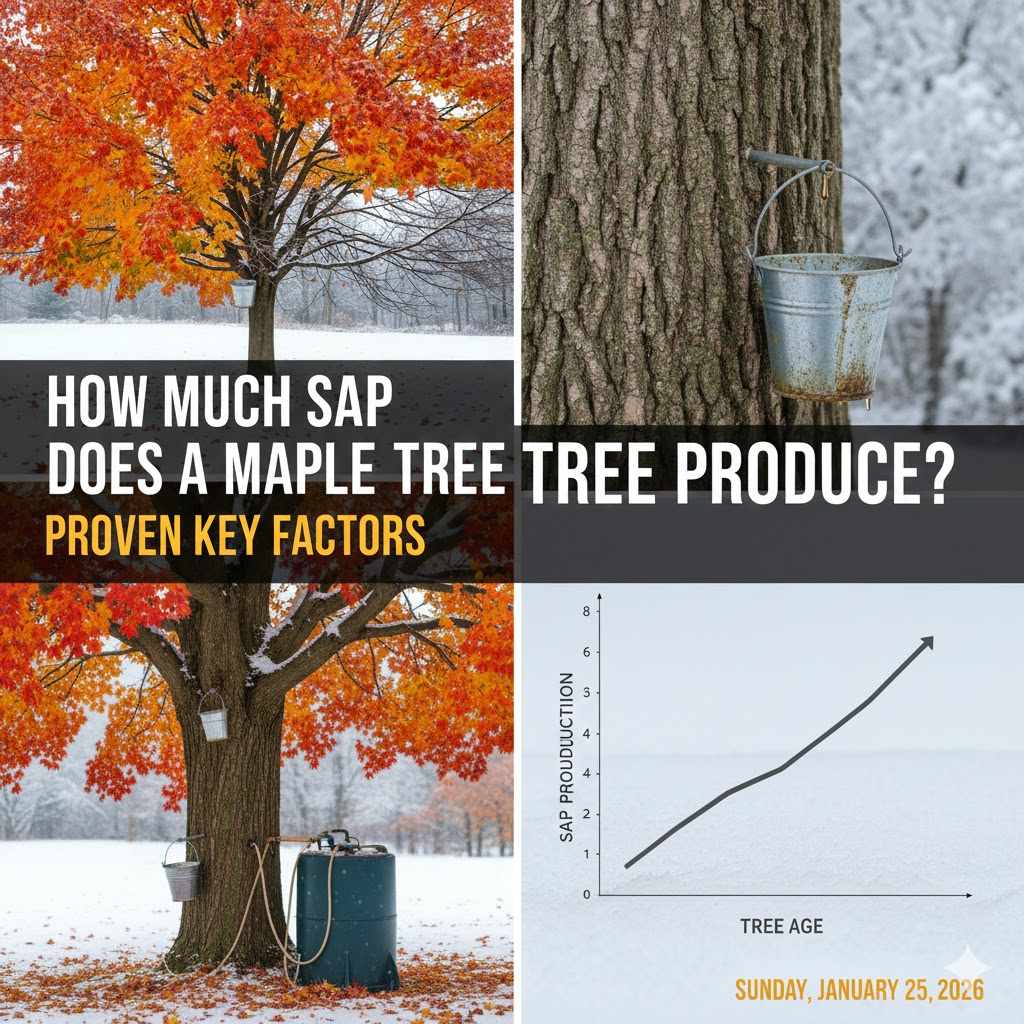
How Much Sap Does a Maple Tree Produce: Proven Key Factors
A healthy, mature maple tree can produce between 10 to 20 gallons of sap per tap during the 4- to 6-week tapping season. However, this amount varies greatly depending on key factors like the tree’s size and health, weather conditions (especially temperature swings), and the specific maple species you are tapping.
Have you ever stood in your backyard, looked at a big maple tree, and wondered, “How much syrup could I get from that?” It’s a great question! Many folks feel a little lost when they first think about tapping maple trees. They worry they won’t get enough sap or might harm the tree.
Don’t worry, I’m here to help clear things up. Making your own maple syrup starts with understanding sap flow. It’s a wonderful project that connects you with nature. In this guide, I’ll walk you through the proven factors that determine how much sap a maple tree produces. We’ll break it down into simple, easy-to-understand pieces. You’ll soon have the confidence to get started!
First, What Is Maple Sap and Why Does It Flow?
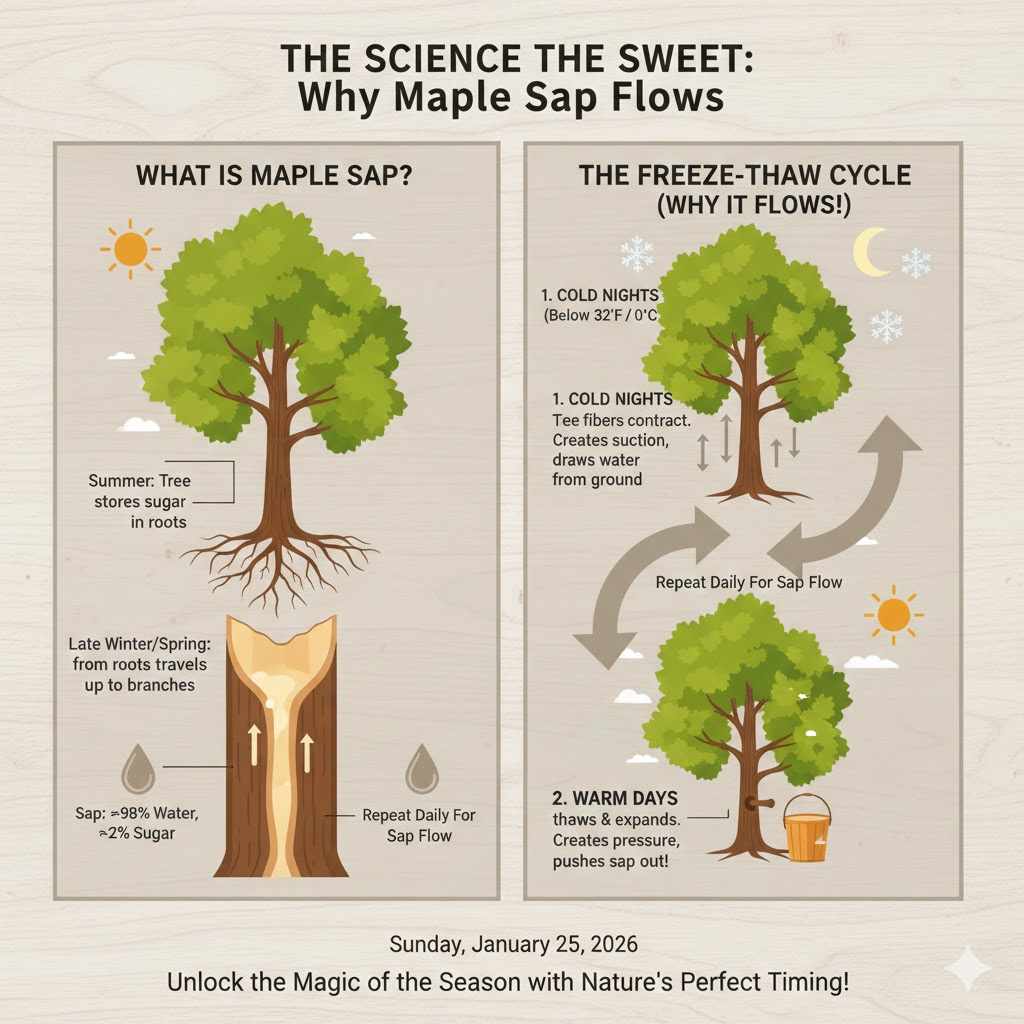
Before we can talk about how much sap you’ll get, it helps to know what it is. Think of maple sap as the lifeblood of the tree. In the summer, the maple tree uses its leaves to make sugar from sunlight. It stores this sugary energy in its roots all winter long.
When late winter and early spring arrive, the magic happens. The tree needs that stored energy to grow new leaves. To move the sugar from the roots up to the branches, it mixes it with water it absorbs from the ground. This slightly sweet, watery mixture is what we call sap.
The flow is driven by weather. Specifically, it relies on a freeze-thaw cycle.
- During cold nights (below freezing): The tree’s fibers contract, creating a suction that draws water up from the roots.
- During warmer days (above freezing): The tree’s wood thaws and expands. This creates positive pressure inside the tree, pushing the sap out through any available opening—like your tap hole!
This natural pressure is what makes your buckets fill up. Without this daily up-and-down in temperature, the sap just won’t run. It’s that simple!
The Golden Rule: How Much Sap Can You Really Expect?
As I mentioned, a single tap hole in a healthy maple tree typically yields between 10 and 20 gallons of sap over the entire season. A very productive tree in a perfect season might even give you more, while a less ideal tree might give you less. That’s a pretty big range, isn’t it?
It’s important to remember that this sap isn’t syrup yet. Sap is mostly water—about 98% water and 2% sugar. You need to boil off a lot of that water to make syrup. The general rule of thumb is that it takes about 40 gallons of sap to make 1 gallon of maple syrup. This is known as the “40-to-1 ratio,” but it can change based on the sugar content of your sap.
So, why such a big difference in sap production from one tree to another? It all comes down to a few key factors. Let’s look at them one by one.
Key Factor 1: Tree Size and Diameter
Bigger is often better when it comes to sap production. A larger, more mature tree has a bigger root system to absorb water and a larger trunk to store starches (which become sugar). It simply has more resources to produce more sap.
However, the most important part of size is how it relates to safe tapping. You should never tap a young, small tree. Tapping puts a small wound on the tree, and only a healthy, mature tree can handle it without any problems. We measure a tree by its diameter at “breast height,” which is about 4.5 feet off the ground.
Follow these guidelines closely to keep your trees healthy for years to come.
Guidelines for Tapping Based on Tree Diameter
| Tree Diameter (at 4.5 feet high) | Maximum Number of Taps | Important Notes |
|---|---|---|
| Under 10 inches | 0 Taps | Do not tap. The tree is too young and small. Tapping it can cause serious, long-term damage. |
| 10 to 17 inches | 1 Tap | This is the ideal starting size. A single tap ensures the tree stays healthy and vigorous. |
| 18 to 24 inches | 2 Taps | A large, healthy tree in this range can safely support a second tap. Place them on opposite sides of the trunk. |
| 25 inches or more | 3 Taps | Only the largest, most vibrant trees should have three taps. Space them out evenly around the trunk. |
Never place more than three taps in a single tree, no matter how large it is. Over-tapping is one of the quickest ways to stress and damage a beautiful old maple. Treat your trees with respect, and they will reward you for many seasons.
Key Factor 2: Tree Health and Crown Size
Just like people, healthy trees are more productive. A tree’s health is directly linked to how much sap it can produce. But how can you tell if a tree is healthy and ready for tapping?
What to Look For in a Healthy Maple:
- A Large, Full Crown: The crown is the upper, leafy part of the tree. A big, round, and full crown means the tree has lots of leaves to capture sunlight during the summer. More sunlight means more sugar production, which leads to sweeter, more abundant sap. A tree with a small or sparse crown will be less productive.
- Healthy Bark: The bark should be mostly intact without huge cracks, missing sections, or a lot of fungal growth (like large mushroom-like growths). A little bit of moss or lichen is perfectly normal and not a sign of poor health.
- No Signs of Major Damage: Look for large, dead branches, signs of insect infestation (like lots of tiny holes in the bark), or deep wounds from past storms. A healthy tree heals its own wounds over time.
- Good Location: Trees that grow in the open with plenty of access to sunlight and water will generally be healthier and produce more sap than trees crowded in a dense forest. Look for trees along the edge of the woods or in your yard.
When you walk through your woods, pick the trees that look the most vibrant and strong. These “dominant” trees with wide crowns will almost always be your best sap producers.
Key Factor 3: Weather and Temperature Swings
If there’s one factor that trumps all others, it’s the weather. You can have the biggest, healthiest sugar maple in the world, but if the weather isn’t right, you won’t get a drop of sap. As we discussed, the sap flow mechanism is entirely dependent on the freeze-thaw cycle.
The Perfect Recipe for a Great Sap Run:
- Nighttime Temperature: The ideal temperature at night is in the mid-20s Fahrenheit (around -4°C). This deep freeze is crucial for creating the negative pressure that recharges the system.
- Daytime Temperature: During the day, you want it to warm up nicely, ideally into the low 40s Fahrenheit (around 5°C). This warming creates the positive pressure that pushes sap out.
- Sunshine: Sunny days are better than cloudy days! Direct sunlight helps to warm the trunk and crown of the tree faster, leading to stronger and longer sap runs.
A string of several days with this exact weather pattern will lead to what sugar makers call a “gusher,” where buckets can fill up in a single afternoon. On the other hand, if you have a week where it stays below freezing or a week where it stays above freezing day and night, the sap flow will stop completely. For more detailed local forecasts, you can check resources like the National Weather Service to plan your tapping days.
Key Factor 4: Length and Timing of the Season
The maple season isn’t defined by a calendar date. It is 100% defined by the weather we just discussed. In some years, the season might last for six or seven weeks. In other years, if the weather warms up too quickly, it might only last for three weeks.
A longer season with multiple freeze-thaw cycles will naturally yield much more sap than a short, inconsistent season. The key is to be ready. Start watching the 10-day forecast in late winter. When you see a stretch of days with freezing nights and thawing days on the horizon, it’s time to get your taps in!
How do you know the season is over? The tree will tell you. As the weather gets consistently warmer, the tree’s leaf buds will begin to swell and eventually open. When this happens, the chemical makeup of the sap changes. It becomes cloudy and develops an “off” flavor, often described as “buddy.” At this point, it’s time to pull your taps, clean your equipment, and thank your trees for the sweet gift they provided.
Key Factor 5: Maple Tree Species
While many types of maple trees can be tapped, they are not all created equal. Some species are superstars, while others are just supporting actors. The difference comes down to both the volume of sap and, more importantly, the sugar content of that sap.
Comparing Common Maple Species for Tapping
| Maple Species | Average Sugar Content | Sap Production Level | Notes for the Beginner |
|---|---|---|---|
| Sugar Maple (Acer saccharum) | 2.0% – 4.5% | Very High | This is the champion! Its high sugar content means less boiling time, which saves you time and fuel. The sap flow is strong and consistent. This is the tree to look for. |
| Red Maple (Acer rubrum) | 1.5% – 2.5% | High | A very good alternative to Sugar Maple. It produces a lot of sap, but the lower sugar content means more boiling is required. Red Maples tend to bud out earlier, ending their season sooner. |
| Silver Maple (Acer saccharinum) | 1.0% – 2.0% | High | Like the Red Maple, it’s a high-volume producer with low sugar content. It is also one of the very first trees to bud out in the spring, giving it the shortest season of all. |
| Box Elder (Acer negundo) | 1.0% – 2.0% | Moderate | Yes, this is technically a maple! It can be tapped and makes a decent syrup, but its sugar content is low. Some say the syrup has a slightly different, butterscotch-like flavor. |
For a beginner, I strongly recommend starting with Sugar Maples if you have them. Their high sugar content is much more forgiving and rewarding. If you need help identifying trees, the U.S. Forest Service offers excellent online tree identification guides that can help you distinguish between the different species.
Key Factor 6: Your Tapping Technique
Finally, how you tap the tree plays a role in your success. Good craftsmanship isn’t just for the woodshop; it applies here, too! A clean, properly drilled tap hole will yield more sap and allow the tree to heal more effectively.
Best Practices for Tapping:
- Use the Right Drill Bit: Modern taps (or “spiles”) are designed for smaller holes. Use a 5/16-inch drill bit, which is the current industry standard. It creates a smaller wound that the tree can heal in a year or two. Avoid older, larger 7/16-inch spiles.
- Drill at a Slight Upward Angle: Angle your drill slightly upwards (about 10 degrees) as you drill into the tree. This helps the sap flow downhill and out of the tap.
- Drill to the Correct Depth: Drill the hole about 1.5 inches deep into the white wood behind the bark. Don’t go deeper than 2 inches. You only need to reach the sapwood layer.
- Keep it Clean: Use a clean, sharp drill bit. A dull bit can burnish and seal the wood, reducing sap flow. Don’t use any disinfectants like bleach on your equipment; hot water is all you need for cleaning.
- Find Fresh Wood: Never drill in the same spot as a previous year’s tap hole. You need to drill into fresh, healthy wood to get good sap flow. Stay at least 6 inches away (horizontally) and 12 inches away (vertically) from old tap holes.
Taking care with these simple steps shows respect for the tree and ensures you get the best possible sap run from your efforts.
Bringing It All Together: What This Means for You
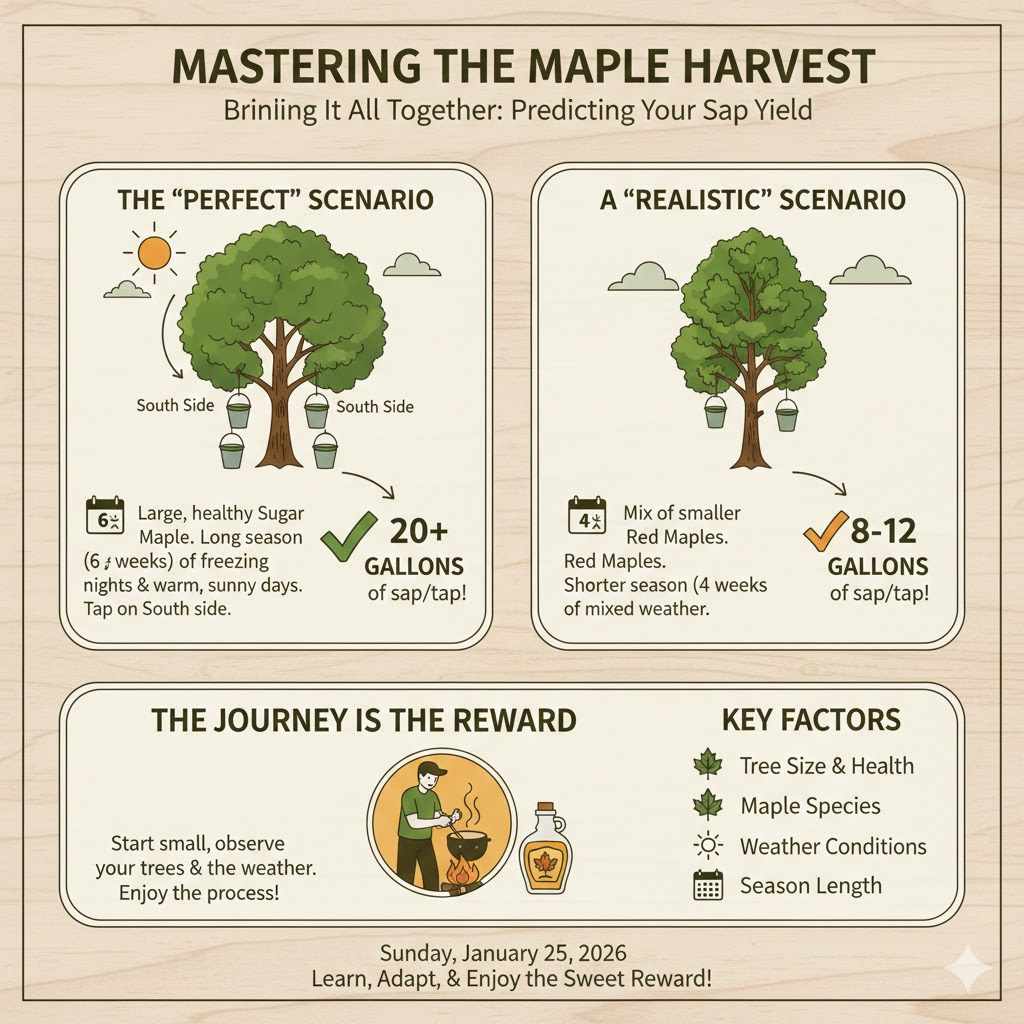
So, how much sap will your trees produce? As you can see, it’s a puzzle with many pieces. The “perfect” scenario is a large, healthy Sugar Maple with a massive crown, tapped on the sunny south side, during a long, six-week season filled with freezing nights and warm, sunny days. In that case, you might get well over 20 gallons of sap!
More realistically, you will have a mix of conditions. Maybe you have smaller Red Maples, and the weather is only ideal for four weeks. You might get 8-12 gallons per tap. And that’s perfectly fine! The process of tapping trees, collecting sap, and boiling it down over an open fire is an incredibly rewarding experience, no matter how much syrup you end up with.
Start small, pay attention to your trees and the weather, and enjoy the journey. With each season, you’ll learn more and get better at predicting how much sap you can expect.
Frequently Asked Questions (FAQ)
1. Does tapping the tree hurt it?
When done correctly on a healthy, mature tree, tapping causes minimal and temporary harm. The tree is very good at healing the small tap hole. Think of it like a person donating blood; the body quickly replenishes what was given. By following the guidelines for tree size and the number of taps, you ensure the tree remains healthy for decades.
2. How much syrup does 1 gallon of sap make?
This depends on the sap’s sugar content. With high-quality Sugar Maple sap (about 2.5% sugar), it takes roughly 40 gallons of sap to make 1 gallon of syrup. For Red Maple sap (about 2% sugar), it might be closer to 50 or 60 gallons of sap for 1 gallon of syrup.
3. Can I tap the same maple tree every single year?
Yes, absolutely! As long as the tree remains healthy, you can tap it year after year. The key is to rotate your tapping locations. Never drill in or right next to an old tap hole. Always move to a new spot on the trunk to give the old holes plenty of time to fully heal and disappear.
4. How do I know when the maple sap season starts and ends?
The season starts when you see a consistent weather pattern of below-freezing nights and above-freezing days. This is typically in late winter or early spring. The season ends when this pattern stops and the tree’s leaf buds begin to swell and open. Once you see buds, the sap’s flavor will change, and it’s time to stop collecting.
5. What does fresh maple sap taste like?
Fresh maple sap looks and feels almost exactly like water. It has a very faint, slightly sweet, and sometimes woody taste. It’s refreshing to drink straight from the tree! The strong, classic maple flavor only develops after the sap has been boiled down and the sugars become concentrated into syrup.
6. Can I use sap that looks cloudy?
Sap should run crystal clear. If it starts to look cloudy or yellowish, it usually means that bacteria have started to grow in it due to warm weather. This often happens near the end of the season. It’s best to discard cloudy sap, as it can result in off-flavored syrup.
Conclusion: Your Sweet Reward Awaits
Understanding how much sap a maple tree produces is less about finding a single magic number and more about learning to read the signs that nature gives you. The size of the tree, its overall health, the species, and especially the daily dance of the weather all play a crucial role in how much sap will drip into your bucket.
Don’t get too caught up in the numbers at first. Choose your healthiest trees, tap them with care, and watch the weather. The simple act of collecting sap and turning it into delicious, homemade maple syrup is a joy in itself. It’s a fantastic project that connects you to the seasons and gives you a deep appreciation for the natural world right in your own backyard.
So get out there, take a closer look at your maple trees, and get ready for the season. With a little bit of knowledge and patience, you’ll be enjoying the sweet results of your work in no time.