1 Wood Vs 3 Wood: Proven Golf Essential
1 Wood vs 3 Wood: Your Golf Essential Guide. Understand the key differences between golf’s 1 wood and 3 wood to choose the right one for your game and improve your shots from the tee and fairway.
Navigating the golf world can feel like a puzzle, especially when you’re just starting out. You’ve got your clubs, your balls, and your enthusiasm, but then you look at your bag and see those longer clubs – the woods. Specifically, you might be wondering about the fuss around the “1 wood” and the “3 wood.” Are they really that different? When do you use each one? It’s a common question that can leave new golfers feeling a bit puzzled. Don’t worry, we’ll break it down simply. Learning the basics of these essential clubs will boost your confidence and your game. Ready to unlock the secret to hitting straighter, longer shots? Let’s dive in!
Understanding Golf Woods: The Basics
In the world of golf, clubs are designed for specific purposes. The “woods,” despite often being made of metal or composite materials today, are historically known for their larger heads and longer shafts, which help players achieve greater distance. They are typically used for shots from the tee box on longer holes (par 4s and par 5s) and for very long approach shots from the fairway.
The primary difference between various “woods” lies in their loft and shaft length, which directly impact the ball’s trajectory and how far it travels. A lower loft generally means a lower, more penetrating ball flight suitable for maximum distance, while a higher loft provides a higher, more stable shot, often easier to control. When you’re learning, understanding these nuances can make a big difference in your shot selection and success.
The Driver (The “1 Wood”)
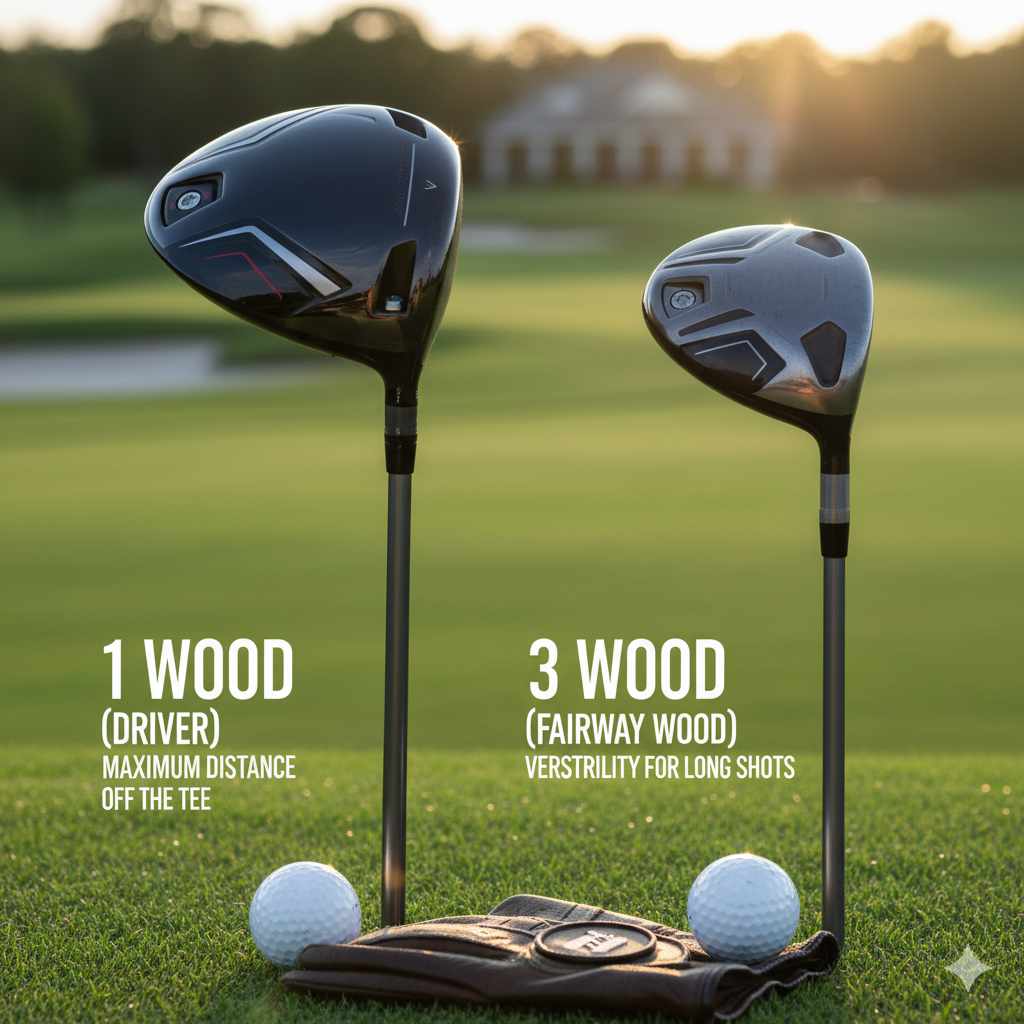
The driver, often called the “1 wood,” is typically the longest club in your bag and has the least loft. Its purpose is to hit the ball the farthest.
Loft: Usually ranges from 8 to 12 degrees.
Shaft Length: The longest among all clubs, contributing to higher swing speeds.
Head Size: The largest head of all woods, offering a bigger sweet spot.
Purpose: Primarily used for the tee shot on par 4 and par 5 holes where maximum distance is needed.
Ball Flight: Tends to produce a lower, more penetrating ball flight.
The large head and minimal loft are engineered to maximize clubhead speed and impart significant force on the ball, sending it soaring down the fairway. Because of its low loft and long shaft, the driver can be more difficult to control for beginners, leading to slices or hooks if the swing isn’t consistent.
The Fairway Wood (The “3 Wood”)
The 3 wood is another vital club for distance, but it offers a bit more control and a higher ball flight than the driver. It’s a versatile club, useful both off the tee and from the fairway.
Loft: Typically ranges from 13 to 17 degrees.
Shaft Length: Shorter than the driver but longer than irons.
Head Size: Smaller than the driver but larger than irons.
Purpose: Used for tee shots on shorter par 4s, or when a more controlled tee shot is preferred. Also excellent for long approach shots from the fairway.
Ball Flight: Produces a higher, more arcing ball flight than the driver, often easier for beginners to get airborne.
The 3 wood is a workhorse for many golfers. Its slightly higher loft and shorter shaft make it more forgiving than the driver, allowing for more consistent contact and a more manageable ball flight. Many amateurs find the 3 wood easier to hit off the deck (from the grass) than the driver.
1 Wood vs 3 Wood: Key Differences Explained
The distinction between a 1 wood and a 3 wood boils down to a few critical design elements that significantly influence how the club performs. Understanding these differences will help you decide which club to reach for in different situations on the course.
Here’s a breakdown of the core differences:
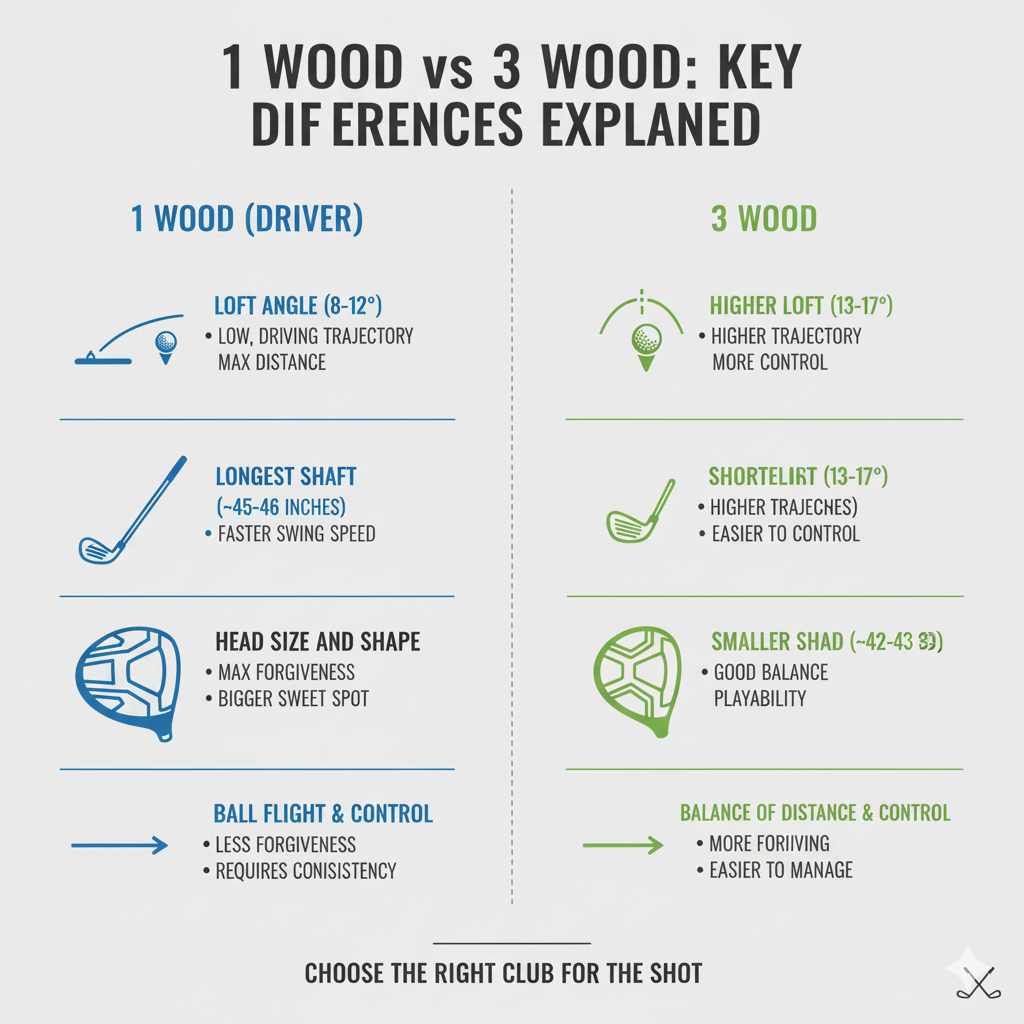
Loft Angle
The loft of a clubface determines the launch angle of the ball. More loft means the ball goes higher; less loft means the ball goes lower.
1 Wood (Driver): Has the lowest loft, typically between 8-12 degrees. This low loft is designed to promote maximum distance by creating a low, driving trajectory.
3 Wood: Has a higher loft than the driver, usually between 13-17 degrees. This extra loft helps get the ball airborne more easily and creates a higher trajectory, which can be beneficial for distance with more control.
Shaft Length
The length of the club’s shaft affects swing speed and control. Longer shafts allow for more potential clubhead speed, leading to greater distance, but they can also be harder to control.
1 Wood (Driver): Features the longest shaft in a golf bag, commonly around 45-46 inches. This length is a major contributor to its potential for very high swing speeds.
3 Wood: Has a shorter shaft than the driver, typically around 42-43 inches. The reduced length makes it easier to swing more consistently and control the clubface through impact.
Head Size and Shape
While modern drivers are often much larger, historically both were referred to as “woods” and their relative sizes were a distinguishing factor. Today, drivers have the largest head dimensions allowed by the Rules of Golf.
1 Wood (Driver): Has the largest head size, designed for maximum forgiveness and a larger sweet spot. This makes it more tolerant of off-center hits.
3 Wood: Has a smaller head than the driver, but typically larger than an iron’s head. This design still offers a good balance of forgiveness and playability for various shots.
Ball Flight and Distance
The combination of loft, shaft length, and head design dictates the resulting ball flight and distance.
1 Wood (Driver): Designed for maximum distance. The lower loft and longer shaft aim to produce the longest possible shots, especially off the tee. However, this can come at the cost of accuracy for some golfers.
3 Wood: Offers a balance between distance and control. It will generally travel shorter than a driver but longer than most fairway irons. The higher loft helps achieve a more consistent trajectory that is often easier to manage.
Forgiveness and Control
Forgiveness refers to how well a club performs when you don’t hit the ball perfectly in the center of the clubface. Control refers to how easily you can influence the ball’s direction and trajectory.
1 Wood (Driver): Due to its large head and low loft, it can be less forgiving for beginners. Off-center hits can result in significant loss of distance or accuracy. Control requires a consistent swing.
3 Wood: Generally considered more forgiving than the driver. Its shorter shaft and slightly higher loft make it easier to hit consistently, leading to more predictable results. It’s often the preferred choice for players who struggle with the driver’s length.
When to Use Your 1 Wood (Driver)
The driver is your go-to club for one primary reason: maximum distance. It’s specifically engineered for this purpose and is usually the first club you’ll pull out on the tee box for most holes.
Tee Shots on Long Holes: On par 4s and par 5s where you need to cover a significant amount of ground, the driver is your best bet. The goal is to get as close to the green as possible in one shot.
When Confidence is High: If you’re feeling good about your swing and have a solid routine, the driver can unlock your longest drives.
Wide Fairways: On courses with generous fairways, the risk of hitting it too far off-line is lower, making the driver a safer option for maximizing distance.
Pro Tip for Beginners: Many golf instructors suggest that beginners wait to master their irons and woods before heavily relying on the driver. Focusing on solid contact and a reasonable swing with a 3 wood or even a hybrid can build confidence and a more consistent foundation for the game. You can always add the driver later once your swing mechanics are more established.
When to Use Your 3 Wood
The 3 wood is incredibly versatile. It’s a true hybrid club that excels from the tee as well as from the fairway. It offers a sensible alternative to the driver when you need distance but also a good dose of control.
Tee Shots on Shorter Par 4s: If a par 4 is shorter, or if the landing area is tighter, a 3 wood can be a smarter play than a driver. It gives you good distance without the risk of overshooting or going out of bounds.
Second Shots on Long Par 5s: When you’re too far to reach the green in two shots with an iron, but a driver feels too risky or difficult from the fairway, the 3 wood is your ideal companion.
Lay-up Shots: If you’re in a position where you don’t want to risk going into a hazard (like water or a bunker) but still need to advance the ball a good distance, the 3 wood is perfect for a controlled “lay-up” shot.
When the Driver is Misbehaving: We all have those days when the driver just isn’t cooperating. The 3 wood is often the perfect backup, providing a reliable way to get good distance when your driver is proving elusive.
Fairway Shots: It’s designed to be hit off the grass (the “fairway”) effectively, providing more distance than your longest iron.
The 3 wood is often considered a confidence-booster because it’s typically easier to get airborne and control than a driver, leading to more satisfying results.
Comparing Performance: A Practical Look
To truly grasp the difference between the 1 wood and 3 wood, let’s look at how they might perform in a typical scenario. Imagine you’re on the tee of a 400-yard par 4.
With a Driver (1 Wood): If you hit a good drive, you might be left with 180-200 yards to the green for your second shot. However, if you mishit it, you could be in the rough, out of bounds, or significantly shorter than intended. A common outcome for many amateur golfers might be 220-240 yards, leaving them with an approach shot of 160-180 yards.
With a 3 Wood: If you hit a solid 3 wood off the tee, you might cover 200-220 yards. This would leave you with a longer approach shot, perhaps 180-200 yards. Your ball flight will be higher, and you have a better chance of keeping it in the fairway. This might be the smarter play on a tight hole or if you’re not feeling confident with your driver.
This comparison highlights the trade-off: the driver offers the potential for the absolute longest ball, but the 3 wood often provides a statistically better chance of a good outcome.
When Different Numbers Matter: 5 Wood, 7 Wood, and Hybrids
While we’re focusing on the 1 wood and 3 wood, it’s useful to know that golf clubs come in a range of numbered fairway woods and hybrids, each designed to fill specific distance gaps and offer varying levels of loft and playability.
5 Wood: Typically has 18-22 degrees of loft and a shorter shaft than a 3 wood. It’s easier to hit than a 3 wood for many players and is useful for tee shots on shorter holes, approach shots from the fairway, and as a more forgiving option than longer irons.
7 Wood: Offers even more loft (around 20-24 degrees) and a shorter shaft. It’s very easy to get airborne and is excellent for players who struggle with distance or hitting long irons.
Hybrids: These clubs are designed to combine the best features of fairway woods and irons. They have a clubhead shape that is typically larger than an iron but smaller than a wood, and they are meant to provide more distance and a more forgiving loft than the equivalent iron number. For example, a 3-hybrid is often used to replace a 3-iron or sometimes even a 5-wood, offering an easier-to-hit option for players seeking more height and distance in that part of their bag.
Understanding these other options helps illustrate the progression of clubs, where each offers a slightly different distance and trajectory. Ultimately, it’s about filling the gaps in your bag so you have the right tool for every situation.
Key Considerations for Your Game
Choosing between clubs and deciding which ones make the cut for your bag isn’t just about the numbers; it’s about how they work for your unique swing.
Here’s what to think about:
Your Swing Speed: Faster swing speeds generally benefit from lower lofts (like a driver) to achieve optimal distance. Slower swing speeds might find that slightly higher lofts on a 3 wood or 5 wood help them get the ball up in the air and achieve better distance.
Your Skill Level: Beginners often find more success and confidence with clubs that are easier to control and get airborne. For many, this means starting with a 3 wood or a hybrid over a driver.
Course Conditions: If you play a lot of courses with tight fairways and lots of hazards, you might opt for more control-oriented clubs like the 3 wood or hybrids more often. If you play wide-open courses, you might unleash the driver more frequently.
Your Strengths and Weaknesses: Are you a long hitter who struggles with accuracy? Then perhaps the 3 wood is a better choice more often. Are you a shorter hitter who needs every yard? Then mastering the driver becomes more critical.
It’s always a good idea to get fitted by a professional or test clubs yourself at a driving range to see what feels and performs best for you.
What the Pros Say (and Why It Matters to You)
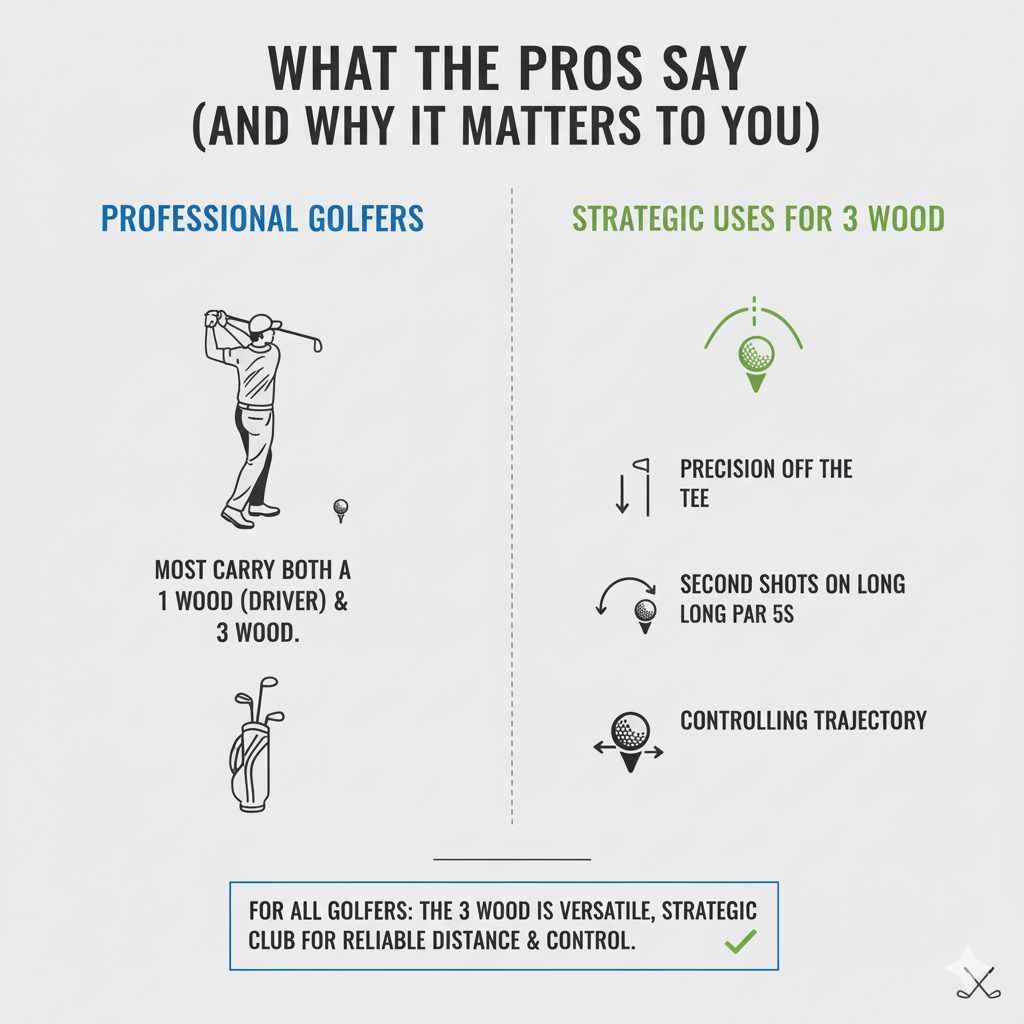
While professional golfers possess incredibly refined swings, their club selections can offer insights into what makes certain clubs valuable. Most pros carry a driver (1 wood) and a 3 wood. The driver is almost always their longest-hitting club off the tee on par 4s and 5s where length is paramount.
However, the 3 wood is not just a backup; it’s a strategic choice. Pros use their 3 wood for:
Precision off the tee: On holes where accuracy is more important than maximum distance, or when the fairway is narrow.
Second shots on long par 5s: To confidently reach the green in two.
Controlling trajectory: Sometimes they need a specific high or low flight that the 3 wood can provide more reliably than the driver.
For the recreational golfer, this shows that the 3 wood is a highly respected and incredibly useful club for more than just a “plan B.” It’s a tool for strategic play and reliable distance when needed. Knowing that it provides value even at the highest levels of the game can give you the confidence to use it effectively in your own play.
FAQs About 1 Wood vs 3 Wood
Frequently Asked Questions
What is the main difference between a 1 wood and a 3 wood?
The main difference lies in their loft and shaft length. A 1 wood (driver) has the lowest loft and longest shaft for maximum distance. A 3 wood has slightly more loft and a shorter shaft, offering a balance of distance and control, and is easier to hit consistently.
Which club should a beginner golfer use off the tee?
Many beginners find the 3 wood or a hybrid club easier to control than a driver. While the driver offers the most distance, consistent contact and accuracy are more important when starting. It’s often recommended to focus on mastering irons and fairway woods first.
Can I hit a 1 wood (driver) from the fairway?
While technically possible, it’s generally not recommended for most golfers to hit a driver from the fairway (the “deck”). The low loft and long shaft make it very difficult to get the ball airborne consistently from the grass, often resulting in poor shots. The 3 wood is much better suited for fairway shots.
How much farther does a 1 wood go than a 3 wood?
On average, a well-struck driver might go 10-20 yards farther than a well-struck 3 wood for a proficient amateur golfer. However, for beginners or those who struggle with the driver, the distance difference can be negligible, or the 3 wood might even go farther due to more consistent contact.
Is a 3 wood easier to hit than a 5 wood?
For most golfers with average to fast swing speeds, a 5 wood is easier to hit than a 3 wood because it has more loft and a shorter shaft. This makes it easier to get the ball up in the air and achieve a consistent trajectory. The 3 wood is generally hit by players seeking maximum distance from that club type.
What is a “fairway wood” in golf?
“Fairway wood” is a general term for clubs that are longer than irons and have larger heads, designed for distance. The 3 wood, 5 wood, and 7 wood are all types of fairway woods. The driver is also technically a fairway wood, though it’s usually considered its own category due to its unique design and purpose.