How Many Watts Does a Miter Saw Use? Real Numbers
Most corded miter saws, 10-inch or 12-inch, are rated at 15 amps on a standard 120-volt circuit, which works out to 1,800 watts maximum (amps x volts = watts). Blade size doesn’t actually change that number much – a 10-inch saw and a 12-inch saw from the same brand are very often both 15-amp motors, just turning different-diameter blades. What matters more for real-world power planning is the difference between running watts and starting watts, and whether you need to run the saw on a generator or a long extension cord.
Nameplate Wattage vs. What It Actually Draws
MATCHED TO A 15A/1800W SAW
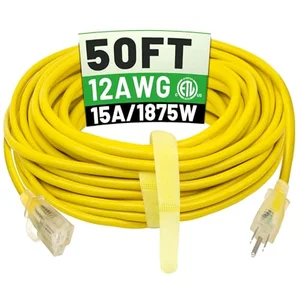 |
POWGRN 12-Gauge Extension Cord – $43.99 A thin 16-gauge cord causes voltage drop under a 15A load, which makes a motor run hotter and weaker – 12-gauge is the right thickness for a full-size miter saw at 50 feet.
|
The 15A/1,800W rating on a miter saw’s nameplate is the maximum the motor is built to draw, not what it pulls during a typical cut. Under normal use – crosscutting trim or dimensional lumber – actual draw is often closer to 1,000-1,400 watts, with the number spiking upward only when the blade is working hard through dense or thick material. The nameplate number is what you should size a circuit, extension cord, or generator around, not the typical-use number, since that’s the ceiling the motor can actually pull under load.
Starting Watts Are the Number That Actually Trips Breakers
Like most motors, a miter saw draws a brief surge – often 2-3 times its running wattage – for a fraction of a second at startup, before settling down to its normal running draw. An 1,800-watt saw can momentarily pull 3,600-5,400 watts the instant it’s switched on. This is the number that actually trips a breaker or stalls an underpowered generator, not the steady running wattage, which is why “will my generator run my miter saw” comes down to the generator’s surge rating, not just its continuous rating.
Running a Miter Saw on a Generator
For a 1,800-watt (15A) saw, look for a generator with at least 3,000-3,600 watts of surge capacity, even though its continuous rating could be lower once the saw is running. A generator rated for exactly 1,800 watts continuous, with no meaningful surge headroom, will often stall or trip on startup even though the saw’s steady-state draw would fit comfortably within its continuous rating. Also account for anything else running off the same generator at the same time – a shop light or vacuum draws its own share of that surge capacity.
Power Source and Circuit Requirements
Standard corded miter saws run on a normal 120-volt household outlet – a 240-volt circuit is not something you’ll need for a miter saw; that voltage is reserved for larger stationary shop equipment like some table saws and dust collectors, not portable miter saws. A dedicated 15 or 20-amp circuit is worth having if you’re also running a shop vac or dust collector at the same time as the saw, since sharing one circuit with several tools is the more common way people trip breakers, not the saw alone.
Extension cord gauge matters more than people expect: a cord that’s too thin for the distance causes voltage drop, and a motor running on low voltage draws more amps to make up the difference, which means more heat and more wear, not less power used. As a rule of thumb, use 12-gauge for a 15A tool at 50 feet or more, and 10-gauge if you’re running much past 100 feet.
What It Actually Costs to Run
Energy cost is based on actual running watts, not the nameplate maximum, since you’re rarely cutting continuously at full load. At a realistic average of 1,200 watts during active cutting and a U.S. average residential rate of roughly $0.16 per kWh, an hour of actual saw-on cutting time costs about 19 cents. Even a full weekend project with several hours of real trigger-time rarely adds up to more than a dollar or two in electricity – wattage matters far more for circuit and generator sizing than for the power bill.
Cordless Miter Saws: A Different Kind of Power Budget
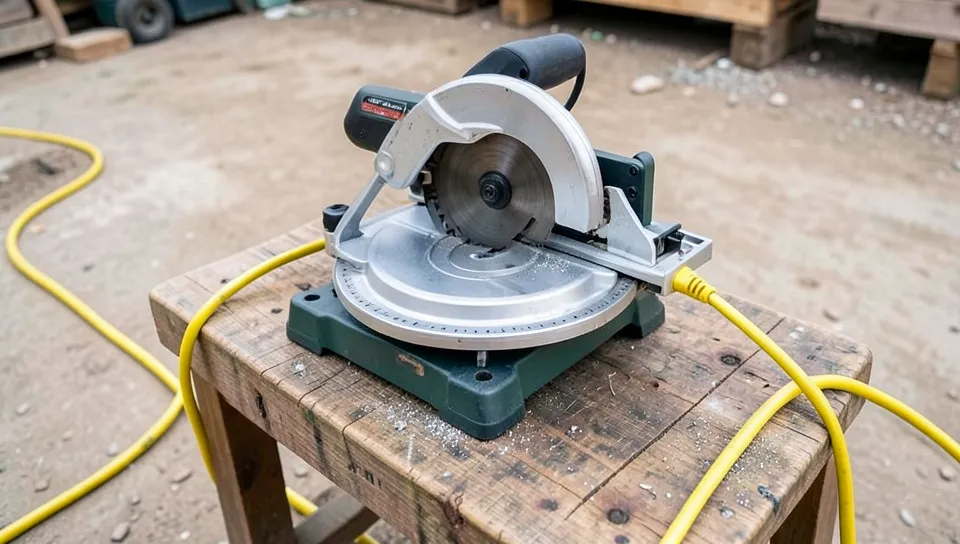
Cordless 12-inch sliding miter saws (typically 18V/20V or 40V-60V platforms) sidestep the circuit and cord question entirely, but they trade it for battery runtime – a large-format battery might deliver somewhere in the range of 100-200 crosscuts in framing lumber per charge, well below what a corded saw can do in a full day without a spare battery on the charger. For a home shop near an outlet, corded remains the more power-practical option; cordless earns its keep mainly where running a cord isn’t realistic.
Frequently Asked Questions
How many watts does a miter saw use on average?
Most corded miter saws, both 10-inch and 12-inch, are rated 15 amps at 120 volts, which is 1,800 watts maximum. Actual draw during typical cutting is usually lower, often 1,000-1,400 watts, with the full rating reserved for peak load under dense material.
What power source does a miter saw need?
A standard 120-volt household outlet on a 15 or 20-amp circuit. A 240-volt circuit is not needed for a portable miter saw; that voltage is used for larger stationary shop machines, not for miter saws.
Will a 2,000-watt generator run a miter saw?
It depends on the generator’s surge rating, not just its continuous wattage. An 1,800-watt saw can briefly draw 3,600 watts or more at startup, so a generator rated 2,000 watts continuous with limited surge headroom may stall on startup even though it could handle the saw’s steady running draw.
How can I reduce strain on my miter saw’s motor?
Use a sharp blade appropriate for the material (a dull blade forces the motor to work harder and draw more current), avoid feeding the cut too fast, and use a properly sized extension cord (12-gauge for 50+ feet on a 15A saw) to prevent voltage drop that makes the motor run hotter.
Bottom Line
A miter saw’s power story is simpler than it looks: nearly every corded model tops out at 15A/1,800W regardless of blade size, actual running draw is usually well under that, and the number that actually matters for generators and breakers is the brief startup surge, not the steady running wattage. Size your extension cord and generator around the full 1,800W rating, and the electricity cost itself won’t be a real factor in the decision either way.
Sponsored / affiliate links. As an Amazon Associate I earn from qualifying purchases. I may earn additional commission from eligible campaigns.