1-Inch Deck Screws: What They’re Actually For (Not Deck Boards)
1-inch deck screws are too short to fasten deck boards to joists — they’re built for attaching joist hangers, hurricane ties, and other thin metal hardware to framing lumber. Using them on the actual decking surface leaves barely any thread biting into the joist, so boards work loose within a season. This guide covers what 1-inch screws are correctly used for, the real screw length you need for deck boards, and how to install either one without splitting the wood.
What 1-Inch Deck Screws Are Actually For
Best Deck Board Screw Pick

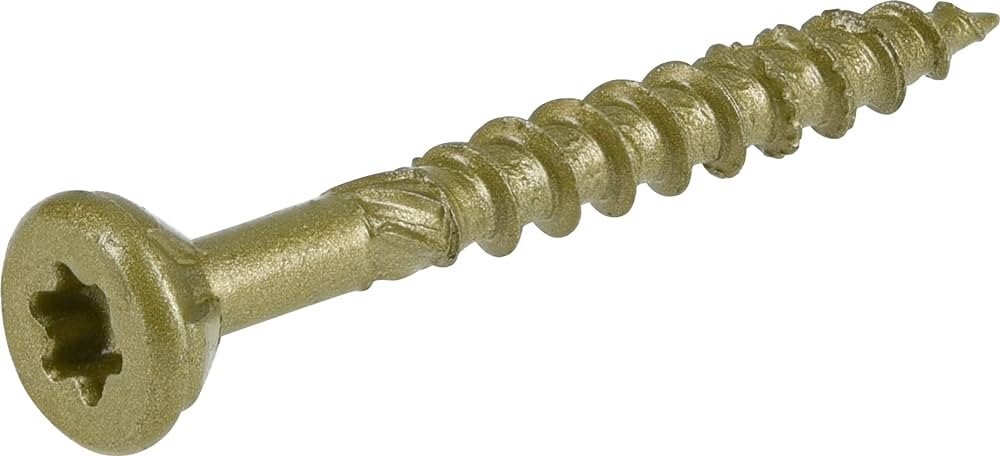
Power Pro Premium Exterior Wood Screws, #9 x 2-1/2″ (100-Pack) – $12.99
The correct length this guide recommends for fastening 5/4″ deck boards into the joist below — a 1-inch screw won’t reach far enough to hold.
- Best for: face-fastening standard 5/4″ deck boards to joists
- Why we picked it: #9 diameter with a T-25 star drive resists cam-out, and the included bit means you’re not hunting for the right driver
- Main drawback: bronze coating is fine for standard PT lumber but stainless is the better call on ACQ-treated wood near saltwater
As an Amazon Associate we earn from qualifying purchases.
A 1-inch screw is the right length any time you’re fastening thin material to framing, not building up through a full deck board. Common correct uses:
- Joist hangers and hurricane ties: these metal brackets are thin, so a 1-1/2″ to 1-inch structural screw (the hanger manufacturer specifies the exact length — never substitute a generic deck screw here) seats fully without poking through the joist face.
- Composite decking hidden-clip systems: many clip brands specify a 1-inch or shorter screw to fasten the clip itself to the joist before the board snaps into place.
- Thin trim, lattice, and skirting: fascia boards, picture-frame border trim over an existing field, and 1/4″–1/2″ thick trim pieces only need a short screw.
- Fence pickets and thin stock: attaching a picket to a rail where the picket itself is thin enough that a longer screw would poke through the face.
If your project is any of the above, a box of 1-inch deck screws is exactly right. If you’re attaching deck boards to the joists themselves, keep reading — you need a longer screw.
The Right Screw Length for Deck Boards
Industry best practice is a screw long enough to fully penetrate the deck board and go at least 1 inch into the joist beneath it. For standard 5/4″ (actual ~1″ thick) decking, that means a 2-1/2″ to 3″ screw, not a 1-inch one. Thicker 2″ nominal lumber typically needs a 3″ screw for the same 1″-into-joist rule.
| Decking Thickness | Recommended Screw Length | Notes |
|---|---|---|
| 5/4″ (~1″ actual) wood or composite decking | 2-1/2″ | Minimum to hold boards against warping/shrinking |
| 5/4″ decking, extra holding power | 3″ | Common upgrade for high-traffic or older/drier lumber |
| 2x (1-1/2″ actual) decking | 3″ | Keeps the 1″-into-joist rule with thicker boards |
| Railings, 4×4 posts | 4″ – 6″ | Structural connections, not surface decking |
Material and Coating
Whatever length you use, the material and coating matter as much as the size. Stainless steel resists rust the longest and is required with ACQ-treated lumber if you want to avoid galvanic corrosion; coated carbon steel (ceramic or polymer coatings) costs less and holds up fine for most standard pressure-treated decks. Match the point type to the job too — sharp points for hardwood or dense composite, self-drilling points when you’re skipping a pilot hole in softer lumber.

How to Pre-Drill and Countersink (Either Length)
Pre-drilling and countersinking prevent splitting and give a flush, safe finish regardless of which screw length you’re using. Follow these steps:
- Choose a drill bit slightly narrower than the screw’s shank, matched to the screw diameter you’re using.
- Mark the screw locations, keeping them at least 3/4″ from the board edge to avoid splitting.
- Drill a pilot hole at each mark. Depth should be slightly shorter than the screw length so the threads still get full engagement.
- Switch to a countersink bit (or a combo pilot/countersink bit) to create a shallow recess so the screw head sits flush with or just below the surface.
- Drive the screw with steady pressure, aligned with the wood grain, stopping as soon as the head seats — overdriving strips the hole and kills holding power.

Signs a Deck Screw Needs Replacing
Walk the deck once a season and check for these warning signs rather than following a fixed maintenance schedule:
- Rust streaks bleeding out from around the screw head — the coating has failed and moisture is reaching bare steel.
- A screw head sitting proud of the board surface — a trip hazard, and a sign the board has shrunk or the screw backed out.
- Any screw that spins freely without tightening — the pilot hole has stripped out and needs a slightly larger screw or a filled/re-drilled hole, not just re-driving the same screw.
- Cracked wood radiating from the screw head — usually means the original screw was driven without a pilot hole.
Replace a failed screw with the same diameter and one size up in length if the original hole has enlarged at all, and always pre-drill the replacement hole even if the original screw didn’t have one.
Frequently Asked Questions
What are 1-inch deck screws actually used for?
Joist hangers, hurricane ties, composite decking hidden-clip systems, and other thin hardware or trim — not fastening deck boards to joists, which needs a much longer screw.
How long should deck screws be for deck boards?
2-1/2″ to 3″ for standard 5/4″ decking, so the screw penetrates the board fully and goes at least 1 inch into the joist. Thicker 2x decking or extra-hard lumber may need the full 3″.
What type of screws are best for decks?
Stainless steel or coated (ceramic/polymer) deck screws with a star or square drive resist rust and corrosion in outdoor environments. Stainless is required to avoid galvanic corrosion with ACQ pressure-treated lumber.
Why are deck screws better than nails?
Screws provide a tighter, more secure connection that resists boards working loose or warping, and they’re easier to remove for repairs. Their threads also help prevent splitting compared to a driven nail’s shock impact.
Conclusion
1-inch deck screws have a real job on a deck — joist hangers, hardware, and thin trim — but fastening the decking surface itself calls for a 2-1/2″ to 3″ screw so it actually grips the joist. Match the length to the job, pre-drill and countersink either way, and check for rust or loosening once a season to catch failures before they become a trip hazard.
See our guide to the best deck screws for pressure-treated wood for a longer-length pick, or how to remove a stripped deck screw if one has already failed.
Sponsored / affiliate links. As an Amazon Associate I earn from qualifying purchases. I may earn additional commission from eligible campaigns.