How To Kill An Oak Tree Safely And Effectively
Sometimes, you might need to remove a large oak tree from your property. This can feel like a big job, especially if you haven’t done it before. Many people wonder about How to Kill An Oak Tree Safely and Effectively because these trees are so strong.
It might seem complicated, but we’ll walk you through it step by step with simple instructions.
Safely Removing An Oak Tree
Taking out a mature oak tree is a task that requires careful planning and execution. It’s not something to rush into. Safety is the top priority, for yourself, your property, and anyone nearby.
This section covers the basics of planning your tree removal, including assessing the tree and the surrounding area. We’ll discuss what makes oak trees tough to deal with and why using the right methods is so important. Getting this initial assessment right helps make the whole process smoother and much safer.
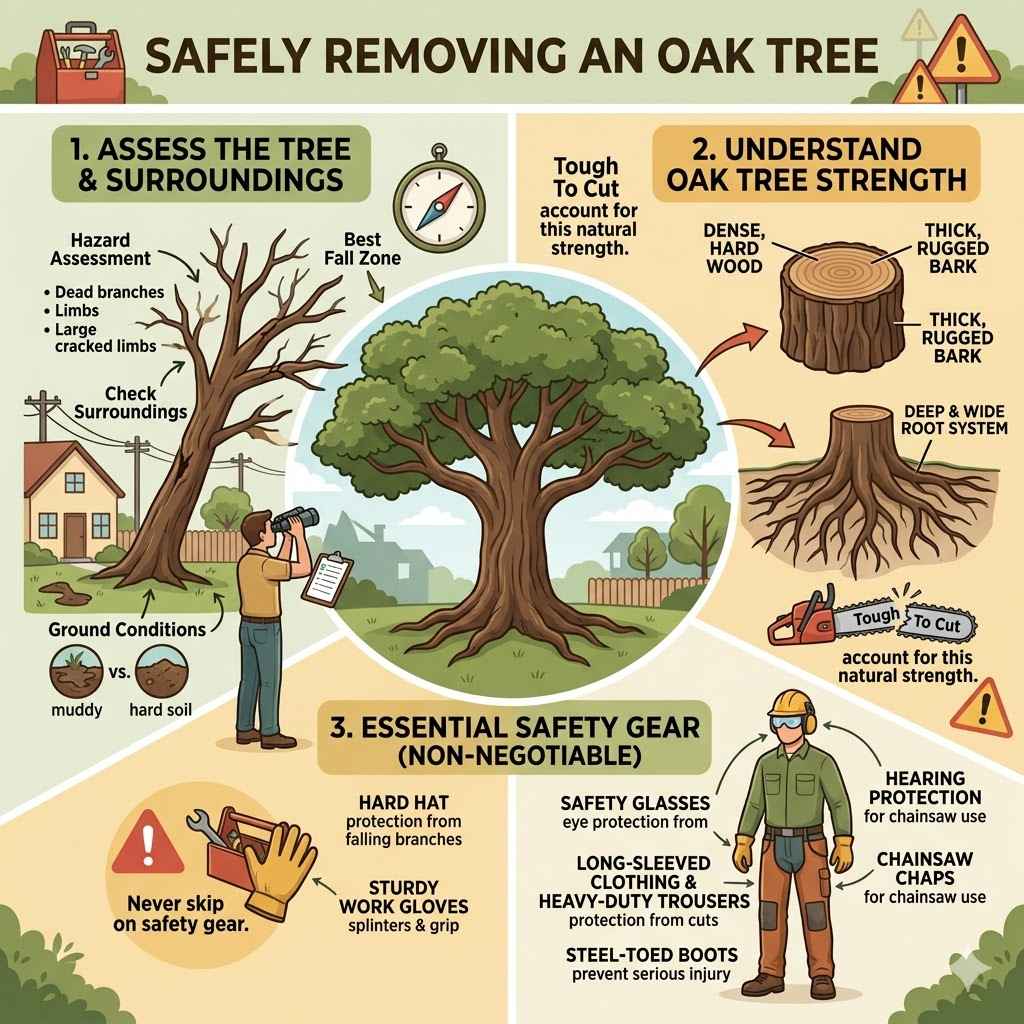
Assessing The Oak Tree And Its Surroundings
Before you even think about cutting, take a good look at the tree. Is it leaning in a particular direction? Are there any large dead branches that look like they could fall easily?
This is called a hazard assessment. It helps you figure out the best way to approach the removal and what tools you might need.
Next, check the area around the tree. Are there buildings, fences, power lines, or other trees nearby? You need to know where the tree will fall when it comes down.
If it’s close to anything valuable, you might need professional help or special equipment.
Think about the ground, too. Is it soft and muddy, or hard and dry? Soft ground can make it harder to control the tree’s fall.
Understanding these factors helps you make a plan that keeps everyone and everything safe. It’s like looking at a map before you go on a trip.
Understanding Oak Tree Strength
Oak trees are known for their strength and resilience. Their wood is dense and hard, which is why they are so tough to cut through. This means that standard methods might not work as well or as quickly as they would on other trees.
Their root systems are also very deep and wide, anchoring them firmly in the ground. This makes them resistant to falling over, even in strong winds. When you plan to remove an oak, you have to account for this natural strength.
It’s not just a matter of cutting.
The bark on oak trees is also thick and rugged. This protects the tree but can make it harder for treatments to penetrate if you are trying to kill the tree using chemicals. Knowing this helps you choose the most effective methods for your specific situation.
Essential Safety Gear
Safety gear is non-negotiable when dealing with trees. You absolutely must protect yourself. This includes wearing a hard hat to guard against falling branches and debris.
Safety glasses are vital to protect your eyes from sawdust and small flying pieces of wood.
Sturdy work gloves will protect your hands from splinters and give you a better grip on tools. Always wear thick, long-sleeved clothing and heavy-duty trousers made of durable material like denim or canvas. This offers protection from cuts and abrasions.
The most important item is steel-toed boots. They protect your feet from falling objects and can prevent serious injury if a tool slips. If you’re using a chainsaw, you’ll also need hearing protection and chaps designed to stop a chainsaw blade.
Never skip on safety gear.
Methods For Killing An Oak Tree
There are several ways to go about killing an oak tree, depending on how quickly you need it done and what your preferences are. Some methods are faster than others. Some involve chemicals, while others rely on physical methods or a combination of both.
We’ll explore the most common and effective options for safely and effectively dealing with an unwanted oak.
Chemical Treatments For Oak Trees
Chemical treatments are often used to kill trees, especially larger ones. They work by introducing a herbicide into the tree’s system, which then kills it from the inside out. This can be a very effective method if done correctly.
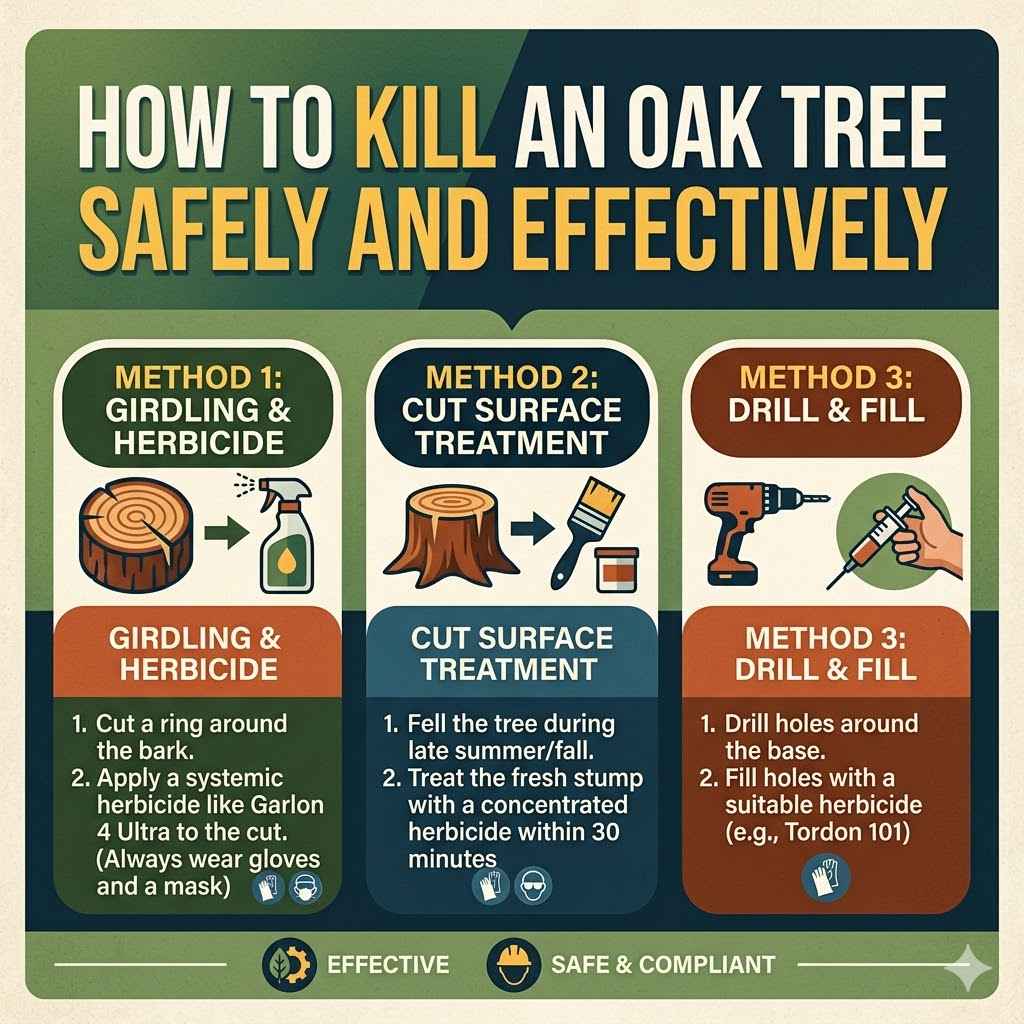
One common method is basal bark treatment. This involves spraying a special herbicide mixed with oil onto the lower 12-18 inches of the tree’s trunk. The oil helps the herbicide soak through the bark.
This method is often used on trees with thin bark or during times when the tree is not actively growing.
Another method is a hack and squirt technique. This involves making cuts or notches around the trunk and then injecting herbicide directly into the cuts. These cuts are made deep enough to reach the tree’s vascular system, where the herbicide can spread.
This is usually done with a special tool that looks like a small gun.
It is very important to follow the product instructions precisely when using herbicides. Wear your safety gear, and be mindful of wind direction to avoid spray drift. These chemicals are designed to kill plants, so they can be harmful if not handled with care.
Always check local regulations regarding herbicide use, as some areas have restrictions.
Understanding Herbicides For Tree Removal
Herbicides are substances designed to kill plants. For tree removal, you’ll typically want a systemic herbicide. This means it’s absorbed by the plant and moves throughout its system, killing it from within.
Common types of herbicides used for trees include glyphosate and triclopyr. Glyphosate is a broad-spectrum herbicide, meaning it kills most plants it comes into contact with. Triclopyr is more selective and often used for woody plants like trees and brush.
When applying herbicides, timing is important. Some work best when the tree is actively growing and moving nutrients, while others are better applied when the tree is dormant. Always read the label of the specific product you are using.
The label will tell you the best time of year, the proper dilution, and the safest way to apply it.
Remember that even though they are designed for plants, herbicides can be harmful to humans, pets, and other desirable plants. Handle them with extreme caution. Proper personal protective equipment, like gloves and eye protection, is essential.
Avoid applying them on windy days to prevent drift.
Glyphosate
Glyphosate is a widely used herbicide that works by blocking a specific enzyme that plants need to grow. This enzyme, called EPSP synthase, is not found in animals, which is why glyphosate is considered to have relatively low toxicity to humans and other mammals. However, it can still cause irritation if it comes into contact with skin or eyes.
It is effective against a wide range of weeds and woody plants. When used for tree killing, it is often applied to the leaves or as a cut stump treatment after the tree has been felled. The chemical is absorbed by the plant and moves to the roots, preventing regrowth.
For tree removal, glyphosate is often mixed with water according to label instructions. It can be applied using a sprayer to the foliage of young trees or to the freshly cut surface of a stump. The key is to get it into the tree’s system efficiently.
Triclopyr
Triclopyr is another herbicide that is very effective for controlling woody plants and broadleaf weeds. It works by mimicking plant hormones, causing uncontrolled growth that eventually kills the plant. It is often preferred for trees because it is more selective than glyphosate, meaning it is less likely to harm grasses.
It comes in different formulations, including ester and amine forms. The ester formulations are generally more potent and are often used for foliar or basal bark applications. The amine formulations are water-soluble and can be used for stump treatments.
When applying triclopyr to kill an oak tree, it can be mixed with a carrier oil for basal bark treatments or with water for cut stump applications. It’s important to apply it to the cambium layer, which is just under the bark, to ensure it is absorbed into the tree’s system.
Physical Methods Of Tree Removal
While chemicals can be very effective, sometimes physical methods are preferred or used in combination. These methods involve disrupting the tree’s ability to survive without chemicals. They can be labor-intensive but don’t involve harsh chemicals.
One simple method is girdling. This involves removing a strip of bark all the way around the tree trunk. You need to go deep enough to cut into the wood, removing the cambium layer.
This layer is what carries water and nutrients up and down the tree. Cutting it completely severs these pathways, eventually starving the tree.
Another approach is to repeatedly cut into the tree’s bark and roots. This damages the tree’s ability to function and can eventually lead to its death. However, this can be a slow process and may not always be fully effective, especially for large, established trees.
For very large trees, mechanical removal using specialized equipment like excavators or felling machines is the safest and most efficient way to bring the tree down. This is typically done by professionals.
Girdling The Tree
Girdling a tree is an old method for killing it. It involves completely removing a ring of bark and cambium tissue from the trunk. The cambium is a thin layer of cells just beneath the bark.
It’s responsible for transporting water from the roots to the leaves and sugars from the leaves to the roots.
To girdle a tree effectively, you need to cut through the bark and into the sapwood. A sharp axe, saw, or specialized girdling tool can be used. The ring should be about 6 inches wide, and you must ensure there are no gaps.
Once girdled, the tree can no longer move water and nutrients. It will slowly decline and eventually die. This process can take several weeks or months.
It’s important to note that while girdling kills the tree, the dead tree can remain standing for a long time, becoming a falling hazard. It’s often best to cut the tree down after it has died and dried out, or use girdling in conjunction with other methods.
Felling The Tree
Felling a tree means cutting it down. This is the most direct way to remove it, but it’s also the most dangerous. It requires skill, the right tools, and a solid understanding of how trees fall.
The process involves making a notch on the side of the tree where you want it to fall. This is called the “felling notch.” Then, you make a back cut on the opposite side, higher than the notch, leaving a hinge of wood to control the direction of the fall.
Chainsaws are the most common tool for felling, but they must be used with extreme caution. If the tree is large or leaning, or if there are obstacles, it’s best to hire a professional tree removal service. They have the expertise and equipment to do this safely.
Using Natural Methods
For those who prefer to avoid chemicals, there are some natural methods, though they are often slower and may not be as effective for very large or stubborn oak trees. These methods focus on disrupting the tree’s life processes through natural means.
One method is to bore holes into the tree and pour in things like Epsom salts or vinegar. The idea is that these substances will dehydrate or poison the tree. However, the effectiveness of these methods is often debated, and they may only work on smaller trees.
Another natural approach is to physically damage the roots. This can involve digging around the base of the tree and cutting major roots, or using a rototiller. This starves the tree of water and nutrients.
Again, this is more effective on younger trees.
Epsom Salts For Trees
Epsom salts, which are magnesium sulfate, are sometimes suggested as a natural way to kill trees. The theory is that the magnesium and sulfur in Epsom salts can be toxic to plants in high concentrations, or that they can disrupt the tree’s nutrient balance.
To use Epsom salts, people often drill holes into the tree’s trunk and fill them with the salts. The idea is that the tree will absorb them. However, many experts question the effectiveness of this method.
Oak trees are very hardy, and it’s unlikely that a few handfuls of Epsom salts would be enough to kill a mature tree.
While Epsom salts are safe for soil in moderate amounts and can benefit some plants, using them in large quantities directly on a tree is generally not a reliable method for killing it. It’s more of an anecdotal remedy than a proven technique.
Vinegar Applications
Vinegar, especially horticultural vinegar which has a higher acidity, can kill plants by burning their tissues. The acetic acid in vinegar breaks down the cell walls of the plant. It’s most effective on young plants or weeds with shallow root systems.
For trees, you might try pouring vinegar into holes drilled into the trunk or applying it directly to a freshly cut stump. However, for large oak trees, this method is usually not strong enough to kill the entire tree. The tree’s thick bark and extensive root system can often withstand the effects of vinegar.
It’s also important to be aware that vinegar can be a mild acid and can irritate skin and eyes, so protective gear is still recommended. While it’s a natural substance, it’s not a guaranteed solution for a large tree removal.
Best Practices For Killing An Oak Tree Safely
Combining different methods and following best practices significantly increases your chances of successfully and safely killing an oak tree. This section focuses on the timing, the best tools to use, and how to ensure the tree dies completely without causing harm. We’ll also touch upon what to do after the tree is dead.
Timing Is Crucial For Success
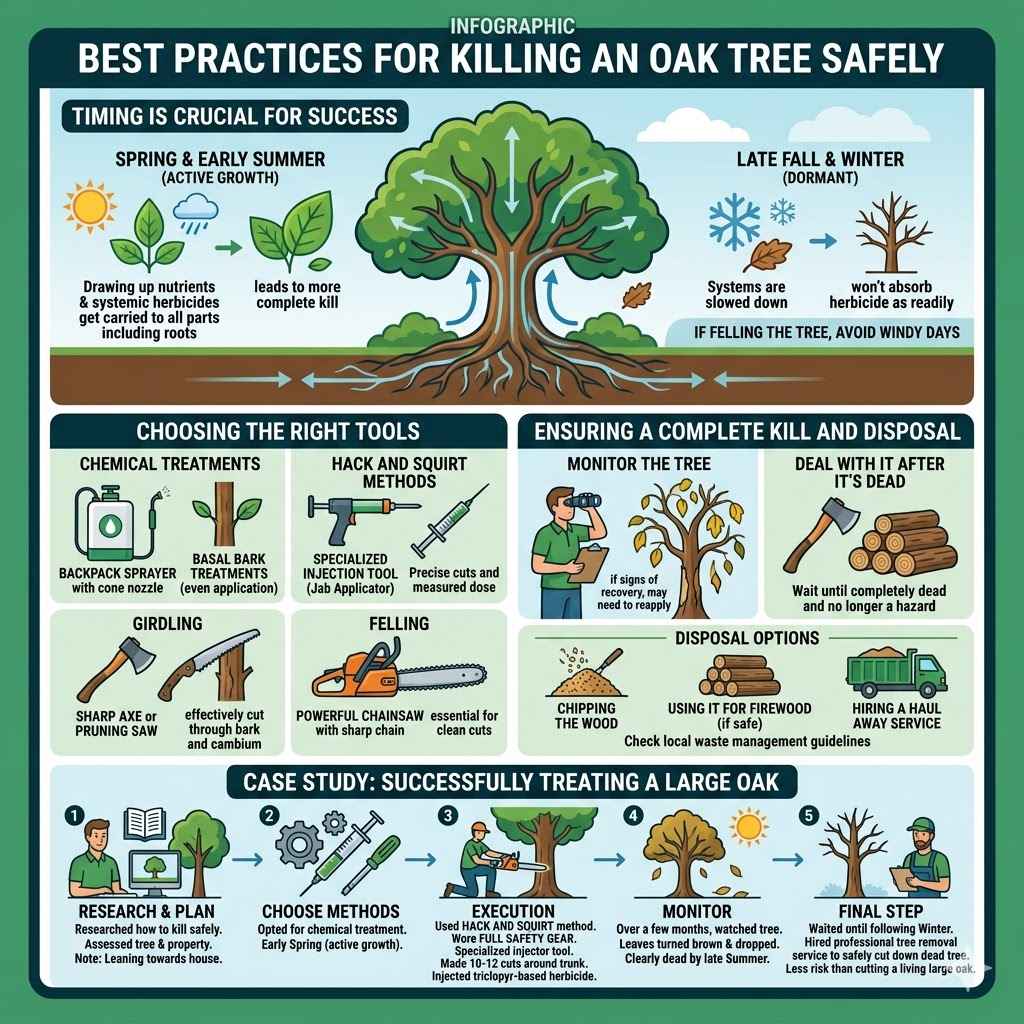
The time of year you choose to treat an oak tree can greatly affect how well your chosen method works. Generally, applying herbicides is most effective when the tree is actively growing. This is typically in the spring and early summer.
During active growth, the tree is drawing water and nutrients up from the roots and distributing them throughout its system. When you apply a systemic herbicide during this time, it gets carried to all parts of the tree, including the roots. This leads to a more complete kill.
Treating a tree in late fall or winter, when it is dormant, is usually less effective for chemical methods. The tree’s systems are slowed down, and it won’t absorb the herbicide as readily. However, physical methods like girdling can be done at any time of year.
If you are felling the tree, consider weather conditions. Avoid windy days.
Choosing The Right Tools
The tools you use can make a big difference in how easy and effective the process is. For chemical treatments, you’ll need specific application tools.
For basal bark treatments, a backpack sprayer with a cone nozzle is ideal for applying the herbicide mixture evenly to the trunk. For hack and squirt methods, a specialized injection tool, sometimes called a “jab applicator,” is recommended. These tools are designed to make precise cuts and deliver a measured dose of herbicide.
If you are girdling, a sharp axe or a pruning saw that can cut through bark and cambium effectively is needed. For felling, a powerful chainsaw with a sharp chain is essential. Always ensure your tools are well-maintained and sharp for cleaner cuts and better results.
Ensuring A Complete Kill And Disposal
Once you’ve applied a treatment, it’s important to monitor the tree. Look for signs of decline like yellowing leaves, wilting, or bark peeling. If the tree shows signs of recovery, you may need to reapply the treatment.
After the tree has died and has begun to dry out, you will need to deal with it. If you are cutting it down, wait until it is completely dead and no longer a hazard. You can then cut it into manageable sections for disposal.
Disposal options include chipping the wood, using it for firewood if it’s safe and appropriate, or hiring a service to haul it away. Check with your local waste management or recycling centers for specific guidelines on disposing of tree debris.
Case Study: Successfully Treating A Large Oak
Mr. Henderson had a large oak tree in his backyard that was damaging his foundation. He decided to take on the job himself.
After researching how to kill an oak tree safely and effectively, he chose a combination of methods.
First, he assessed the tree and the surrounding property. He noted the tree was leaning slightly towards his house. He decided not to fell it himself due to the risk.
Instead, he opted for a chemical treatment.
In early spring, he used a hack and squirt method. He wore his full safety gear and used a specialized injector tool. He made 10-12 cuts around the trunk, about 2 feet from the ground.
Into each cut, he injected a measured dose of a triclopyr-based herbicide.
Over the next few months, he watched the tree. The leaves started to turn brown and drop. By late summer, the tree was clearly dead, with no new growth appearing.
He then waited until the following winter when the wood was drier. He hired a professional tree removal service to safely cut down the dead tree, which was much less risky than cutting a living, large oak. This approach ensured the tree was killed effectively and removed safely.
Frequently Asked Questions
Question: How long does it take for an oak tree to die after treatment?
Answer: It can take anywhere from a few weeks to several months, or even up to a year, for an oak tree to completely die after treatment. This depends on the method used, the size of the tree, and the time of year. Systemic herbicides applied during the growing season usually work faster than other methods.
Question: Can I use household bleach to kill an oak tree?
Answer: Household bleach is generally not effective for killing large trees. While it is a strong chemical, it doesn’t have the systemic action needed to reach the tree’s roots. It might damage the bark or superficial layers, but it’s unlikely to kill the entire tree and is not an efficient or recommended method for this purpose.
Question: Is it safe to cut down a dead oak tree myself?
Answer: Cutting down a dead tree can be even more dangerous than cutting a live one. Dead trees can be brittle, unstable, and unpredictable. They might snap or fall in unexpected directions.
It’s always safer to hire a professional arborist or tree removal service to cut down dead trees, especially large ones.
Question: What is the best time of year to treat an oak tree with chemicals?
Answer: The best time to apply systemic herbicides to kill an oak tree is during its active growing season, typically in the spring or early summer. During this period, the tree is actively drawing water and nutrients, which helps the herbicide spread throughout its system more effectively. Fall applications can also work, but spring is generally considered optimal.
Question: Can I kill an oak tree by just cutting off all its branches?
Answer: Simply cutting off all the branches will not kill a mature oak tree. The tree can regrow new branches from the trunk and existing limbs. For a tree to die, its root system needs to be affected or its transport system of water and nutrients must be permanently disrupted.
You would need to damage the trunk or roots significantly for it to be fatal.
Summary
Successfully killing an oak tree involves careful planning, choosing the right method, and prioritizing safety. Whether you opt for chemical treatments like basal bark application or hack and squirt, or consider physical methods like girdling, understanding the oak tree’s resilience is key. Always use appropriate safety gear and tools, and consider the timing of your treatment for the best results.
Ensure proper disposal of the dead tree.