Paddle Bit vs Spade Bit: Are They Different?
Many people starting DIY projects wonder about tools. Specifically, they often ask, Paddle Bit vs Spade Bit: Are They Different? It’s a common question because these bits look similar to beginners. This can make choosing the right one confusing.
But don’t worry, it’s simpler than you think. We’ll break it down step by step so you know exactly which bit to grab for your next job. Let’s clear this up so you can get to building.
What Are Paddle Bits and Spade Bits
This section explores the fundamental nature of paddle bits and spade bits. We will look at their design, how they are made, and what makes them unique. Understanding these basic differences is key to using them correctly.
We will cover the materials they are often made from and the general shapes that define each type. This will help you see why they are not the same tool.
Understanding the Paddle Bit
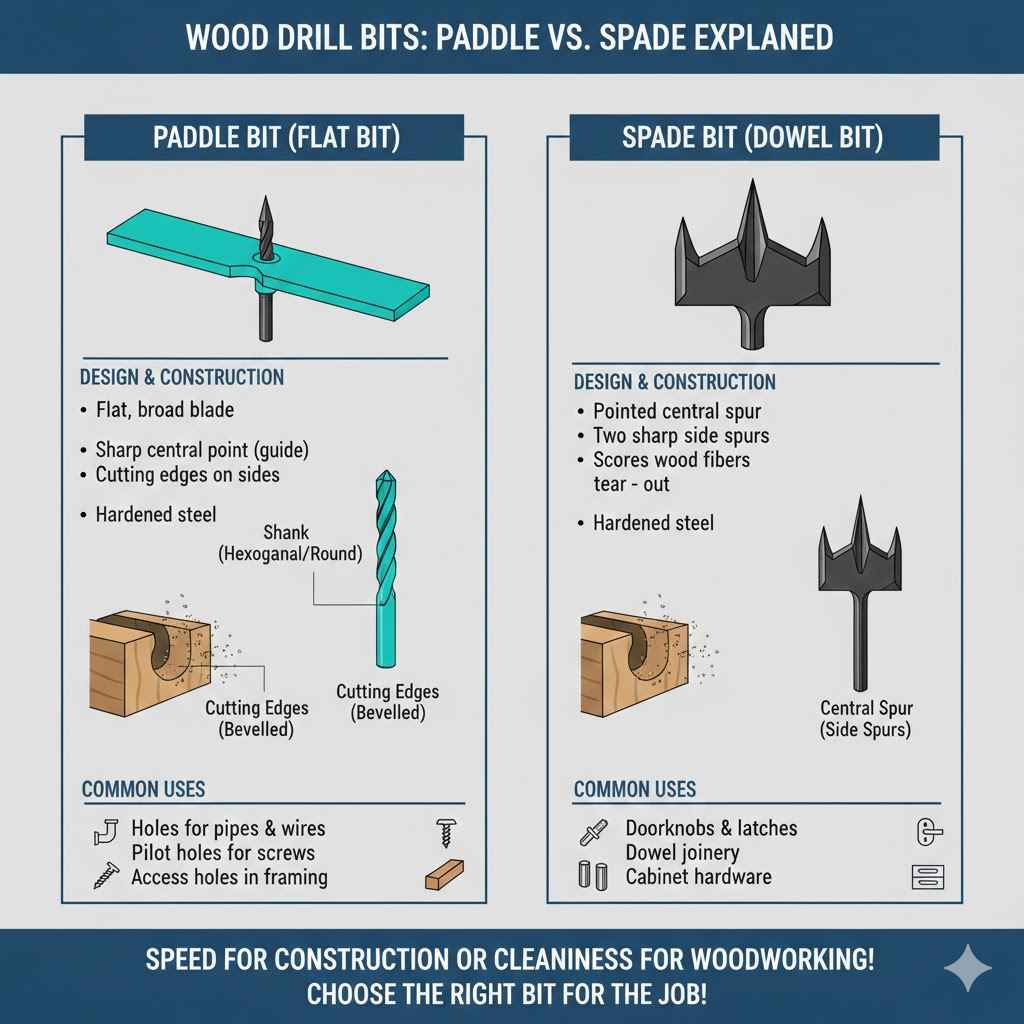
A paddle bit, also known as a flat bit, has a very simple and recognizable design. It features a flat, broad blade with a sharp point in the center. This point helps to guide the bit and keep it from wandering when you start drilling.
The cutting edges are on the sides of the flat blade. They are designed to scrape out wood efficiently, creating a clean hole.
Paddle bits are typically made from hardened steel. This makes them durable and able to withstand repeated use. The shape of the paddle bit is its most defining characteristic.
It’s essentially a flat piece of metal with sharpened edges. This shape allows it to remove material quickly. They are great for making larger diameter holes in wood.
Material and Construction
Paddle bits are usually forged from high-carbon steel or a similar alloy. This process creates a strong and tough bit. The center point is often sharpened to a fine tip, and the outer edges are beveled.
This beveling helps the bit cut into the wood. The shank, the part that goes into the drill, is often hexagonal or round. A hexagonal shank helps prevent slipping in the drill chuck.
The size of a paddle bit can vary greatly. You can find them for making small holes or very large ones. The width of the paddle is what determines the hole size.
The overall length of the bit can also differ, allowing you to drill through different thicknesses of material.
Common Uses for Paddle Bits
- Making holes for pipes and wires.
- Drilling pilot holes for larger screws.
- Creating access holes in framing lumber.
Paddle bits are widely used in construction and woodworking. Their ability to make quick, rough holes makes them ideal for many tasks. For instance, if you need to run electrical wiring through a stud, a paddle bit is a good choice.
You can also use them to create openings for plumbing. They are not usually the choice for fine woodworking where precise and smooth holes are needed.
Another common use is for creating larger holes for hinges or door hardware. While not as precise as a hole saw, they can get the job done when accuracy is not paramount. The speed at which they remove material is a big advantage.
This saves time on many jobs.
Exploring the Spade Bit
A spade bit, also known as aダウエルビット (dowel bit in Japanese, though the English term is spade bit), is another common woodworking tool. It has a pointed tip, similar to a paddle bit, but its cutting edges are different. It features two spur-like cutters on the sides and a sharpened point in the center.
These spurs score the wood fibers before the main cutting edges remove the material.
This design makes spade bits excellent for drilling clean, precise holes in wood. The spurs prevent the wood from splintering as much. This results in a smoother finish inside the hole.
They are great for applications where the appearance of the hole matters.
Design and Features
The defining feature of a spade bit is its pointed tip, often called a spur. This spur acts like a tiny drill bit itself, starting the hole and scoring the wood. Behind the spur, you’ll find two sharp cutting edges.
These are angled to efficiently cut through wood. The overall shape is flatter than a twist drill bit but less broad than a paddle bit.
Spade bits are typically made from hardened steel, just like paddle bits. However, the way they cut is distinct. The spurs lead the way, ensuring a stable start.
Then, the main cutting edges follow, clearing out the wood. This action leads to a cleaner hole. They are very effective for creating holes of medium diameter.
Applications for Spade Bits
- Drilling holes for doorknobs and latches.
- Creating dowel joinery in furniture.
- Making holes for cabinet hardware.
Spade bits are a favorite among woodworkers for many reasons. Their ability to make clean holes is a major advantage. When you’re building furniture or cabinets, you want the holes to look good.
A spade bit helps achieve this. For example, drilling holes for a doorknob requires a clean, smooth opening.
They are also used for creating dowel joints. Dowels are small wooden pins that help align and strengthen glued joints. Spade bits are perfect for drilling the mating holes for these dowels.
The precision they offer is valuable here.
Paddle Bit vs Spade Bit Are They Different
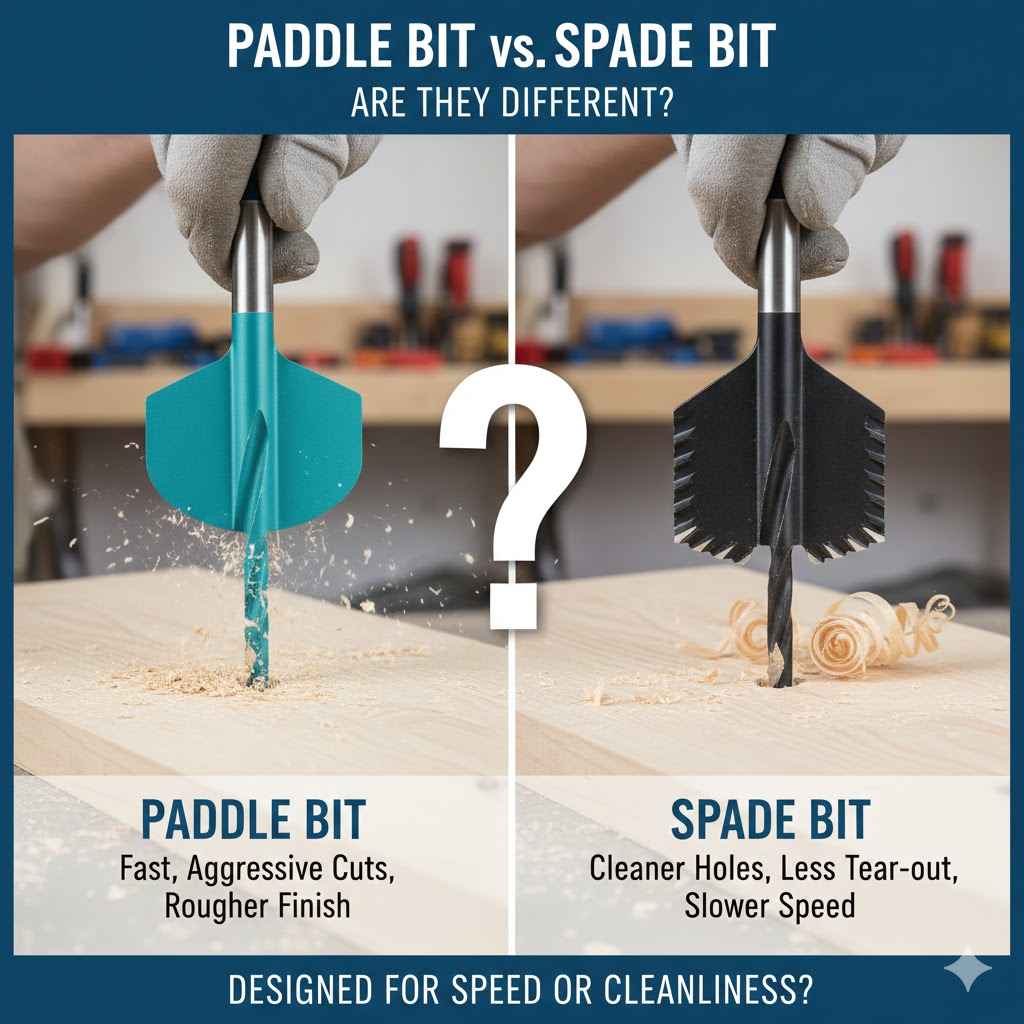
Now, let’s directly address the question Paddle Bit vs Spade Bit: Are They Different? Yes, they are different, and knowing how will help you pick the right tool. The main difference lies in their cutting action and the quality of the hole they produce. While both drill holes in wood, their designs lead to different results and suit different tasks.
Think of it this way: a paddle bit is a brute force tool. It’s fast and effective for general-purpose drilling. A spade bit is more refined.
It prioritizes a cleaner finish and more control. The presence of the spurs on a spade bit is a key differentiator.
Key Differences in Cutting Action
The way each bit cuts wood is the most significant difference. A paddle bit’s cutting edge is a simple beveled surface that scrapes and shaves wood. It can create a lot of sawdust quickly.
However, this scraping action can sometimes lead to rough edges and tear-out, especially in softer woods.
A spade bit uses a different approach. The sharp spur at the tip scores the wood fibers. This scores the perimeter of the hole.
Then, the main cutting lips remove the wood from the center. This two-stage cutting process results in a much cleaner hole. It minimizes tear-out and leaves a smoother surface.
Hole Quality and Finish
When it comes to hole quality, spade bits generally win. They create a cleaner, more precise hole with less splintering. This is crucial for projects where the appearance of the drilled hole is important.
For instance, in furniture making, you want the holes to be neat and tidy.
Paddle bits can leave a rougher finish. They are better suited for applications where the hole will be hidden or where speed is more important than a perfect finish. For example, if you are drilling through framing lumber to run wires, a rough hole is perfectly acceptable.
Speed vs. Precision
Paddle bits are typically faster for general drilling. Their broad blades remove material quickly. This makes them a good choice when you need to make many holes or large holes in a short amount of time.
If you are working on a large construction project, speed can be a major factor.
Spade bits, while not slow, are not as fast as paddle bits for sheer material removal. Their design prioritizes precision and a cleaner cut over raw speed. If you need accuracy and a good finish, the spade bit is the better option.
The extra time spent drilling is often worth the improved result.
When to Use Which Bit
You would choose a paddle bit for rough carpentry and construction tasks. This includes drilling through studs for wiring or plumbing, or making holes for large fasteners where finish quality is not a concern. If you need to make a quick opening and speed is key, the paddle bit is your tool.
You would opt for a spade bit when drilling for hardware like doorknobs, creating joinery with dowels, or when you need a clean, splinter-free hole in furniture or cabinetry. Anytime the visible appearance of the drilled hole matters, the spade bit is preferred.
Comparing Paddle Bits and Spade Bits Directly
Let’s put paddle bits and spade bits side-by-side to see their differences clearly. This comparison will highlight their strengths and weaknesses. We will look at aspects like their primary design features, the types of holes they create, and the tasks they are best suited for.
This direct comparison will help solidify your understanding.
Design Differences at a Glance
The most striking design difference is the cutting head. A paddle bit has a flat, broad blade with a sharp point. It looks like a flat paddle.
A spade bit has a pointed tip (spur) and two cutting lips on the sides. It’s more like a flattened cone with extra cutting features.
The material and basic construction are similar. Both are usually made of hardened steel. The shank shape can also be similar, often hex or round.
The difference is not in what they are made of, but how the cutting surfaces are shaped and function.
Hole Characteristics Comparison
| Feature | Paddle Bit | Spade Bit |
|---|---|---|
| Cutting Style | Scraping and shaving | Scoring and cutting |
| Spur/Pilot Point | Center point only | Center spur with scoring points |
| Hole Finish | Can be rough, prone to tear-out | Cleaner, smoother, less tear-out |
| Speed of Drilling | Generally faster | Slightly slower, more controlled |
| Best For | Rough construction, large holes, speed | Fine woodworking, hardware, precise holes |
This table shows the core differences. A paddle bit is built for speed and bulk removal. It’s like using a shovel.
A spade bit is designed for more delicate work. It’s more like using a chisel. The spur on the spade bit is key to its precision.
It starts the cut cleanly and guides the bit.
Examples in Action
Imagine you’re building a simple wooden planter box. You need to drill some large holes for drainage at the bottom. Using a 1-inch paddle bit here would be quick and efficient.
The holes don’t need to be perfectly smooth. You just need them to let water out.
Now, suppose you are installing a new doorknob on a solid wood door. You need to drill a precise hole for the knob mechanism and another for the latch bolt. For this, a set of spade bits is the ideal choice.
They will create clean, accurate holes that ensure the doorknob operates smoothly. The visual appearance of these holes is also important.
When to Avoid Each Bit
You should avoid using a paddle bit when a clean, smooth hole is required. If the hole will be visible in furniture or fine woodwork, the tear-out from a paddle bit can ruin the finish. It’s also not the best choice for very precise measurements where the slightest wobble could be an issue.
A spade bit is not ideal for extremely large holes, as they become more difficult to control. While you can get large spade bits, there are other tools like hole saws that are better suited for very big diameters. Also, for very soft woods or materials that chip easily, even the spurs on a spade bit might not prevent all tear-out.
Making the Right Choice for Your Project
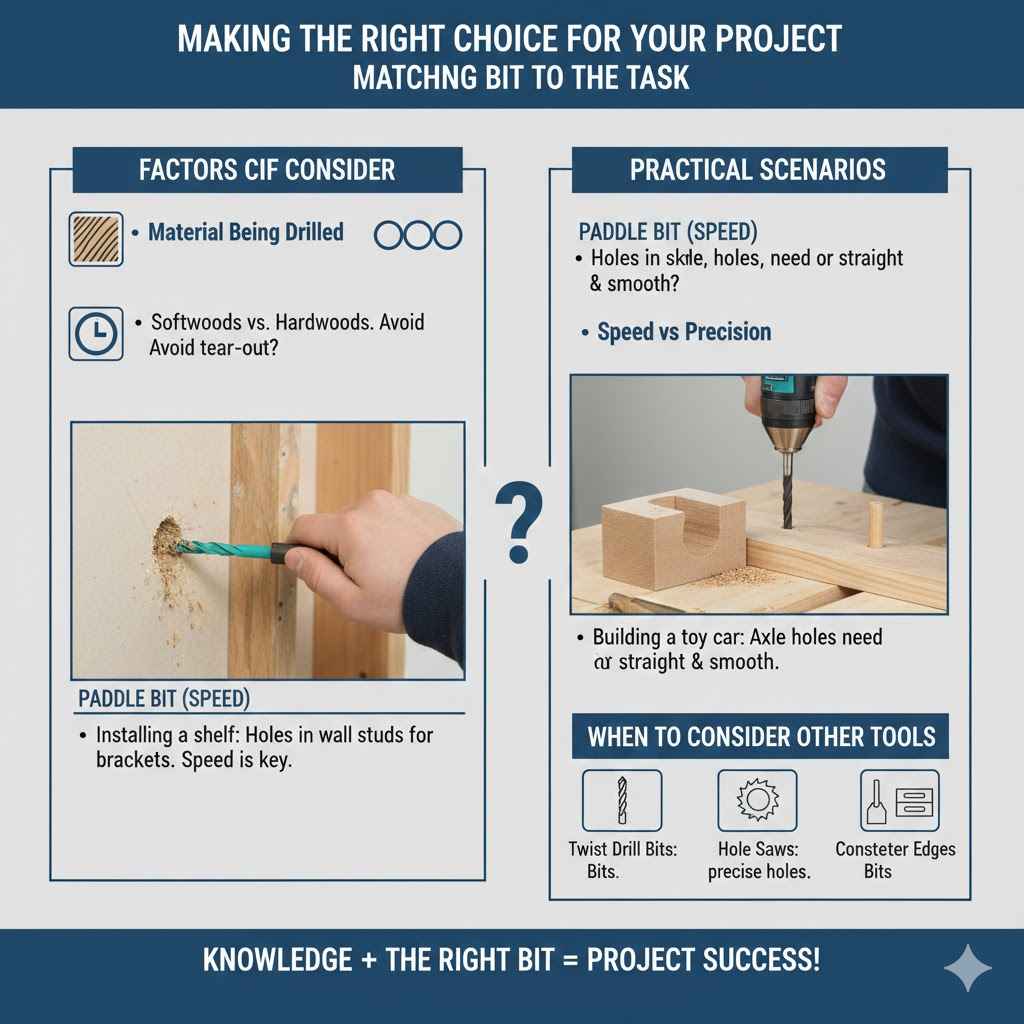
Choosing between a paddle bit and a spade bit comes down to your project’s specific needs. Think about what you’re drilling into and what the final result should look like. Considering the material, the hole size, and the required finish will guide you.
Making the correct selection ensures your work is easier and the outcome is better.
Factors to Consider
- Material Being Drilled Softwoods might show tear-out more with paddle bits. Hardwoods can be harder to drill with any bit, but spade bits offer better control.
- Hole Diameter Needed Both come in various sizes, but for very large holes, other tools might be more efficient.
- Required Hole Finish If the hole needs to be smooth and clean, choose a spade bit. If it just needs to be an opening, a paddle bit is fine.
- Speed vs. Precision Do you need to drill quickly, or is accuracy the main goal?
For example, if you are drilling through a thin piece of plywood to hang a light fixture, a paddle bit might be sufficient. You just need a hole for the wire. However, if you are building a birdhouse and want the entrance hole to look neat, a spade bit would be a better selection.
Practical Scenarios
- You are installing a new shelf and need to drill holes in the wall studs for mounting brackets. The holes don’t need to look pretty, and speed is helpful. A paddle bit is a good choice here.
- You are making a wooden toy car and need to drill holes for the axles to pass through. These holes need to be straight and smooth so the wheels turn freely. Spade bits are ideal for this precise work.
- You need to drill a hole through a workbench top to allow a clamp to pass through. The exact finish of the hole is not critical, and you want to get it done quickly. A paddle bit will work well.
In the first scenario, the paddle bit’s speed and rough drilling capability are beneficial. For the toy car, the spade bit’s precision ensures smooth operation. The workbench scenario again highlights the paddle bit’s efficiency for non-critical holes.
When to Consider Other Tools
Sometimes, neither a paddle bit nor a spade bit is the best tool for the job. For very small, precise holes, a standard twist drill bit is what you need. For making very large diameter holes, especially in sheet metal or thicker wood, a hole saw is often the best option.
Hole saws create large circular cuts very effectively.
Countersink bits are another specialized tool. They create a beveled edge at the top of a hole so that screw heads can sit flush or below the surface. You would use a countersink bit in conjunction with a regular drill bit, not instead of it.
Knowing when to use these other tools expands your capabilities.
Frequently Asked Questions
Question: Are paddle bits and spade bits interchangeable?
Answer: No, they are not interchangeable. While both drill holes in wood, their cutting designs create different results and they are best suited for different tasks. Paddle bits are for speed and rough holes, while spade bits are for cleaner, more precise holes.
Question: Which bit is better for making holes for screws?
Answer: For pilot holes for screws, a standard twist drill bit is usually best. If you need to create a larger hole for something like a lag bolt where a clean edge isn’t crucial, a paddle bit can be used. For decorative screws where you might want a cleaner finish, a spade bit could be an option, but typically a standard bit is sufficient.
Question: Can I use a spade bit on metal?
Answer: No, spade bits are designed specifically for wood. Trying to drill metal with a spade bit can damage the bit and is not effective. You would need specialized metal drill bits for drilling into metal.
Question: Do spade bits splinter wood more than paddle bits?
Answer: Generally, no. Spade bits are designed to minimize splintering thanks to their spur tip that scores the wood fibers first. Paddle bits, which scrape material away, can sometimes cause more tear-out, especially in softer woods.
Question: Which bit is faster for drilling holes?
Answer: Paddle bits are usually faster for drilling general holes because of their broad cutting surface that removes material quickly. Spade bits are slightly slower but offer more control and a cleaner finish.
Summary
Paddle bits and spade bits look similar but have distinct cutting actions. Paddle bits are fast and good for rough work. Spade bits create cleaner holes, making them better for furniture and hardware.
Choose based on your project’s need for speed or precision. You now know the difference and can pick the right tool with confidence.