Professional Chainsaws: Specs, Safety Gear & Maintenance (2026)
Professional chainsaws are built around one number most buying guides skip: engine displacement, measured in cubic centimeters (cc), which is what actually separates a homeowner saw from a commercial one. A true professional-grade saw runs a 45cc–70cc engine, weighs roughly 10–13 lbs bare (before bar and chain), and is engineered for daily multi-hour duty cycles — not the occasional weekend cleanup a big-box “chainsaw” is designed for.
That distinction matters because arborists, loggers, and tree-service crews run these tools for 6–8 hours a day, five or six days a week. A saw that isn’t built for that duty cycle wears out its clutch, bar rails, and anti-vibration mounts within a season. Below, we’ll cover exactly what makes a saw “professional,” how to match displacement and bar length to the actual job, the safety gear standards that matter, and a maintenance schedule based on runtime hours instead of vague “clean it sometimes” advice.
What Actually Makes a Chainsaw “Professional-Grade”
Best 60cc-Class Gas Chainsaw for Daily Professional Use
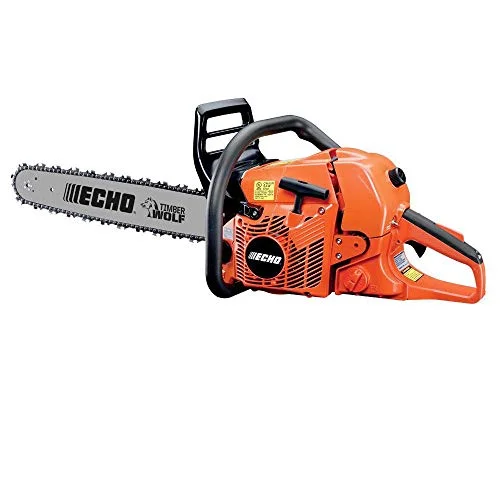 |
Echo CS-590 Timber Wolf 20″ 59.8cc Gas Chainsaw – $478.99 It sits squarely in the 55–70cc engine class and 20″ bar length this guide’s job-matching table recommends for felling and bucking work.
|
“Professional” isn’t a marketing label on these saws — it corresponds to real spec differences you can check before buying:
- Engine class: Homeowner saws typically run 30–45cc; professional models run 45cc–70cc+ (commercial felling saws like the Echo CS-7310P push past 73cc). More displacement means the saw holds its chain speed under load instead of bogging down in dense hardwood.
- Power-to-weight ratio: A pro saw in the 59–60cc class (Husqvarna 562 XP Mark II, Echo CS-590, Stihl MS 362 C-M) weighs 12–13 lbs bare — noticeably lighter per cc than a homeowner saw of similar displacement, because it uses magnesium crankcases and forged components instead of heavier cast parts.
- Anti-vibration mounting: Professional saws isolate the engine and bar from the handles with dedicated rubber/spring AV mounts rated for continuous use, not just enough dampening to pass a spec sheet — this is what keeps all-day use from causing hand-arm vibration syndrome (HAVS) over a career.
- Decompression valve: Larger commercial engines (60cc+) add a manual decompression valve that bleeds cylinder pressure before starting, so pull-starting a cold 70cc saw doesn’t require the effort a smaller saw needs.
- Serviceable components: Pro saws use tool-adjustable carburetors, replaceable clutch/sprocket assemblies, and widely-stocked parts (air filters, fuel lines, chains) because dealers expect these saws to be rebuilt, not replaced.
Matching Engine Size, Bar Length, and Chain to the Job
This is the step most buying guides skip entirely, and it’s the difference between a saw that feels right and one that either bogs down or is needlessly heavy for the work. The bar has to be matched to the engine’s power, and the chain’s pitch and gauge have to be matched to the bar — put a 24-inch bar on a 45cc engine and you’ll starve it of chain speed; put a 14-inch bar on a 70cc engine and you’re carrying weight you don’t need.
| Primary Job | Engine Displacement | Bar Length | Typical Chain Pitch |
|---|---|---|---|
| Climbing / tree work in the canopy | 35–50cc | 12–16 in. | .325″ (lighter chain, tighter turns) |
| Ground-level pruning & limbing | 45–60cc | 16–20 in. | .325″ or 3/8″ |
| Felling & bucking (general logging) | 55–70cc | 20–24 in. | 3/8″ |
| Large-diameter timber / commercial felling | 70cc+ | 24–36 in. | 3/8″ or .404″ (heavier, for big wood) |
Chain gauge (the thickness of the drive link that sits in the bar’s groove — usually .050″, .058″, or .063″ on professional saws) has to match the specific bar, not just the saw model, so always check the bar’s stamped gauge before ordering a replacement chain rather than assuming it matches the engine class. If you’re deciding between a gas saw at all versus a battery-electric option for lighter-duty work, our battery vs. gas chainsaw comparison breaks down where the crossover point actually is.
Anatomy of a Professional Chainsaw
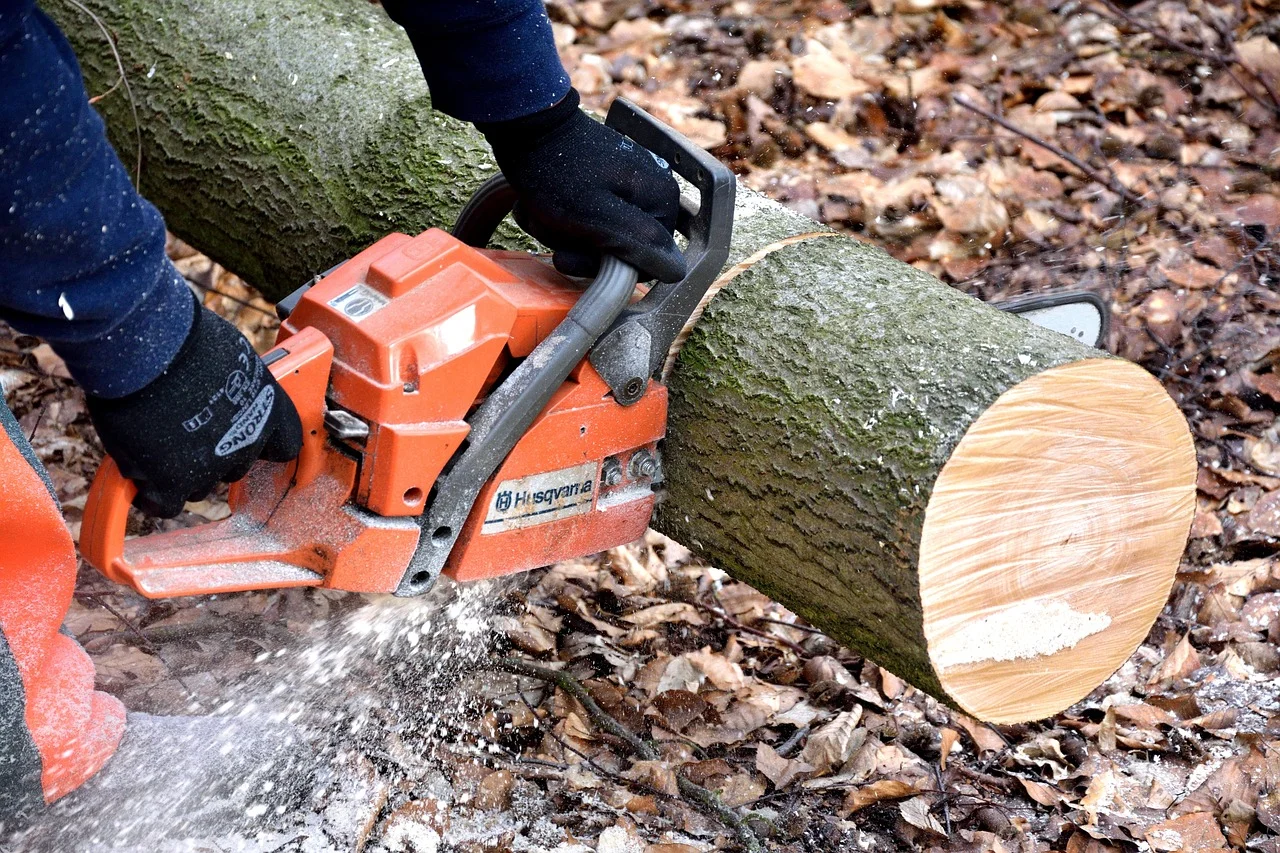
Five systems work together on every cut: the engine, the bar, the chain, the oiling system, and the safety mechanisms. Knowing how each one functions makes troubleshooting and maintenance far less guesswork.
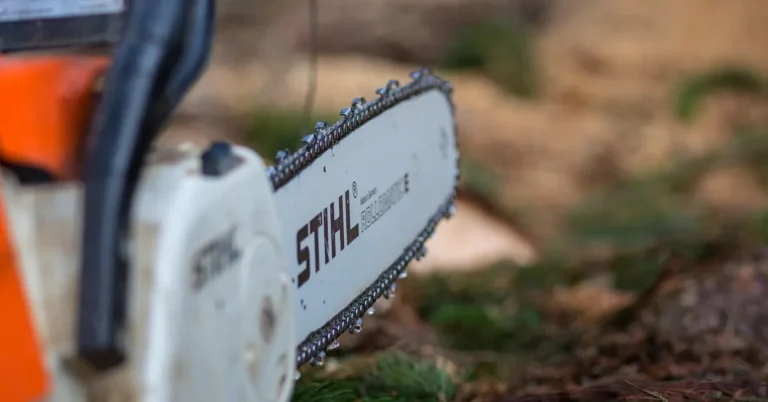
The engine is almost always a two-stroke design on gas professional saws, running on a gas/oil pre-mix (commonly 50:1) because the oil lubricates the crankshaft bearings directly — there’s no separate oil sump like a four-stroke engine. The guide bar is a hardened steel rail with a machined groove that the chain’s drive links ride in; bar length is measured from the tip to where it enters the powerhead, not the saw’s total reach. The chain itself is made of alternating cutter, tie-strap, and drive-link segments riveted together — the cutters are what’s actually sharpened, and their angle (typically 25–35 degrees on a standard chain) determines whether the saw is a fast-cutting or a smoother, kickback-reduced “low-kickback” chain.
An automatic oiler pumps bar-and-chain oil onto the guide bar every time the chain moves, drawing from a separate oil reservoir from the fuel tank; most professional saws let you adjust the oil flow rate for different wood types and weather. The chain brake is a spring-loaded band around the clutch drum that a hand guard can trip — either manually or, on newer saws, inertially during a kickback event — stopping the chain in a fraction of a second.
Safety Gear and Operating Practices That Are Actually Standards
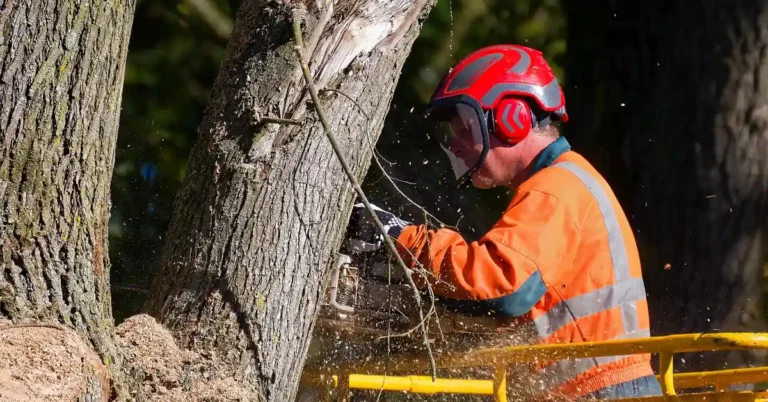
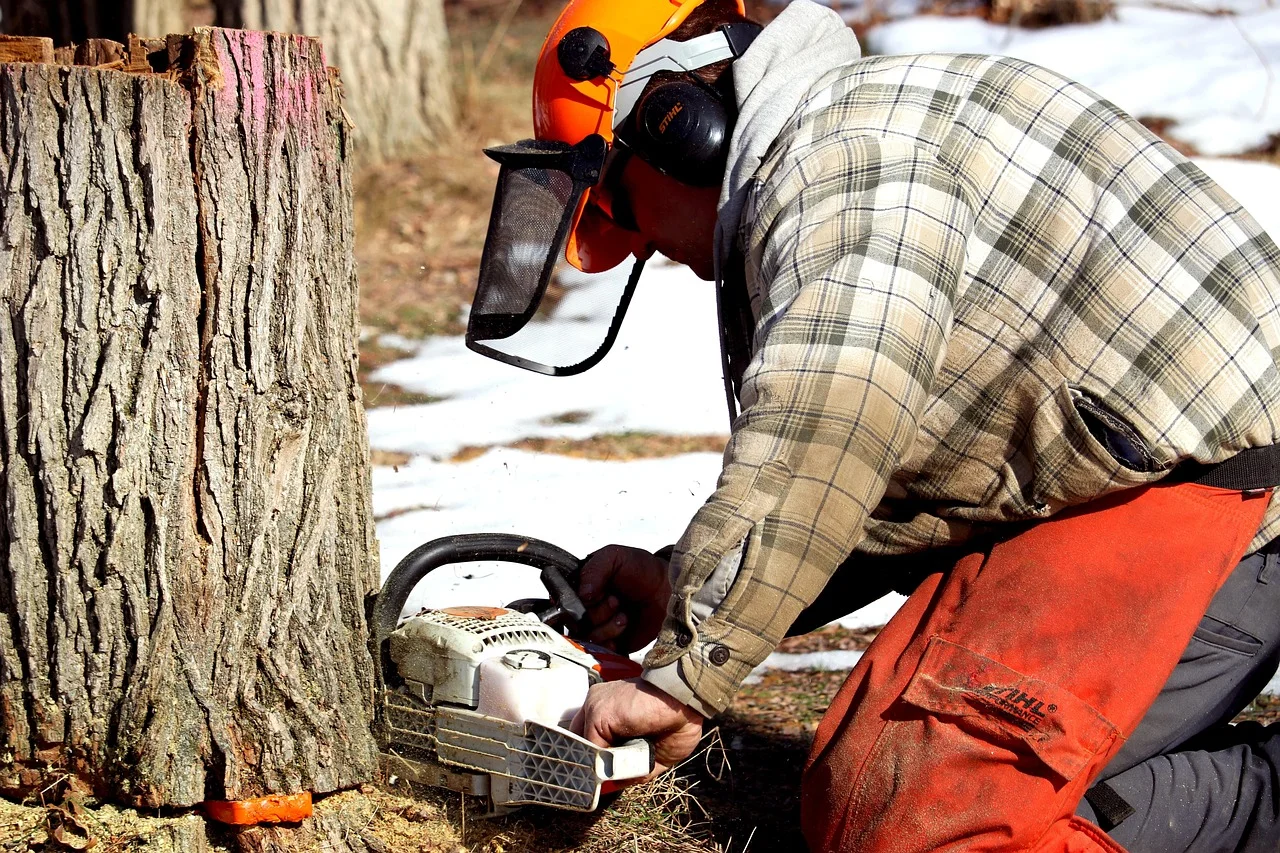
Chainsaw safety gear for professional use isn’t a matter of preference — commercial tree-care work is covered by ANSI Z133 (the arboriculture safety standard) and, for employers, OSHA logging and tree-care regulations, both of which specify minimum protective equipment. Whether or not a given job is technically covered, the same gear list applies:
| Gear | Why It’s Rated the Way It Is |
|---|---|
| Cut-resistant chaps/pants | Layers of long, loose ballistic fibers that jam and stall the chain’s sprocket within a fraction of a second of contact — rated by class based on chain speed they stop. |
| Helmet with mesh face shield | Stops thrown debris and chain fragments; the mesh (not solid plastic) keeps airflow and prevents fogging during multi-hour use. |
| Hearing protection | Professional saws run 100–115 dB at the operator’s ear — well above the 85 dB threshold where hearing damage begins with repeated daily exposure. |
| Cut-resistant gloves | Protect the non-dominant hand, which is statistically the most common injury site when it slips forward of the front handle. |
| Steel-toe boots with good tread | Toe protection plus tread that resists slipping on wet bark and sawdust, a common cause of loss-of-balance injuries. |
Why kickback actually happens is worth understanding rather than just avoiding: it occurs when the upper quadrant of the bar’s tip (the “kickback zone”) contacts material while the chain is moving. At that contact point the chain’s cutters are moving upward and backward relative to the bar tip, and that force gets transmitted straight back into the saw — and the operator’s hands — in a fraction of a second, often faster than a reflexive reaction can stop it. That’s why the rule isn’t “be careful,” it’s “never let the bar tip’s upper quadrant touch anything while the chain is moving,” and why low-kickback chain and a functioning chain brake exist as backups to operator awareness, not replacements for it.
- Inspect before every start: chain tension, bar condition, chain brake function, and fuel/oil levels.
- Clear a fall zone: at least twice the height of what you’re cutting, with an escape path planned before the first cut.
- Cut at waist height or below when possible — overhead cutting removes your ability to control the saw’s reaction and puts the kickback zone closer to your face.
- Maintain the three-point stance: feet shoulder-width apart, weight balanced, saw braced against your body for two-handed control.
- Refuel cold, not hot: let the engine cool for several minutes before refueling to avoid vapor ignition, and move at least 10 feet from the fuel source before restarting.
Maintenance on a Runtime-Hours Schedule
“Clean it after every use” is true but not specific enough for a saw running 30+ hours a week. Professional shops track maintenance by engine runtime hours, the same way you’d service a car by mileage instead of just “sometimes”:
| Task | Interval |
|---|---|
| Check chain tension & sharpness | Every tank of fuel (roughly every 30–45 min of cutting) |
| Clean/inspect air filter | Every 5 hours of runtime, more often in dusty/dry conditions |
| Check bar for wear, flip bar | Every 5–10 hours, to wear both rails evenly |
| Inspect & clean spark plug | Every 25 hours, replace annually or at first sign of fouling |
| Replace fuel filter | Every 90–100 hours or annually |
| Full carburetor inspection/tune | Every 100 hours or at the start of each season |
A dull chain is also a safety issue, not just a productivity one — a dull chain requires more downward force to cut, which increases the chance of the bar tip glancing into the kickback zone when the saw suddenly breaks through the wood. If your chain needs re-tensioning more than once per tank, that usually points to a bar groove that needs cleaning or is worn, not just a chain problem.
Battery-Electric Professional Saws: Where They Fit Now
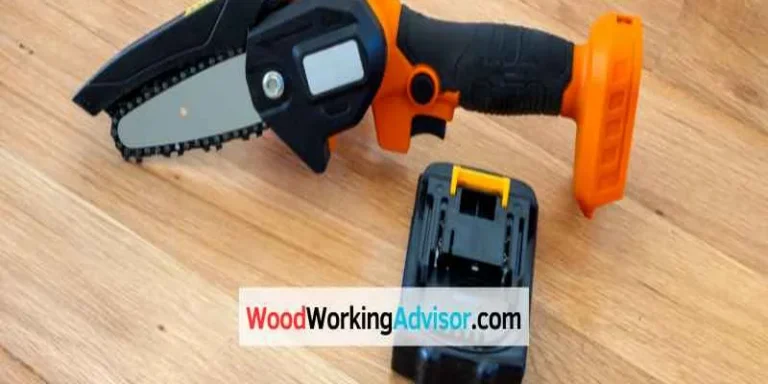
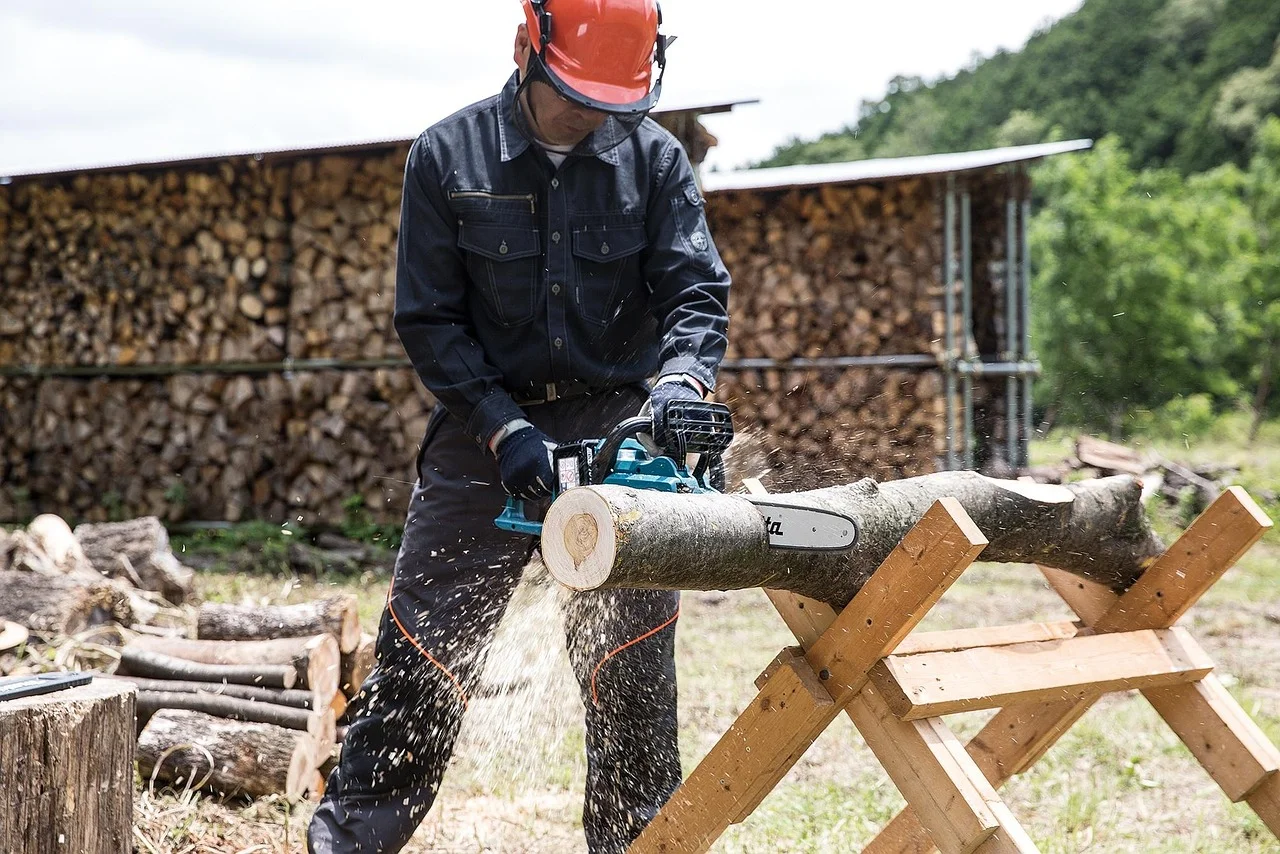
Commercial-grade battery saws (Stihl’s MSA 300-series, Husqvarna’s battery XP line) have closed most of the power gap with 45–50cc gas saws, and they’re increasingly common for arborists doing canopy work where instant on/off, no exhaust fumes, and lower vibration matter more than all-day runtime. They haven’t replaced gas saws for full-day felling or bucking crews, where swapping a five-gallon fuel can is still faster than swapping and recharging battery packs. For a full breakdown of where that crossover point sits, see our battery chainsaw performance guide.
Real-World Applications by Industry
The same core saw shows up doing very different work depending on the industry, which is part of why “best professional chainsaw” doesn’t have one universal answer:
| Industry | Typical Tasks |
|---|---|
| Forestry / logging | Felling, limbing, and bucking large-diameter timber; typically the 55–70cc+ class with 20–24 in. bars. |
| Arboriculture / tree service | Canopy pruning and removal from a rope or lift, often with a lighter top-handle saw (35–50cc) for one-handed control aloft. |
| Landscaping & land clearing | Brush clearing, stump removal, and general property maintenance — mid-range 45–55cc saws cover most of this work. |
| Construction & disaster response | Cutting fallen trees blocking access, occasionally fitted with carbide-tipped chain for cutting through embedded debris or light masonry contact. |
Frequently Asked Questions
What engine size counts as a “professional” chainsaw?
Generally 45cc and up, with the 55–70cc range covering most full-time forestry and tree-service use; commercial felling saws can exceed 73cc.
What bar length should I get for a professional chainsaw?
Match it to the job, not the engine alone: 12–16 inches for climbing/canopy work, 16–20 inches for general pruning and limbing, and 20–24+ inches for felling and bucking larger timber.
What safety gear is actually required for professional chainsaw use?
Cut-resistant chaps or pants, a helmet with a mesh face shield, hearing protection, cut-resistant gloves, and steel-toe boots — this is the minimum set referenced by the ANSI Z133 arboriculture safety standard.
How often should a professional chainsaw’s chain be sharpened?
Check it every tank of fuel; most professional users touch up the edge every 1–2 tanks and do a full grind when the cutters stop biting cleanly or the saw starts pulling to one side.
Conclusion
A professional chainsaw earns that label through engine class, weight-to-power ratio, and duty-cycle-rated components — not branding. Match displacement and bar length to the actual job, treat the ANSI-referenced safety gear list as non-negotiable, and maintain the saw on a runtime-hours schedule instead of a vague “clean it sometimes” habit, and a well-chosen professional saw will outlast several homeowner-grade replacements.
Sponsored / affiliate links. As an Amazon Associate I earn from qualifying purchases. I may earn additional commission from eligible campaigns.