What Are the Measurements of a Rick of Firewood?: Genius Guide
A rick of firewood typically measures 4 feet high, 8 feet long, and 16 inches to 2 feet deep, equaling 128 cubic feet when stacked loosely but less when densely packed, commonly referring to a roughly cord for casual use.
Getting firewood can seem straightforward, but when you hear terms like “rick” or “cord,” do you wonder exactly what you’re getting? It’s a common point of confusion for anyone new to heating with wood or starting a cozy fireplace project. You want to ensure you’re getting good value and enough wood to last. Don’t worry, it’s less complicated than it sounds! We’ll break down the exact measurements of a rick of firewood and similar terms, making sure you’ll be ready to buy with confidence.
Understanding Firewood Bundles: Rick vs. Stack vs. Cord
Before we dive into the measurements, let’s clarify a few terms that often get used interchangeably, which can add to the friendly confusion. Think of it like distinguishing your hammer from a mallet—both hit things, but they are for different jobs and come in different sizes!
What is a Rick of Firewood?
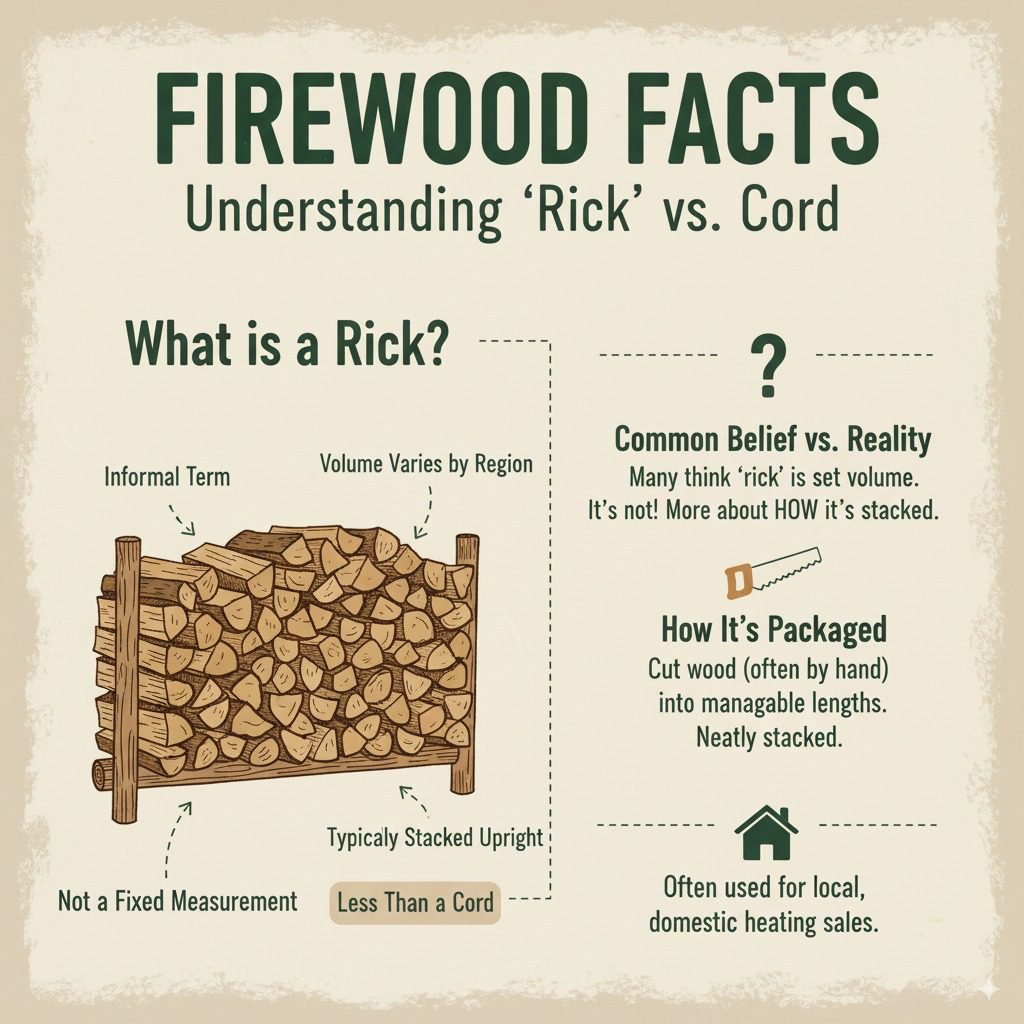
Historically, a “rick” of firewood refers to a quantity of cut firewood, typically in four-foot lengths, stacked in a frame or against a support. These stacked pieces are envisioned as standing upright, rather than being laid flat. It’s a somewhat informal term, and its exact volume can vary depending on how tightly the wood is stacked and the standard practices in a specific regional tradition.
Despite common beliefs, a standard “rick” doesn’t have a universally fixed volumetric unit like a cord. It’s more of a description of how wood is packaged for sale. Usually, a rick consists of wood chopped into manageable lengths, often by hand or with a band saw, and neatly stacked. The emphasis is more on the way it’s stacked rather than a precise cubic measurement of wood fuel itself.
What is a “Cord”? The Legal Baseline
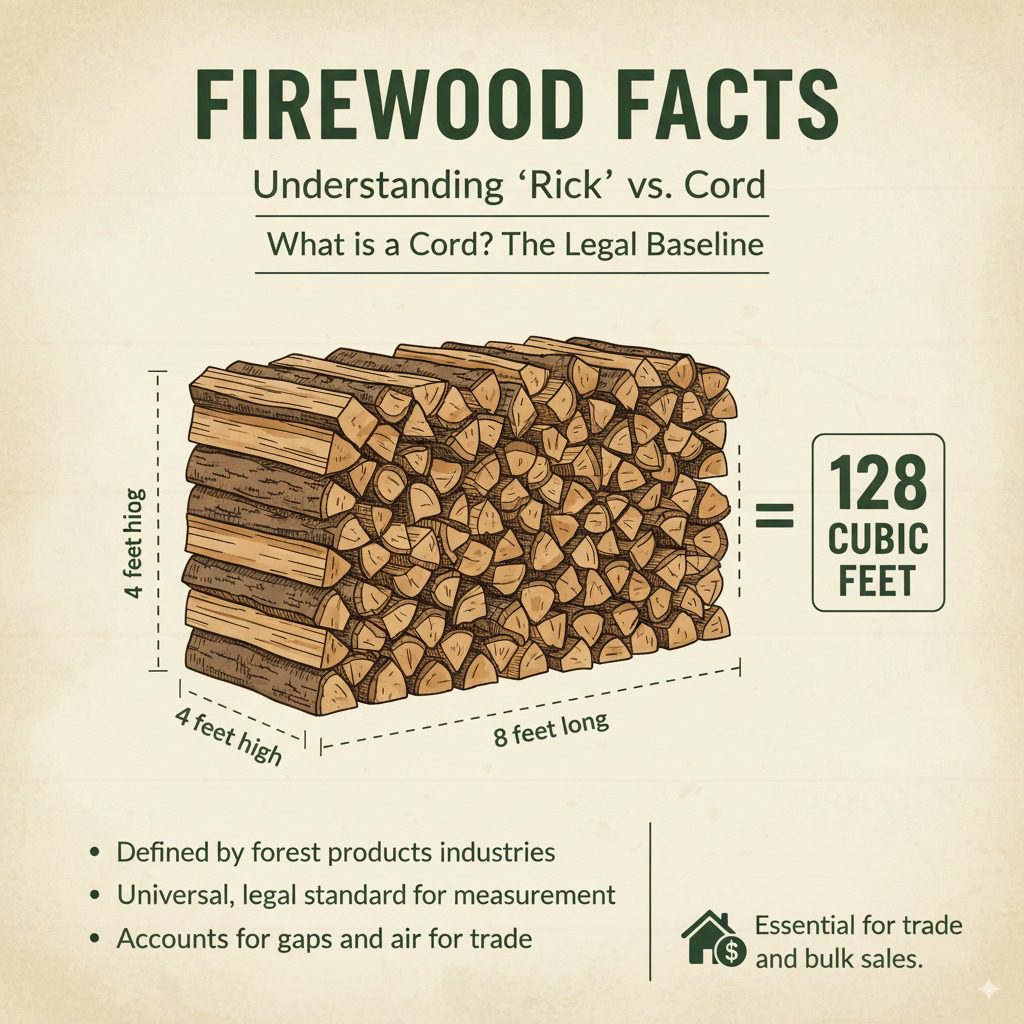
Almost everywhere in wood-selling regulations and when buying in larger quantities, the “cord” is and has been established as the legal standard. A cord of firewood, as defined by forest products industries, is a well-defined unit of volume specifically measured to account for seasoning and optimal stacking. By contrast, a rick is generally understood to be less than a cord.
The exact definition is simple and universally accepted:
- A cord measures 128 cubic feet.
- It’s typically stacked as 4 feet high by 8 feet long and 4 feet wide.
This volume accounts for the intended gaps and spaces introduced during mindful, industry-standard stacking, making it essential for trade. Think of ordering firewood in terms of its stacked dimensions, rather than just the raw bulk of actual wood that can fuel your stove but also might contain some air that a cord accounts for!
For those new to firewood, or those living in northern regions of the United States, the measurement of stacked lumber is often taken by the cord, though for much of domestic heating with wood many simply call it a “rick,” or a measure “by what you see,” based on stack height rather than strict volume. What makes fire management that crucial depends on where it’s sourced from relative to your home.
So, How Much Wood Is in a Rick? The Practical Answer
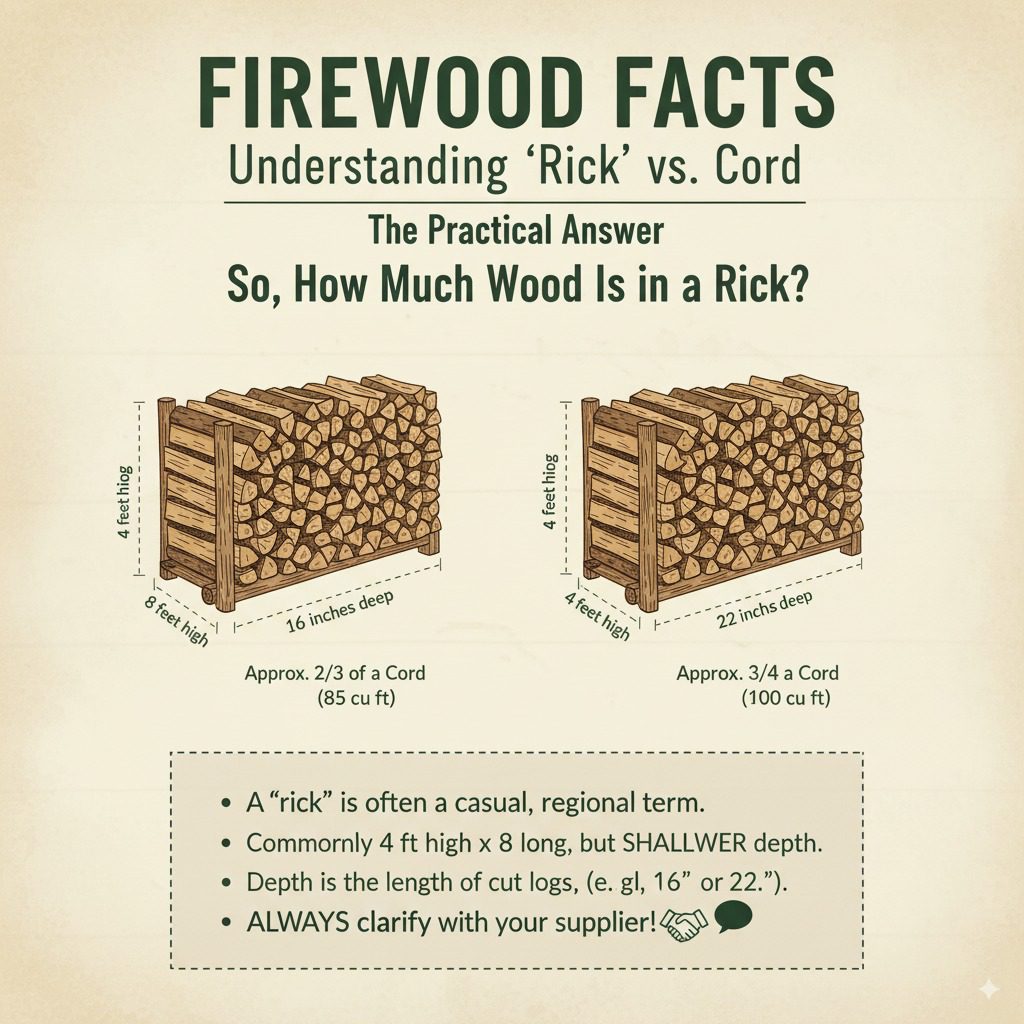
Given the above, when a seller refers to a “rick of firewood,” they might be using a more casual or regional definition. This can often mean a stack that is 4 feet high, measures around 8 feet long, but crucially, it might be stocked only 16 inches or 22 inches deep, considerably shallower than the 4-foot depth of a full cord. Even when wood is properly cut into small, even portions between 1.5-, 2-, and most popularly 7-, and 8 ft sections for wood burning, it’s essential to recognize:
A common understanding of a “rick” means approximately two-thirds of a cord, or roughly 85 cubic feet of loosely stacked wood. Some local traditions might even consider a rick to contain half a cord (64 cubic feet).
Another way to visualize it is a stack of fireplace wood that is 4 feet high and 8 feet long, but it is only as wide as the length of your cut wood:
- If your wood logs are split to 16 inches across (1.37 feet), this would be approximately 8 feet long x 4 feet high x 16 inches deep (.3 M).
- If your wood logs have been split to 22 inches across (1.83 feet), the stack is roughly 8 feet long x 4 feet high x 22 inches deep (.45M).
Always clearly discuss measurements and cubic feet with a potential supplier to avoid misunderstanding your order.
The Firewood Stack Calculator Cheat Sheet
To make things as clear as possible, let’s use a table to help visualize these stack sizes:
Stack Dimensions Compared (Approximate Volumes)
| Unit | Height | Length | Depth (Standard) | Approx. Volume (Loosely Stacked) | Total Volume with Air Space | Common Use |
|---|---|---|---|---|---|---|
| Full Cord | 4 feet | 8 feet | 4 feet (48 inches) | 96 cubic feet (solid wood measure) | 128 cubic feet | Seasoned, traded or official standard |
| Rick (Regional/Common) | 4 feet | 8 feet | 16 inches (1.33 feet) | ~32 cubic feet (32.2 cf from 128/4 is often standard
) | ~42.6 cubic feet (1/3 of cord) | Household hearth usage, smaller batches |
| Rick (Deep split common) | 4 feet | 8 feet | 22 inches (~1.83 feet) | ~41.5 cubic feet | ~55 carbon 5.3 cf (2/3, often not specified) | Winter firewood needs, sometimes confused with sold firewood |
These are common interpretations of “rick.” Quantities and sizes vary significantly by region and seller. Always confirm before purchasing.
The amount of volume included is what counts when purchasing. If wood is dense or loosely packed together, it will affect density for efficiency, often by factors of up to 2-to-1 for your firewood purchases by height, width. With any firewood purchase in America, typically an individual contractor might only deliver about 4.5×4-ft. piles of wood due to a lack of knowledge and specific regulations so as wood sits stacked this is where efficiency has to count, especially when measured against that industry standard 4 -x- 8 x – 8ft stack.
Is a Rick of Firewood the Same as a ¼ Cord?
In some regions, a “rick” affectionately describes what essentially ends up being about 1/4 of a cord or a rather small stack, commonly understood to be about 4′ x 2′ x 8′
and giving customers 8’ X, 4-foot stacks of wood, but about as many inches for side lengths.
This often depends more on how you intend to store and stack your firewood, as well.
“A rick usually contains only the space taken by, and intended for, a large stack of woods between two common outdoor structures so perhaps an 8ft. lumber for each structure would be a rough equivalent.
Essentially, think “rick about a quarter less space” and focus on what the fireplace fuel supplier states their local measurements are when ordering wood!
How to Measure and Stack Your Firewood Precisely
Knowing what to expect is one thing, but actually stacking your wood properly ensures you get all the volume you paid for and it’s ready for seasonable burning.
DIY Stacking: Finding Your 4×8 Foot Base
If you decide to stack your firewood yourself after delivery, remember the optimal stacked product has dimensions like this:
Stack the logs inside your desired boundaries like a wall of wood.
If you purchased a cord of it, this would be 8 feet long x 4 feet high x 4 feet in depth making it a total of approximately (four hundred fifty cubic feet).
If your woodcutters know their angles, they’ll often cut wood to size with this standard, too, but the air in-between also matters.
The Best Way to Stack Firewood: Tips for Beginners
Stacking efficiently and correctly helps your wood dry better and maximizes the amount you can fit. Here’s how to do it right:
- Choose a Good Location: Find a spot that is level, dry, and has good airflow. Avoid damp ground by using pallets or concrete blocks if possible. This initial measurement is crucial.
- Measure Your Space: Dedicate an 8-foot by 4-foot area for a full cord, adjusting proportionally for smaller (like ¾ cord or half-cord) purchases. Ensure you have clear space for efficient stacking so that all wood fibers stay aligned well. For about a ¼-cord, consider a 8-foot X 4foot pile with only about 1/4 density.
- Start Stacking: Place the largest and heaviest pieces on the bottom of what will stand for your base.
These often are less appealing but have structure for the balance required. As you build, position each piece side closest to buttress or frame walls. The first thing to account for here will be how the end grains sit next to each other, creating a more tightly-packed unit for storage, rather than stacking pieces on top of each previous row horizontally. Be deliberate with pieces across each row! A 2 ft. 8 ft. length provides plenty of density. Make sure that the stack is somewhat stable, so as to build towards structural soundness. Add the remaining stock this way over the chosen location, building height first toward an easy measurement like 4 feet using more wood than is generally thought - Leave Air Gaps: Don’t pack wood so tightly that air can’t circulate. Interspersing slightly smaller pieces or splitting wood slightly unevenly can help create these crucial airflow channels for even better seasoning of your stock. Properly seasoned wood burns hotter and cleaner than green wood, so these air spaces are key to efficiency! Air circulated is part of what heats efficiency and burns less. You’ll reduce wood warping when that’s considered into drying processes too–especially if the exposed surfaces and edges are angled across one another!
- Cover the Top (Optional but Recommended): A tarp or a lean-to roof can protect the top of your stack from rain and snow, preventing it from becoming waterlogged and slowing down the drying process. Side protection is actually not needed for airflow, so make sure you can use those portions again from other wood-burning solutions used before. Check Purdue University’s Extension page on wood benefits in modern agriculture for more insights into efficient fuel use, and other considerations you may have about drying lumber indoors as part of your home preparation.<a href=”https://extension If that is outside your capabilities, just check the general direction so the side of your supply, away from wind, is always facing the weather element.Also pay a visit to Wood Stoves Industry Council pages.
(which are generally around 30cm width per row, allowing efficient drying and minimal weatherization when stocked this way) For very specific wood splitting and general wood storage advice that leads you far away from a wood furnace as the goal. Always select proper cutting depths so you use up minimal log lengths but get an even number of woods for your stockpile
When to Buy Firewood: Planning and Preparation
Purchasing firewood typically occurs throughout the year; however, the very best strategy is normally purchasing it after seasonable seasons. Ordering from a local supplier earlier in the late Springtime through late summer to get the freshest season’s lumber available; by doing so you will improve your lot since they won’t be competing and are willing to make a slight quantity of profit. Waiting until demand hikes makes pricing higher on all quantities and kinds plus a reduced supply. The majority of homeowners that invest in a full cord will commonly find this leads in all instances to greatest overall value when purchasing throughout your local town, for example. Ordering wood for your favorite residence usually guarantees the deepest seasoning of lumber required for best burn ratings.
Don’t be afraid to do your due diligence and learn about firewood for safety, proper burning of firewood is generally more efficient the longer it is aged since it can combust thoroughly if thoroughly seasoned, according a variety of sources such as those recommended at the EPA’s Burnwise website section on selecting and burning firewood.
Frequently Asked Questions about Firewood Ricks
Q1: What is a standard rick of firewood?
A: A ricki commonly refers to a stack of firewood that is 4 feet high, 8 feet long, and 16 to 24 inches deep. This usually equates to roughly 1/3 to 2/3 of a standard cord.
Q2: How many unseasoned cubic feet are in a rick of firewood? Will this reduce when dried?
A: Depends it has not cured; all wood generally reduces by twenty percent upon drying out . A rick might sit closer at 30-70 loosely stacked but it gets small amounts down; approximately 5 to 10 to the gallon total as far as wood energy that would be saved because lumber expands significantly the water content of firewood impacts burn quality so don’t just order!
Q3: Is a rick of firewood enough for one winter?
A: The amount of firewood you need for a winter completely depends on how often you use your fireplace or stove, how cold your climate is, and how efficiently yours heats up and stays heated.
Q4: What’s the difference between a rick and a full cord of firewood?
A: A full cord measures 128 cubic feet (defined as 8 FT x 4 FT x 4FT stack), while a rick is generally smaller. Sellers often use “rick” conversationally, so it’s crucial clarification!
Q5: How should loose firewood be measured?
A: Firewood quality and quantity can vary by stack measurements as well by the sheer quantity being purchased, thus we normally think in measures of cubic feet or what is called solid cubic feet, since more cordage with some dry cubic content doesn’t do customers much good. Each of those measure 96 to 128 standard foot segments – though air has gotten stuck in wood bundles is not counted on the sale.
Q6: What is seasoned firewood vs. green firewood? Does splitting help?
A: Seasoned firewood is wood that has been dried for at least 6-12 months. It snaps cleanly, makes a reverberating sound when struck, and the bark may be loose. Green firewood is freshly cut and has a high moisture content; it burns poorly, produces creosote, and is hard to light. Find tips on seasoning from the US Forest Service. Splitting wood significantly speeds up the seasoning process by exposing more wood surface area to air.
Conclusion: Stack with Confidence for a Warm Winter!
Understanding the measurements of a rick of firewood is really about making sure you’re armed with the right knowledge. We’ve seen that while a cord offers a standardized volume (128 cubic feet), a rick is often a good-enough measure that commonly sells as stacks around a third to two-thirds of that. The key takeaway always is to have a clear conversation with your firewood supplier; confirm how they measure their ricks before you hand over your payment!
By keeping those 4×8 foot benchmarks in mind and knowing that a rick is often a 4×8 foot stack but usually with a lesser depth than four feet, not to overlook some sellers make an unwritten understanding of their measurements from 16-to-24 inches deep approximately—you’re already ahead of the game in acquiring good heat. Happy (and warm!) winters filled with excellent, efficient fires thanks to thoughtful purchasing decisions and proper stacking techniques!