What Is a Mortiser? How It Works, Chisel Sizes and Specs
A mortiser cuts square mortises by plunging a hollow square chisel with a spinning auger bit inside it, so the auger clears the waste while the chisel squares the walls. Benchtop models cut mortises up to 1/2 inch square, and most furniture mortises only need 1/4 to 3/8 inch. This guide covers how the chisel works, chisel sizes, real benchtop specs, setup, cut order and safety.
What a Mortiser Is and How the Hollow Chisel Works
Best Benchtop Mortiser Pick
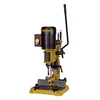 |
Powermatic PM701 Benchtop Mortiser (3/4 HP, 5-1/2 inch stroke), about $1,154 The 3/4 HP machine used in the spec table below, the motor size Fine Woodworking recommends for 1/2 inch chisels in hardwood, with the double-lock hold-down and cam-lock fence this guide’s safety and setup sections describe.
|
A mortiser is a woodworking machine, built like a small drill press, made for one job: cutting the square socket (the mortise) that a tenon slides into. The chisel is a hollow steel square with sharpened edges on all four sides. An auger bit turns inside it. The auger drills out most of the wood and lifts the chips up through an opening in the side of the chisel, and the four chisel edges shave the round hole into a square one.
That partnership is the part most beginners miss. The auger has to sit slightly ahead of the chisel edges, with a small gap between the bit and the chisel so chips have somewhere to go. Popular Woodworking describes setting the bit head about 1/16 inch from the dome inside the chisel, and both Woodsmith and Fine Woodworking describe using a coin as a spacer to get that gap: seat the chisel with a dime or penny between it and the machine, push the bit up until it touches the chisel, tighten the bit, then loosen the chisel and push it up against the housing. Too little clearance packs the chisel with chips and burns it. Too much and you lose the clean square corners.
You will see the machine spelled several ways: mortiser, morticer and mortizer all mean the same tool, and the socket it cuts is a mortise or mortice. The parts worth knowing before you shop or read a manual are below.
| Part | What it does |
|---|---|
| Hollow chisel | Square steel tube with sharpened edges that squares the hole |
| Auger bit | Spins inside the chisel, drills the waste and lifts chips out |
| Stroke | How far the head travels, which limits mortise depth in one plunge |
| Fence | Locates the mortise from the edge of the stock |
| Hold-down | Clamps the wood so it does not lift when the chisel is withdrawn |
| Depth stop | Sets how deep the chisel plunges |
Types of Mortisers
Not every machine sold as a mortiser works the same way. Match the type to the size of the work.
| Type | How it cuts | Best suited to |
|---|---|---|
| Benchtop hollow chisel | Hollow chisel plus auger, lever-fed, mounted on a bench | Furniture, cabinet doors, chairs, small shops |
| Floor-standing hollow chisel | Same hollow chisel method on a larger, heavier stand | Production work and long or heavy stock |
| Chain mortiser | A chain cutter plunges into the wood | Deep mortises in large timbers |
| Horizontal slot mortiser | A bit moves sideways to cut a slot, for example the Grizzly G0846 | Slot mortises for loose tenons, doors and frames |
| Drill press with a mortising attachment | A hollow chisel bolted to a drill press quill | Occasional mortising without buying a dedicated machine |
This article focuses on the benchtop hollow chisel type, since that is what most people mean by “a mortiser.” Fine Woodworking tested 13 benchtop models in its July/August 2014 issue and found that they handle mortises up to 1/2 inch square. If you regularly need bigger mortises than that, look at a floor-standing or chain machine instead.
Benchtop Mortiser Specs Compared: JET JBM-5 vs Powermatic PM701
Most mortiser articles describe the machine in general terms and never put real numbers side by side. These two benchtop machines sit at opposite ends of the price range. The specs below come from the manufacturers and the Amazon listings pulled on 2026-09-30, and prices move, so check the current price before buying.
| Spec | JET JBM-5 | Powermatic PM701 |
|---|---|---|
| Motor | 1/2 HP, 115V | 3/4 HP, 115/230V |
| Spindle speed | 1,725 RPM | 1,725 RPM |
| Stroke | 4-3/4 inch | 5-1/2 inch |
| Chisel sizes | 1/4, 3/8 and 1/2 inch (per JET) | 3/4 inch chisel listed; chisels sold separately per Amazon listing |
| Chuck | Three-jaw, shanks up to 3/8 inch | 1/2 inch chuck |
| Table | Not listed in the sources I read | 11 x 13 inch |
| Notable features | Reversible column, removable switch key, quick-adjust depth stop | Inline depth stop, double-lock hold-down, cam-lock fence |
| Price on 2026-09-30 | $582.99 | $1,154.00 |
The number to notice is horsepower. Fine Woodworking recommends at least 3/4 HP for efficient cutting with 1/2 inch chisels in hardwood, and says smaller motors need a slower feed rate to avoid clogging. So the JBM-5 can cut a 1/2 inch mortise, but you should expect to feed it slowly in oak or maple. In the same test, the Powermatic PM701 was the top pick overall, with the reviewers praising tool-free adjustments and a smooth cam-lever fence.
Which Chisel Size Do You Need?
Fine Woodworking notes that most furniture mortises are 1/4 to 3/8 inch wide, and every benchtop machine it tested handled those. A common rule of thumb is to make the mortise about one third of the thickness of the piece it is cut in, which keeps enough wood on both sides of the joint. Treat the sizes below as a starting point, not a standard.
| Stock thickness | Mortise width (one-third rule) | Nearest common chisel |
|---|---|---|
| 3/4 inch (rails, cabinet frames) | 1/4 inch | 1/4 inch |
| 1 inch | About 5/16 inch | 5/16 or 3/8 inch |
| 1-1/2 inch (light table legs) | 1/2 inch | 1/2 inch |
| 1-3/4 inch and thicker (chair or bed posts) | More than 1/2 inch | Out of reach for many benchtop machines: use a larger machine |
Setting Up a Mortiser Step by Step
- Sharpen first. Woodsmith uses a diamond cone for the inside of the chisel and a paddle sharpener for the auger bit.
- Set the bit-to-chisel clearance with a coin spacer, as described above.
- Rotate the chisel so its back face is parallel to the fence when it is lowered to the table. A chisel that is not aligned leaves uneven walls.
- Set the fence by making a light test dimple on the ends of a scrap piece, and adjust until the marks line up.
- Set the depth stop to the tenon length plus a little extra so the tenon never bottoms out.
The Right Order of Cuts
Do not plunge the chisel side by side down the whole mortise in a row. A chisel with wood on only one side is pushed sideways and can wander. Woodsmith describes a three-pass sequence that avoids this:
- Plunge both ends of the mortise first, so the chisel is fully supported by wood on the outside.
- Remove the middle with staggered cuts, leaving a thin wood bridge between holes so the chisel is never cutting a wall on just one side.
- Make a final clean-up pass to remove the remaining bridges.
Advance the handle steadily and watch the chips coming out of the chisel. If they stop flowing, back off and clear the chisel instead of pushing harder.
Troubleshooting: Smoke, Burning and Crooked Mortises
| Problem | Likely cause | Fix |
|---|---|---|
| Smoke or heat from the chisel | Chips packed inside the chisel | Clear the packed chips and apply dry lubricant |
| Burned or discolored wood | Friction from dull tools or poor clearance | Check sharpness, re-set clearance, verify chips are ejecting |
| Uneven mortise walls | Chisel not parallel to the fence | Re-align the chisel to the fence |
| Mortise out of square | Chisel deflected because a side was unsupported | Use the three-pass sequence: ends, staggered middle, clean-up |
Mortiser Safety
A mortiser is slower and lower-speed than a saw, but a spinning auger inside a sharp four-sided chisel still deserves respect.
- Clamp the workpiece with the hold-down. The Powermatic PM701 has a double-lock hold-down specifically to reduce workpiece slippage, and the same principle applies to any machine.
- Keep your fingers out of the path of the chisel and the area around the chuck. Use the fence and hold-down to control the wood instead of holding it with your hand near the chisel.
- Unplug the machine, or remove the switch key if it has one, before changing chisels, bits or the depth stop. The JET JBM-5 has a removable switch, which makes accidental starts harder.
- Never force the cut. Match the feed to the auger, and if the machine bogs or smokes, stop and clear the chisel.
- Wear eye protection and hearing protection, and use dust collection or a shop vac, since a mortiser throws a steady stream of chips.
Mortiser vs Other Ways to Cut a Mortise
A dedicated machine is not the only route. A drill press drills the bulk of the waste but still leaves round ends, so you finish the corners by hand (our guide to making a square hole in wood compares the options). A hand-tool setup skips the machine entirely, and our guide to mortise and tenon tools covers the chisels, gauges and saws for that method. A loose-tenon system such as the Festool Domino is another approach: see our comparison of the Domino DF 500 and DF 700. If you plan a drill press mortising attachment, our page on what size drill press you need is a useful check.
A mortiser earns its place once you are cutting a dozen or more identical mortises, such as a set of chairs or a run of frame-and-panel doors, because the setup is done once and every plunge repeats it. For a single table, hand tools or a drill press are cheaper. For the strength side of the decision, see how the joint compares in what wood joint is the strongest and the full method in our mortise and tenon joinery guide.
Which Joint Jobs Need a Mortiser and Which Do Not
A hollow chisel mortiser makes deep, narrow sockets with square ends and walls. That is the right shape for a tenon, and the wrong shape for several jobs that sound similar:
| Job | Mortiser a good fit? | Better route |
|---|---|---|
| Deep square socket for a tenon (legs, rails, frame and panel doors) | Yes | This is its purpose |
| Shallow recess for a hinge leaf | No | A chisel or router, as covered in our guide to making wooden hinges |
| Corner where two boards meet at 45 degrees | No, a straight plunge cannot follow the angle | Splines or reinforced glue-ups, see how to join wood at 45 degrees |
| Tenon that meets the rail at a slope | Only with a tilting table or a jig | Plan the geometry first with our angled tenon and sloped mortise guide |
Once you know a mortise is the right joint, our mortise and tenon sizing guide works through tenon proportions, which is the step that decides which chisel you pick up.
Maintaining Your Mortiser
- Sharpen the four chisel edges, the inside of the chisel and the auger cutting edges before they get dull: a dull chisel is the most common cause of burning.
- Clear chips from the chisel slot and the chuck area after each session.
- Store chisels and bits in a holder so the edges are not chipped. The Powermatic PM701 has an integrated chisel holder with a sharpening stone.
- Check that the fence and hold-down lock firmly before each job.
Frequently Asked Questions
What is a mortiser used for?
A mortiser cuts square or rectangular mortises, the sockets that receive tenons in mortise-and-tenon joints for furniture legs, rails, doors and frames. A hollow square chisel with a rotating auger bit inside it does the cutting.
How does a hollow chisel mortiser work?
The auger bit spins inside a hollow square chisel. As you pull the handle, the auger drills and clears chips through a slot in the chisel while the chisel corners square the hole. Cutting the ends first and then the middle keeps the chisel from deflecting.
What size chisels does a benchtop mortiser take?
Benchtop hollow chisel mortisers generally handle mortises up to 1/2 inch square. Most furniture mortises are 1/4 to 3/8 inch wide, so a set of 1/4, 3/8 and 1/2 inch chisels covers most work.
Can a mortiser cut round holes?
No. A hollow chisel mortiser is built to cut square or rectangular holes. Use a drill press with a twist or Forstner bit for round holes.
Is a mortiser better than a drill press?
For repeatable square mortises, yes. A drill press only makes round holes, so you still have to square the corners by hand, while a mortiser squares them in the same plunge.
Conclusion
A mortiser is a hollow chisel and auger on a plunging head that turns a slow, fiddly joint into a repeatable one. Choose a chisel width of about one third of your stock thickness, set the clearance with a coin, cut the ends first, and take a slow feed rate if your motor is under 3/4 HP. Buy one when you have many mortises to cut, not for a single project.
Sponsored / affiliate links. As an Amazon Associate I earn from qualifying purchases. I may earn additional commission from eligible campaigns.