Wood Weight Calculator (kg, Australia): Timber Weight by Species in Metric
Free calculator that turns timber dimensions in millimetres and metres into kilograms for Australian species, from radiata pine to spotted gum. It gives an estimate: moisture content changes the weight, so seasoned and green timber differ.
Quick Answer
Australian timber weight is calculated in metric as Weight (kg) = Width (m) x Thickness (m) x Length (m) x Density (kg/m3): enter your dimensions in millimetres and metres and choose from common Australian species like Radiata Pine, Tasmanian Oak, Jarrah, and Spotted Gum for an instant weight in kilograms, useful for trailer, ute, or van payload planning.
Wood Weight Calculator (kg, Australia): Timber Weight by Species in Metric
Enter your values below for an instant result, then see the formula, worked example, and common mistakes.
Enter your timber dimensions in metres/millimetres, then click calculate.
|
Best Moisture Meter Pick
|
As an Amazon Associate we earn from qualifying purchases.
How to Use This Calculator
Softwoods such as Radiata Pine (545 kg/m3), Hoop Pine (560) and Western Red Cedar (370) are lighter; Australian hardwoods like Jarrah (835), Silvertop Stringybark (860) and Spotted Gum (1,010) are considerably denser. All figures are for timber at 12% moisture content.
Standard Australian structural timber lengths are commonly 2.4, 3.0, 3.6, 4.2, 4.8, 5.4, and 6.0 m.
Common structural sizes include 70×35, 90×35, 90×45, and 140×45 mm (MGP-graded pine); hardwood decking and furniture stock varies more widely.
Seasoned (kiln- or air-dried) timber is the standard reference condition for density tables. Green (freshly milled, unseasoned) timber retains far more moisture and can weigh roughly 35-60% more than the same piece seasoned. If you have a moisture meter reading, type it into the custom moisture field instead.
Useful for checking a full pack or trailer load against a vehicle’s GVM (Gross Vehicle Mass) or payload rating before transport.
Formula
Weight (kg) = Width (m) x Thickness (m) x Length (m) x Density (kg/m3). Since Australian timber is typically sold with width and thickness in millimetres, divide each by 1,000 to convert to metres before multiplying. Green (unseasoned) timber is heavier because of retained water: the species tables below show roughly 35-60% more weight than the seasoned figure, and the calculator’s quick green option applies a rough +40% midpoint. For a more exact result, enter the actual moisture content in the custom field.
Reference Table: Common Australian Timber Densities
| Species | Density (kg/m3, 12% MC) | Type | Typical use |
|---|---|---|---|
| Western Red Cedar | ~370 | Softwood | Cladding, battens, shingles |
| Oregon / Douglas Fir (imported) | ~510 | Softwood | Structural beams, framing |
| Radiata Pine (also called Monterey or insignis pine) | ~545 | Softwood | Framing, structural (MGP grades), treated pine |
| Hoop Pine | ~560 | Softwood | Plywood, joinery, lining |
| Qld Maple | ~575 | Hardwood | Furniture, joinery |
| Blackwood (Tasmanian) | ~640 | Hardwood | Furniture, musical instruments, joinery |
| White Cypress Pine | ~675 | Softwood | Termite-resistant flooring, cladding |
| Tasmanian Oak (675-770 range) | ~700 | Hardwood | Flooring, furniture, joinery |
| Jarrah | ~835 | Hardwood | Decking, flooring, outdoor structures |
| Silvertop Stringybark | ~860 | Hardwood | Structural, decking |
| Spotted Gum | ~1,010 | Hardwood | Decking, heavy structural, flooring |
Green vs Seasoned Timber Weight: It Depends on the Species
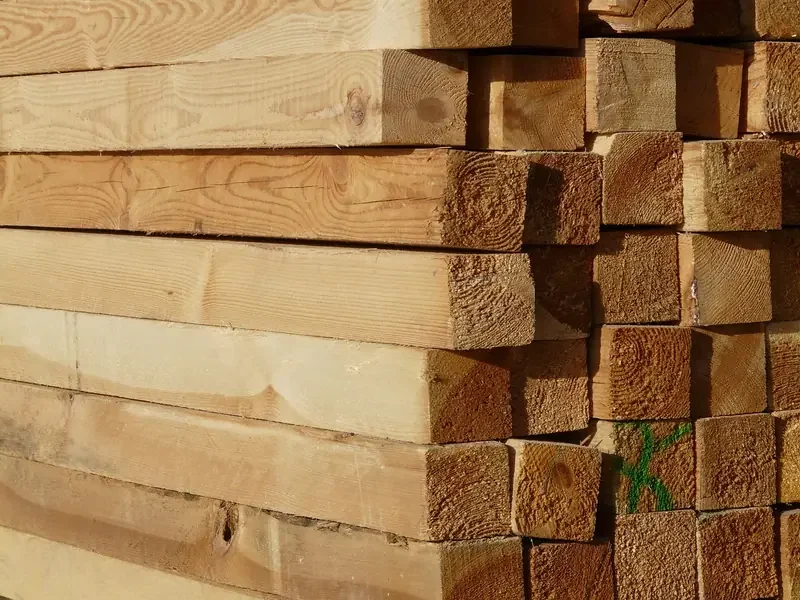
The common rule of thumb that green timber is “about 40% heavier” hides a wide spread. Wood Solutions lists both a seasoned and an unseasoned density for the species below, and the gap is not the same for each.
| Species | Seasoned (kg/m3) | Unseasoned (kg/m3) | Extra weight when green |
|---|---|---|---|
| Jarrah | 820 | 1,100 | about +34% |
| Radiata Pine | 550 | 800 | about +45% |
| Tasmanian Oak | 650 | 1,050 | about +62% |
Jarrah goes from 820 kg/m3 seasoned to 1,100 kg/m3 unseasoned. Source: Wood Solutions, Jarrah
Wood Solutions quotes slightly different seasoned figures (radiata 550, jarrah 820) from the 545 and 835 used in the calculator, which come from Business Queensland and the Wood Database. A difference of 1-2% between reputable sources is normal, and far smaller than the swing from moisture.
How to Correct Timber Weight for Moisture Content
Density tables assume 12% moisture content. If you know the actual moisture content, scale the seasoned weight by (1 + MC) / 1.12, where MC is written as a fraction (25% = 0.25). This works because the dry wood mass stays the same and only the water mass changes. The calculator’s custom moisture field does exactly this.
This treats the timber’s volume as unchanged, which is a good approximation across a few points of moisture. Green timber also swells slightly as it takes on water, so the method slightly understates the weight of freshly milled boards. A pin-type moisture meter takes the guesswork out of the number you type in.
Timber Weight per Metre: Common Australian Sizes
Weight per metre is the quickest way to size up a pack. Multiply the figure by the length in metres. All values are seasoned (12% moisture content) and rounded to two decimals.
| Size (mm) | Radiata Pine (kg/m) | Tasmanian Oak (kg/m) | Jarrah (kg/m) | Spotted Gum (kg/m) |
|---|---|---|---|---|
| 70 x 35 | 1.34 | 1.72 | 2.05 | 2.47 |
| 90 x 35 | 1.72 | 2.21 | 2.63 | 3.18 |
| 90 x 45 | 2.21 | 2.83 | 3.38 | 4.09 |
| 140 x 45 | 3.43 | 4.41 | 5.26 | 6.36 |
| 190 x 45 | 4.66 | 5.99 | 7.14 | 8.64 |
| 240 x 45 | 5.89 | 7.56 | 9.02 | 10.91 |
For example, a 4.8 m length of 140 x 45 radiata pine weighs about 16.5 kg seasoned, and a 4.8 m length of 240 x 45 weighs about 28.3 kg. Both figures rise noticeably if the timber is still damp from treatment or storage; use the custom moisture field to account for that. This page covers solid timber only: plywood, MDF and other sheet products have their own densities and are not in the species list.
Common Mistakes to Avoid
- Mixing millimetres and metres without converting: width and thickness are usually specified in mm on Australian timber, but the density formula requires metres throughout for the result to come out in kg.
- Using a seasoned density figure for green (freshly milled) timber: the extra weight can range from roughly 35% to 60% depending on species (see the green vs seasoned table above).
- Treating every pine as one weight, or one pine as two: Radiata, Monterey and insignis pine are one species (Pinus radiata), while Hoop Pine (560 kg/m3) and imported Oregon (510 kg/m3) are different timbers. Density also varies with where and how fast the pine was grown.
- Forgetting to account for total pack weight when loading a trailer or ute: multiply per-length weight by quantity and check against your vehicle’s GVM/payload rating, since a full pack of dense hardwood can add up quickly. If you are checking what a timber member can carry instead, use our wood load capacity calculator.
When the Estimate May Be Wrong
Density figures above are typical averages for seasoned (kiln- or air-dried) timber and can vary based on growth region, moisture content at time of purchase, and individual board density variation within a species. Treat every result on this page as an estimate, not a weighbridge reading. For precise structural or engineering applications, use the specific grade stamp and supplier documentation for your timber rather than average species density alone.
FAQs
How do you calculate timber weight in kg in Australia?
Multiply width in metres by thickness in metres by length in metres by the species’ density in kg per cubic metre. Since Australian timber sizes are usually given in millimetres, divide each by 1,000 first.
How much heavier is green timber than seasoned timber?
It depends on the species. Using Wood Solutions figures, green jarrah is about 34% heavier than seasoned, green radiata pine about 45% heavier and green Tasmanian oak about 62% heavier, because of retained moisture.
What is the density of Jarrah compared to Radiata Pine?
Jarrah, a dense Australian hardwood, has a density of roughly 835 kg/m3, compared to Radiata Pine (a common structural softwood) at roughly 545 kg/m3, so Jarrah is about 50% heavier by volume.
Are radiata pine and Monterey pine the same timber?
Yes. Radiata pine, Monterey pine and insignis pine are all Pinus radiata, so they share one density figure. Australian-grown radiata is about 545 kg/m3 at 12% moisture content, while New Zealand-grown radiata is about 490 kg/m3.
How much does a 140 x 45 pine length weigh?
A 4.8 m length of 140 x 45 mm radiata pine weighs about 16.5 kg at 12% moisture content (3.43 kg per metre). It will weigh more if it is damp or freshly treated.
How do you adjust timber weight for moisture content?
Multiply the seasoned weight by (1 + MC) / 1.12, where MC is the moisture content as a fraction. For example, at 25% moisture the factor is about 1.12, so a 5.30 kg stud weighs roughly 5.9 kg.
Why does timber weight matter for transport in Australia?
Knowing accurate timber weight helps ensure a trailer, ute, or van load stays within its rated GVM (Gross Vehicle Mass) and payload limits, which is both a safety and legal compliance requirement.
Sources and Methodology
Densities are for timber at 12% moisture content and were checked in October 2026 against these sources: Business Queensland timber property pages (for example spotted gum at 1,010 kg/m3) for radiata pine 545 (Australian-grown), hoop pine 560, Qld maple 575, white cypress 675, Tasmanian oak 675-770, silvertop stringybark (Eucalyptus laevopinea) 860 and spotted gum 1,010; the Wood Database for jarrah 835, western red cedar 370, Douglas fir 510 and Australian blackwood 640; and Wood Solutions for the seasoned and unseasoned figures in the green vs seasoned table. Where sources differ, the calculator uses the Australian figure; for example the Wood Database lists spotted gum at 940 kg/m3 against Business Queensland’s 1,010. Tasmanian oak is a trade group (Eucalyptus regnans, E. delegatensis and E. obliqua), so the 700 kg/m3 used here is a mid-range value. The moisture correction assumes constant volume. Results are estimates only.
Sponsored / affiliate links. As an Amazon Associate I earn from qualifying purchases. I may earn additional commission from eligible campaigns.