Can Benjamin Moore Paint Be Color Matched? Essential Tips
Yes, Benjamin Moore paint can be expertly color matched. Whether you have a swatch from another brand, a piece of fabric, or an old paint chip, Benjamin Moore retailers use advanced spectrophotometers to analyze and replicate the color. For best results, provide a clean, flat, and solid-colored sample at least one inch in size.
Hello, fellow makers and DIYers! It’s Md Meraj, your guide in the workshop. Today, we’re stepping away from the sawdust for a moment to tackle a question that comes up on almost every project that needs a coat of paint: getting that perfect color. You found a beautiful shade—maybe in a magazine, on a piece of furniture, or even from a competitor’s paint swatch. Now you want that exact color in the high-quality paint you trust, like Benjamin Moore. But can it be done accurately? It’s a common worry, and a bad match can be frustrating. Don’t worry, though. I’m here to walk you through the entire process, making it simple and foolproof. We’ll cover everything you need to know to get a flawless match every time.
What is Paint Color Matching, Anyway?
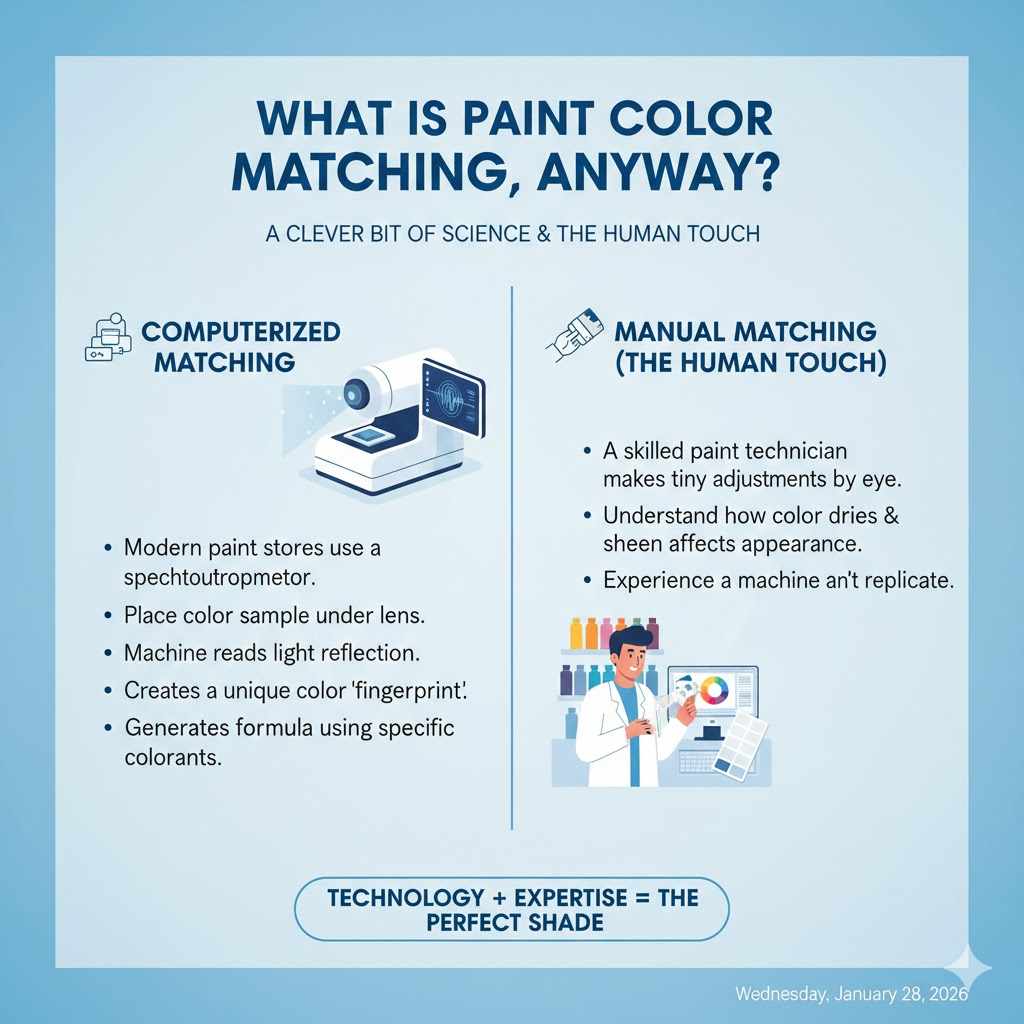
Before we dive into the “how,” let’s quickly understand the “what.” Paint color matching isn’t magic, but it is a clever bit of science. At its heart, color matching is the process of recreating a specific color in a new can of paint. This is usually done in two ways:
- Computerized Matching: Modern paint stores, including official Benjamin Moore retailers, use a machine called a spectrophotometer. You place your color sample under its lens, and it shines a precise light onto it. The machine reads the light that reflects back to create a unique color “fingerprint.” It then generates a formula using the store’s specific colorants (the pigments added to the base paint) to replicate that color.
- Manual Matching (The Human Touch): While the machine is incredibly accurate, a skilled paint technician is often the secret ingredient. They can look at the machine’s formula and make tiny adjustments by eye to get it even closer. They know how a color will dry and how the sheen will affect its appearance—an experience a machine just can’t replicate.
So, when you ask for a color match, you’re getting a combination of advanced technology and human expertise working together to nail that perfect shade for your project.
Why Would You Need to Color Match?
There are several common reasons why you might find yourself needing a custom color. Understanding your goal will help you get the best possible result at the paint counter.
- You Love a Competitor’s Color: You might have a color chip from Sherwin-Williams, Behr, or Farrow & Ball, but you prefer the application, durability, or finish of Benjamin Moore’s Aura® or Regal® Select lines. This is one of the most common reasons for color matching.
- You’re Matching an Existing Wall: Maybe you need to do some touch-ups but don’t have the original can of paint. Or perhaps you want to paint an adjoining room the same color but have no idea what it was called. A color match can save you from repainting the entire space.
- You’re Inspired by an Object: Inspiration is everywhere! You might want to match the color of a favorite throw pillow, a piece of artwork, a vase, or even a piece of clothing. A good paint store can match almost any physical item.
Getting it Right: A Step-by-Step Guide to a Perfect Color Match
Getting a great color match is less about luck and more about good preparation. Follow these steps, and you’ll walk out of the store with a can of paint you can be confident in. This process works whether you’re bringing a competitor’s paint chip or a unique item.
Step 1: Provide a High-Quality Sample
The saying “garbage in, garbage out” is very true for color matching. The quality of your sample is the single most important factor for success. The spectrophotometer is a precise instrument, and it needs a good, clear target to read.
| Sample Type | Tips for Best Results |
|---|---|
| Paint Chip (from any brand) | This is the easiest to match. Just bring the original paper chip from the store. Ensure it’s clean and not faded from being in the sun. |
| Existing Painted Surface | Carefully cut a piece of drywall or trim at least 1-inch by 1-inch. A larger sample is always better. Wipe it gently with a damp cloth to remove any dust or grime. |
| Fabric or Textile | Choose a section with a solid, consistent color. Iron it if it’s wrinkled. The machine works best on flat surfaces. Be aware that texture can slightly affect the reading. |
| Printed Item (Magazine, Photo) | This is the most challenging. The dots of ink used in printing can confuse the machine. It can be done, but expect it to be an approximation. A physical object is always better. |
Crucial Tip: Never use a photo on your phone screen! The colors on a digital screen are created with light (RGB) and are backlit, which is completely different from how paint pigment (CMYK) works. It will never produce an accurate match.
Step 2: Choose Your Sheen (It Matters!)
Did you know the same color can look dramatically different depending on its sheen? A higher sheen (like semi-gloss) reflects more light, which can make a color appear lighter and more saturated. A lower sheen (like matte or flat) absorbs light, making the color look darker and softer.
- Matte/Flat: Hides imperfections well, great for ceilings and low-traffic areas.
- Eggshell/Satin: A slight sheen, durable and easy to clean. Perfect for most rooms like living rooms, bedrooms, and hallways.
- Semi-Gloss/Gloss: Very durable and reflective. Best for trim, doors, and cabinets.
When matching a color, try to match it in the sheen you plan to use. If you’re matching an existing wall, figure out its sheen. A simple way is to look at it from an angle; if you see a noticeable shine, it’s likely eggshell or higher. If there’s no shine at all, it’s probably flat.
Step 3: Talk to the Paint Expert
Don’t just hand over your sample and walk away. Engage with the person behind the counter. Tell them about your project. For example, say, “I’m trying to match this Sherwin-Williams chip, ‘Sea Salt,’ for a bathroom, and I plan on using an Eggshell finish.”
This context helps them ensure the final product is perfect. They might know from experience that a certain color tends to look slightly different in their base paint and can make a small adjustment upfront. Their expertise is your best tool.
Step 4: Always, Always Get a Sample Pot
This is the step that most people skip, and it’s the one that can lead to the most regret. Even with a perfect match in the can, you must see how it looks in your own space. For a few dollars, a sample pot is the best insurance policy for your project.
Paint a large swatch (at least 2 feet by 2 feet) on a piece of poster board or directly on the wall in the room you’ll be painting. Move the poster board around to different walls. Look at it in the morning with natural daylight, in the afternoon, and at night with your lights on. This is where you might notice something called metamerism.
Step 5: Understand Metamerism
This sounds like a complex term, but the idea is simple. Metamerism is a phenomenon where two colors appear to match under one light source but not under another. For example, your freshly matched paint might look perfect in the fluorescent lighting of the store but look slightly off in the warm, incandescent light of your living room at night.
This happens because the matched paint is made with a different combination of pigments than the original color, even if they look identical to the naked eye. As explained by color experts at the Rochester Institute of Technology, different light sources have different color spectrums, which cause these pigment combinations to reflect light differently. This is why testing the paint in your actual environment is non-negotiable for a project you’ll be proud of.
The Challenges of Getting a 100% Perfect Match
While technology and techniques have come a long way, achieving a 100.00% identical match can sometimes be tricky. It’s important to have realistic expectations.
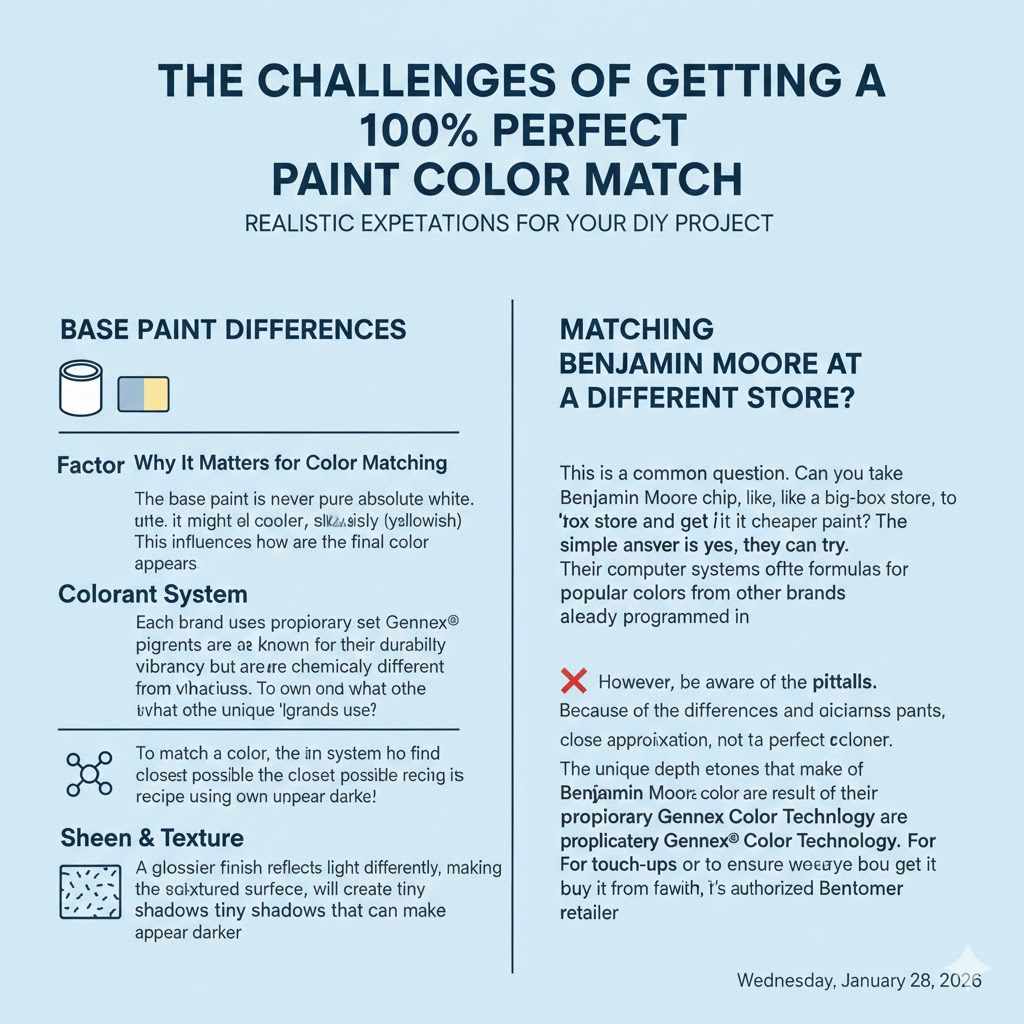
Base Paint Differences
Every paint brand starts with a range of “base” paints—the white, un-tinted liquid in the can. These bases have slightly different chemical makeups and shades of white. A “white” from Benjamin Moore might have a slightly different undertone than a “white” from another brand. When colorants are added, this subtle difference in the starting point can affect the final shade.
| Factor | Why It Matters for Color Matching |
|---|---|
| Base Undertone | The base paint is never pure, absolute white. It might be slightly cooler (blueish) or warmer (yellowish). This influences how the final color appears. |
| Colorant System | Each brand uses a proprietary set of pigments. Benjamin Moore’s Gennex® colorants are known for their durability and vibrancy but are chemically different from what other brands use. To match a color, the system has to find the closest possible recipe using its own unique “ingredients.” |
| Sheen & Texture | As we discussed, a glossier finish reflects light differently, making a color look brighter. A textured surface, like a popcorn ceiling, will create tiny shadows that can make a color appear darker. |
What About Matching a Benjamin Moore Color at a Different Store?
This is a common question. Can you take a Benjamin Moore chip, like the popular “Revere Pewter,” to a big-box store and get it matched in a cheaper paint? The simple answer is yes, they can try. Their computer systems often have the formulas for popular colors from other brands already programmed in.
However, be aware of the pitfalls. Because of the differences in base paints and colorant systems, the match will be a close approximation, not a perfect clone. The unique depth and undertones that make a Benjamin Moore color special are a result of their proprietary Gennex® Color Technology, which cannot be replicated by other brands. For touch-ups or to ensure you get the exact color you fell in love with, it’s always best to buy it from an authorized Benjamin Moore retailer.
Frequently Asked Questions (FAQ)
Can I just take a picture of a color with my phone for matching?
No, this is highly discouraged. Your phone’s camera, screen brightness, and the ambient light all distort the color. The sample provided to the paint store should be a physical object to allow the spectrophotometer to get an accurate reading.
Will a matched color be 100% identical to the original?
It can get incredibly close, often to the point where the human eye cannot tell the difference (what’s known as a “Tolerable Match” in the industry). However, due to different base paints and pigment systems between brands, it’s more of a precise replication than a perfect clone. For touch-up work, it’s always best to use paint from the original can or a chip of the exact same wall.
How much does it cost to have a color matched?
The color matching service itself is free! You only pay for the paint you purchase, whether it’s a small sample pot or a gallon. This service is part of the value you get from a quality paint store.
I have a Benjamin Moore color code. Can another store use it?
Yes and no. Another store can look up the Benjamin Moore color name/code in their computer system and find their own brand’s closest equivalent formula. It will be a close match but not identical, for all the reasons we’ve discussed (base paint, colorants, etc.).
Why does my perfectly matched paint look different on the wall at home?
This is almost always due to lighting—the “metamerism” effect we covered earlier. Your home’s lighting (natural light from windows, warm-toned lamps, cool-toned LEDs) is different from the store’s lighting. This is why testing a sample in the actual room is the most critical step.
Is it better to match a dry paint chip or a wet paint sample?
Always match a dry paint sample. Paint colors can change slightly as they dry, a process called “color shift.” A dry chip from a painted surface will give the machine the most accurate reading of the final, intended color.
Your Perfect Color is Within Reach
So, can Benjamin Moore paint be color matched? Absolutely. With today’s technology and the expertise found at your local Benjamin Moore retailer, you can confidently replicate nearly any color you desire. The key to success isn’t a secret—it’s just a little preparation.
Remember to bring in a great sample, think about your sheen, and always test your color in your home’s unique lighting before committing. By following these simple tips, you take the guesswork out of the process and put the power in your hands. You’re no longer limited to the colors on a single paint swatch wall; your inspiration can come from anywhere. Now you can pair that perfect custom color with the lasting quality of a paint you trust. Happy painting!