Desktop Bandsaw Guide: WEN, DEWALT, and RIKON Models Compared
A desktop bandsaw is the 9- to 14-inch benchtop class of bandsaw – small enough to sit on a workbench or a stand of its own, but still capable of resawing, curve-cutting, and joinery work a table saw or jigsaw can’t handle cleanly. Below we compare the current WEN, DEWALT, VEVOR, and RIKON models that actually show as in stock right now, explain which specs matter more than the amp rating on the box, and flag the buying mistakes that lead people to return a bandsaw within the first month.
What a Desktop Bandsaw Is Good For (and What It Isn’t)
A bandsaw’s blade is a continuous loop running over two or three wheels, cutting only downward into the table. That single design detail is why bandsaws handle curves, irregular shapes, and resawing (slicing a thick board into thinner boards) far better than a table saw, and why they carry almost none of the kickback risk that comes with a spinning circular blade. A desktop-class model – meaning the 9-inch to 14-inch benchtop saws, not the 17-inch-plus floor-standing cabinet saws – trades maximum resaw height and throat depth for a footprint that fits on a bench or a small stand. That’s the right trade for cutting boards, curved furniture parts, box joints, and stock under about 5-6 inches thick. It’s the wrong tool if you’re regularly resawing 10-inch-wide slabs or ripping full sheets of plywood – that’s a floor-model bandsaw or a table saw’s job.
Best Overall Desktop Bandsaw
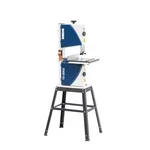 |
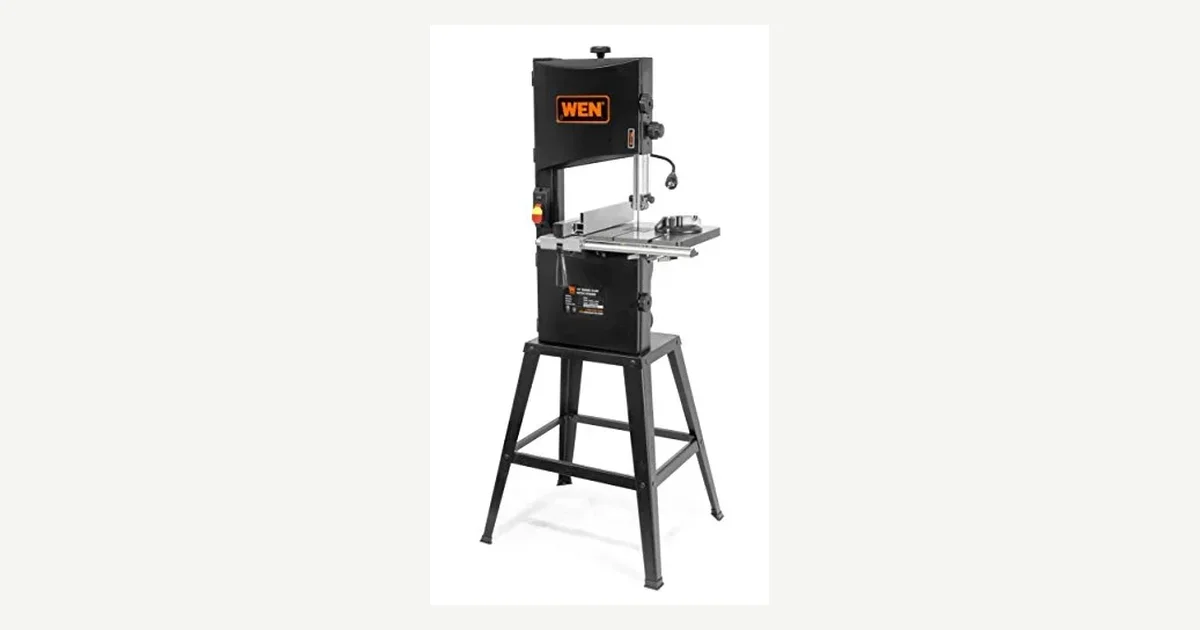
RIKON 10-3062S 10-Inch Deluxe Bandsaw with Stand – $584.99 A two-speed, 1/2 HP bandsaw with a real 5-inch resaw height and a cast-iron table – enough capability to grow into for several years of projects.
|
Specs That Matter More Than the Amp Rating
Most desktop bandsaw listings lead with amps (2.8A, 3.5A, and so on), which makes it tempting to assume more amps always means a stronger saw. It doesn’t. Amps measure how much electrical current the motor draws, not how much usable cutting torque reaches the blade – two 9-inch saws with the identical 2.8-amp motor rating can still cut noticeably differently depending on wheel mass, drive-belt tension, and how well the blade tracks under load. The specs that actually predict how a desktop bandsaw performs in practice are:
- Resaw height: the maximum thickness of stock the saw can cut when the blade is raised all the way up. This is the number that determines whether you can resaw a 6-inch board into two 3-inch slabs in one pass, and it varies far more between models than amp ratings do (from about 3-1/2 inches on basic 9-inch saws up to 5+ inches on the RIKON above).
- Throat depth: the distance from the blade to the vertical column, which caps how wide a piece of material can pass under the blade guides. A narrow throat is fine for small parts and rules out resawing wide boards.
- Blade speed (FPM): feet per minute, not RPM. A two-speed saw lets you drop blade speed for denser hardwoods or thicker stock and run faster for thin material and curves.
- Table material: cast iron holds flat and resists vibration better than the stamped-aluminum or plastic tables on the cheapest 9-inch saws, which matters more once you’re doing anything beyond simple curve cuts.
How the Current Desktop Models Compare
Listings and availability on Amazon change constantly, so treat the prices and stock status below as a snapshot – but every ASIN here was checked live before publishing and confirmed in stock.
| Model | Motor | Resaw Height / Throat | Best For | Price |
|---|---|---|---|---|
| WEN BA3959 (9-inch) | 2.8A, single speed | 3-1/2″ / 9″ | Budget first bandsaw for small parts and curves | ~$140 |
| WOODSKIL 9-inch | 1/2 HP, 2,500 FPM | 3-1/2″ / 9″ | Same class as the WEN, cast-aluminum tilting table | ~$150 |
| WEN BA3962 (10-inch, with stand) | 3.5A, two-speed | 6″ / 9-3/4″ | Stepping up in resaw height without a big price jump | ~$200 |
| VEVOR 13.39-inch (with stand) | 1100W (1.5 HP), variable speed | 13″ / 15.55″ table | Larger stock and a work light included, at a mid floor-model footprint | ~$330 |
| RIKON 10-3062S (our pick) | 1/2 HP, two-speed | 5″ / 9-5/8″ | Best resaw capacity in the true desktop class, cast-iron table | $584.99 |
| DEWALT DCS378B (cordless, portable) | 20V MAX brushless, bare tool | 3-3/8″ cut capacity | Job-site and on-the-go cuts, not a bench tool, sold without battery | ~$180 |
Note the DEWALT is a different category entirely – a handheld, cordless portable bandsaw meant for on-site metal and pipe cutting, not a benchtop machine you’d set up in a shop. It shows up in “bandsaw” searches constantly, but it isn’t a substitute for any of the benchtop saws above if what you actually need is a shop tool for resawing lumber or cutting curves.
Stand or Tabletop-Only: Which Should You Get?
Several models in the table above are sold both as a bare tabletop unit and as a version bundled with a floor stand, and the difference is bigger than it looks in photos. A tabletop-only saw sits on an existing workbench, which keeps the footprint small but means the bench has to be sturdy enough to absorb vibration – a lightweight folding table will transmit enough shake to affect cut quality on anything but the lightest work. A stand-mounted version, like the RIKON 10-3062S or the WEN BA3962, raises the working height to a comfortable standing position and adds its own mass to dampen vibration, at the cost of a dedicated floor spot roughly 2 feet square. If shop space is genuinely tight and you already have a solid workbench, the tabletop-only route saves both money and floor space; if you’re setting up a first dedicated tool corner, the stand version is usually worth the extra cost.
Common Buying Mistakes
A few patterns show up repeatedly in return and complaint data for entry-level bandsaws:
- Buying on amps alone. As covered above, amps don’t tell you resaw height or throat depth, which are the specs that actually determine what the saw can cut.
- Assuming “9-inch” or “10-inch” refers to cutting capacity. That number is the wheel diameter, not the maximum board thickness – always check the resaw height spec separately.
- Ignoring blade width compatibility. Most desktop bandsaws are limited to blades under 1/2 inch wide. A narrower blade (1/8″-1/4″) cuts tighter curves; a wider blade (3/8″-1/2″) tracks straighter for resawing. Buying only the blade that ships with the saw and never swapping it is the single most common reason people conclude a bandsaw “can’t cut straight.”
- Underestimating dust collection needs. A shop vac hooked to the dust port makes a real difference in blade visibility and table cleanliness; running a benchtop bandsaw with no dust collection at all is a common source of “why can’t I see my cut line” complaints.
Blade Selection, Setup, and Basic Maintenance
Out of the box, most desktop bandsaws ship with a general-purpose blade around 1/4 inch wide and 6 TPI (teeth per inch) – fine for learning the saw, but a compromise blade that isn’t ideal for either tight curves or clean resawing. For curve and scroll-style cutting, drop down to a 1/8-inch blade with more TPI; for resawing, move up to the widest blade the saw supports (usually 3/8″ to 1/2″ on a desktop model) with fewer TPI (3-4) so the gullets can clear sawdust from a deep cut.
Blade tension and tracking are the two settings that cause the most frustration for new owners. Tension that’s too loose lets the blade wander and produces a “barrel” cut that drifts off a straight line even when you’re feeding the wood straight; tracking that’s off-center wears the blade edge unevenly and can throw it off the wheels entirely. Most saws in this class – including every model in the comparison table above – have a tracking window on the upper wheel housing specifically so you can check this without removing the guard. Check tension and tracking every time you swap blades, not just once when the saw is new.
Frequently Asked Questions
What size bandsaw counts as a “desktop” or “benchtop” model?
Desktop and benchtop bandsaws are generally the 9-inch to 14-inch class, measured by wheel diameter, small enough to sit on a workbench or a lightweight stand, as opposed to 17-inch-and-larger floor-standing cabinet saws.
Does a higher amp rating mean a more powerful bandsaw?
Not reliably. Amps measure electrical draw, not cutting torque delivered to the blade. Resaw height, throat depth, and table material are better predictors of real-world cutting performance than the amp number on the box.
Can a desktop bandsaw resaw thick boards?
Within limits. Resaw height varies from about 3-1/2 inches on basic 9-inch saws up to 5-plus inches on higher-end desktop models like the RIKON 10-3062S. Anything thicker than the saw’s rated resaw height needs a floor-model bandsaw instead.
Conclusion
For most home shops, a 9-inch benchtop saw like the WEN BA3959 or WOODSKIL 9-inch is enough for curves, small parts, and light-duty work at a low price point. If resawing is part of your plans, the extra resaw height and cast-iron table on the RIKON 10-3062S make it worth the jump in price over a basic 9-inch saw. Either way, check the current stock and price before buying, since availability on these models shifts often, and match the blade to the cut you’re actually making rather than leaving the stock blade on indefinitely.
Sponsored / affiliate links. As an Amazon Associate I earn from qualifying purchases. I may earn additional commission from eligible campaigns.