DeWalt 20V Battery Circular Saw: Models, Specs, and How to Use It
DeWalt’s 20V MAX cordless circular saw line lets you make clean crosscuts and rips without a power cord holding you back. Two models cover most jobs: the DCS391B with a 6-1/2 inch blade for lighter work, and the DCS570B with a 7-1/4 inch blade for framing and deeper cuts. This guide covers the real specs for each, how to set up and make a straight cut, two beginner projects to practice on, and the mistakes that cause most crooked cuts.
What Is a DeWalt 20V Battery Circular Saw?
Best 7-1/4″ Model for Framing
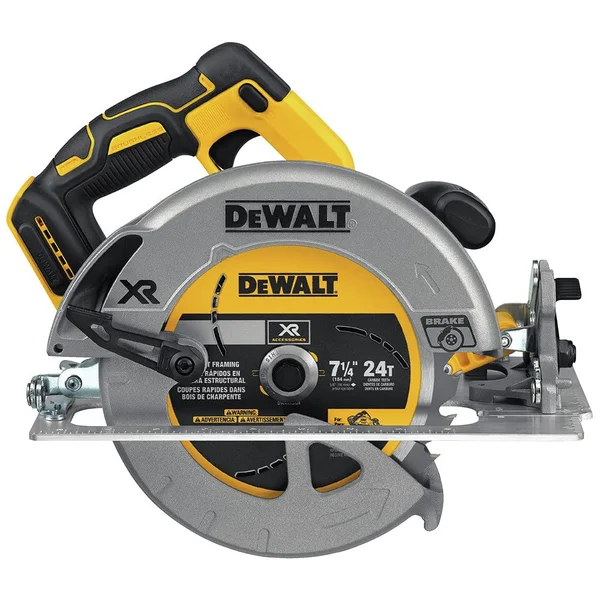 |
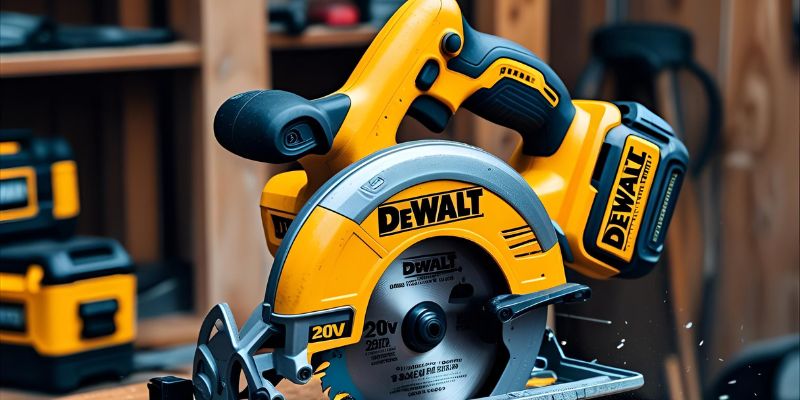
DeWalt DCS570B 20V MAX Circular Saw – $241.94 The 7-1/4 inch brushless model from this guide, built for framing lumber and deeper cuts than the smaller DCS391B.
|
A DeWalt 20V battery circular saw is a cordless tool that cuts wood, and with the right blade, thin metal or plastic, using a spinning carbide-tipped blade. It runs on a 20-volt lithium-ion battery instead of a cord, which matters most when you’re working somewhere without easy outlet access – a deck, a shed build, or a job site. DeWalt’s two main 20V MAX models are the DCS570B (7-1/4 inch blade, 5,500 RPM under load, brushless motor with electric brake) and the DCS391B (6-1/2 inch blade, 5,150 RPM), each suited to different cutting depths.
The saw is portable and strong enough for real framing work – it will cut a 2×4 in a couple of seconds and rip plywood sheets cleanly with a sharp blade. It’s also generally safer to operate than a corded saw around a job site, since there’s no cord to trip over or accidentally cut through.
Why Choose a DeWalt 20V Circular Saw?
- No cord required: work anywhere a battery reaches, without running an extension cord.
- Lightweight: both models weigh roughly 7 to 8.2 pounds bare, which is manageable for one-handed cuts on smaller stock.
- Enough power for framing: DeWalt rates the DCS570B’s brushless motor to hold 5,500 RPM under load, which is what lets it cut a 2×4 without bogging down.
- Real runtime: DeWalt lists roughly 330 crosscuts through 2×4 pine on a single charge for the DCS570B with a 5.0Ah battery – enough for a full afternoon of framing for most DIYers.
The trade-offs: the battery can run low mid-project on a big job, so a second battery is worth having, and the tool-plus-batteries cost more up front than an equivalent corded saw.
Getting Started: What You Need
- The saw: DCS570B (tool only) for deeper cuts, or DCS391B for a lighter, cheaper option on smaller stock.
- Battery: a 5Ah or 6Ah pack for longer runtime between charges; a 2Ah pack works but needs more frequent swaps.
- Charger: DeWalt’s DCB115 fast charger brings a 5Ah pack back up in under an hour.
- Blade: a 40-tooth carbide-tipped blade for clean cuts in plywood; a 24-tooth blade cuts faster but leaves a rougher edge, better for framing lumber.
- Safety gear: safety glasses, hearing protection, and gloves that don’t have loose fabric near the blade.
- Practice stock: a couple of 2x4s or a scrap sheet of 3/4-inch plywood.
Comparing the DeWalt 20V Models
| Model | Blade Size | Weight (lbs) | RPM | Best For |
|---|---|---|---|---|
| DCS570B | 7-1/4 inch | 7.9 | 5,500 | Framing, decks |
| DCS391B | 6-1/2 inch | 7.0 | 5,150 | Plywood, small jobs |
| DCS573B (FlexVolt Advantage) | 7-1/4 inch | 8.2 | ~5,500 | Heavy-duty tasks |
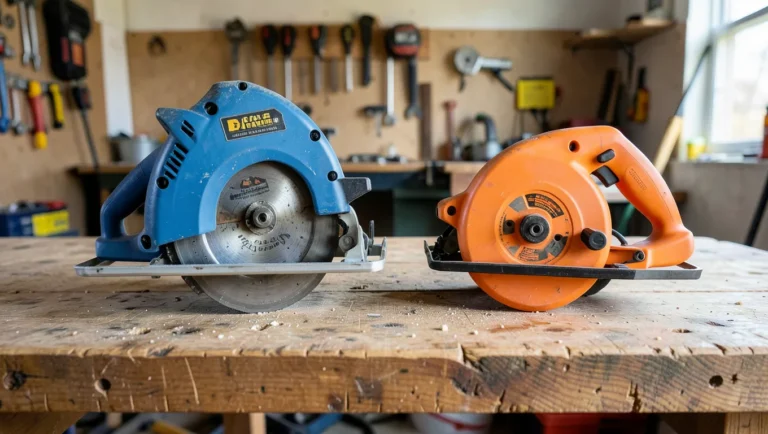
Choose the DCS570B for framing and deeper cuts; the DCS391B if you mostly cut plywood and thinner stock and want a lighter saw.
How to Use a DeWalt 20V Circular Saw
Step-by-Step Guide to Cutting
- Charge the battery: a 5Ah pack takes roughly 45 minutes to an hour on DeWalt’s fast charger.
- Pick the right blade: a 40-tooth blade for clean cuts on plywood or finished lumber.
- Support the wood: clamp it to a workbench or set it across two sawhorses so the offcut can fall free of the blade.
- Set the cutting depth: adjust so the blade extends about 1/4 inch below the bottom of the material – deep enough to cut through, not so deep it’s unsafe.
- Mark the cut line: use a pencil and a speed square for a straight, visible line.
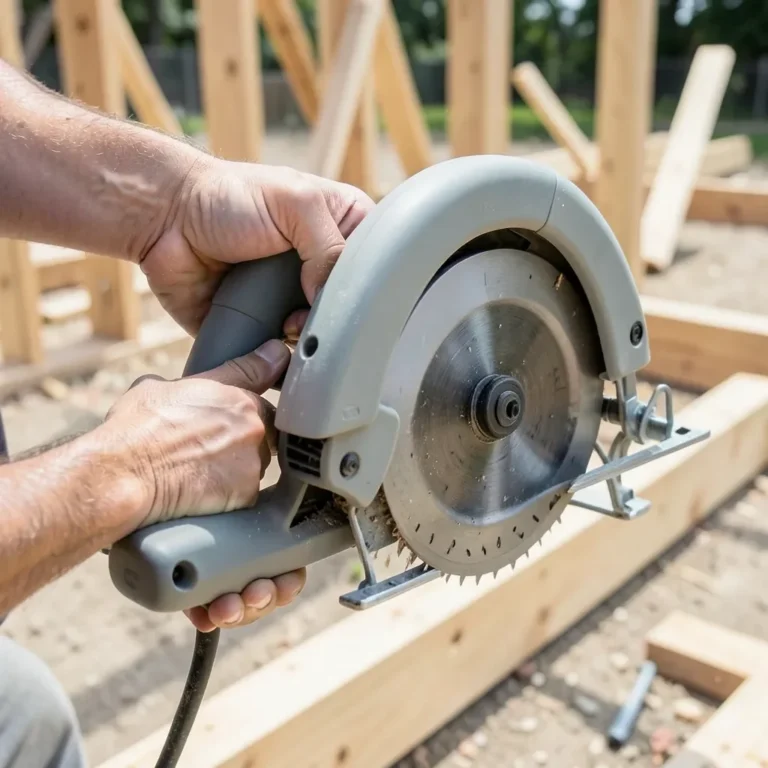
- Make the cut: brace the saw’s base plate on the material before starting the trigger, then guide it along the line at a steady pace – don’t force it.
- Check the edge: a clean, splinter-free edge means the blade and feed rate were right for the material.
Two Beginner Projects to Practice On
Project 1: Simple Birdhouse
- Materials: 1/2-inch plywood, exterior wood screws, wood glue.
- Cuts: four 6×6-inch squares for the walls, two 8×6-inch pieces for the roof, and a 2-inch entry hole (drilled, not sawn).
- Assembly: screw and glue the pieces together, then sand the edges smooth.
Project 2: Small Bookshelf
- Materials: 3/4-inch plywood, wood screws, paint or finish of your choice.
- Cuts: two 24×12-inch side panels and three 12×12-inch shelves.
- Assembly: screw the shelves between the sides, then sand and finish.
- Tip: a 24-tooth blade cuts faster through plywood if you’re making several rip cuts.
Tips for Better Results
- Keep the blade sharp: a dull blade burns the wood and makes rough, wandering cuts. Swap it every few months with regular use.
- Keep a spare battery charged: for anything beyond a quick cut, a dead battery mid-project is the most common complaint in owner reviews.
- Practice on scrap first: get a feel for the trigger and feed rate before cutting your actual project material.
- Don’t force the saw: pushing too hard is the most common cause of kickback. Let the blade do the work at a steady, even pace.
Common Mistakes and Fixes
| Mistake | Fix |
|---|---|
| Crooked cuts | Use a straightedge or saw guide clamped to the material. |
| Battery dies fast | Upgrade to a 5Ah or larger battery pack. |
| Blade binds mid-cut | Slow down and check that the wood isn’t pinching the blade as the cut closes. |
Benefits and Drawbacks
Benefits
- Portable: no cord means no extension cord to run or trip over.
- Fast: the DCS570B’s 5,500 RPM brushless motor cuts a 2×4 in seconds.
- Versatile: handles wood, and with the correct blade, thin metal or plastic sheet.
Drawbacks
- Battery cost: extra 5Ah batteries typically run $50 to $100 each.
- Less power than 60V models: DeWalt’s FlexVolt 60V saws (like the DCS578B) cut thick hardwood more easily than the 20V line.
- A learning curve: it takes a few cuts to get comfortable holding a straight line freehand.
If You Need More (or Less) Power
For thicker hardwood or all-day framing, DeWalt’s 60V FlexVolt saw (DCS578B) cuts more easily but is heavier and costs more. For light-duty jobs, the 6-1/2 inch DCS391B is lighter, cheaper, and enough saw for most trim and plywood work.
Getting the Most from Your Saw
For a full day of framing or deck work, plan on at least two batteries so one can charge while the other is in use – a 5Ah pack holds up well for hours of cutting on 2×6 stock. Double-check your measurements before every cut; it’s a lot cheaper to re-measure than to re-buy a board. Clean sawdust out of the blade guard after each job so the retracting guard keeps moving freely, since a gummed-up guard is a common cause of the blade sticking open.
Cost-Saving Tips
| Tip | How It Saves Money |
|---|---|
| Buy tool-only | Reuse batteries you already own from other DeWalt 20V tools. |
| Buy a blade multi-pack | Multi-packs cost less per blade than buying one at a time. |
| Watch for kit bundles on sale | A saw-plus-battery kit is often cheaper than buying the tool and battery separately. |
Frequently Asked Questions
What is the best DeWalt 20V battery circular saw for beginners?
The DCS391B is a good starting point. It’s lighter than the 7-1/4 inch models and well suited to plywood and 2×4 cuts. Pair it with a 5Ah battery for longer runtime between charges.
How long does the battery last?
A 5Ah battery is rated for roughly 330 crosscuts through 2×4 pine on the DCS570B, which typically covers several hours of on-and-off cutting depending on the material. Keep a second battery charged for bigger jobs.
Can it cut metal or plastic?
Yes, with the right blade – a metal-cutting blade for thin aluminum, or a fine-tooth blade for plastic sheet. Always wear eye and hearing protection when switching materials.
How do I keep cuts straight?
Mark a clear line with a pencil and square, then guide the saw along a clamped straightedge rather than freehanding it. Go at a steady pace and let the blade do the work instead of pushing.
Is it safe for kids to use?
No. A circular saw is not a tool for children to operate unsupervised. Teenagers learning under direct adult supervision should always wear safety glasses and hearing protection and follow the same safety steps as an adult user.
What’s the difference between the 6-1/2 and 7-1/4 inch models?
The 6-1/2 inch DCS391B is lighter and better suited to thinner material. The 7-1/4 inch DCS570B cuts deeper, which matters for framing lumber and thicker stock.
Conclusion
A DeWalt 20V battery circular saw covers most DIY and light framing cuts without a cord in your way. Pick the DCS391B if you mostly cut plywood and trim, or the DCS570B if you need more depth for framing lumber. Start with scrap wood to get a feel for the trigger and feed rate before moving on to an actual project.
Sponsored / affiliate links. As an Amazon Associate I earn from qualifying purchases. I may earn additional commission from eligible campaigns.