Best Circular Saw: 7 Top Picks Tested by Specs and Reviews
A circular saw is the one power tool almost every woodworking and home-improvement project eventually needs — breaking down sheet goods, framing a wall, or making a quick rip cut a table saw can’t reach. But “best circular saw” means something different depending on whether you’re framing a deck, building furniture, or picking up your first saw at all. This guide compares seven current, widely available circular saws across the specs that actually affect a cut — cutting depth, bevel range, motor power, weight, and blade size — and cross-references manufacturer data against verified buyer reviews from Amazon, Home Depot, and independent tool-review sites to sort out which saw fits which job.
Picks were chosen by comparing published cutting capacity and power specs side-by-side, then weighing that against aggregated buyer sentiment on retailer listings and professional tool-review sites — not in-house lab testing. See our compact circular saw picks if you specifically need a smaller, lighter saw for trim and one-handed work; this guide covers full-size 7-1/4″ saws for general woodworking and framing — see our circular saw size guide if you are unsure which blade diameter fits your project.
Quick Picks
Best Overall
the most well-rounded corded saw here, with pro-grade build quality and a bevel range wide enough for almost any cut.
$172
Best Value / Budget Pick
the best balance of low price, low weight (8.8 lbs), and a genuinely useful electric brake.
$149
Best Cordless
it matches a 15A corded saw for power while cutting the cord entirely, with up to 750 cuts per charge.
$224–$300 (bare tool to kit)
Best for Beginners
it’s the lightest full-size saw here (7 lbs bare), affordable, and rated highly for ergonomics by professional reviewers.
$134
How These Circular Saws Are Grouped
Rather than ranking seven saws on one scale, we grouped them by the situation they actually fit best, since the right circular saw depends heavily on whether you need corded reliability, cordless freedom, framing torque, or just an affordable saw for occasional use. The seven categories below cover the situations a home woodworker or weekend framer is most likely to run into:
- Best Overall: Makita 5007MG
- Best Value / Budget Pick: DeWalt DWE575SB
- Best Cordless: Milwaukee M18 FUEL 2732-20
- Best for Beginners: Ryobi ONE+ HP PBLCS300B
- Best Worm Drive: SKILSAW SPT77WML-01
- Best Budget Corded: SKIL 5280-01
- Best Cordless for Heavy Cutting: DeWalt DCS578B FlexVolt
Circular Saw Comparison Table
All seven saws below use the same 7-1/4″ blade size, which keeps depth-of-cut comparisons apples-to-apples. Prices are approximate and reflect typical online pricing at the time of research — check current listings before buying.
| Model | Blade Side | Depth (90°/45°) | Bevel Range | Motor | Weight | Power | Price | Verdict |
|---|---|---|---|---|---|---|---|---|
| Makita 5007MG Best Overall |
Left | 2-1/2″ / 1-3/4″ | 0–56° (stops at 22.5° & 45°) | 15A, 5,800 RPM | 10.6 lbs | Corded | $172 | The all-around benchmark corded sidewinder — smooth power and a wide bevel range in a magnesium body built to outlast a jobsite. |
| DeWalt DWE575SB Best Value / Budget Pick |
Right | 2-9/16″ / 1-7/8″ | 57° (stops at 22.5° & 45°) | 15A, 5,200 RPM | 8.8 lbs | Corded | $149 | The lightest full-size corded saw in its class, with a brake and a wide bevel range for less money than most premium sidewinders. |
| Milwaukee M18 FUEL 2732-20 Best Cordless |
Right | 2-1/2″ / 1-7/8″ | 50° | 18V brushless, 5,800 RPM | 9.05 lbs (bare tool) | Cordless (18V) | $224–$300 (bare tool to kit) | Corded-saw cutting power without the cord — the cordless pick that doesn’t feel like a compromise on a jobsite. |
| Ryobi ONE+ HP PBLCS300B Best for Beginners |
Right | 2-7/16″ / 1-3/4″ | 0–56° | 18V brushless | 7.0 lbs (bare tool) | Cordless (18V) | $134 | Light, affordable, and forgiving to learn on — the easiest on-ramp into a first full-size circular saw. |
| SKILSAW SPT77WML-01 Best Worm Drive |
Left | 2-3/8″ / 1-15/16″ | 53° | 15A Dual-Field, 5,300 RPM | 11.5 lbs | Corded | $198 | Worm-drive torque and in-line blade tracking in the lightest worm-drive body Skilsaw makes — built for ripping and framing all day. |
| SKIL 5280-01 Best Budget Corded |
Right | 2.43″ (2-7/16″) / 1.93″ (1-15/16″) | 51° (stop at 45°) | 15A (2.5 HP), 5,300 RPM | 8.7 lbs | Corded | $59 | The cheapest saw here by a wide margin, with a laser guide and dust blower most budget saws skip entirely. |
| DeWalt DCS578B FlexVolt Best Cordless for Heavy Cutting |
Right | 2-9/16″ / 2″ | 57° (stops at 22.5° & 45°) | 60V MAX brushless, 5,800 RPM | 8.2 lbs (bare tool) | Cordless (60V MAX FlexVolt) | $196–$269 (bare tool) | FlexVolt battery muscle that matches corded cutting depth and bevel range without a cord in the way. |
Full Reviews: 7 Circular Saws Worth Buying
Best Overall: Makita 5007MG
Best Overall • Approx. $172
Makita 5007MG 7-1/4″ Magnesium Circular Saw
| Blade / Power | 7-1/4″ • Corded |
| Cutting Depth | 2-1/2″ at 90° / 1-3/4″ at 45° |
| Bevel Range | 0–56° (stops at 22.5° & 45°) |
| Weight | 10.6 lbs |
- Magnesium construction keeps it light (10.6 lbs) without feeling flimsy
- 15-amp motor at 5,800 RPM has power to spare for dimensional lumber and sheet goods
- Wide 0–56° bevel range with positive stops at 22.5° and 45°
- LED light and dust blower keep the cutline visible
- Corded, so it’s less convenient for overhead cuts or tight spaces than a cordless saw
- Costs more than comparable non-magnesium sidewinders
The 5007MG is Makita’s flagship corded sidewinder, and it earns the top spot here because it doesn’t ask you to compromise on anything specific — it just does most jobs well. Owners consistently describe it as reliable, accurate, and easy to track a line with, and the magnesium shoe and upper guard shave real weight off the tool without the flex you sometimes get from stamped steel.
It’s the right pick for anyone doing repeated framing, subfloor, or sheet-goods cuts who wants a saw that stays predictable cut after cut rather than one built around a single standout feature. The 15-amp motor doesn’t bog down in doubled-up 2x lumber, and the electric brake stops the blade almost the instant you release the trigger, which speeds up repetitive cutting.
Its one real drawback is the same one every corded saw has: it’s tied to an outlet, and the added weight of the magnesium castings makes it less nimble for quick overhead or awkward-angle cuts than a smaller cordless saw. If most of your cutting happens at a bench or sawhorses rather than up a ladder, that trade-off is easy to accept.
Best Value / Budget Pick: DeWalt DWE575SB
Best Value / Budget Pick • Approx. $149
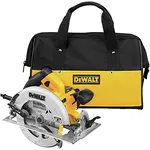
DEWALT DWE575SB 7-1/4″ Lightweight Circular Saw with Electric Brake
| Blade / Power | 7-1/4″ • Corded |
| Cutting Depth | 2-9/16″ at 90° / 1-7/8″ at 45° |
| Bevel Range | 57° (stops at 22.5° & 45°) |
| Weight | 8.8 lbs |
- At 8.8 lbs, it’s one of the lightest full-size 7-1/4″ saws you can buy
- 57° bevel capacity beats most saws in its price range
- Electric brake stops the blade almost instantly after release
- Backed by DeWalt’s 3-year warranty
- Plastic shoe flexes slightly more than the magnesium saws above it
- No LED worklight
The DWE575SB is the saw we’d point a budget-conscious buyer to first. It undercuts the Makita 5007MG by more than $20 while still cutting a deeper 2-9/16″ at 90° and offering a wider 57° bevel range with stops at both 22.5° and 45° — numbers that usually only show up on saws costing considerably more.
Reviewers and owners consistently mention the weight first: at 8.8 lbs it’s noticeably easier on the wrist during a long day of repeated cuts than most 10+ lb corded sidewinders, and the electric brake means less standing around waiting for the blade to coast to a stop between cuts.
It’s not the saw for someone chasing premium build materials — the shoe is stamped steel rather than magnesium and there’s no onboard LED — but for general framing, deck, and shop work where the budget matters as much as the spec sheet, it’s hard to beat.
Best Cordless: Milwaukee M18 FUEL 2732-20
Best Cordless • Approx. $224–$300 (bare tool to kit)
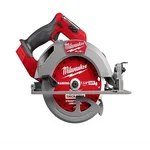
Milwaukee 2732-20 M18 FUEL 7-1/4″ Cordless Circular Saw
| Blade / Power | 7-1/4″ • Cordless (18V) |
| Cutting Depth | 2-1/2″ at 90° / 1-7/8″ at 45° |
| Bevel Range | 50° |
| Weight | 9.05 lbs (bare tool) |
- POWERSTATE brushless motor delivers cutting speed comparable to a 15A corded saw
- Up to 750 cuts per charge with the bundled 12.0Ah battery
- Magnesium shoe and aluminum body keep it tough but manageable at just over 9 lbs
- Shares batteries with the rest of the M18 lineup if you’re already invested in Milwaukee
- Bare tool price is high before you add a battery and charger
- 50° bevel range is narrower than the corded picks above
The 2732-20 is the saw that made us comfortable recommending cordless for more than light-duty cuts. Reviewers who tested it side-by-side with corded 15A saws found the cutting speed genuinely comparable, not just “good for a battery saw,” and the M18 FUEL platform’s 12.0Ah battery option pushes runtime up to roughly 750 cuts — enough for a full day of framing on most residential jobs. For the full breakdown of the 2732-20 against the newer 2834 and the rear-handle 2930, see our Milwaukee circular saw lineup guide.
See our full cordless circular saw buying guide for a breakdown of sidewinder vs worm-drive vs compact saws and which blade specs actually matter before you buy.
It’s built around the same magnesium-and-aluminum approach as Milwaukee’s other FUEL tools, so it holds up to repeated drops and dust exposure better than lighter plastic-bodied cordless saws, and the integrated dust port and rafter hook are genuinely useful rather than checkbox features.
The catch is cost: as a bare tool it’s priced close to some premium corded saws, and once you add Milwaukee’s larger-capacity batteries and a charger, a full kit runs well past $300. If you’re not already on the M18 platform, that’s a real consideration — but if cutting the cord matters more than saving money, this is the one to get. For the full breakdown of what that platform commitment costs across every major brand, see our battery-powered circular saw comparison.
Best for Beginners: Ryobi ONE+ HP PBLCS300B
Best for Beginners • Approx. $134

RYOBI ONE+ HP 18V Brushless Cordless 7-1/4″ Circular Saw
| Blade / Power | 7-1/4″ • Cordless (18V) |
| Cutting Depth | 2-7/16″ at 90° / 1-3/4″ at 45° |
| Bevel Range | 0–56° |
| Weight | 7.0 lbs (bare tool) |
- Lightest full-size 7-1/4″ saw in this guide at 7.0 lbs bare
- Tool-free depth and bevel adjustments make setup approachable for new users
- Rated highly for ergonomics and comfort in independent reviews
- Fits into the wider ONE+ battery ecosystem if you already own other Ryobi tools
- Dust extraction port design has been criticized for not capturing much dust
- Right-bladed design is less convenient for left-handed users
- Performs best with a larger 4Ah+ battery, which may cost extra
The PBLCS300B is our pick for anyone buying their first circular saw. It’s the lightest full-size saw in this comparison, tool-free depth and bevel adjustments mean there’s less to fumble with mid-project, and independent testers gave it strong marks specifically for ergonomics — the kind of thing that matters most to someone still building comfort and muscle memory with a power saw. See our step-by-step guide to setting blade depth and making a first cut on a Ryobi circular saw before your first project.
At around $134 for the bare tool, it’s also one of the more approachable prices here, and it draws from Ryobi’s large ONE+ battery platform, so if you already own other Ryobi tools you may not need to buy a battery at all. Reviewers noted the brushless motor represents a real step up from older Ryobi saws in both power and runtime.
The tradeoffs are minor for a beginner: the dust port doesn’t capture debris as well as some competitors, and it’s a right-bladed saw, which some left-handed users find less comfortable for sightlines. Neither is a dealbreaker for someone learning the basics of straight cuts and depth-setting on a manageable, lightweight saw. For a full walkthrough of blade attachment, depth and angle setup, and safe cutting technique, see our guide to using a skill saw.
Best Worm Drive: SKILSAW SPT77WML-01
Best Worm Drive • Approx. $190
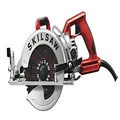
SKILSAW SPT77WML-01 15-Amp 7-1/4″ Lightweight Worm Drive Circular Saw
| Blade / Power | 7-1/4″ • Corded |
| Cutting Depth | 2-3/8″ at 90° / 1-15/16″ at 45° |
| Bevel Range | 53° |
| Weight | 11.5 lbs |
- Considered the lightest worm-drive saw on the market at 11.5 lbs
- 15A Dual-Field motor with dual copper windings handles dense lumber without bogging down
- In-line worm-drive design tracks straighter on long rip cuts than most sidewinders
- Strong price-to-quality ratio for a dedicated worm-drive saw
- Gears need regular lubrication, and oil should be added before first use
- Hard plastic handle instead of a rubber overmold
- No rip guide or dust port included
Worm-drive saws put the motor behind the blade instead of alongside it, which changes the balance and gearing in a way framers and rip-cut specialists tend to prefer — more low-end torque, better tracking on long straight cuts, and a blade on the left side that gives right-handed users a clear sightline. The SPT77WML-01 packages that layout into what’s widely regarded as the lightest worm-drive saw currently sold, at 11.5 lbs versus the 13–15 lbs typical of older worm-drive designs.
Owners and reviewers describe the cut quality as accurate, smooth, and stable, crediting the dual-field motor’s dual copper windings for RPM that doesn’t sag in doubled lumber or engineered beams. For repeated ripping of sheet goods or framing lumber, that combination of torque and lighter weight is exactly why worm-drive saws remain a jobsite standard in some regions even as sidewinders dominate elsewhere.
The tradeoff is maintenance and features: worm-drive gearing needs occasional oiling to stay quiet, and this model skips extras like a rip guide or dust port that come standard on some sidewinders. If you’re doing occasional cuts around the shop, a sidewinder is simpler to live with — but if ripping lumber all day is the job, the SPT77WML-01 is built for exactly that.
Best Budget Corded: SKIL 5280-01
Best Budget Corded • Approx. $59
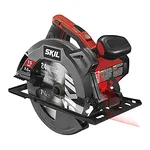
SKIL 5280-01 15 Amp 7-1/4″ Circular Saw with Single Beam Laser Guide
| Blade / Power | 7-1/4″ • Corded |
| Cutting Depth | 2.43″ (2-7/16″) at 90° / 1.93″ (1-15/16″) at 45° |
| Bevel Range | 51° (stop at 45°) |
| Weight | 8.7 lbs |
- By far the lowest price in this comparison at around $59
- Single-beam laser guide helps hold a straight line without extra layout marking
- Spindle lock and on-tool wrench storage speed up blade changes
- Integrated dust blower keeps the cutline and laser visible
- Thinner base plate that some users report bends more easily than pricier saws
- Laser is harder to see in bright daylight and can drift out of alignment over time
- No electric brake
The 5280-01 exists to answer one question: how cheap can a genuinely usable 7-1/4″ circular saw be? At around $59 it undercuts every other saw in this guide by a wide margin, yet it still delivers a real 15-amp motor, a 2.43″ cutting depth at 90°, and a laser guide that most competitors at this price skip entirely. For a closer look at amp ratings, blade sizes, and more picks in this exact price range, see our budget circular saw buying guide.
User feedback is largely positive on core performance — owners report clean cuts, adequate power for typical DIY deck and furniture projects, and appreciate the dust blower keeping both the cutline and laser visible while cutting. It’s a reasonable choice for occasional use, a first tool purchase, or a backup saw to keep around the shop.
It shows its price in the details: the base plate is thinner and some owners report it bending under pressure, the laser can be hard to see outdoors in direct sun and may need periodic realignment, and there’s no electric brake to stop the blade quickly between cuts. For light and occasional work it’s a legitimate value pick; for daily job-site use, step up to the DWE575SB above.
Best Cordless for Heavy Cutting: DeWalt DCS578B FlexVolt
Best Cordless for Heavy Cutting • Approx. $196–$269 (bare tool)
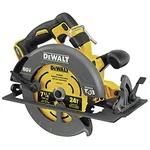
DEWALT DCS578B FLEXVOLT 60V MAX Brushless 7-1/4″ Cordless Circular Saw
| Blade / Power | 7-1/4″ • Cordless (60V MAX FlexVolt) |
| Cutting Depth | 2-9/16″ at 90° / 2″ at 45° |
| Bevel Range | 57° (stops at 22.5° & 45°) |
| Weight | 8.2 lbs (bare tool) |
- Matches the corded DWE575SB’s 2-9/16″ cutting depth and 57° bevel range on battery power
- Up to 47% more power than DeWalt’s previous-generation 60V saw
- Handles LVL beams and thick plywood without bogging down, per independent testing
- FlexVolt batteries also power DeWalt’s 60V miter saws, table saws, and other outdoor equipment
- Sold as a bare tool; FlexVolt batteries and charger are a significant additional cost
- Some users report the 9.0Ah battery runs shorter than expected under heavy load
The DCS578B represents a different approach to cordless power than the smaller-battery saws above: it runs on DeWalt’s FlexVolt 60V MAX system, which is also what powers DeWalt’s cordless table saws and miter saws. That extra voltage translates directly into cutting depth and bevel range that match the corded DWE575SB spec-for-spec — 2-9/16″ at 90° and a full 57° bevel — numbers most cordless saws can’t touch.
Independent testing found it handles LVL beams and thick plywood without bogging down, putting it in the upper tier of cordless circular saws for framing-grade work rather than light trim cuts. If you’re already invested in DeWalt’s FlexVolt platform for other tools, adding this saw doesn’t mean buying into a new battery ecosystem.
The catch is cost and battery draw: it’s sold bare, and FlexVolt batteries large enough to make the most of this saw’s power add real money to the total price. A few users also found the largest 9.0Ah battery didn’t quite deliver the runtime they expected under sustained heavy cutting. If corded-level performance without a cord is the priority and you don’t mind the battery investment, it delivers. If you would rather stay on the standard 20V MAX platform instead of adding FlexVolt batteries, see our full DeWalt DCS570 review for a lighter, lower-cost saw that still includes the electric brake.
If none of the seven above fit your specific cutting needs — for example, cutting concrete board, tile backer, or metal roofing rather than wood — blade choice matters more than saw choice. The same diamond-blade principle applies if you’re cutting tile with a circular saw instead of backer board. See our guide to the best circular saw blade for concrete or our breakdown of woodworking circular saw blades for guidance on matching a blade to the material.
How We Picked These Saws
We did not run these saws through in-house lab testing with instrumented cut-time measurements. What we did instead: pulled published manufacturer specifications for cutting depth, bevel range, motor power, and weight directly from Makita, DeWalt, Milwaukee, Ryobi, and SKIL/Skilsaw’s own product data, then cross-referenced that against aggregated buyer feedback on Amazon, Home Depot, and independent power-tool review sites (Pro Tool Reviews, Tool Box Buzz, and similar outlets that do publish hands-on testing) to see whether real-world sentiment matched the spec sheet. Where a claim in this guide is about lived experience — like a laser guide drifting out of alignment, or a saw feeling front-heavy — that came from that review and buyer-feedback research, not from us running the saw ourselves.
The practical criteria we weighed, in rough order of importance for a woodworking-focused audience:
- Cutting capacity: depth of cut at 90° and 45°, since this determines what stock thickness and bevel angles a saw can actually handle in one pass.
- Power: amperage for corded saws, voltage and brushless-motor status for cordless saws.
- Ergonomics and weight: lighter saws reduce fatigue on repeated cuts and matter more for overhead or one-handed work.
- Value: price relative to the feature set, not just the lowest sticker price.
- Verified user-review sentiment: recurring themes across retailer and independent reviews — both praise and recurring complaints.
Circular Saw Buying Guide
Corded vs. Cordless
Corded saws like the Makita 5007MG and DeWalt DWE575SB still offer an edge in sustained power and never run out of charge mid-cut, which matters for long ripping sessions or all-day framing. Cordless saws like the Milwaukee M18 FUEL and DeWalt FlexVolt DCS578B have closed most of the performance gap in recent years thanks to brushless motors, and they win on mobility — no cord to manage on a ladder, roof, or scaffold. If your work is mostly stationary (a shop or driveway), corded usually wins on cost-per-cut. If you move around a jobsite or work where outlets are inconvenient, cordless is worth the battery investment.
Blade Size: 6-1/2″ vs. 7-1/4″
All seven saws in this guide use a 7-1/4″ blade, which is the standard full-size circular saw blade and cuts deep enough to get through 2x dimensional lumber at a bevel in one pass. Compact saws use a smaller 6-1/2″ or 5-1/2″ blade, trading some cutting depth for lower weight and a smaller kerf (the width of material the blade removes) — useful for trim work, thinner sheet goods, or one-handed cutting. If you need that smaller, lighter format, see our separate compact circular saw picks rather than the full-size saws reviewed here.
Bevel and Depth Capacity for Common Woodworking Cuts
Standard 2×4 and 2×6 dimensional lumber is easily within reach of every saw in this guide at 90°, but check the 45° depth figure specifically if you’re cutting beveled edges on thicker stock — that measurement drops meaningfully on every saw compared to a straight 90° cut, and it’s where saws with a wider bevel range (like the DWE575SB or DCS578B at 57°, versus the Milwaukee 2732-20 at 50°) pull ahead. A rip cut (with the grain) and a cross cut (across the grain) put different demands on a blade’s tooth count and kerf (see our 7-1/4 circular saw blade guide for how tooth count changes cut quality), which is a separate consideration from the saw itself. If you want more control on repeated rip cuts without buying a dedicated table saw, some woodworkers mount their circular saw upside-down in a stationary base — see our guide to turning a circular saw into a table saw for the build steps. For a full breakdown of when the extra cost and shop space of a dedicated table saw are worth it instead, see our circular saw vs table saw comparison.
Sidewinder vs. Worm Drive
A sidewinder (also called an in-line saw) mounts the motor directly beside the blade, making it lighter, more compact, and the more common format for general woodworking — five of the seven saws here, including the Makita 5007MG and both Ryobi and Milwaukee cordless picks, are sidewinders. A worm-drive saw, like the SKILSAW SPT77WML-01, mounts the motor behind the blade at a right angle, using worm gears that trade some top-end speed for more low-end torque and better tracking on long rip cuts — a format favored by framers on the West Coast in particular. For most furniture-scale woodworking, a sidewinder is the simpler, lighter choice; for repeated ripping of framing lumber or sheet goods, worm-drive torque earns its extra weight.
Blade Side: Left vs. Right (Why It Matters for Visibility)
Circular saws are built with the blade mounted on either the left or right side of the motor housing, and this isn’t just a manufacturing quirk — it changes what you can actually see while cutting. On a right-blade saw, a right-handed user’s line of sight to the cut mark is partially blocked by the motor body; on a left-blade saw, the blade sits closer to your eye line, so the cut mark and blade are easier to track without leaning over the tool. The trade-off flips for left-handed users, who often prefer right-blade saws for the same visibility reason.
There’s no universal “correct” side — it comes down to which hand you cut with and which saw you learned on. Of the seven saws above, the Makita 5007MG and SKILSAW SPT77WML-01 (a worm-drive, which is traditionally left-blade) put the blade on the left; the DeWalt DWE575SB, Milwaukee M18 FUEL 2732-20, Ryobi ONE+ HP PBLCS300B, SKIL 5280-01, and DeWalt DCS578B FlexVolt are right-blade. If you’re right-handed and haven’t used a circular saw much, it’s worth testing both orientations at a store before committing — the difference in comfort is noticeable in the first few cuts.
Safety Features Worth Checking For
- Electric brake: stops the blade within a second or two of releasing the trigger, rather than letting it coast — present on the Makita 5007MG, DeWalt DWE575SB, Milwaukee 2732-20, and DeWalt DCS578B in this guide — see our circular saw brake vs. no-brake comparison for real stopping-time data.
- Blade guard: a spring-loaded lower guard should retract smoothly on every saw and snap back fully after the cut; check this before first use on any saw.
- Spindle lock: holds the arbor still for one-wrench blade changes without a second tool, standard on all seven saws here.
- Anti-kickback / riving design: keep the blade’s bevel and depth locked at the setting you intend, and never force a saw through a cut faster than the motor wants to go — that’s the most common cause of kickback regardless of which saw you own.
Don’t own a table saw yet? Any of these circular saws can work as a temporary stand-in for one — see our guide on how to use a circular saw as a table saw for the clamp-and-guide method, plus the extra kickback precautions a makeshift setup needs that a stock anti-kickback design doesn’t cover.
For a wider view of how a circular saw fits alongside the rest of a woodworking shop’s saw lineup, see our circular saw hub, and if you’re specifically cutting plywood, our guide on choosing a circular saw blade for plywood covers tooth count and kerf selection in more depth.
Once you’ve picked a saw, how you store it matters too — see our guide on circular saw (skill saw) storage for wall-mount racks, cases, and blade-safety tips that keep it rust-free between cuts.
Frequently Asked Questions
What’s the difference between a sidewinder and a worm-drive circular saw?
A sidewinder mounts the motor directly in line with the blade, making it lighter and more compact — the more common format for general woodworking. A worm-drive saw mounts the motor behind the blade at a right angle through worm gears, adding weight but delivering more low-end torque and straighter tracking on long rip cuts, which is why framers ripping lumber often prefer it.
What blade size do I need: 6-1/2″ or 7-1/4″?
7-1/4″ is the standard full-size blade and what all seven saws in this guide use — it cuts deep enough to get through 2x dimensional lumber at a bevel in a single pass. A 6-1/2″ blade (used on compact saws) trades some cutting depth for lower weight and a narrower kerf, which suits trim work, thinner sheet goods, and one-handed cutting better than framing-depth material. For a full breakdown of small-saw options by blade size, weight, and cost, see our best small circular saw comparison.
Is a cordless circular saw powerful enough for framing and ripping?
Modern brushless cordless saws like the Milwaukee M18 FUEL 2732-20 and DeWalt FlexVolt DCS578B are rated by independent reviewers as comparable to 15-amp corded saws in cutting speed, and the DCS578B specifically matches corded cutting depth and bevel range. The main tradeoff isn’t cutting power anymore — it’s battery cost and runtime under sustained heavy use.
How deep can a circular saw cut, and does that matter for 2x lumber?
The seven 7-1/4″ saws in this guide cut between roughly 2-3/8″ and 2-9/16″ at 90 degrees, which comfortably clears a standard 2×4 or 2×6 (actual thickness 1-1/2″) even at a bevel. Depth matters most when bevel-cutting thicker stock, since the 45-degree depth figure drops meaningfully below the 90-degree figure on every saw.
Which circular saw is best for a beginner?
The Ryobi ONE+ HP PBLCS300B is our pick for a first circular saw: it’s the lightest full-size saw in this comparison at 7 lbs bare, uses tool-free depth and bevel adjustments, and independent reviewers rated it highly for ergonomics — all things that make a saw less intimidating to learn on.
Do I need a laser guide on a circular saw?
A laser guide, like the one on the SKIL 5280-01, can help hold a straight line without extra layout marking, but it’s a convenience feature rather than a necessity — most professional-grade saws in this guide skip it entirely and rely on the shoe’s cut-line notch instead. Laser guides can also be harder to see in bright daylight and may drift out of alignment with heavy use.
Final Verdict
For most woodworkers, the Makita 5007MG is the safest all-around pick if you don’t mind a cord, and the DeWalt DWE575SB is the smarter buy if budget matters more than the magnesium build. Going cordless no longer means giving up real cutting power — the Milwaukee M18 FUEL 2732-20 and DeWalt FlexVolt DCS578B both prove that — and if you’re buying your first saw at all, the lightweight, forgiving Ryobi PBLCS300B is the easiest one to learn on. Match the category to the job in front of you rather than chasing the single highest-spec saw, and any of these seven will serve a home shop or jobsite well. Once your saw arrives, see our guide on installing a circular saw blade before your first cut, especially for the correct arbor nut direction, which trips up a lot of first-time owners. If the spindle lock or blade guard ever seizes up on you, our guide on how to unlock a circular saw walks through all three lock mechanisms and how to free each one.
Sponsored / affiliate links. As an Amazon Associate I earn from qualifying purchases. I may earn additional commission from eligible campaigns.