Difference Between Sycamore And Maple: Key Genius Facts
The main difference between American Sycamore and Maple is their family and key features. Sycamore has distinctive camouflage-like, patchy bark and round, fuzzy seed balls. Maple has tighter, grooved bark and familiar winged “helicopter” seeds. In woodworking, Hard Maple is much harder and denser, ideal for flooring, while Sycamore is softer with a unique flecked grain.
Hello fellow makers! It’s Md Meraj, your friendly guide in the workshop. Today, we’re tackling a question that trips up even seasoned woodworkers: what’s the difference between sycamore and maple? It’s easy to get them mixed up. They both have light-colored wood and similar-looking leaves at a glance. This confusion can lead to choosing the wrong lumber for your project, affecting everything from durability to the final look.
But don’t worry! I’m here to clear things up for you. We are going to walk through the simple, can’t-miss differences between these two fantastic trees, both in the wild and on the lumber rack. By the end of this guide, you’ll be able to spot the difference like a pro and choose the perfect wood with total confidence. Let’s dive in!
Understanding the Family Tree: Are Sycamore and Maple Related?
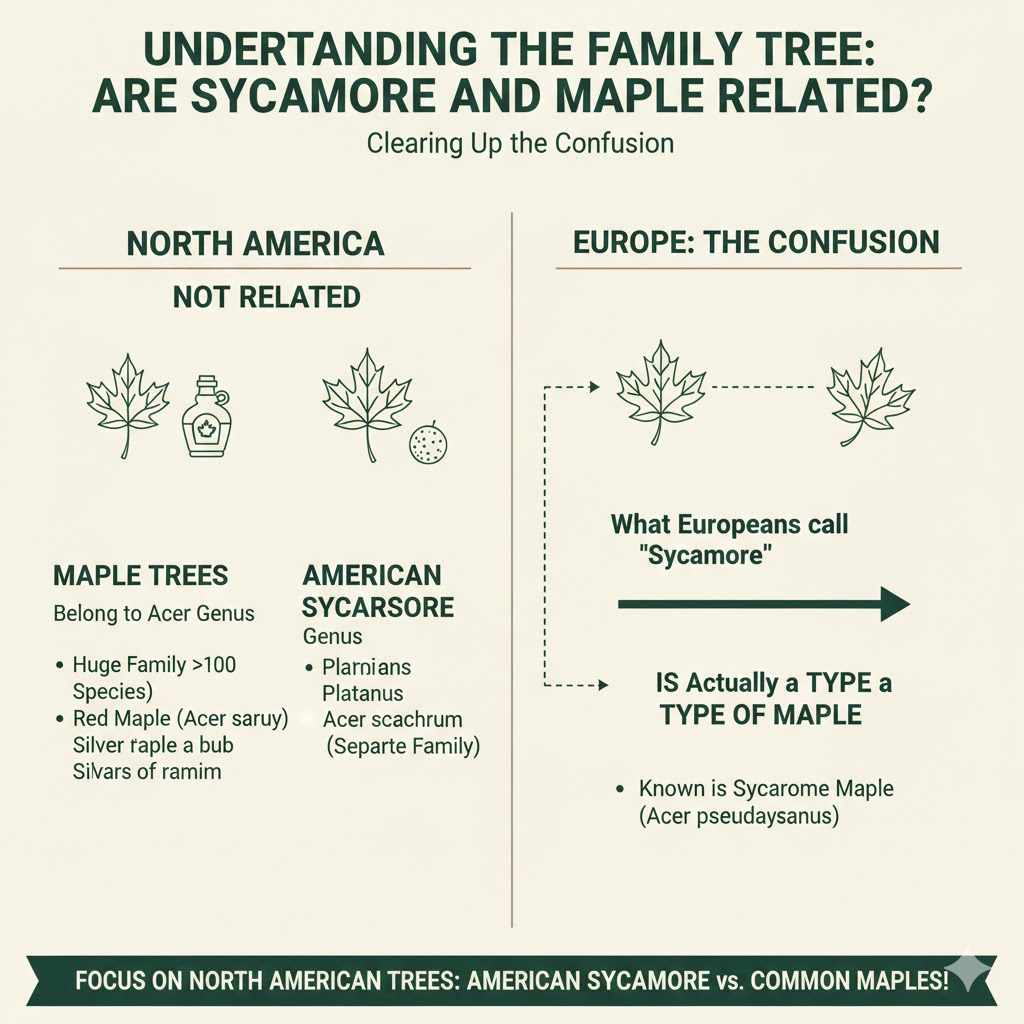
This is where the confusion starts, so let’s get it straightened out right away. In North America, the answer is no—they are not closely related. They belong to entirely different botanical families.
- Maple Trees belong to the Acer genus. This is a huge family with over 100 species, including familiar names like Sugar Maple, Red Maple, and Silver Maple.
- American Sycamore Trees belong to the Platanus genus, specifically Platanus occidentalis. This is a completely separate family.
So why the mix-up? The confusion often comes from Europe. In the United Kingdom and much of Europe, the tree they call a “Sycamore” is actually a type of maple (Acer pseudoplatanus), also known as the Sycamore Maple. Its wood and characteristics are very similar to other maples.
For this guide, we’ll focus on the North American trees that you’ll most likely encounter: the American Sycamore (Platanus occidentalis) versus common maples like the Sugar Maple (Acer saccharum). Knowing this key distinction is the first step to becoming a wood-identifying expert!
The Telltale Signs: How to Identify Sycamore vs. Maple in the Wild
Before the wood ever reaches your workshop, you can learn to spot these trees outdoors. Each has a few dead giveaways that make identification simple once you know what to look for. Think of it as being a detective for trees!
Bark: The Easiest Clue to Spot
The bark is often the fastest and most reliable way to tell these two apart from a distance.
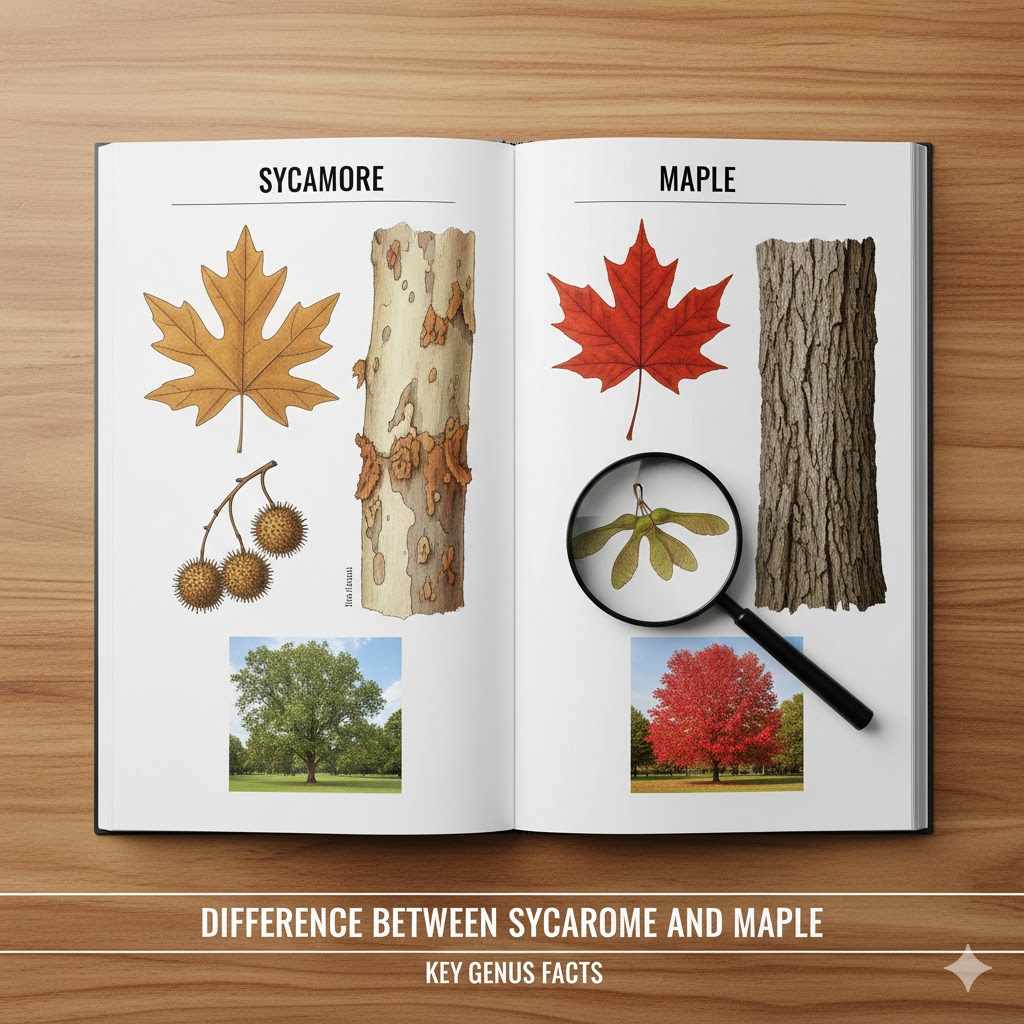
American Sycamore: The bark of a sycamore is its most famous feature. It has a beautiful, multi-colored camouflage pattern. The outer bark is grayish-brown and peels away in large, irregular patches, revealing a creamy white or pale yellow inner bark. This mottled, patchy look is unmistakable, especially on the upper trunk and larger branches. It looks like the tree is shedding its skin.
Maple: The bark on most mature maple trees is very different. On a Sugar Maple or Red Maple, the bark is typically grayish-brown, firm, and develops deep grooves or furrows as it ages. Some species, like the Silver Maple, have a shaggier bark that peels in long, thin strips, but it never has the multi-colored, patchy look of a sycamore.
Leaves: A Game of Points and Lobes
If you can get a close look at the leaves, you’ll see another clear difference. Both have lobed leaves, but the details are what matter.
Maple Leaves: Think of the Canadian flag! Most maple leaves have 3 to 5 distinct, pointed lobes with sharp, v-shaped valleys between them. The edges of the lobes are typically toothed or serrated. The overall shape is well-defined and sharp.
Sycamore Leaves: Sycamore leaves are also lobed, but they look broader and chunkier. They have 3 to 5 lobes, but the valleys between them are much shallower and wider. The points of the lobes are not as sharp as a maple’s. They have a coarser texture and are often much larger than maple leaves.
Seeds: Whirlybirds vs. Seed Balls
The seeds are another foolproof way to identify these trees. They couldn’t be more different!
Maple Seeds: Maples produce paired, winged seeds known as “samaras.” You probably played with these as a kid! They are the classic “helicopters” or “whirlybirds” that spin their way to the ground in the autumn.
Sycamore Seeds: Sycamores produce a completely different kind of seed vessel. It’s a single, dense, fuzzy ball about one inch in diameter that hangs from a long stalk. These seed balls stay on the tree through the winter before breaking apart into fluffy, individual seeds that are carried by the wind.
In the Workshop: Comparing Sycamore and Maple Wood
Okay, now for the part that matters most for our projects! Identifying the lumber on the rack is just as important. Both are considered hardwoods and have a lovely light color, but they behave very differently under our tools.
Appearance and Grain
At first glance, flat boards of maple and sycamore can look similar. They are both creamy white to a light golden tan. But the grain pattern tells the real story.
- Maple Wood: Maple, especially Hard Maple, is known for its incredibly fine, tight grain. The texture is uniform and smooth, with growth rings that are subtle. It has a clean, consistent appearance that’s perfect for a modern look. Maple is also famous for its stunning “figured” grain patterns like curly, quilted, and bird’s-eye maple, which are highly prized.
- Sycamore Wood: Sycamore also has a fine, even texture. However, its grain is often interlocked. This is not a flaw; it’s what gives sycamore its secret weapon! When sycamore is quartersawn (cut perpendicular to the growth rings), it reveals a beautiful and dramatic ray fleck pattern. This pattern looks like small, silvery ribbons or specks across the face of the board, sometimes called a “laced” or “leopard” grain. This makes it a fantastic decorative wood.
Hardness and Durability
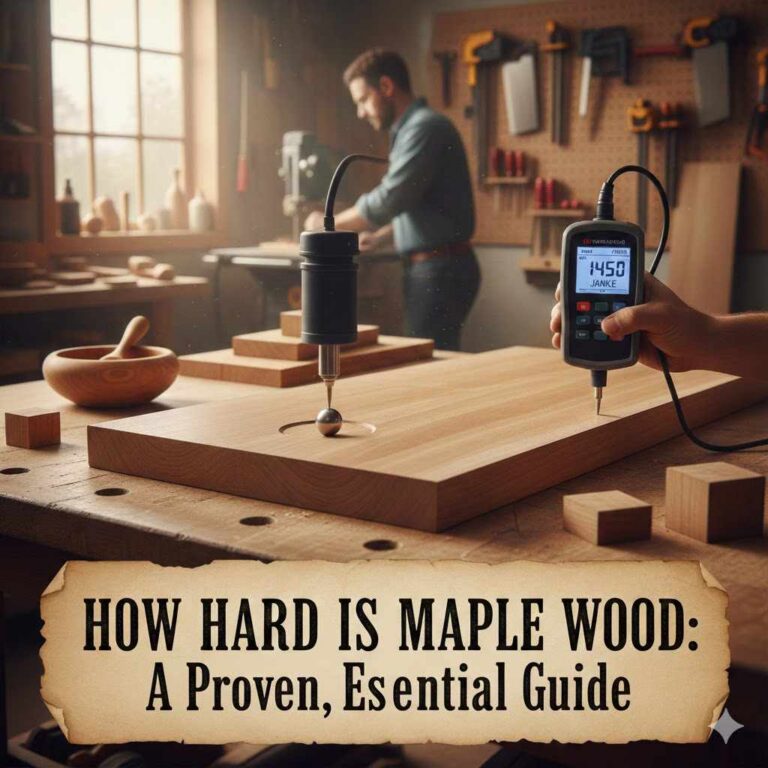
This is one of the biggest differences and will heavily influence what you use each wood for. We measure wood hardness using the Janka scale, which tests the force needed to embed a steel ball into the wood.
- Maple Wood: Hard Maple (Sugar Maple) is one of the toughest domestic hardwoods. It has a Janka hardness rating of around 1,450 lbf (pounds-force). This makes it incredibly resistant to dents, scratches, and wear. It’s a true workhorse. Soft maples, like Red Maple, are softer but still quite durable, typically around 950 lbf.
- Sycamore Wood: American Sycamore is significantly softer than hard maple, with a Janka hardness of about 770 lbf. This places it in the medium-density range. It’s still a durable hardwood, but it will dent and scratch more easily than hard maple. For reference, you can find Janka ratings for many species at the USDA Forest Service.
Workability and Finishing
How a wood behaves with your saws, planes, and sanders is a critical factor in any project.
Maple: Because of its extreme density, hard maple can be tough on tools. It requires sharp blades and can be prone to burning if you move too slowly with a router or table saw. The tight grain can also make it difficult to stain evenly, so using a pre-stain wood conditioner is highly recommended. However, once sanded, it takes on a beautiful, glass-smooth finish.
Sycamore: Sycamore is generally considered easier to work with than hard maple. It cuts, drills, and glues well. The main challenge comes from the interlocked grain, especially on quartersawn boards, which can be prone to tear-out during planing or routing. Using very sharp blades and taking shallow passes is key. It sands to a beautiful smooth surface and takes stain and finishes very nicely.
Side-by-Side Comparison: Sycamore vs. Maple At a Glance
Sometimes, a simple chart is the best way to see the differences. Here’s a quick reference guide to help you keep things straight.
| Feature | American Sycamore (Platanus occidentalis) | Hard Maple (Acer saccharum) |
|---|---|---|
| Tree Bark | Patchy, peeling, camouflage-like (gray, brown, and white) | Gray-brown, firm, with deep furrows on mature trees |
| Leaves | Large, broad lobes with shallow valleys | 3-5 sharp, pointed lobes with deep “V” shaped valleys |
| Seeds | Fuzzy, round seed balls that hang from a stalk | Paired, winged “helicopter” seeds (samaras) |
| Wood Color | Creamy white to light tan or reddish-brown | Creamy white to off-white, with a light golden hue |
| Grain Pattern | Fine, interlocked grain; strong ray fleck pattern on quartersawn faces | Very fine, tight, uniform grain; can have curly or bird’s-eye figures |
| Janka Hardness | ~770 lbf (Medium Hardness) | ~1,450 lbf (Very Hard) |
| Common Uses | Decorative veneer, boxes, furniture, turned items, butcher blocks | Flooring, cutting boards, workbenches, cabinets, musical instruments |
Common Uses: When to Choose Sycamore and When to Choose Maple
So, with all this new knowledge, which wood should you pick for your next project? It all comes down to what you’re making and what properties are most important.
Best Projects for Maple Wood
Choose maple when you need maximum durability, wear resistance, and a clean, bright look.
- Cutting Boards & Butcher Blocks: Hard maple is the king of cutting boards. Its hardness resists knife marks, and its closed-pore grain structure makes it food-safe and easy to clean.
- Flooring & Stair Treads: It can stand up to heavy foot traffic without denting or scratching easily.
- Workbench Tops: A hard maple workbench top can take a beating for decades and still stay flat and solid.
- Cabinetry & Fine Furniture: It provides a crisp, modern aesthetic and the strength needed for sturdy construction.
- Musical Instruments: The density and tonal qualities of maple make it a top choice for guitars (especially necks and tops), violins, and cellos.
Best Projects for Sycamore Wood
Choose sycamore when you want a unique, decorative grain pattern and a wood that’s a bit more forgiving to work with.
- Decorative Boxes & Inlays: Quartersawn sycamore’s ray fleck is stunning and adds an incredible visual pop.
- Veneer: The lacy grain pattern makes sycamore a popular choice for decorative veneers used in high-end furniture and architectural paneling.
- Furniture Parts: It’s great for parts that aren’t subject to extreme wear, like drawer sides, cabinet door panels, and small tables.
- Wood Turning: Sycamore is a favorite among woodturners. It turns smoothly on the lathe, creating beautiful bowls, vases, and other decorative objects.
- Traditional Butcher Blocks: Historically, sycamore was widely used for butcher blocks because it is tough, imparts no taste to the meat, and wears evenly without splintering.
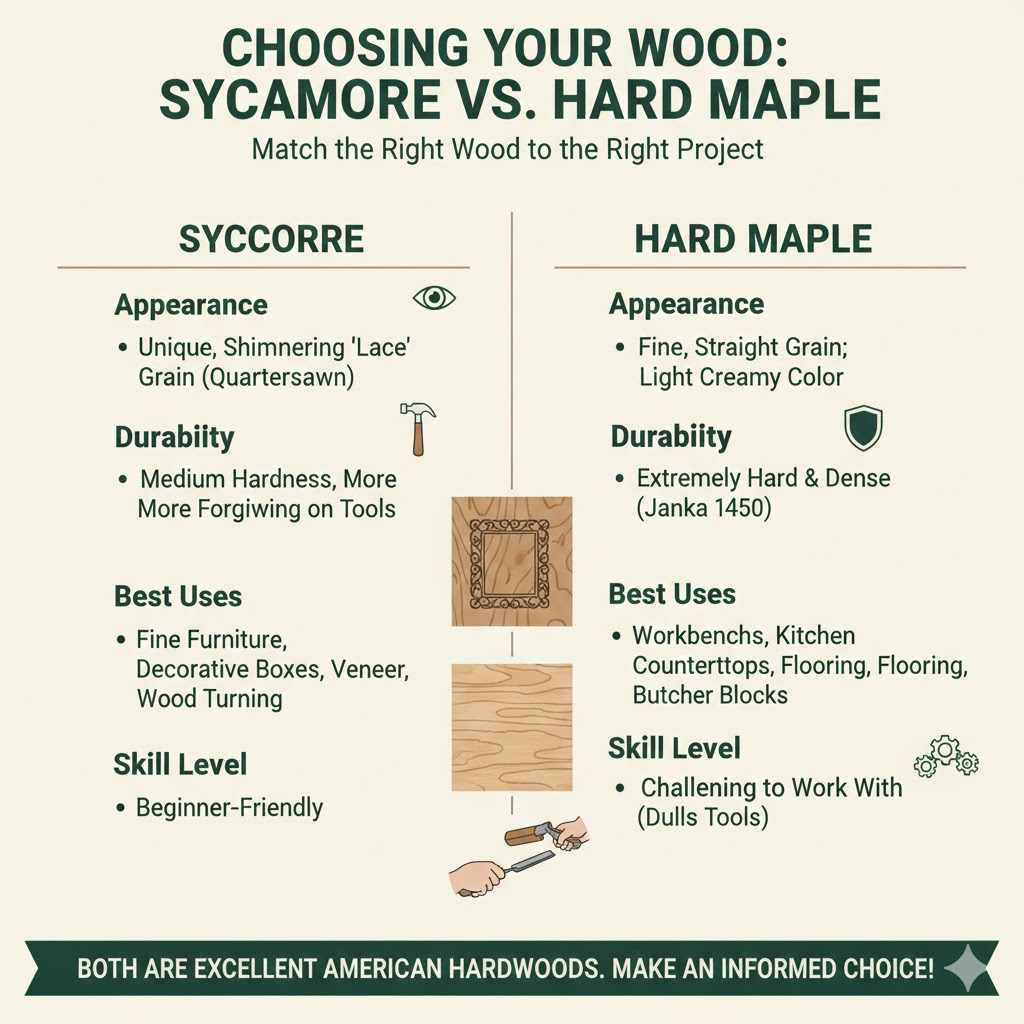
Putting It All Together: Making Your Choice
Deciding between sycamore and maple doesn’t have to be complicated. Now you have the tools to make an informed choice. Think about your project’s needs:
- Is durability paramount? If you’re building a workbench, a kitchen countertop, or a floor that will see a lot of action, Hard Maple is your best bet. Its incredible hardness is worth the extra effort it takes to work with it.
- Is appearance the main goal? If you want a piece that really stands out with a unique, shimmering grain, quartersawn Sycamore is an amazing choice. It will bring a touch of artistry to your work.
- What is your skill level? If you are newer to woodworking, you might find Sycamore a bit more friendly and forgiving on your tools than the ultra-dense Hard Maple.
Both are wonderful American hardwoods that will serve you well. By understanding their unique personalities, you can match the right wood to the right project every single time.
Frequently Asked Questions (FAQ)
Is sycamore a good wood for furniture?
Yes, sycamore is a great wood for furniture, especially for decorative pieces or parts that won’t see heavy abuse. Its beautiful flecked grain makes it perfect for cabinet panels, tabletops (with a protective finish), and decorative boxes. It’s durable enough for general use and is a pleasure to work with.
Which is harder, maple or sycamore?
Hard Maple is significantly harder than American Sycamore. Hard Maple has a Janka hardness rating of about 1,450 lbf, making it one of the hardest domestic woods. American Sycamore’s rating is around 770 lbf, which is still solid but much softer in comparison.
Do sycamore and maple trees both produce syrup?
No, only maple trees from the Acer genus can be tapped for sap to make syrup. The Sugar Maple is the primary source. The American Sycamore, being from the Platanus genus, does not produce the sugary sap needed for syrup production.
Can I use sycamore for a cutting board?
You can, and it has been used for traditional butcher blocks for centuries. However, for modern kitchen cutting boards, Hard Maple is the superior choice. Maple’s harder surface resists knife scoring better, and its tighter grain is considered more sanitary and easier to clean.
How can I tell the difference just by looking at the wood?
The easiest way is to look for the grain pattern on a quartersawn board. Sycamore will have a very distinct and prominent ‘lacy’ or ‘flecked’ pattern from the wood rays. Maple’s grain is much plainer and more uniform unless it is a figured piece like curly or bird’s-eye maple.
Is sycamore wood expensive?
Generally, American Sycamore is quite affordable and is often less expensive than Hard Maple. Its price is usually comparable to other domestic hardwoods like soft maple or poplar. Figured maples, however, are specialty woods and will be significantly more expensive than sycamore.
Conclusion: Craft with Confidence
There you have it! The mystery of sycamore versus maple is officially solved. What once seemed like two nearly identical trees now stand apart with their own unique personalities. From the sycamore’s patchy, artistic bark to the maple’s iconic helicopter seeds, and from the workhorse strength of maple wood to the decorative shimmer of sycamore, you now have the knowledge to tell them apart with ease.
The next time you’re planning a project or walking through the lumberyard, I hope you’ll feel a new sense of confidence. You can look at a board, understand its strengths, and know exactly how it will perform in your workshop. Choosing the right wood is the first step toward building something beautiful and lasting. Keep learning, stay curious, and as always, happy building!