Engineer Hammer vs Drilling Hammer: What’s the Difference
Sometimes, tool names can sound a lot alike, making it tricky to pick the right one for your job. The Engineer Hammer vs Drilling Hammer: What’s the Difference? is a common question for folks just starting out with tools. You might see them both and wonder if they really do different things.
Don’t worry, it’s not as complicated as it seems. We’ll break down exactly what makes them unique, step by step, so you can feel confident choosing the right hammer for your project.
Understanding Engineer Hammers
Engineer hammers, also known as blacksmith hammers or simply general-purpose hammers, are versatile tools designed for a wide range of tasks. Their primary purpose is striking, shaping, and breaking materials. They are often used in metalworking, construction, and general repair jobs.
The design of an engineer hammer typically features a balanced head, with one face generally flat and the other sometimes peened or rounded. This shape allows for controlled impact and the ability to bend or draw out metal. They are built to withstand repeated forceful blows, making them a staple in many workshops and toolboxes for their reliability and broad utility in everyday tasks.
The Design of Engineer Hammers
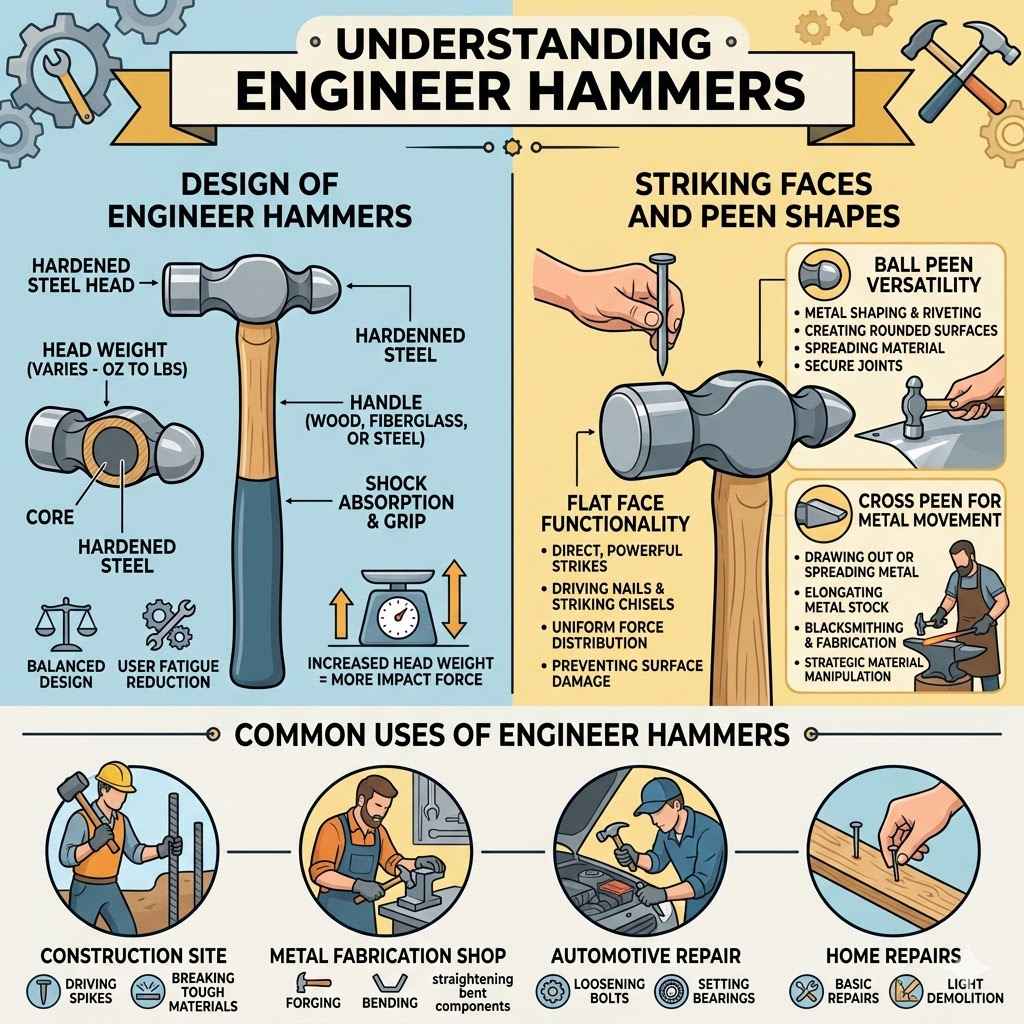
The head of an engineer hammer is usually made from hardened steel, providing durability and strength. The weight of the hammer head can vary significantly, from a few ounces to several pounds, depending on the intended application. A heavier head delivers more impact force, suitable for heavy-duty tasks like driving large nails or breaking concrete.
The handle is often made of wood, fiberglass, or steel, chosen for its ability to absorb shock and provide a comfortable grip. The balance between the head weight and handle length is crucial for efficient use and reducing user fatigue during prolonged work sessions.
The flat striking face is ideal for direct, powerful blows, much like driving a nail or shaping metal. The opposite end of the hammer head, known as the peen, comes in various shapes. A ball peen hammer, a common type of engineer hammer, has a rounded peen used for shaping metal, riveting, and creating a rounded surface.
A cross peen hammer has a wedge-shaped peen that is used for drawing out metal or spreading it. These different peen shapes highlight the versatility of engineer hammers for specific metalworking tasks beyond simple striking.
Striking Faces and Peen Shapes
The flat face of an engineer hammer is its most straightforward component. It provides a clean, even surface for striking objects like nails or chisels. The flatness ensures that the force is distributed uniformly across the striking area.
This is essential for driving fasteners straight and preventing damage to the surface being worked on. For general carpentry or demolition, this flat face is the workhorse, delivering a solid, predictable impact every time.
The peen is where the true versatility of many engineer hammers lies. A ball peen has a spherical end. This shape is perfect for peening rivets, which is a process of deforming the end of a rivet to create a secure joint.
It’s also used to shape metal, creating rounded surfaces or spreading material. Imagine working with sheet metal; the ball peen can gently curve edges or create decorative patterns. A cross peen, with its wedge shape, is designed to move metal.
When struck against metal, it can stretch or spread the material, allowing you to shape it into different forms. This makes it invaluable for blacksmithing and metal fabrication where precise material manipulation is key.
- Flat Face Functionality: The primary flat surface is designed for direct, powerful strikes. It’s the go-to for driving nails, striking chisels, or general demolition work where a solid, focused impact is needed. The flatness ensures a good contact area for maximum force transfer.
- Ball Peen Versatility: The rounded peen is excellent for metal shaping and riveting. It allows for precise control when creating rounded edges or securing fasteners. It’s a key feature for any metalworking enthusiast or professional.
- Cross Peen for Metal Movement: The wedge-shaped peen is used to spread or draw out metal. This is critical in blacksmithing for elongating or shaping metal stock. It offers a way to manipulate materials by strategically spreading their mass.
Common Uses of Engineer Hammers
Engineer hammers are incredibly useful in many different jobs. In construction, they are used for everything from driving large spikes to breaking apart tough materials. A carpenter might use one to set foundation stakes or to shape wood for specific fittings.
Metalworkers rely on them heavily for forging, bending, and shaping metal parts. They are essential for tasks like straightening bent components or creating decorative elements on metal objects. Even for basic home repairs, an engineer hammer can be your best friend for tasks like removing stubborn nails or light demolition.
Think about a blacksmith. They use a blacksmith’s hammer (a type of engineer hammer) to repeatedly strike hot metal on an anvil. This shaping process is fundamental to creating tools, decorative items, and repairs.
Another example is a mechanic who might use a ball peen hammer to set bearings or to shape small metal components. In a more general sense, you might use an engineer hammer for any task requiring a solid, controlled impact that goes beyond what a lighter hammer can achieve. Its robustness and varied head shapes make it adaptable to numerous situations.
Here’s a look at some typical scenarios:
- Construction Site: A worker needs to drive a large rebar stake into the ground. They use an engineer hammer with a heavy head to deliver the force needed to sink the stake deeply and securely.
- Metal Fabrication Shop: A craftsman is creating a custom bracket. They use the flat face of an engineer hammer to strike the metal against a die, shaping it into the required form, and then use the ball peen to round off sharp edges.
- Automotive Repair: A mechanic needs to remove a seized bolt. They might use a smaller engineer hammer to tap around the bolt head to loosen it, or to strike a chisel positioned against the bolt to help break it free.
Exploring Drilling Hammers
Drilling hammers, often called sledgehammers or drilling sledgehammers, are distinctly different from engineer hammers. Their primary function is to deliver immense, forceful blows, typically used in conjunction with a drill bit or chisel to break apart hard materials. They are designed for brute force applications where significant impact energy is required to penetrate or fracture stubborn substances like concrete, rock, or hardened earth.
The substantial weight and long handle of a drilling hammer are key features that amplify the kinetic energy delivered with each swing, making them the tool of choice for heavy-duty demolition and excavation tasks.
The Heavy-Duty Design of Drilling Hammers
The defining characteristic of a drilling hammer is its substantial weight. These hammers can range from a few pounds to over twenty pounds. This immense mass is concentrated in the hammer head, which is usually quite large and rectangular or slightly rounded.
The sole purpose of this weight is to generate maximum impact force. When swung with power, the head accrues significant momentum, which is then transferred to the object being struck.
The handle of a drilling hammer is typically much longer than that of an engineer hammer, often two to three feet in length. This longer lever arm allows the user to generate greater swing speed, further increasing the kinetic energy delivered by the hammer head. The handle is usually made of strong materials like fiberglass or steel to withstand the intense forces involved in its use.
Some handles may have rubber grips to provide better shock absorption and a more secure hold during powerful swings.
Weight and Handle Length Factors
The sheer weight of a drilling hammer is its most significant attribute. A heavier hammer means more mass is being accelerated. According to physics, kinetic energy is calculated as 0.5 mass velocity squared.
Therefore, increasing the mass directly increases the energy delivered upon impact. This is why drilling hammers are used for tasks requiring substantial force to overcome resistance, such as breaking through thick concrete slabs or stubborn rock formations where lighter hammers would simply bounce off or cause minimal damage.
The extended handle length is equally critical. A longer handle allows the user to achieve a higher velocity at the head of the hammer. Imagine swinging a short stick versus a long pole; the end of the pole can move much faster.
This increased velocity, when squared in the kinetic energy formula, contributes significantly to the hammer’s power. The combination of a heavy head and a long handle makes drilling hammers incredibly effective for heavy-duty demolition. However, this power comes at the cost of control and requires considerable physical strength and proper technique to use safely and effectively.
- Massive Head Weight: Drilling hammers possess a considerably heavier head than engineer hammers, ranging from 3 to 20+ pounds. This mass is essential for delivering powerful, penetrating blows.
- Extended Handle Design: The long handle (often 2-3 feet) enables users to generate higher swing speeds, boosting the hammer’s kinetic energy and impact force for heavy-duty tasks.
- Durability of Materials: Handles are typically constructed from robust materials like fiberglass or steel to withstand the high stresses and impacts associated with forceful swinging.
Applications of Drilling Hammers
Drilling hammers are specialized tools used for forceful impact applications. Their most common use is in conjunction with a concrete drill bit or a demolition chisel. The user will first use the drilling hammer to drive the bit or chisel into the material, creating a starting point or widening a crack.
Then, repeated, powerful blows from the drilling hammer advance the bit or chisel deeper, breaking apart the material. This is typical in construction demolition, excavation, and quarrying.
In road construction or repair, drilling hammers are used to break up old asphalt or concrete for removal. They are also employed in mining operations for breaking rock. For a homeowner undertaking a major renovation, like removing an old concrete patio, a drilling hammer would be the tool of choice for the heavy demolition work.
It is not a tool for delicate tasks; its purpose is to apply raw, unadulterated force to conquer resistant materials. The sheer power required means safety precautions, like wearing safety glasses and sturdy footwear, are absolutely paramount.
Consider these real-world applications:
- Demolishing a Concrete Driveway: To break up a thick concrete driveway for replacement, a worker would use a drilling hammer to drive a concrete chisel into the surface, fracturing it into manageable pieces.
- Creating a Trench in Hard Soil: For a gardening project that requires digging through very hard, compacted soil or breaking up rocky ground, a drilling hammer can be used with a pointed chisel to loosen the earth.
- Industrial Demolition: In large-scale construction demolition, drilling hammers are often used by crews to break down concrete walls, foundations, and slabs before heavy machinery can move in to clear the debris.
Key Differences Summarized
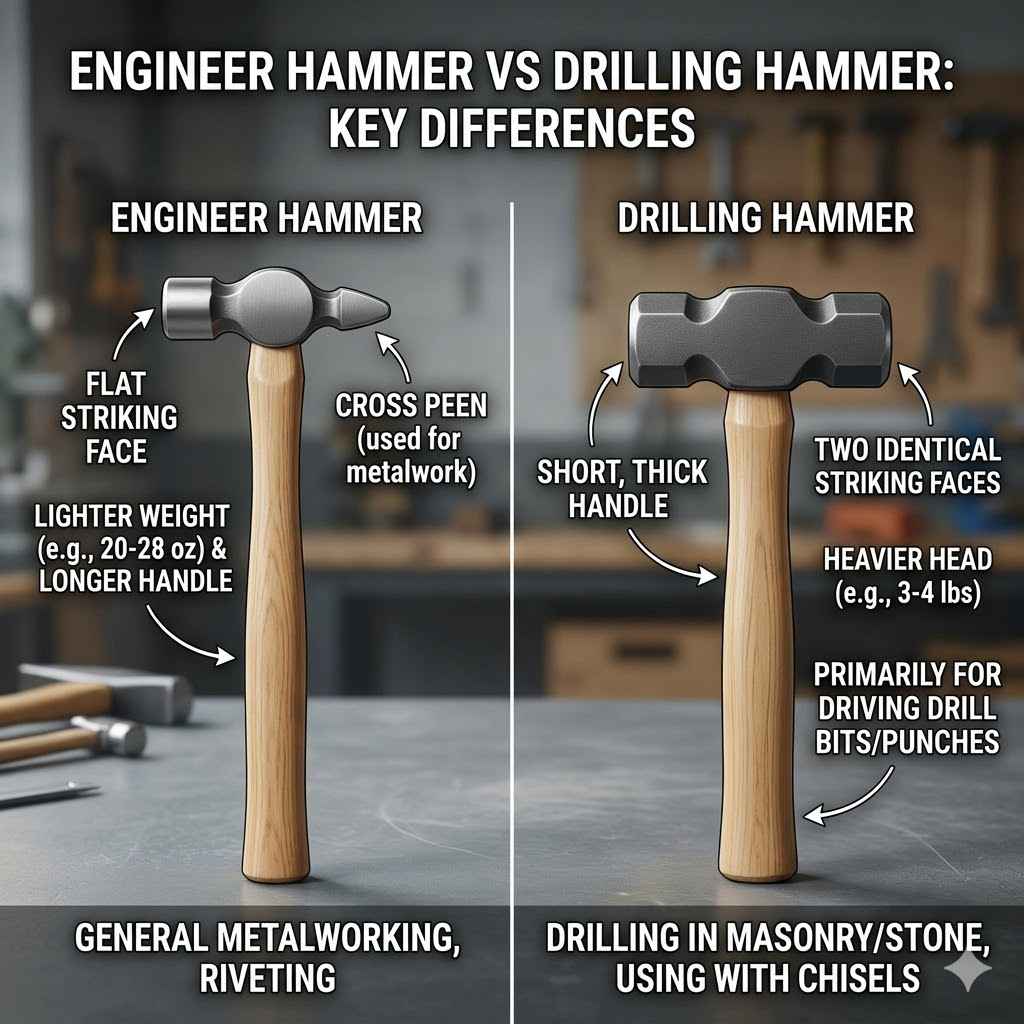
The main distinction between an engineer hammer and a drilling hammer lies in their intended use and design. An engineer hammer is a general-purpose tool for striking, shaping, and driving, offering a balance of force and control. It’s like a multi-tool for many common tasks.
A drilling hammer, on the other hand, is a heavy-duty tool built for brute force, designed specifically to break apart hard materials through sheer impact power. You wouldn’t use a drilling hammer to hang a picture, and you wouldn’t use an engineer hammer to break up a concrete floor.
The weight difference is enormous. Engineer hammers typically weigh between 1 to 3 pounds, while drilling hammers start around 3 pounds and can go much higher. The length of the handle also varies significantly, with drilling hammers having much longer handles to maximize swing speed and force.
The head shape also differs; engineer hammers often have peen ends for shaping, whereas drilling hammers have simpler, robust striking faces designed purely for impact. Understanding these core differences is key to selecting the right tool for any given job, ensuring efficiency and safety.
Weight and Size Comparison
The weight and overall size of these hammers are primary differentiators. An engineer hammer is designed to be wielded with one or two hands for controlled strikes, with weights typically in the 1-3 pound range. This allows for precise placement of blows and reduces user fatigue during extended use on less demanding tasks.
Their heads are proportionally sized to the handles, creating a balanced tool.
Conversely, a drilling hammer is characterized by its significant mass. The heads can weigh 3 pounds and often exceed 20 pounds. This substantial weight is the main factor in its ability to deliver high-impact force.
The long handle, typically 2-3 feet, complements this heavy head, allowing the user to generate considerable momentum. The sheer bulk and weight mean drilling hammers are usually swung with two hands and require considerable physical exertion. This stark contrast in size and weight directly dictates their respective applications.
| Feature | Engineer Hammer | Drilling Hammer |
|---|---|---|
| Typical Weight | 1-3 pounds | 3-20+ pounds |
| Head Shape | Flat face, often with a peen (ball, cross) | Heavy, robust striking face (rectangular or rounded) |
| Handle Length | Shorter, balanced | Longer (2-3 feet) |
| Primary Use | Striking, shaping, driving fasteners, general repair | Demolition, breaking hard materials, heavy impact |
Head Design for Purpose
The head design of each hammer is engineered for its specific role. Engineer hammers often feature a flat striking face combined with a peen. This peen, whether a ball, cross, or chisel shape, adds a layer of functionality beyond just impact.
It allows for shaping metal, peening rivets, or drawing out materials, making the engineer hammer a more versatile tool for craftspeople and mechanics.
Drilling hammers, however, have a head that is almost exclusively focused on delivering a powerful, blunt force. The striking surfaces are broad and designed to withstand repeated, heavy blows against extremely hard materials. There are no shaping features like peens.
The head is simply a dense mass optimized for penetration and fracture. This focused design emphasizes raw power over intricate manipulation, highlighting their specialized purpose in heavy demolition and excavation.
- Versatile Head on Engineer Hammer: The inclusion of a peen (ball, cross) on engineer hammers allows for metal shaping, riveting, and drawing out materials, expanding their utility beyond simple striking.
- Specialized Impact Head on Drilling Hammer: Drilling hammer heads are designed purely for delivering maximum blunt force. They are robust and simple, lacking any features for shaping or manipulation, emphasizing their demolition role.
- Impact vs. Shaping Focus: The engineer hammer’s head balances impact with shaping capabilities, whereas the drilling hammer’s head is singularly focused on generating and delivering immense impact energy.
Choosing the Right Hammer for the Job
Selecting the correct hammer is crucial for efficiency, safety, and the quality of your work. If you’re doing general carpentry, driving nails, or light metal shaping, an engineer hammer is your best bet. Its balanced weight and versatile head make it suitable for a wide array of tasks without being overly cumbersome.
For any task involving breaking apart concrete, stone, or very hard, compacted ground, a drilling hammer is the only appropriate choice. Attempting these jobs with an engineer hammer would be ineffective and could damage the tool. Always match the hammer’s capabilities to the demands of the project.
Using the right tool ensures the job gets done correctly and safely, preventing unnecessary strain or potential injury.
When to Use Which Hammer
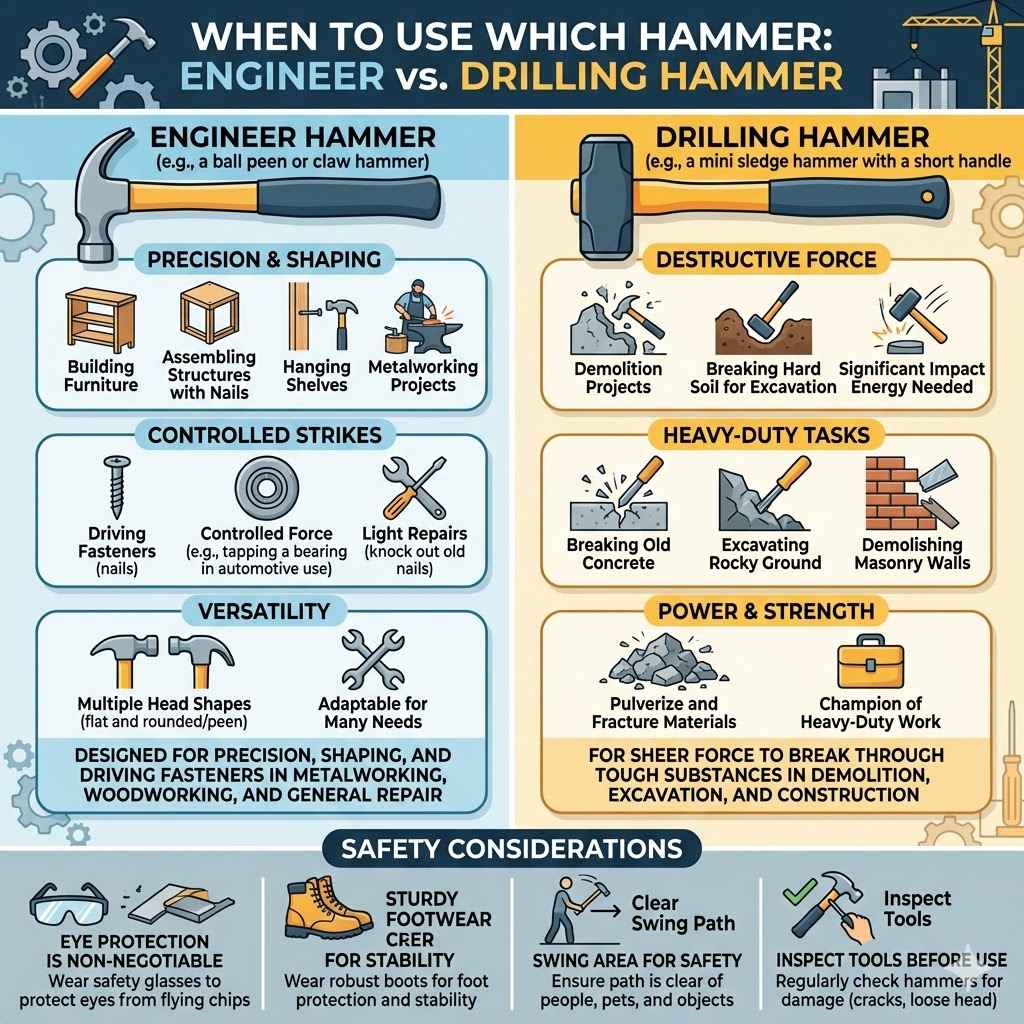
The decision to grab an engineer hammer or a drilling hammer hinges entirely on the nature of the work you need to accomplish. If your task involves precision, shaping, or driving fasteners, the engineer hammer is the tool of choice. Think about tasks like building furniture, assembling structures with nails, or performing repairs on metal components.
Its design prioritizes controlled strikes and the ability to manipulate materials with its varied head shapes.
On the flip side, when the job requires sheer destructive force to break through tough substances, the drilling hammer is indispensable. This includes demolition projects, breaking up hard soil for excavation, or any situation where significant impact energy is needed to overcome resistance. The power of a drilling hammer means it’s not suitable for fine work; its strength is in its ability to pulverize and fracture materials, making it the champion of heavy-duty tasks.
Engineer Hammer Scenarios
Imagine you’re a hobbyist metalworker. You need to create a curved piece of metal for a decorative project. You would use an engineer hammer, likely a ball peen, to gently shape the metal against an anvil.
Or perhaps you’re a carpenter building a deck; you’ll use the flat face of an engineer hammer to drive large nails into the wooden joists. Even for simple tasks like knocking a stubborn old nail out of a piece of wood, an engineer hammer can be very effective.
Consider a mechanic working on an engine. They might use a small engineer hammer to tap a bearing into place or use the peen to lightly shape a metal shim. These are all examples where control, moderate force, and sometimes shaping are required.
The engineer hammer’s balanced design and multiple head functions make it the preferred tool for such jobs. Its versatility allows it to adapt to many different needs without requiring multiple specialized tools for each one.
Here are some typical situations for an engineer hammer:
- Hanging Shelves: You need to drive a nail into a wall stud to hang a shelf. An engineer hammer provides the right amount of force for this common household task.
- Metalworking Projects: A blacksmith uses an engineer hammer to shape glowing metal on an anvil, turning a rough piece of steel into a functional tool or art piece.
- Automotive Maintenance: A mechanic might use a ball peen hammer to lightly tap a seal into place or to gently reshape a slightly bent metal component.
Drilling Hammer Scenarios
When you need to break through a concrete patio to install new landscaping, you’ll reach for a drilling hammer. You might first use a concrete chisel with the drilling hammer to score a line, then use repeated, forceful blows to shatter the concrete. Similarly, if you’re excavating a site with very hard, rocky soil, a drilling hammer with a pointed chisel attachment will be necessary to break up the ground effectively.
In a professional construction setting, crews use drilling hammers for large-scale demolition. They might be used to break down walls, foundations, or even sections of roads. The sheer power delivered by these hammers is essential for making significant progress on such demanding projects.
It’s important to remember that these hammers require significant physical effort and proper technique to use safely, making them a tool for specific, challenging applications.
Consider these examples for a drilling hammer:
- Breaking Old Concrete: Removing an old concrete sidewalk or patio requires the brute force of a drilling hammer to shatter the material into pieces.
- Excavating Rocky Ground: Digging a deep foundation in an area with dense, rocky soil can be made possible by using a drilling hammer with a rock chisel.
- Demolishing Masonry Walls: For projects involving the removal of brick or stone walls, a drilling hammer provides the necessary impact to break apart the structure.
Safety Considerations
Using any hammer requires attention to safety, but this is especially true for powerful tools like drilling hammers. Always wear safety glasses to protect your eyes from flying debris. Sturdy work boots are essential to protect your feet.
When using a drilling hammer, ensure you have a firm grip and a clear swing path. Maintain a stable stance to prevent loss of balance. If you are not physically capable of safely wielding a heavy drilling hammer, consider using a lighter one or seeking assistance.
For engineer hammers, the same eye protection is recommended, especially when striking metal or objects that might chip. Be mindful of your surroundings and ensure no one is in the path of your swing. Proper grip and technique will prevent hand injuries and make your work more efficient.
Always inspect your hammer before use; a damaged handle or head can lead to serious accidents.
- Eye Protection is Non-Negotiable: Always wear safety glasses or goggles when hammering to prevent injury from flying chips or fragments. This is critical for both types of hammers but especially for demolition tasks.
- Sturdy Footwear for Stability: Wear robust work boots to protect your feet and provide a stable base, especially when using heavy drilling hammers where balance is key.
- Clear Swing Area for Safety: Ensure your swinging path is clear of people, pets, and valuable objects. This is paramount for preventing accidental damage or injury.
- Inspect Tools Before Use: Regularly check hammers for any signs of damage, such as cracks in the handle or a loose head. A damaged tool can be dangerous and should be repaired or replaced.
Frequently Asked Questions
Question: Can I use an engineer hammer for light demolition?
Answer: Yes, for very light demolition tasks, like breaking apart small pieces of wood or plaster, an engineer hammer can be sufficient. However, for anything more substantial, like concrete or thick materials, a drilling hammer is necessary.
Question: What is the difference between a drilling hammer and a sledgehammer?
Answer: There is very little difference. A drilling hammer is essentially a type of sledgehammer specifically designed for use with drill bits or chisels to break materials. The terms are often used interchangeably for heavy-duty striking tools.
Question: Which hammer is better for shaping metal?
Answer: An engineer hammer, particularly a ball peen hammer, is much better for shaping metal. The peen end allows for precise manipulation and forming of metal without causing damage.
Question: Can I use a drilling hammer for general carpentry?
Answer: No, a drilling hammer is not suitable for general carpentry. It is too heavy and powerful for driving nails or typical woodworking tasks, and you would likely damage the wood or the nail.
Question: How do I choose the right weight for an engineer hammer?
Answer: The right weight depends on the task. Lighter hammers (1-1.5 pounds) are good for smaller nails and precision work. Heavier ones (2-3 pounds) are better for larger nails or when more impact force is needed, but still manageable with one or two hands.
Conclusion
The core difference between an engineer hammer and a drilling hammer is their purpose. Engineer hammers offer versatility for striking and shaping, while drilling hammers provide raw power for breaking tough materials. Choosing the right tool ensures your work is effective and safe.