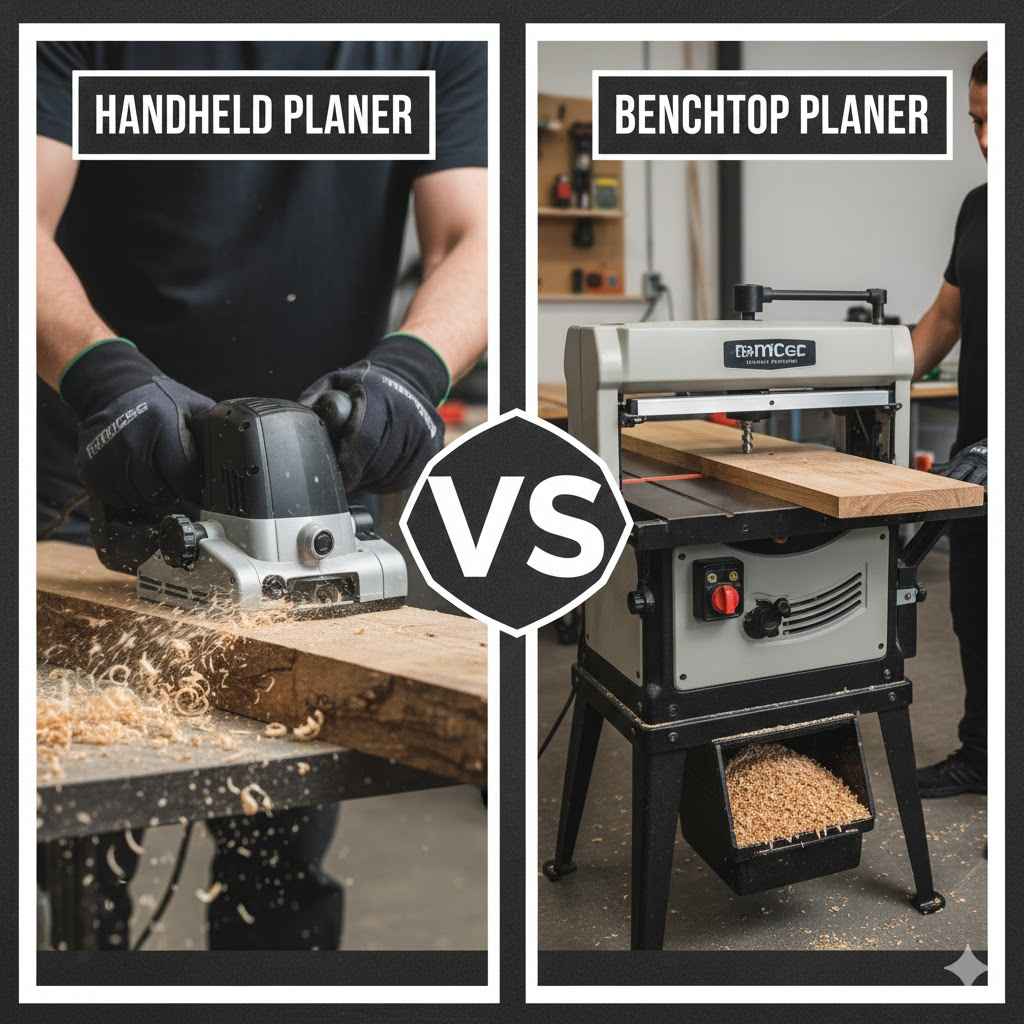
Handheld Planer Versus Benchtop: Which To Buy
Choosing between a handheld planer and a benchtop planer can be tricky, especially when you’re just starting out with woodworking. It feels like a big decision, and you want to get it right. But don’t worry!
We’re going to break down the Handheld Planer vs Benchtop: Which Should You Buy? question into simple steps. By the end, you’ll know exactly which one fits your needs best. Let’s get your project smoothed out.
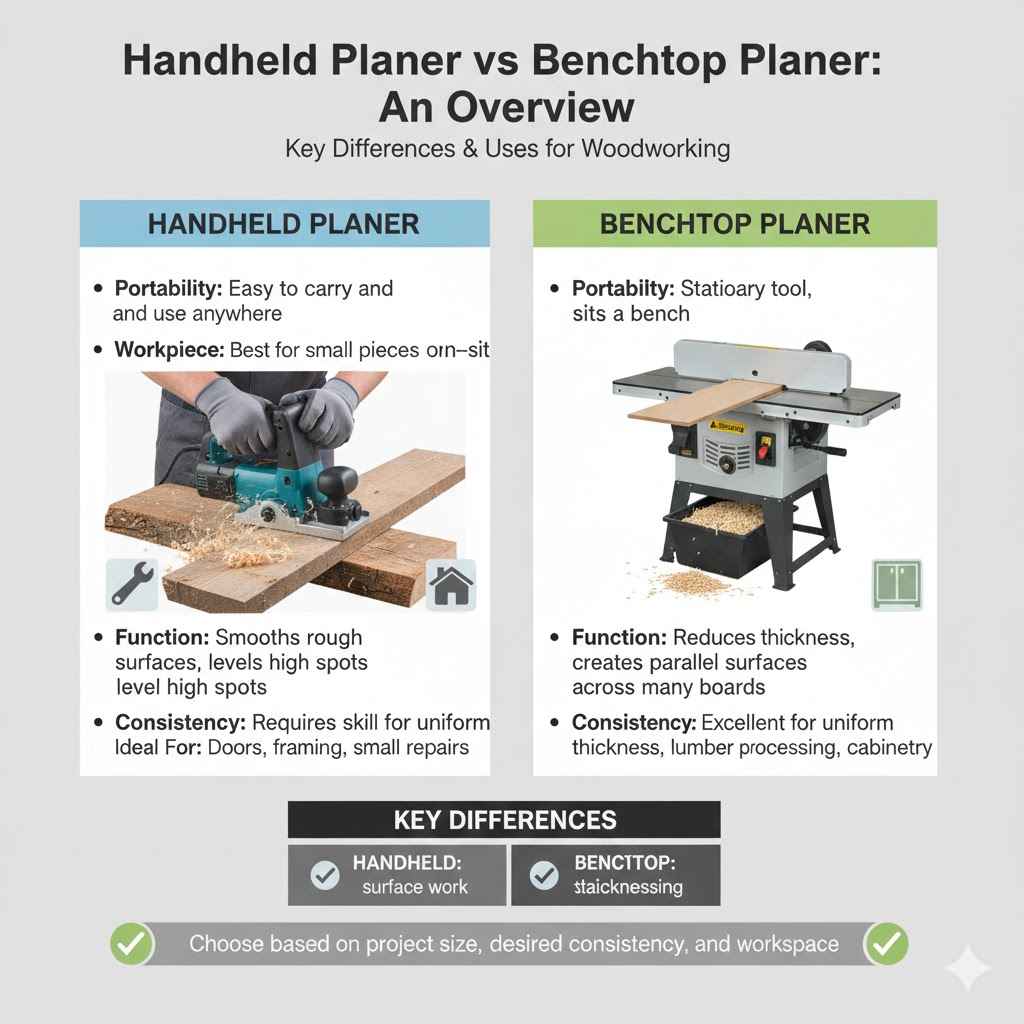
Handheld Planer vs Benchtop Planer An Overview
This section looks at the basic differences between handheld and benchtop planers. We’ll cover what each one is good for and who might prefer one over the other. Think of this as getting to know your tools before you pick them up.
We’ll talk about how they work and what makes them unique. This will help you see which one might be a better match for the kind of work you do or plan to do.
What Is A Handheld Planer
A handheld planer is a tool you hold in your hands. You move it across the surface of the wood. It’s like a big, powerful blade that shaves off thin layers of wood.
This makes rough wood smooth and flat. It’s great for smaller jobs or when you need to work on a piece of wood that can’t be moved to a workbench.
Handheld planers are usually electric. They have a motor that spins a sharp blade very fast. As you push the planer along the wood, the blade cuts away a small amount.
You can adjust how deep the blade cuts. This lets you control how much wood you remove. They are often lighter than benchtop models, making them easier to maneuver.
What Is A Benchtop Planer
A benchtop planer, also called a thickness planer, is a stationary tool. You place the wood onto its bed. The machine then pulls the wood through a set of blades.
It shaves off wood to make the surface flat and the thickness consistent. These are ideal for taking larger projects from rough lumber to smooth, ready-to-use pieces.
Benchtop planers are bigger and heavier. They typically have a wider cutting capacity than handheld versions. You set the thickness you want your wood to be, and the planer does the work.
This means you can process many boards to the exact same thickness without a lot of effort. They are often more powerful, allowing for quicker wood removal.
Key Differences At A Glance
The main differences are portability and capacity. Handheld planers are portable and good for on-site work or small tasks. Benchtop planers are stationary and better for processing larger amounts of wood to a consistent thickness.
Think about where and how you’ll be doing your woodworking.
- Portability A handheld planer is easy to carry anywhere. A benchtop planer stays in one place.
- Workpiece Size Handheld planers work best on pieces you can hold. Benchtop planers handle larger boards.
- Consistency Benchtop planers excel at making many pieces the exact same thickness. Handheld planers require more skill for perfect consistency.
Handheld Planer Pros And Cons
This section explores the good and not-so-good points of using a handheld planer. We’ll talk about why they are popular for certain tasks and when they might not be the best choice. Understanding these points helps you see if a handheld planer is the right fit for your woodworking projects.
Advantages Of Handheld Planers
Handheld planers are very versatile. You can take them to a job site or use them in tight spaces. They are good for shaving down doors that stick or smoothing out rough spots on furniture.
They are also generally less expensive than benchtop models.
Their compact size means they are easy to store. For beginners, they can be less intimidating than larger machines. You can get a feel for how planing works by using one on smaller projects.
- Portability Easily carried to different locations. This is perfect for contractors or DIYers who work on various sites. It means you don’t have to bring the wood to your shop.
- Cost Handheld planers are usually more affordable. This makes them a good entry-level tool for those on a budget. You can start woodworking without a huge investment.
- Maneuverability Great for working on irregular shapes or in tight spots. You can easily reach awkward areas that a benchtop planer cannot.
- Quick Fixes Ideal for small tasks like fitting trim or adjusting cabinet doors. They offer a fast solution for common household woodworking issues.
Disadvantages Of Handheld Planers
While great for many things, handheld planers have limits. It takes practice to get perfectly flat surfaces. You might get tired from holding and moving the tool.
They also can’t handle very wide boards.
Getting a consistent depth of cut over a large area can be challenging. You might also experience more tear-out, which is when the wood splinters, especially on figured wood.
- Consistency Challenges Achieving perfectly flat and consistent thickness can be difficult. This is due to hand movement and the tool’s nature. It requires a lot of skill to get professional results on large surfaces.
- Fatigue Holding and guiding the tool for extended periods can lead to physical tiredness. This is especially true when working on larger pieces or for longer durations.
- Limited Width Capacity Handheld planers can only plane boards of a certain width. They are not suitable for processing wide lumber like tabletops or large panels efficiently.
- Surface Quality While they smooth wood, the finish might not be as fine as from a benchtop planer. You might need additional sanding.
Real-Life Example
Sarah was renovating her old house. One of her antique doors wouldn’t close properly because it was rubbing against the frame. She didn’t want to remove the entire door.
She used her handheld planer to shave a small amount off the edge of the door. Within minutes, the door closed perfectly. This saved her a lot of time and effort compared to trying to adjust the frame.
Benchtop Planer Pros And Cons
Here, we examine the benefits and drawbacks of using a benchtop planer. These tools are workhorses for many woodworkers. We will explore why they are favored for certain tasks and when they might not be the best fit.
This will help you decide if a benchtop planer is the right investment for your workshop.
Advantages Of Benchtop Planers
Benchtop planers are excellent for making wood perfectly flat and the same thickness. They save you a lot of time and effort. You can process lumber much faster than with a handheld tool.
They provide a professional finish.
They are ideal for dimensioning rough lumber into usable stock for projects like furniture or cabinets. The consistent results mean less waste and more predictable outcomes.
- Precision and Consistency Benchtop planers excel at producing flat and uniformly thick lumber. This is vital for projects where exact dimensions are important, like cabinet doors or furniture parts.
- Speed and Efficiency They can plane boards much faster than handheld models. This is a big advantage when working with a lot of wood or preparing multiple pieces.
- Surface Finish The blades on benchtop planers often provide a smoother finish. This reduces the amount of sanding needed afterward.
- Capacity They can handle wider boards than most handheld planers. This makes them suitable for milling larger pieces of wood.
Disadvantages Of Benchtop Planers
Benchtop planers are not portable. They take up valuable shop space. They can also be more expensive than handheld planers.
They are not practical for on-site work.
If you only have a few small tasks, a benchtop planer might be overkill. You also need a stable workbench or stand for it.
- Lack of Portability Benchtop planers are stationary tools. They cannot be easily moved to different locations. This limits their use to your workshop.
- Space Requirement They require a dedicated space in your workshop. This can be an issue for those with limited workspace.
- Cost Benchtop planers are generally more expensive than handheld versions. The initial investment can be significant.
- Not for On-Site Jobs They are impractical for tasks that need to be done away from your shop, like fitting a door in someone’s house.
Sample Scenario
Mark is building a dining table. He bought rough-cut lumber from a local sawmill. He needs to mill all the boards to the exact same thickness and ensure their surfaces are flat and smooth.
He uses his benchtop planer to quickly process each board. This gives him perfectly dimensioned lumber that fits together beautifully for his table.
Handheld Planer vs Benchtop Which Should You Buy
Now that we’ve looked at each type, let’s directly answer the main question. We will help you decide which planer suits your needs best. Consider your typical projects, your budget, and the space you have available.
This section will guide you through the decision-making process.
Who Needs A Handheld Planer
A handheld planer is a good choice if you are a beginner woodworker. It’s also great for DIY enthusiasts. It is perfect for small home improvement tasks.
This includes trimming cabinet doors, smoothing rough edges, or fitting trim. If you don’t have a dedicated workshop or work on various sites, a handheld planer is practical.
If your budget is limited, a handheld planer is a more accessible option. It allows you to start performing planing tasks without a large financial commitment. It’s a tool for quick fixes and small jobs.
- Beginners and DIYers If you are new to woodworking or do occasional home projects, a handheld planer is a good starting point. It’s less complex and easier to learn on.
- Limited Budget For those who need to keep costs down, handheld planers offer effective planing capabilities at a lower price.
- Mobile Woodworkers If you work on different job sites or don’t have a fixed workshop, a portable planer is essential.
- Small Task Enthusiasts For tasks like shaving down sticky doors, fitting trim, or rounding edges, a handheld planer is efficient and convenient.
Who Needs A Benchtop Planer
A benchtop planer is for serious woodworkers. If you frequently work with rough lumber and need flat, parallel surfaces. It’s ideal for building furniture, cabinets, or anything requiring precise dimensions.
If you have a dedicated workshop and value efficiency, this is the tool for you.
If you often process many boards to the same thickness, a benchtop planer will save you significant time and effort. It ensures accuracy and a professional finish for your projects.
- Serious Hobbyists and Professionals If woodworking is a significant hobby or your profession, a benchtop planer is a must-have for efficient lumber milling.
- Furniture Makers and Cabinet Builders Those who create items requiring high precision and consistent material thickness will benefit greatly.
- Users Processing Rough Lumber If you regularly buy rough-sawn lumber and need to dimension it, a benchtop planer is essential.
- Those Valuing Time Efficiency For anyone who wants to speed up their workflow and get more done in their shop, a benchtop planer is a key tool.
Comparison Table
Here’s a simple table to help you compare at a glance.
| Feature | Handheld Planer | Benchtop Planer |
|---|---|---|
| Portability | High | Low |
| Cost | Lower | Higher |
| Best For | Small jobs, on-site fixes | Dimensioning lumber, consistent thickness |
| Space Needed | Minimal | Dedicated space |
| Ease of Use (Beginner) | Moderate | High (once set up) |
| Consistency | Requires skill | High |
Common Planer Terms Explained
To help you understand more about these tools, we will explain some common terms. Knowing these words will make it easier to choose the right planer and use it effectively. We want you to feel confident with your choice.
Depth Of Cut
The depth of cut refers to how much wood the planer blades remove with each pass. You can adjust this setting on both handheld and benchtop planers. A smaller depth of cut is generally better for achieving a smoother finish and for working with harder woods.
A larger depth of cut removes more material quickly but can lead to a rougher surface or put a strain on the motor.
For instance, if you need to remove only a thin layer to flatten a warped board, you would set a shallow depth of cut. If you are taking rough lumber down to a specific thickness, you might start with a slightly deeper cut and then make subsequent passes with shallower cuts.
A common statistic for many consumer-grade benchtop planers is a maximum depth of cut of around 1/8 inch (about 3mm) per pass. However, this can vary greatly depending on the motor power and the type of wood. Always check your tool’s manual for its specific capabilities.
Feed Rate
Feed rate is how fast the wood moves through a benchtop planer, or how fast you push a handheld planer across the wood. On a benchtop planer, this is often set by the machine itself, though some models offer variable speeds. A slower feed rate usually results in a finer finish because the blades have more time to cut the wood cleanly.
A faster feed rate removes material quicker but can leave a coarser surface.
For example, when using a benchtop planer, if you notice ridges left on the wood, you might need to slow down the feed rate. For handheld planers, it means moving the tool at a steady, controlled pace rather than rushing.
Research suggests that optimal feed rates for woodworking planers typically fall between 15 to 30 feet per minute. This range balances efficiency with surface quality.
Rebate Or Relief Cut
A rebate, sometimes called a relief cut, is a groove or step cut along the edge of a board. While not directly a function of a planer itself, planers are used in conjunction with other tools to create rebates. You might use a handheld planer to shave down an edge to create a small lip, or a benchtop planer might be used to reduce a section of wood to create a shoulder for a joint.
For instance, when making a simple shelf with a lip, you might use a router to cut the main groove and then a handheld planer to refine the edges for a cleaner look. Or, in joinery, a benchtop planer might prepare a piece for a dado or rabbet joint.
Dust Collection
Dust collection is crucial for both types of planers. Planing wood creates a lot of fine sawdust. This dust can be a health hazard and makes your workshop messy.
Most handheld planers have a port to attach a dust bag or vacuum hose. Benchtop planers also typically have dust ports. Good dust collection keeps your workspace cleaner and your air healthier.
For a handheld planer, attaching a shop vacuum is highly recommended. It captures most of the dust. For a benchtop planer, connecting it to a dedicated dust collection system provides the best results.
A study by a woodworking safety organization found that effective dust collection systems can reduce airborne dust particles by over 90%.
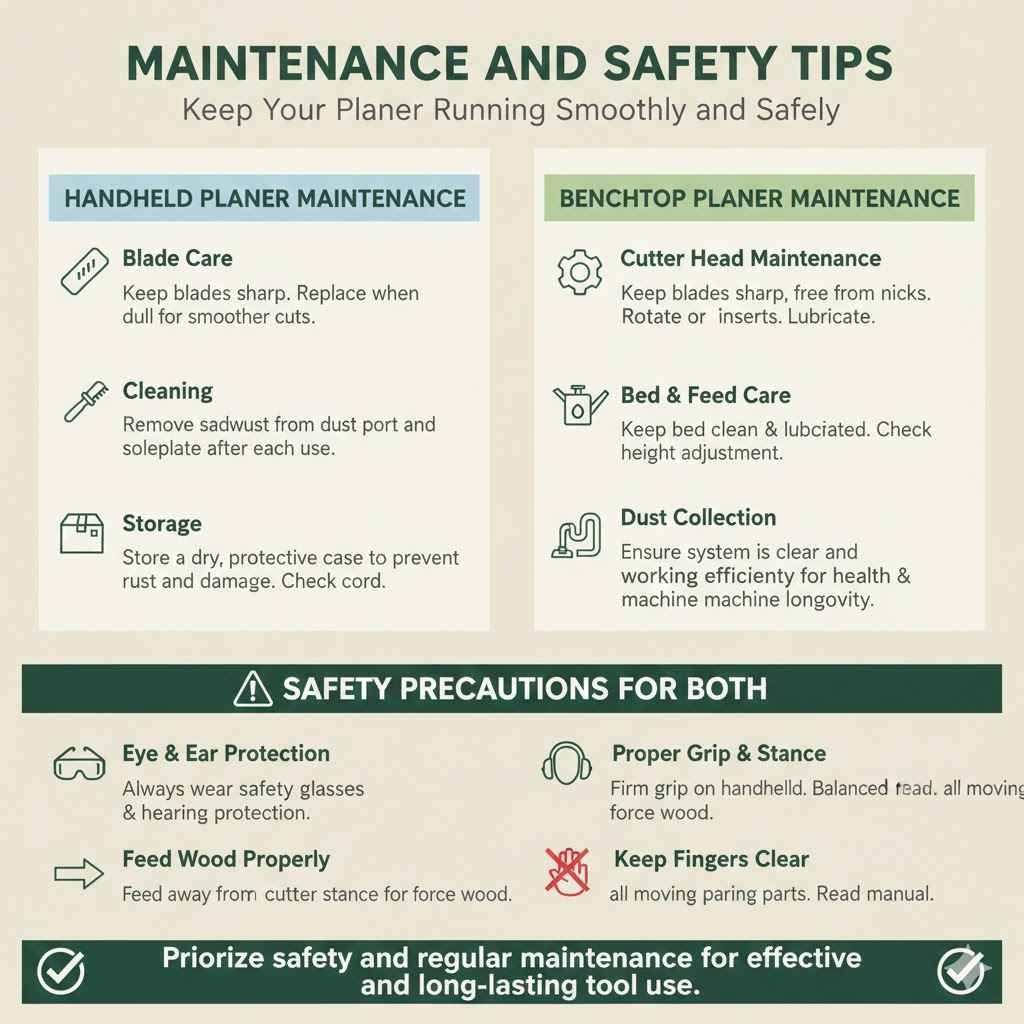
Maintenance And Safety Tips
Keeping your planer in good shape and using it safely is very important. This section provides tips to ensure your tools last long and you stay safe while working. Safe practices mean fewer accidents and better results.
Maintaining Your Handheld Planer
Regularly check and sharpen or replace the planer blades. Dull blades make the tool work harder and produce a rougher cut. Clean the dust port and the soleplate (the bottom part of the planer) to ensure smooth operation.
Store the planer in a dry place to prevent rust.
After each use, use a brush to remove sawdust from the housing and the blade area. Inspect the power cord for any damage. If you notice any issues, get them repaired before using the tool again.
- Blade Care Keep planer blades sharp. Dull blades make planing harder and can damage the wood. Sharpen them often or replace them when needed.
- Cleaning Clean sawdust from the planer body and the dust chute regularly. This prevents build-up that can affect performance and create fire hazards.
- Storage Store your handheld planer in a protective case or a clean, dry location. This shields it from dust, moisture, and damage.
Maintaining Your Benchtop Planer
For benchtop planers, keep the blades sharp and clean. Ensure the feed mechanism is free of debris. Regularly lubricate moving parts as recommended in the owner’s manual.
Make sure the dust collection system is working efficiently.
Check the cutter head for any nicks or damage. If you hear unusual noises, stop the machine and investigate the cause. Keeping the machine clean will prevent premature wear.
- Cutter Head Maintenance The blades in the cutter head are the most critical part. Keep them sharp and free from nicks. Some planers have reversible blades, extending their useful life.
- Bed Cleaning and Lubrication Keep the planer bed free from dust and debris. Lubricate the height adjustment mechanism according to the manufacturer’s instructions. This ensures smooth operation and accurate depth settings.
- Dust Collection System Regularly check your dust collector. Make sure it’s not clogged and is effectively removing sawdust. This protects your machine and your health.
Safety Precautions For Both
Always wear safety glasses to protect your eyes from flying wood chips. Wear hearing protection as planers can be noisy. For handheld planers, keep both hands on the tool and maintain a firm grip.
For benchtop planers, never force wood through the machine. Always feed wood flat and square. Keep your fingers away from the cutter head.
Read your owner’s manual carefully. Understand how your specific planer works before you use it. Never wear loose clothing or jewelry that could get caught in the machine.
- Eye and Ear Protection Always wear safety glasses to guard against flying debris. Use earplugs or muffs to protect your hearing from the noise.
- Proper Grip and Stance For handheld planers, maintain a firm grip with both hands. For benchtop planers, stand securely and ensure good balance.
- Feed Wood Properly Never force wood through a benchtop planer. Feed wood flat and square to avoid jams or damage to the machine.
- Keep Fingers Clear Always be aware of where your hands and fingers are. Keep them well away from the cutter head and any moving parts.
Frequently Asked Questions
Question: Which planer is better for a beginner
Answer: For a beginner, a handheld planer is often a better starting point. It’s more affordable, easier to store, and great for learning basic planing tasks on smaller projects without a big investment.
Question: Can a handheld planer do the same job as a benchtop planer
Answer: A handheld planer can perform planing tasks, but it’s much harder to achieve the same level of precision and consistency as a benchtop planer, especially on larger boards or when multiple pieces need to be exactly the same thickness.
Question: How wide of a board can a benchtop planer handle
Answer: Benchtop planers typically have a maximum planing width that varies by model, but most can handle boards between 12 to 15 inches wide. This is significantly wider than most handheld planers.
Question: Is a handheld planer safe for a beginner
Answer: Yes, a handheld planer can be safe for a beginner if proper safety precautions are followed, such as wearing safety glasses and hearing protection, and learning to control the tool properly. Always read the manual.
Question: When should I consider upgrading to a benchtop planer
Answer: You should consider upgrading to a benchtop planer if you find yourself frequently working with rough lumber, need to mill multiple boards to precise and consistent thicknesses, or if your projects demand a high level of flatness and accuracy that is difficult to achieve with a handheld unit.
Summary
Deciding between a handheld planer and a benchtop planer comes down to your specific needs. Handheld planers offer portability and affordability for smaller jobs and beginners. Benchtop planers provide precision and efficiency for larger projects and serious woodworkers.
Choose the tool that best fits your projects, budget, and workspace. Get the right tool, and your woodworking will be smoother.