How Do You Kill A Maple Tree: The Essential Proven Method
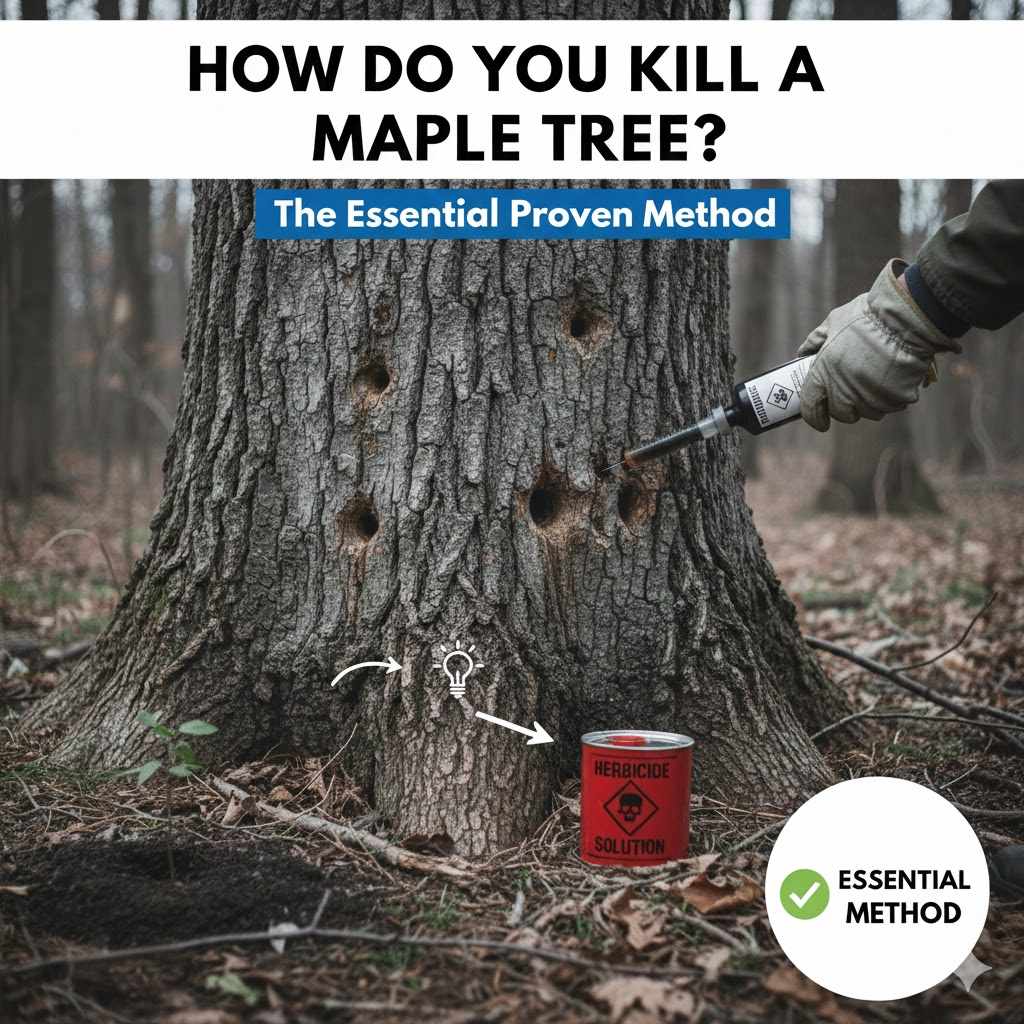
To kill a maple tree, the most proven method is girdling combined with a systemic herbicide. First, remove a complete ring of bark and the underlying cambium layer around the trunk to cut off its nutrient supply. Then, apply a suitable herbicide like glyphosate or triclopyr into the exposed wood to kill the root system and stop it from resprouting.
Hello there! I’m Md Meraj. In my workshop, I spend a lot of time turning wood into something beautiful and useful. But I also know that sometimes, a tree in your yard can become a real problem. Maple trees are beautiful, but their strong roots and stubborn nature can cause issues for homeowners. Maybe one is too close to your house, or its roots are cracking your driveway. You might feel a little overwhelmed, but don’t worry. You’ve come to the right place.
Taking care of a problem tree might seem like a giant task, but I’m here to break it down for you. We’ll go through a simple, safe, and effective method step-by-step. With the right tools and a little guidance, you can handle this project with confidence. Let’s get started and learn the proper way to manage that troublesome maple tree for good.
Why You Might Need to Remove a Maple Tree
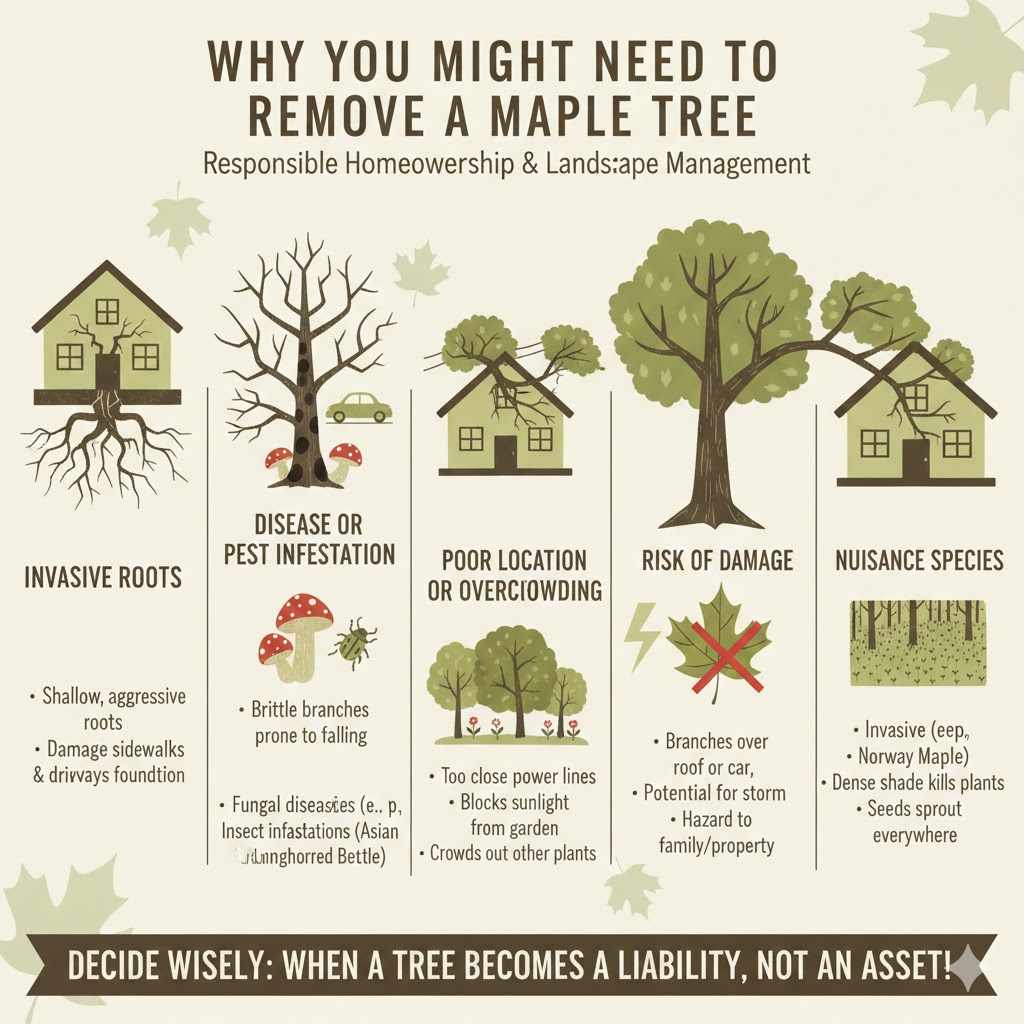
Maple trees are a staple in many landscapes, known for their stunning fall colors and sweet syrup. However, there are times when even a beautiful tree needs to be removed. Understanding why is the first step in making a confident decision for your property. It’s not about disliking trees; it’s about responsible homeownership.
Here are some of the most common reasons you might need to say goodbye to a maple tree:
- Invasive Roots: Maple trees have notoriously shallow and aggressive root systems. These roots can spread out and damage sidewalks, driveways, patios, and even the foundation of your home. If you see cracks appearing, the tree’s roots are a likely culprit.
- Disease or Pest Infestation: A sick tree can quickly become a dangerous one. Diseases like tar spot or Verticillium wilt can weaken a maple, making its branches brittle and prone to falling. Insect infestations from pests like the Asian Longhorned Beetle can kill a tree and spread to other healthy trees in the area.
- Poor Location or Overcrowding: Sometimes a tree is simply in the wrong spot. It might be growing too close to power lines, blocking sunlight from your garden, or crowding out other plants. Removing it can restore balance to your yard and improve the health of surrounding vegetation.
- Risk of Damage: A large maple with branches hanging over your roof, your car, or your kids’ play area poses a constant risk. During a storm, a falling limb can cause thousands of dollars in damage or, worse, a serious injury.
- It’s a Nuisance Species: Certain types of maples, like the Norway Maple, are considered invasive species in many areas. They grow quickly, produce a dense shade that kills everything beneath them, and their seeds sprout everywhere, making them a headache for gardeners.
Deciding to remove a tree is a big decision. But when a tree becomes a liability instead of an asset, taking action is the smartest and safest choice for your home and family.
Understanding Why Maple Trees Are So Tough to Kill
Before we jump into the “how-to,” let’s take a moment to understand our opponent. Maple trees are survivors. Simply cutting one down at the stump is often not enough. If you’ve ever tried that, you’ve probably seen a cluster of new sprouts shoot up from the stump just a few weeks later. It’s frustrating!
This happens because the tree’s life isn’t just in its trunk and leaves; it’s in its extensive root system. As long as the roots are alive and healthy, they will use their stored energy to send up new growth. To kill the tree for good, you have to kill the roots.
The method we’ll use today targets the tree’s circulatory system. Just beneath the outer bark is a thin, green layer called the cambium. This layer is like the tree’s veins and arteries. It moves water and nutrients up from the roots to the leaves, and it moves sugars (food) from the leaves back down to the roots. By cutting off this flow, we starve the roots and make the tree vulnerable.
Safety First: Your Most Important Tools
Anytime you work with cutting tools and chemicals, safety has to be your number one priority. This isn’t a step to rush or skip. Taking a few minutes to prepare properly will keep you safe and ensure the job goes smoothly. Think of your safety gear as the most valuable tool in your workshop.
Essential Safety Gear (PPE)
- Safety Glasses or Goggles: Protect your eyes from wood chips, sawdust, and any potential herbicide splash. This is non-negotiable.
- Thick Work Gloves: A sturdy pair of leather or canvas gloves will protect your hands from cuts, scrapes, and blisters. They also keep chemicals off your skin.
- Long-Sleeved Shirt and Pants: Covering your skin protects you from flying debris and chemical contact.
- Sturdy, Closed-Toe Boots: Protect your feet from falling tools or debris and provide good traction while you work.
Key Safety Precautions
- Check Your Surroundings: Before you start, look up and around. Make sure there are no power lines, buildings, or people in the area where you’ll be working.
- Work on a Calm Day: Avoid working on windy or rainy days. Wind can make handling tools tricky, and rain can wash away the herbicide before it has a chance to work.
- Read the Herbicide Label: Every chemical is different. You must read and follow the manufacturer’s instructions for mixing, application, and safety. The label is the law.
- Keep Kids and Pets Away: Ensure that children and pets are kept indoors or far away from the work area until the herbicide has dried completely.
Choosing the Right Method: Girdling and Herbicide
There are many ways people try to kill trees, from pouring salt on the roots (which is bad for your soil) to just hoping for the best. But for a stubborn tree like a maple, the most effective and reliable strategy is a two-part approach: girdling combined with a systemic herbicide.
This combination is the gold standard used by professionals because it’s so effective. Girdling mechanically stops the flow of nutrients, weakening the tree. The herbicide then finishes the job by getting absorbed into the wood and carried directly to the root system, killing the entire organism from the inside out. This one-two punch ensures the tree dies and, most importantly, doesn’t grow back.
| Method | Effectiveness | Pros | Cons |
|---|---|---|---|
| Girdling + Herbicide | Very High | Permanent solution; prevents resprouting; targets only the specific tree. | Requires tools and chemicals; takes several weeks or months to work. |
| Cutting Down Only | Low | Removes the trunk quickly. | Stump and roots remain alive; vigorous resprouting is very common. |
| Stump Grinding | High (for stumps) | Removes the visible stump. | Doesn’t kill deep roots, which can still sprout; requires expensive machinery. |
| Salt / Vinegar / Epsom Salts | Very Low & Harmful | Inexpensive ingredients. | Rarely works on large trees; contaminates and kills the surrounding soil for years. |
The Essential Proven Method: How to Kill a Maple Tree Step-by-Step
Alright, you’re prepared and you understand the plan. Now it’s time to get to work. Follow these steps carefully, and you’ll be able to tackle that maple tree with confidence. Remember to work deliberately and safely.
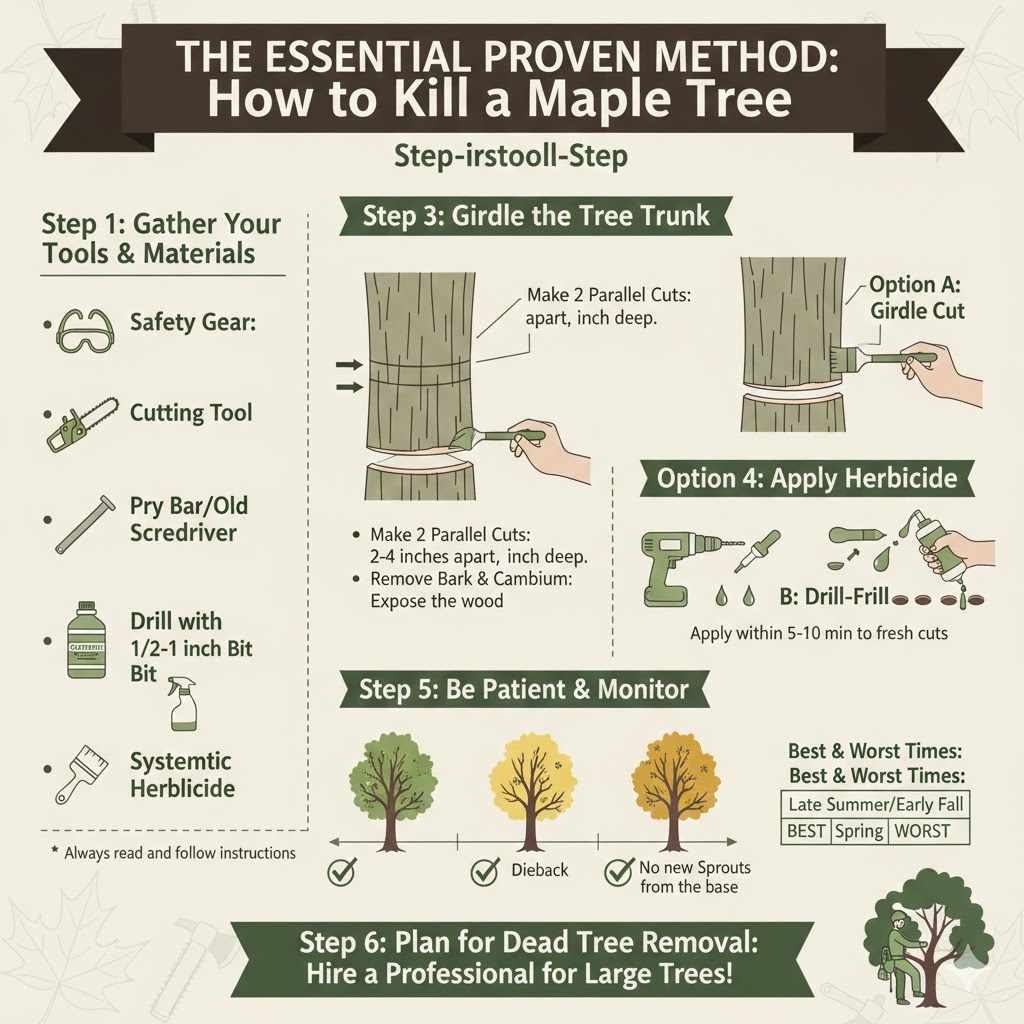
Step 1: Gather Your Tools and Materials
Before you start, let’s get everything you’ll need in one place. This way, you won’t have to stop midway through the job.
- Your Safety Gear: Glasses, gloves, long sleeves, and boots.
- Cutting Tool: A chainsaw is fastest for a large tree. For smaller trees, a handsaw or an ax will work. You’ll need two for the girdling technique.
- Pry Bar or Old Screwdriver: To help remove the bark.
- Drill with a 1/2-inch or 1-inch Bit: This is for the optional but highly recommended drilling method.
- Systemic Herbicide: Look for a product with glyphosate (41% concentration or higher) or triclopyr. These are readily available at garden centers and hardware stores.
- Applicator for Herbicide: A small disposable paintbrush, a sponge dauber, or a small spray bottle. Do not use this for anything else afterward.
Step 2: Prepare the Area
Clear the base of the maple tree. Remove any weeds, small shrubs, mulch, or grass from around the trunk. You want a clear, flat, and safe space to stand and work. This also prevents other plants from accidentally getting herbicide on them.
Step 3: Girdle the Tree Trunk
Girdling, also known as ring-barking, is the physical part of the process. Your goal is to create a gap in the tree’s nutrient highway. Here’s how you do it:
- Make Your First Cut: Using your chainsaw or handsaw, make a cut completely around the circumference of the trunk. The cut should go through the bark and into the lighter-colored wood underneath, about 1 to 1.5 inches deep.
- Make Your Second Cut: About 2 to 4 inches below your first cut, make another identical cut completely around the trunk. You should now have two parallel rings circling the tree.
- Remove the Bark: Using your pry bar or screwdriver, peel and chip away the ring of bark between the two cuts. You must remove all of it, right down to the dense wood. Scrape away the slippery, greenish cambium layer until you only see the pale wood underneath. The ring must be complete, with no strips of bark left connecting the top and bottom.
This act alone will slowly kill most trees, but a tough maple can sometimes heal a narrow girdle. That’s why the next step is so crucial.
Step 4: Apply the Herbicide
With the fresh wood exposed, the tree is now vulnerable. It’s time to apply the herbicide that will finish the job. For best results, you should apply the herbicide within 5-10 minutes of making the cuts. This ensures the wood is fresh and will absorb the chemical most effectively.
You have two great options here:
Option A: Apply Directly to the Girdle Cut (Cut-Surface Treatment)
Using your paintbrush or dauber, carefully apply the undiluted herbicide directly into the bottom cut you made. Saturate the exposed wood, but not to the point that it’s dripping down the trunk. This is the simplest method.
Option B: Drill Holes (Hack-and-Squirt or Drill-Frill Method)
This method is even more effective as it creates reservoirs for the herbicide. Take your drill and drill a series of holes inside the girdled area.
- Angle the holes downward at about a 45-degree angle. This helps hold the liquid herbicide.
- Drill about 1.5 inches deep.
- Space the holes every 2-3 inches around the trunk.
Carefully fill each hole with the herbicide. According to research from institutions like Penn State Extension, applying herbicides directly to fresh cuts is the most efficient way to control unwanted trees.
Important: Always read and follow the herbicide manufacturer’s specific instructions. More is not better. Use the recommended amount to avoid waste and environmental harm.
Step 5: Be Patient and Monitor
This is not an instant process. The tree needs time to circulate the herbicide down to its roots. You may not see any changes for a few weeks, especially if you do this in the fall when the tree is preparing for dormancy.
Look for these signs that the method is working:
- Leaves turning yellow and wilting out of season.
- Leaves that are smaller than usual in the next growing season.
- Dieback at the top of the tree canopy.
- No new sprouts emerging from the base.
It can take anywhere from a few weeks to several months for the entire tree to die. If you see vigorous new growth from the base after a month or two, you may need to make fresh cuts and reapply the herbicide.
| Season | Effectiveness | Why |
|---|---|---|
| Late Summer / Early Fall | Best | The tree is actively sending sugars (food) down to the roots for winter storage. The herbicide will be transported down efficiently, ensuring the roots are killed. |
| Winter | Good | The tree is dormant, but the herbicide can still be effective when applied on a warmer day. There are no leaves to obscure your work. |
| Spring | Worst | The sap is flowing upward strongly to produce new leaves. This upward flow can push the herbicide out of the cuts, making the treatment much less effective. |
| Summer | Good | The tree is actively growing, and herbicide application will work. However, the effectiveness is highest in late summer. |
Step 6: Plan for Dead Tree Removal
Once the maple tree is completely dead, it will start to decay. A standing dead tree is a hazard. The wood becomes brittle, and branches can break and fall unexpectedly, especially during wind or snow. You need a plan to take it down.
For a small tree, you may be able to cut it down yourself if you have the right equipment and experience. However, for large trees, especially those near your home or other structures, it is highly recommended that you hire a professional. A certified arborist has the training, insurance, and equipment to remove a dead tree safely and efficiently. You can find a qualified professional through organizations like the International Society of Arboriculture (ISA).
Frequently Asked Questions (FAQ)
1. How long does it take to kill a maple tree with this method?
Patience is key. It can take anywhere from a few weeks to a full year for the tree to die completely. The time depends on the tree’s size, its health, and the time of year you apply the treatment. You should see significant wilting or leaf drop within one growing season.
2. What is the best herbicide to use to kill a maple tree?
A systemic herbicide is essential. Look for products containing at least 41% glyphosate or a high concentration of triclopyr. These are designed to be absorbed and transported throughout the entire tree, including the roots, to ensure a complete kill.
3. Will killing the maple tree harm my other plants or grass?
If applied carefully and correctly, this method is very targeted. By applying the herbicide directly into the tree’s cut tissue, you avoid spraying it onto other plants or the soil. There might be some minor root grafting with nearby trees of the same species, but harm to other plants is very unlikely.
4. Why can’t I just cut the tree down at the stump?
You can, but a healthy maple root system will almost always send up new shoots and sprouts from the stump and surrounding roots. You will find yourself constantly cutting back this new growth. The girdling and herbicide method kills the root system itself, preventing this frustrating cycle of regrowth.
5. Is this method safe to use around my children and pets?
You must take precautions. Keep children and pets away from the area during the application and until the herbicide has fully dried and absorbed into the tree. Store the herbicide securely in its original container and out of reach. Once absorbed, the chemical poses a very low risk to anything on the surface.
6. What should I do with the wood after the tree is dead?
You must consider the herbicide used. According to most labels, wood from trees treated with glyphosate is generally safe to use as firewood or to be chipped into mulch once the tree is dead and the chemical has broken down. However, you must read the specific label of the product you used for guidance on this matter. If you’re unsure, it’s safest to dispose of it at a local brush-disposal site.
7. What if I don’t feel comfortable using herbicides?
If you prefer to avoid chemicals, you can use the girdling method alone. Girdling by itself will eventually kill the tree by starving it. However, it will take much longer (potentially years), and a very healthy maple might still manage to send up shoots from its roots before it dies completely. You will need to be diligent about cutting off any new sprouts.
Conclusion: Taking Control of Your Yard
And there you have it. The essential, proven method for killing a problem maple tree. It may seem like a lot of steps, but by breaking it down and focusing on one part at a time—from safety checks to the final application—you can handle this job effectively and confidently. Remember, the goal is to target the root system to prevent any regrowth, and the combination of girdling and herbicide is the surest way to achieve that.
Taking on projects around the home is all about building skills and confidence. You’ve now learned a technique that professionals use, and you’ve learned how to do it safely. Whether you’re making room for a new garden, protecting your home’s foundation, or simply removing a hazard, you’re taking responsible control of your property. Be patient, be safe, and take pride in a job well done.