How to Taper a Wooden Pole: 5 Methods and the Taper Math
To taper a wooden pole, mark the small-end diameter on the end grain, then remove wood from the big end toward the small end with a drawknife and spokeshave, on a lathe, or with a planer sled on square stock. Never push round stock through a table saw.
A tapered pole should keep the grain running the length of the wood, and that is where most quick guides go wrong. A jigsaw or handsaw cut leaves a faceted, wandering surface, and a table saw cannot hold a round pole still. This guide covers five methods that work, the taper-per-foot math to set each one up, and the hazards that the usual advice skips.
Which Method Fits Your Pole?
Best Drawknife Pick
 |
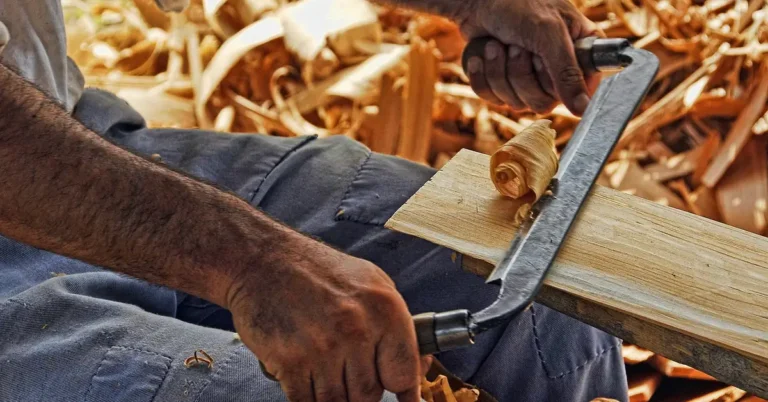
Stubai Drawknife (Made in Austria) – $49.95 A drawknife does the heavy lifting on a pole, removing bark and wood fast before a spokeshave or plane refines the taper.
|
The right method depends on what you start with and how many poles you need. Round branches and green poles suit hand tools. A lathe gives the most uniform result if the pole fits between centers. Square stock can go through a planer sled or a table saw jig before you round it off.
| Method | Starting stock | Best for | Main limit |
|---|---|---|---|
| Drawknife | Round or square, green or dry | Fast rough taper, bark removal | Needs a firm hold; rough finish |
| Spokeshave or hand plane | Square or octagon | Clean, controlled final taper | Slow on large removal |
| Lathe | Square or round, straight grain | Perfectly round, repeatable taper | Pole must fit the lathe; slender poles flex |
| Planer sled | Square stock only | Matching tapers on several poles | Square section only; round it afterward |
| Table saw jig | Square stock only | Straight tapers on square legs and posts | Never for round stock |
Do the Taper Math Before You Cut
Taper is the change in diameter over a length. Divide the difference between the big and small diameters by the length to get the taper per inch, then multiply by 12 for taper per foot. The number that trips people up is the per-side amount: on a centered taper, each side loses only half of the total diameter change, and that half is what you mark, cut or shim for.
| Length | Big end | Small end | Taper per foot | Removed per side | Included angle |
|---|---|---|---|---|---|
| 36 in | 1 1/2 in | 3/4 in | 1/4 in | 3/8 in | 1.19 degrees |
| 48 in | 1 1/2 in | 1 in | 1/8 in | 1/4 in | 0.60 degrees |
| 60 in | 1 1/4 in | 3/4 in | 0.10 in | 1/4 in | 0.48 degrees |
| 72 in | 2 in | 1 in | 1/6 in | 1/2 in | 0.80 degrees |
| 72 in | 2 in | 1 1/4 in | 1/8 in | 3/8 in | 0.60 degrees |
| 96 in | 3 in | 1 1/2 in | 3/16 in | 3/4 in | 0.90 degrees |
The included angle stays under 1.3 degrees in the table. That is why a tilted saw blade is the wrong idea for this job: the taper is a gentle slope along a long piece, not an angle you set on a machine. Our table saw taper guide explains how a jig setting differs from a blade tilt, and the tapered legs calculator does the same math for shorter pieces.
Draw a line along the full length of the pole from the small-end mark to the big-end mark, using a chalk line or a long straightedge so the taper is straight rather than eyeballed. Mark all sides, or all four faces of square stock.
Pick Wood That Suits the Load
For a decorative pole, almost any straight-grained wood works. For a pole that carries load or shock, such as a tool handle, a tent pole or a support post, grain direction matters more than species. A pole cut from a board with grain that runs out through the side of the taper has short grain at the thin end and breaks there. Split or turned stock from straight-grained wood keeps the fibers running the full length.
| Wood | Janka hardness (lbf) | How it works by hand |
|---|---|---|
| Western red cedar | about 350 | Very soft and easy to cut; dents and splits easily |
| Eastern white pine | about 380 | Soft; fast with a drawknife, fuzzes if the edge is dull |
| Douglas fir | about 660 | Moderate; hard and soft growth rings make the surface uneven |
| White oak | about 1,360 | Hard; needs a sharp edge and light cuts |
| White ash | about 1,320 | Hard and tough; a traditional choice for handles and poles |
| Hickory | about 1,820 | Very hard and shock resistant; slow to shape by hand |
Avoid knots in the tapered zone. A knot at the thin end is the most likely place for a pole to snap under load.
Taper a Pole With a Drawknife
A drawknife is the fastest way to turn a round branch or a rough pole into a taper. Hold the pole firmly, either in a vise, clamped to a bench, or on a shaving horse, and pull the blade toward you with both hands, wrists straight.
- Mark the taper lines along the pole as described above.
- Start at the big end and shave toward the small end. That direction goes with the grain: on a taper, the wood fibers end at the surface pointing toward the thin end, so the blade lays them down instead of lifting them.
- Take thin, slicing cuts. Tilting the handles raises or lowers the cutting angle, and a steeper angle digs in.
- Work around the pole in turns rather than finishing one side, checking the diameter against the marks.
- Stop about 1/16 in outside the line and finish with a spokeshave or plane.
Keep both hands behind the blade, keep your body out of the path of a slip, and never hold the pole on your knee. A dull drawknife is more dangerous than a sharp one because it needs force and skips.
Taper Square Stock With a Spokeshave or Plane (The Octagon Method)
For a pole that ends up round, the cleanest hand-tool route starts square. After you plane the taper flat on each of the four faces, turn the square section into an octagon, then sixteen sides, then sand the corners off.
- Plane the taper onto all four faces down to your lines, so the section is a square that gets smaller toward the tip.
- Mark the octagon: measure in 0.293 times the face width from each corner on every face, at both ends, and join the marks with a straightedge. That chamfer leaves a flat 0.414 times the face width, which makes a regular octagon.
- Plane or spokeshave the corners to the lines, keeping the same bevel angle all the way down the pole.
- Knock the eight corners off to make sixteen sides, then smooth the surface with sandpaper.
A spokeshave gets into a taper where a plane can dig in, and our guide to rounding wood without a router shows hand-tool techniques that give a clean round-over. If you want to build your own tool, see how to make a wooden spokeshave.
Taper a Pole on a Lathe
A lathe makes a straight, perfectly round taper and repeats it across several poles. Mount the pole between centers, true it to a cylinder with a roughing gouge, then cut the taper by working from the big diameter toward the small one.
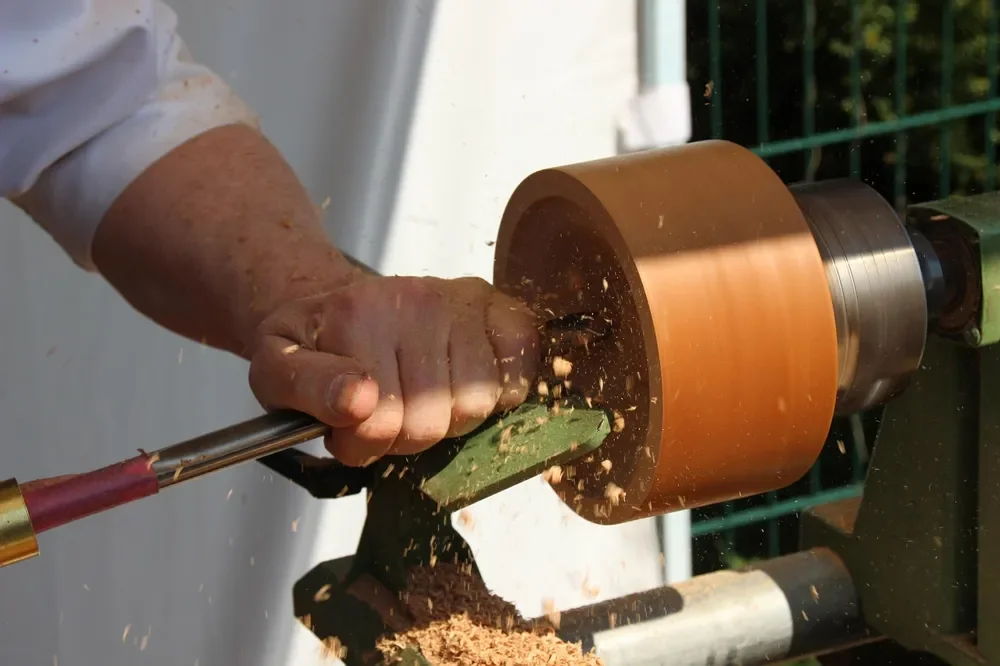
- Start at a low speed until the blank is round, then raise it as the section gets smaller and more balanced.
- Set the tool rest close to the wood and just below the center line.
- Mark the big and small diameters, and check them with calipers at both ends.
- Cut from the large diameter toward the small one, checking the slope against a straightedge held along the pole.
- Sand with the lathe running at low speed, holding the sandpaper so it cannot wrap around the pole.
Slender poles flex and chatter. If the pole is much longer than it is thick, support it with a steady rest, or take light cuts and stop the lathe often to check for whip. Wear a face shield, tie back loose sleeves and hair, remove jewelry, and skip the gloves. The usual advice to wear gloves is wrong at a lathe, because a glove can catch on a spinning workpiece and pull your hand in.
Taper Square Stock With a Planer Sled or a Table Saw Jig
When you need several matching square tapers, a tapered sled for a thickness planer is a practical route. Screw or clamp a wedge under the tip end of a flat carrier board, seat the pole against stops so it cannot shift, and take light passes. The wedge height at the tip must equal the amount you are removing per face. From the table above, that is 3/8 in for the 36 in pole that goes from 1 1/2 in to 3/4 in. Turn the pole 90 degrees between faces so all four faces taper equally.
A table saw jig does the same job on square stock. The tapering jig for a table saw sets the per-side amount, and the tapered table legs guide walks through the same idea for legs. For very large tapered columns, see how to build tapered wood columns.
Both machine methods produce a square taper. To make a round pole, finish with the octagon method above.
Why Not Saw or Table-Saw a Round Pole?
The most common advice for tapering a pole is to use a handsaw or a jigsaw along a marked line. The cut can be made, but a saw kerf wanders on a round surface, leaves a faceted taper that needs a lot of sanding, and cuts across the fibers if the pole is not perfectly straight.
A table saw is a worse choice for round stock. A round pole rolls against the blade, and a piece that rolls or twists can bind and kick back. If the stock is square, use a taper jig that holds it. If it is round, use a drawknife, spokeshave or lathe. Small round stock is handled a little differently, and how to taper wood dowels covers dowel-size work.
Smooth, Check and Seal the Taper
- Check straightness by sighting along the pole, and lay a straightedge along it to find a dip or a bump.
- Sand with 80 grit to remove tool marks, then 120 and 180. Sand with the grain, along the pole.
- Measure the diameter at both ends and at a few points in between and compare with your math table.
- Seal end grain first for any pole used outdoors, since the ends take up moisture fastest. Then apply the finish to the whole pole according to the label.
Common Mistakes When Tapering a Pole
- Marking the diameter change as the per-side change. Halve the total diameter change to get the amount removed per side.
- Cutting from the small end toward the big end. That direction goes against the grain and tears fibers.
- Putting round stock in a machine that needs a flat reference. Round poles roll on a table saw or planer bed.
- Removing too much too fast. A pole that is over-cut cannot be put back, so stop short of the line and finish with a smoothing tool.
- Ignoring knots and run-out. A weak zone in the tapered part is where the pole fails.
Frequently Asked Questions
How do you taper a wooden pole by hand?
Mark the small-end diameter on the end grain and draw lines to the big end. Use a drawknife to remove wood from the big end toward the small end, then finish with a spokeshave or hand plane. For a round pole, work from square to octagon to sixteen sides, then sand.
Can you taper a round pole on a table saw?
No. A round pole rolls against the blade and can bind or kick back. A table saw taper jig is only for square or rectangular stock. For round poles, use a drawknife, a spokeshave or a lathe.
How do you calculate the taper per foot of a pole?
Subtract the small diameter from the big diameter, divide by the length in inches, and multiply by 12. A 72 in pole that goes from 2 in to 1 in tapers about 1/6 in per foot, and each side loses 1/2 in over the full length.
Which tool is best to taper a long wooden pole?
A drawknife with a spokeshave finish is the practical choice for a long pole in a home shop. A lathe gives a more uniform round taper, but the pole must fit between centers and needs support if it is long and thin.
Conclusion
Tapering a wooden pole comes down to a plan and the right tool. Work out the taper per foot and the per-side amount first, mark it along the full length, and cut from the big end toward the small end. Use a drawknife and spokeshave for hand work, a lathe for a uniform round taper, and a sled or jig for square stock. Keep round poles off the table saw, and check the pole for knots and grain run-out before you commit.
Sponsored / affiliate links. As an Amazon Associate I earn from qualifying purchases. I may earn additional commission from eligible campaigns.