Is Ash a Dense Wood? Janka Hardness & Real Numbers
Yes, ash is a dense wood. White ash (Fraxinus americana), the species most common in U.S. lumberyards, has a Janka hardness rating of 1,320 lbf and a dry density of roughly 42 lbs per cubic foot (0.67 g/cc). That puts it solidly in the mid-to-upper range of North American hardwoods – denser than walnut and cherry, close to red oak, but softer than hard maple or hickory. Ash’s real claim to fame isn’t just raw density, though – it’s an unusual combination of density and springiness, which is exactly why it became the standard wood for baseball bats, axe handles, and oars for over a century. Below are the actual numbers, how ash stacks up against other common furniture and flooring woods, and what its density means once you’ve got a board in front of you.
How Dense Is Ash Wood? The Real Janka Numbers
The Janka hardness test measures how much force (in pounds-force, or lbf) it takes to embed a small steel ball halfway into a piece of wood. It’s the industry-standard way to compare how hard and dent-resistant different species are. White ash scores 1,320 lbf on the Janka scale, with a specific gravity of about 0.67 (oven-dry weight over green volume), which works out to roughly 42 pounds per cubic foot once the wood has air-dried to typical indoor moisture content. For comparison, a common softwood like eastern white pine scores around 380 lbf – ash is more than three times harder. That’s the number that makes ash a genuine hardwood in both the botanical and practical sense: it resists dents, holds up to daily wear, and doesn’t compress easily under load.
Best Pick: Wood Moisture Meter
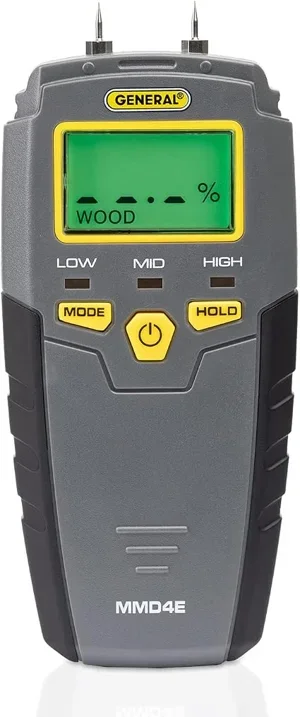 |
General Tools MMD4E Moisture Meter – $39.98 Confirms a board’s actual moisture content before you rely on its listed density and hardness for a demanding project like a bat blank or tool handle.
|
Ash vs Other Hardwoods: Density Comparison
Numbers mean more with context. Here’s how white ash’s density and hardness compare to the other hardwoods it’s most often confused with or substituted for:
| Wood Species | Janka Hardness (lbf) | Approx. Dry Density (lb/ft³) |
|---|---|---|
| White Ash | 1,320 | ~42 |
| Red Oak | 1,290 | ~44 |
| Black Walnut | 1,010 | ~38 |
| Cherry | 950 | ~35 |
| Hard Maple | 1,450 | ~44 |
| Shagbark Hickory | 1,820 | ~51 |
So ash lands right next to red oak – close enough that the two are often interchangeable for flooring and furniture – while sitting noticeably softer than hard maple and well below hickory. It’s meaningfully harder than walnut and cherry, which is one reason ash doesn’t dent as easily as those two darker cabinet woods. If you’re shopping for boards and want to compare grades and pricing at the lumberyard, our ash wood lumber buying guide covers that side in more depth.
Why Ash’s Density Made It the Classic Baseball Bat Wood
Density alone doesn’t explain why ash ended up in baseball bats, axe handles, and oars instead of harder woods like hickory or maple. The real reason is a combination most people miss: ash has unusually long, straight fibers arranged in continuous growth rings, which give it excellent shock resistance and elasticity relative to its density. When a bat makes contact with a ball, or an axe head strikes a log, the wood needs to flex slightly and absorb the impact rather than transmitting all of that force straight to your hands – and rather than shattering outright. Hickory is harder and technically stronger, but it’s noticeably heavier for the same dimensions, which matters in a bat swung hundreds of times a game. Ash hits the sweet spot: dense enough to survive repeated high-force impacts, light enough to swing fast, and springy enough to cushion the shock. That’s why ash was the standard MLB bat wood for most of the 20th century (maple and birch have since taken over a large share of the pro market, partly due to ash tree supply pressure from the emerald ash borer), and it’s still the default choice for axe and hammer handles sold today.
What Ash’s Density Means for Working It in the Shop
In practice, ash’s 1,320 lbf rating shows up in a few concrete ways once you’re actually building something:
- Machining: Ash cuts and planes more easily than its hardness number suggests, because its grain is usually straight and open rather than interlocked. Expect it to dull blades faster than a softwood, but it won’t fight your tools the way a dense, interlocked-grain wood like hard maple can.
- Fastening: Pilot holes are non-negotiable near edges and ends. Ash’s density means it can split if you drive a screw into it without pre-drilling, especially within an inch or two of a board’s edge.
- Finishing: The open pore structure that makes ash easy to cut also means it takes stain unevenly if you skip a pre-stain conditioner or grain filler. For a glass-smooth finish, plan on an extra filling step that a tighter-pored wood like maple wouldn’t need.
- Weight: At around 42 lbs per cubic foot dry, a full board is noticeably heavier than the same size piece of pine or poplar – worth factoring in for large furniture pieces or anything that needs to be moved once assembled.
Where Ash’s Density Is Actually Put to Use
Ash’s specific combination of hardness and shock resistance points it toward certain jobs more than others:
- Flooring: Hard enough to resist everyday dents, similar in performance to red oak.
- Furniture and cabinetry: Strong enough for chair frames and table legs that take repeated stress, with an open, attractive grain pattern.
- Tool and axe handles: The shock-absorption properties matter more here than raw hardness.
- Sporting goods: Traditional baseball bats, oars, and hockey stick shafts all trace back to this same density-plus-springiness profile.
- Bent-wood parts: Ash steam-bends unusually well for a wood this dense, which is why it shows up in curved chair backs and boat parts.
Potential Drawbacks of Ash’s Density
Density is a trade-off, not a pure win. A few things worth knowing before committing to ash for a project:
- It’s heavier to move and mill than lower-density woods like pine, poplar, or even walnut, which matters for large casework or anything shipped as furniture.
- The same open grain that makes it easy to cut also makes ultra-smooth, pore-free finishes more work to achieve.
- Ash is vulnerable to the emerald ash borer, an invasive beetle that has killed hundreds of millions of ash trees in North America since the early 2000s – supply and pricing have tightened in many regions as a result, so don’t assume it’s automatically the cheap alternative to oak it once was.
- Left untreated outdoors or in contact with soil, ash’s open grain absorbs moisture readily and it will rot faster than naturally rot-resistant species like white oak or cedar.
Frequently Asked Questions
Which is heavier, ash or oak?
Red oak and white ash are close, but ash edges out red oak on the Janka hardness scale (1,320 lbf vs. 1,290 lbf) while the two have almost identical dry density, at roughly 42-44 lbs per cubic foot. In practical terms, they feel and perform similarly enough that many woodworkers treat them as interchangeable for furniture and flooring.
What is the densest wood?
Among commercially available woods, lignum vitae is the densest, with a Janka hardness around 4,390 lbf – more than three times harder than ash. Ash is a solidly dense hardwood by everyday standards, but it’s nowhere near the extreme end of the density spectrum.
Is wood ash (the ash from a fire) as dense as ash wood?
No – and it’s a common mix-up because they share a name. Wood ash, the powdery residue left after burning any wood, is far less dense than solid ash lumber. It’s a loose bed of light, porous mineral particles rather than solid wood fiber, so it weighs only a fraction as much per cubic foot as the solid board it came from, regardless of which species was burned.
What’s the main disadvantage of ash’s density?
The density itself isn’t the drawback so much as what comes with it: ash’s open grain structure (a byproduct of the same growth pattern that gives it its springiness) makes it harder to get an ultra-smooth, pore-free finish without extra grain-filling steps, and its weight makes large pieces more cumbersome to handle than lighter woods.
Conclusion
Ash is a genuinely dense hardwood – 1,320 lbf on the Janka scale, about 42 lbs per cubic foot dry – close to red oak, harder than walnut or cherry, and softer than hard maple or hickory. What sets it apart isn’t the raw number, though; it’s the combination of that density with real springiness and shock resistance, which is exactly why it’s been the go-to wood for baseball bats, tool handles, and bent-wood furniture parts for generations. If you’re choosing between ash and another hardwood, the density numbers above should tell you most of what you need to know – the rest comes down to how much you value that shock-absorbing flex versus a harder, stiffer wood like maple or hickory.
Sponsored / affiliate links. As an Amazon Associate I earn from qualifying purchases. I may earn additional commission from eligible campaigns.