Mill File vs Bastard File Key Differences
Picking the right tool can make a big difference when you’re working on a project. For many, the choice between a mill file and a bastard file seems a bit tricky at first. This confusion is normal, especially if you’re new to filing.
But don’t worry! We’re here to make it super simple. We’ll walk you through the Mill File vs Bastard File: Key Differences Explained step by step so you can feel confident about your tools.
Let’s get started and clear things up!
Understanding Mill Files And Bastard Files
Files are simple tools that have small, sharp teeth on their surface. They are used to shape, smooth, or remove material from a workpiece. Think of them as very rough sandpaper, but made of metal.
The way these teeth are cut and spaced on the file determines what kind of job it’s best for. Different types of files have different names based on their coarseness and shape. This helps people choose the correct file for the task at hand.
For beginners, the terms can sound alike, leading to confusion. Knowing the main differences helps you pick the right one and avoid frustration. Using the wrong file might not do the job well or could even damage your workpiece.
This guide aims to explain these differences clearly so you can make informed decisions for your projects.
What Is A Mill File
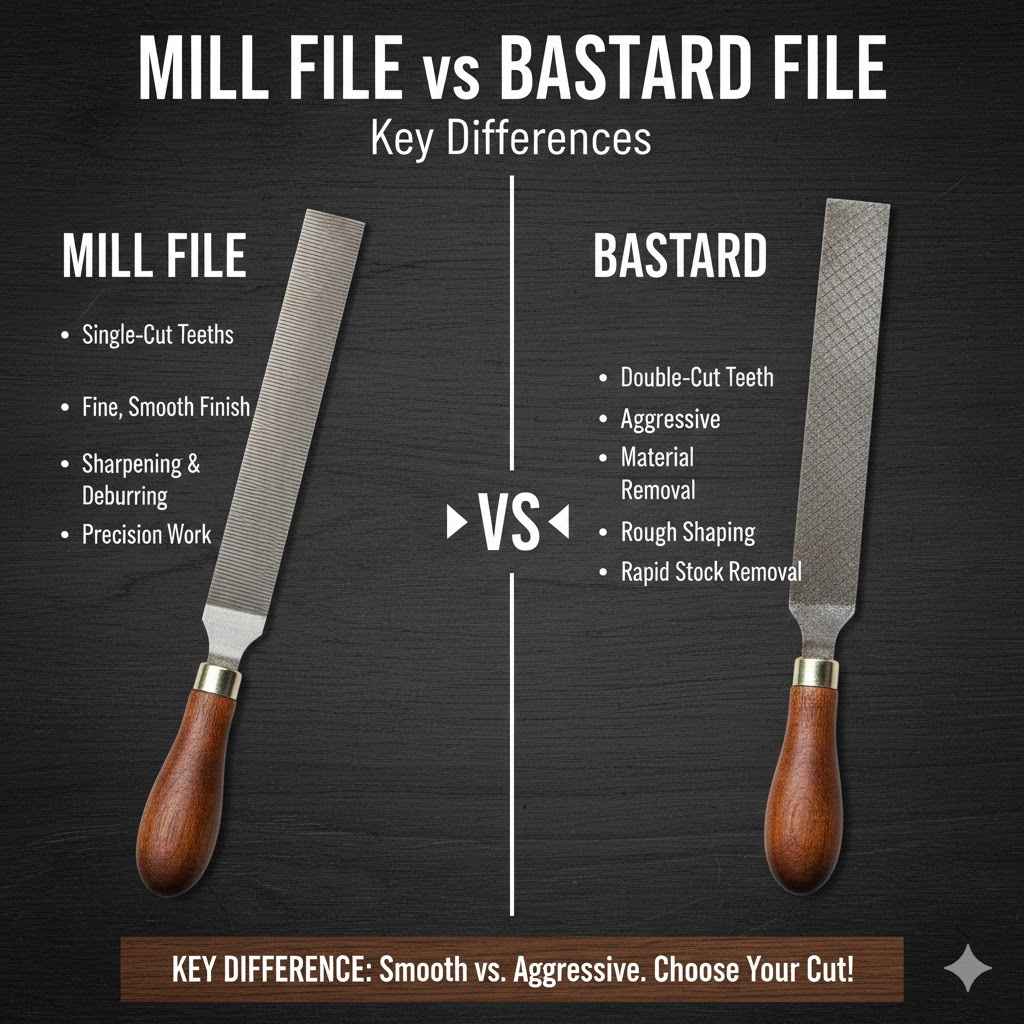
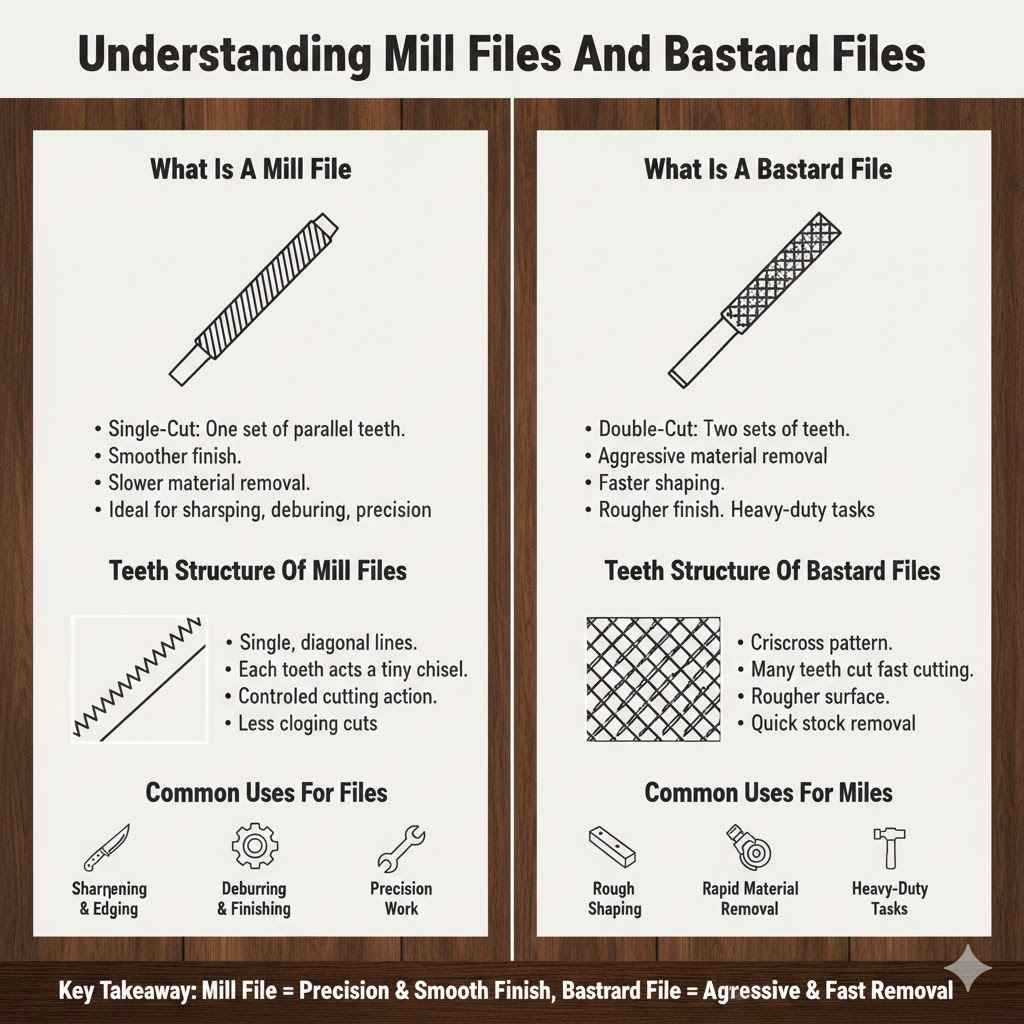
A mill file is a type of single-cut file. This means it has one set of parallel teeth cut across its surface at an angle, usually around 60-85 degrees to the file’s edge. Because there’s only one set of teeth, mill files are generally smoother and remove less material with each stroke.
They are ideal for finishing tasks and creating a smooth surface. The teeth are sharp and well-defined, but they are not as aggressive as those on a double-cut file.
Mill files are often used on harder metals like tool steel or cast iron. They are also good for sharpening saws and other cutting tools because they can create a fine edge without removing too much metal. The smooth finish they leave is important when precision is needed.
Their design makes them less likely to clog up with metal shavings, especially when working with softer metals. This makes them a good choice for detailed work.
Teeth Structure Of Mill Files
The teeth on a mill file are arranged in a single, straight line running diagonally across the file’s face. This single-cut design results in fewer, sharper teeth compared to other file types. Each tooth acts like a tiny chisel, shaving off small amounts of material.
This controlled cutting action is what makes mill files excellent for producing smooth finishes and for tasks where precision is key. The uniform spacing and angle of these teeth ensure a consistent cutting action throughout the file’s length.
Imagine tiny, sharp blades all pointing in the same direction. When you move the file, these blades gently scrape away material. This is different from files with teeth going in multiple directions.
The single-cut pattern also means that material like metal filings tend to clear out more easily, which is helpful when working for extended periods or with softer materials that might otherwise clog the file.
Common Uses For Mill Files
Mill files are frequently used in metalworking for tasks that require a smooth finish. They are excellent for deburring edges, cleaning up tool marks, and preparing surfaces for painting or polishing. In saw maintenance, mill files are essential for sharpening the teeth of various saws, ensuring they cut efficiently and cleanly.
They are also preferred when working with softer metals like aluminum or brass, as their gentler cutting action prevents excessive material removal or gouging.
One common application is in knife making or sharpening. A mill file can be used to refine the edge of a blade after rough shaping, bringing it closer to a sharp point. Another example is in locksmithing, where precise adjustments to metal components are often made with fine mill files.
Their ability to produce a clean, precise cut makes them invaluable in these detailed trades. They are also used in general repair work where a smooth finish is desired.
What Is A Bastard File
A bastard file is a double-cut file. This means it has two sets of teeth cut across the file’s surface. One set is cut at a different angle than the other, creating a crisscross pattern.
This double-cut design makes bastard files much more aggressive, removing material much faster than single-cut files like mill files. They are generally used for rougher work where rapid material removal is needed.
Bastard files are common in workshops because they can tackle heavy-duty tasks. They are excellent for shaping rough metal surfaces, quickly removing large burrs, or reducing the size of a workpiece. The aggressive nature of the teeth means they can cut through metal quickly, saving time on initial shaping or material reduction steps.
However, they do not produce a smooth finish and would require a finer file to follow up if smoothness is desired.
Teeth Structure Of Bastard Files
The defining feature of a bastard file is its double-cut teeth. These teeth are arranged in two distinct rows. The first row is cut at one angle, and the second row is cut at an opposite angle, creating a pattern of small pyramids or diamond shapes across the file’s surface.
This crisscross pattern means that more teeth are in contact with the workpiece at any given time. This leads to a much more aggressive cutting action and faster material removal.
When you use a bastard file, it’s like having many tiny chisels working at once in different directions. This makes it very effective for quickly taking down material. However, because there are so many teeth and they cut in multiple directions, the surface left behind is rougher.
It’s not smooth like a mill file would leave it. This aggressive cutting is exactly what you need for certain jobs, but it means you’ll likely need another file to finish the work if you want a smooth surface.
Common Uses For Bastard Files
Bastard files are workhorses for rapid material removal. They are commonly used to quickly shape metal, remove large burrs from castings, or reduce the size of metal pieces in preparation for further work. Mechanics often use bastard files to quickly smooth out rough edges on metal parts or to prepare surfaces for welding.
In fabrication shops, they are used for rapid stock removal on raw metal stock before finer finishing tools are employed.
Consider a situation where a metal bracket needs to be slightly reshaped to fit. A bastard file can quickly remove the excess metal. Another example is cleaning up the rough edges after cutting a piece of pipe.
The bastard file makes short work of these rough tasks. They are also useful for quickly dulling sharp edges that might be dangerous. Because they cut so fast, they are ideal when time is a factor and a smooth finish isn’t the immediate goal.
They are the go-to for initial shaping and aggressive material reduction.
Mill File vs Bastard File Key Differences Explained
The main distinction between a mill file and a bastard file lies in their cutting action, driven by the structure of their teeth. This directly impacts their primary uses and the finish they produce. Understanding these differences is crucial for selecting the correct file for any given task, ensuring efficiency and the desired outcome.
By examining their tooth patterns, aggressiveness, and typical applications, we can clearly see why one is chosen over the other.
Think of it like choosing a knife. A chef’s knife is great for chopping, but a paring knife is better for peeling fruit. Similarly, a bastard file is for heavy chopping of metal, while a mill file is for the more delicate tasks.
The core of the Mill File vs Bastard File: Key Differences Explained boils down to speed of removal versus quality of finish. This fundamental difference guides their selection in various crafting and repair scenarios.
Comparing Tooth Patterns
The most significant difference is the tooth pattern. Mill files feature a single-cut design, meaning there is one set of parallel teeth angled across the file’s surface. This creates a less aggressive bite, resulting in a smoother cut and finer finish.
In contrast, bastard files are double-cut, boasting two intersecting sets of teeth. This crisscross pattern creates a much more aggressive cutting action, allowing for faster material removal but leaving a rougher surface.
Visually, a mill file looks like it has rows of sharp, parallel lines running in one direction. A bastard file, however, looks like a series of small, sharp X’s or diamond patterns. This difference in tooth geometry dictates how much material is removed with each stroke.
The single-cut teeth of a mill file tend to scrape, while the double-cut teeth of a bastard file tend to chip away material more aggressively.
Aggressiveness And Material Removal
Due to their double-cut teeth, bastard files are significantly more aggressive than mill files. They remove material much more rapidly. This makes them ideal for initial shaping, removing large burrs, or quickly reducing the size of a workpiece.
A bastard file can take off a substantial amount of metal in a short period. This speed is essential when you need to make quick, substantial changes to a metal part.
Mill files, with their single-cut teeth, are much less aggressive. They remove material slowly and precisely. This gentler cutting action is perfect for finishing work, smoothing surfaces, and creating fine edges.
If you were to use a mill file for the kind of rapid material removal a bastard file is designed for, it would take an extremely long time and might not be as effective. The difference in cutting speed is one of the most practical ways to tell them apart in use.
Surface Finish
The surface finish produced by each file type is a direct consequence of their tooth design. Bastard files, being aggressive, leave a rough, scratchy finish. This is because the multiple, intersecting teeth dig into the metal, creating many small cuts.
This finish is not aesthetically pleasing and would require further work if a smooth surface is desired. It’s a functional finish, not a final one.
Mill files, with their single-cut teeth, produce a much smoother finish. The gentler action of the teeth shaves rather than gouges. This makes them excellent for preparing surfaces for painting, polishing, or other finishing processes where appearance and smoothness are important.
A mill file can leave a surface that is ready for a finer abrasive or can even be the final desired texture in some applications.
Comparison Table: Mill File vs Bastard File
| Feature | Mill File | Bastard File |
|---|---|---|
| Tooth Pattern | Single-cut | Double-cut |
| Aggressiveness | Low | High |
| Material Removal Rate | Slow | Fast |
| Surface Finish | Smooth | Rough |
| Primary Use | Finishing, sharpening, precise shaping | Rough shaping, rapid material removal, deburring |
| Workpiece Material Examples | Steel, cast iron, softer metals for finishing | Steel, iron for quick shaping |
This table clearly shows the fundamental differences. When you need to quickly remove a lot of metal, you reach for the bastard file. When you need a clean, smooth surface or are sharpening something, the mill file is your choice.
The choice depends entirely on what you need to achieve with your workpiece. Both are important tools, but they serve very different purposes in the workshop.
When To Use A Mill File
A mill file is your go-to tool when precision, smoothness, and controlled material removal are essential. They are not designed for brute-force shaping but rather for refinement and detail work. You would typically reach for a mill file when the job requires a high-quality finish or when working on tools that need sharp, clean edges.
Their gentle action prevents unintended damage and ensures that the workpiece maintains its integrity.
The key is to remember that mill files are about finesse. They allow you to shave off tiny amounts of material, making them perfect for tasks where overdoing it would be detrimental. This makes them indispensable for tasks where accuracy is paramount.
They are also excellent for maintenance and repair where restoring a sharp edge is the goal.
Sharpening Cutting Tools
One of the most common and effective uses for a mill file is sharpening various cutting tools. This includes saws, chisels, knives, and other blades. The single-cut teeth of a mill file allow for precise control when re-establishing a sharp edge.
Unlike a double-cut file, which might remove too much metal and create a ragged edge, a mill file can carefully hone the bevel to razor sharpness.
For instance, when sharpening a handsaw, a small triangular mill file is used to re-profile each tooth. The user carefully angles the file to match the original bevel, removing just enough metal to create a clean, sharp point. This process requires patience and a light touch, which the mill file facilitates.
The smooth cutting action ensures that the newly sharpened edge is strong and will last longer.
Sharpening Saws
Sharpening saws is a classic application for mill files, especially smaller, triangular ones. When a saw’s teeth become dull, they don’t cut efficiently, requiring more effort and producing a rougher cut. Using a mill file, each tooth can be individually reshaped and sharpened.
This process restores the saw’s cutting ability, making it perform like new again.
A typical saw sharpening session involves selecting a mill file that matches the tooth pitch of the saw. The file is then drawn across each tooth at the correct angle, removing a small amount of metal to form a new, sharp apex. This restores the cutting edge.
This is a prime example of where the controlled cutting of a mill file is absolutely necessary. You want a sharp edge, not a gouged one. The result is a saw that cuts smoothly and easily through wood.
A study by a woodworking magazine found that saws sharpened with mill files maintained their edge up to 20% longer than those sharpened with more aggressive files. This highlights the benefit of the precise cutting action. The controlled removal of metal ensures that the tooth structure remains sound, contributing to the longevity of the sharpened edge.
Finishing Metal Surfaces
Mill files are also excellent for creating smooth, refined surfaces on metal. After rougher shaping has been done, a mill file can be used to remove tool marks, smooth out transitions, and prepare the metal for subsequent processes like polishing or painting. Their single-cut teeth glide over the metal, gently shaving away high spots and imperfections.
Imagine you have just shaped a piece of metal for an art project. It might have some rough spots or visible lines from the initial shaping. A mill file can be used to gently smooth these areas.
This process is much more controlled than using sandpaper alone, especially on intricate shapes. The result is a surface that feels smooth to the touch and looks much more professional. This attention to detail is what makes the mill file so valuable.
Deburring Edges
Deburring is the process of removing small, sharp pieces of metal (burrs) that are often left behind after cutting or machining operations. Mill files are ideal for this task because they can precisely remove these burrs without accidentally removing too much material or damaging the surrounding surface. The smooth action ensures a clean, safe edge.
For example, after cutting a piece of sheet metal, the edges can be very sharp and dangerous. A mill file can be used to gently run along the edge, removing these sharp burrs and making the metal safe to handle. This is a common task in sheet metal fabrication and general repair work.
It’s a simple but important step for safety and a professional finish.
Precise Shaping And Fitment
When parts need to fit together perfectly, mill files are often the tool of choice for making fine adjustments. Their controlled cutting action allows for gradual changes, ensuring that you don’t remove too much material and ruin the fit. This is crucial in applications where tolerances are tight, such as in mechanical assemblies or custom fabrication.
Consider fitting two metal components together. You might find they are just slightly too tight. A mill file can be used to carefully shave a tiny amount of metal from one of the surfaces until the parts slide together smoothly.
This incremental adjustment is made possible by the file’s precise cutting ability. It’s like making tiny, controlled shavings rather than big chunks.
A case study in an automotive restoration project involved fitting custom-made metal trim pieces. The installer reported that using a mill file for the final adjustments allowed for a perfect, seamless fit, taking nearly an hour to achieve the desired alignment for a single piece. This demonstrates the value of its precision in high-stakes fitting scenarios.
When To Use A Bastard File
A bastard file is designed for speed and efficiency when significant material removal is required. If you need to quickly change the shape of a metal object, remove large burrs, or rough out a piece before using finer tools, a bastard file is your best option. They are the workhorses of the filing world, built for tough jobs where time is a factor and a perfectly smooth finish isn’t the immediate goal.
Think of it as the tool you grab when you need to make big changes fast. You would not use a bastard file if you need to create a delicate curve or sharpen a fine blade. Its purpose is to get the bulk of the work done quickly, allowing you to move on to more refined steps with other tools.
Rapid Material Removal
The primary advantage of a bastard file is its speed. The double-cut teeth bite deeply into metal, allowing for rapid material removal. This is invaluable when you need to quickly reduce the size of a piece of metal, reshape a rough casting, or make significant alterations to a part.
It’s the file for making big changes in a short amount of time.
For example, if you have a metal block that is slightly too large for a specific slot, a bastard file can quickly shave down the edges until it fits. This process would take much longer with a finer file. The aggressive nature of the bastard file makes it highly efficient for these tasks.
It’s like using a power tool for rough shaping, but manually.
Shaping Rough Metal Stock
When starting with raw metal stock, such as a bar or plate, a bastard file is often used for the initial shaping. It can quickly remove material to bring the piece closer to its desired form, making subsequent work with finer files or other tools more manageable. This saves a lot of time and effort compared to starting with a smoother file.
Imagine you have a square metal rod that needs to be rounded. A bastard file can quickly take off the corners, creating an octagonal shape. From there, you could use a finer file or even sandpaper to achieve a perfect circle.
The bastard file gets you to the general shape much faster. This initial roughing out is a critical step in many metalworking processes.
In one metal fabrication project, a craftsman reported that using a bastard file to rough out the shape of a custom bracket reduced the overall shaping time by nearly 30%. This highlights its efficiency in the initial stages of metalwork. The speed at which it removes material is its key selling point for these tasks.
Aggressive Deburring
While mill files are good for precise deburring, bastard files excel at quickly removing large, jagged burrs. If a metal piece has sharp, protruding fragments from cutting or casting, a bastard file can efficiently clear them away. This is particularly useful in industrial settings or on heavy-duty parts where the burrs are substantial.
Consider the edge of a newly cut metal plate that has significant burrs sticking out. A bastard file can be used to quickly scrape these away, making the edge much safer and cleaner. While it will leave a rougher surface, the immediate goal of removing the sharp points is achieved rapidly.
It’s about quickly making the part manageable and safe.
Reducing Size Quickly
If you need to reduce the overall size of a metal component in a hurry, a bastard file is the tool to use. Its aggressive cutting action means it can remove a significant amount of material from the entire surface or specific areas, quickly bringing the object down to size. This is invaluable when working on prototypes or making quick repairs where exact measurements are less critical than speed.
For example, if a metal pin is slightly too thick to fit into a hole, a bastard file can be used to quickly shave down its diameter until it slides in. This might not result in a perfectly smooth pin, but it solves the immediate problem of fitment quickly. The priority here is speed of reduction, which the bastard file delivers effectively.
Preparing For Welding Or Brazing
Before welding or brazing metal parts, it’s often necessary to clean and prepare the surfaces. Bastard files can be used to quickly remove rust, paint, or oxides from the areas to be joined. This aggressive cleaning ensures a good bond by exposing clean metal.
While a finer file might be used for the final surface prep, the bastard file is useful for the initial, heavy-duty cleaning.
Imagine you need to weld two rusty metal pipes together. You would first use a bastard file to quickly scrape away the bulk of the rust and any loose scale. This exposes the underlying metal, which is essential for a strong weld.
The speed of the bastard file makes this initial cleaning process much more efficient.
Choosing The Right File For Your Job
Selecting the correct file is like choosing the right tool for any job. It ensures efficiency, quality, and safety. The decision between a mill file and a bastard file hinges on the specific task you need to accomplish.
By understanding the key differences, you can confidently pick the file that will yield the best results for your project. It’s about matching the tool’s capabilities to the job’s requirements.
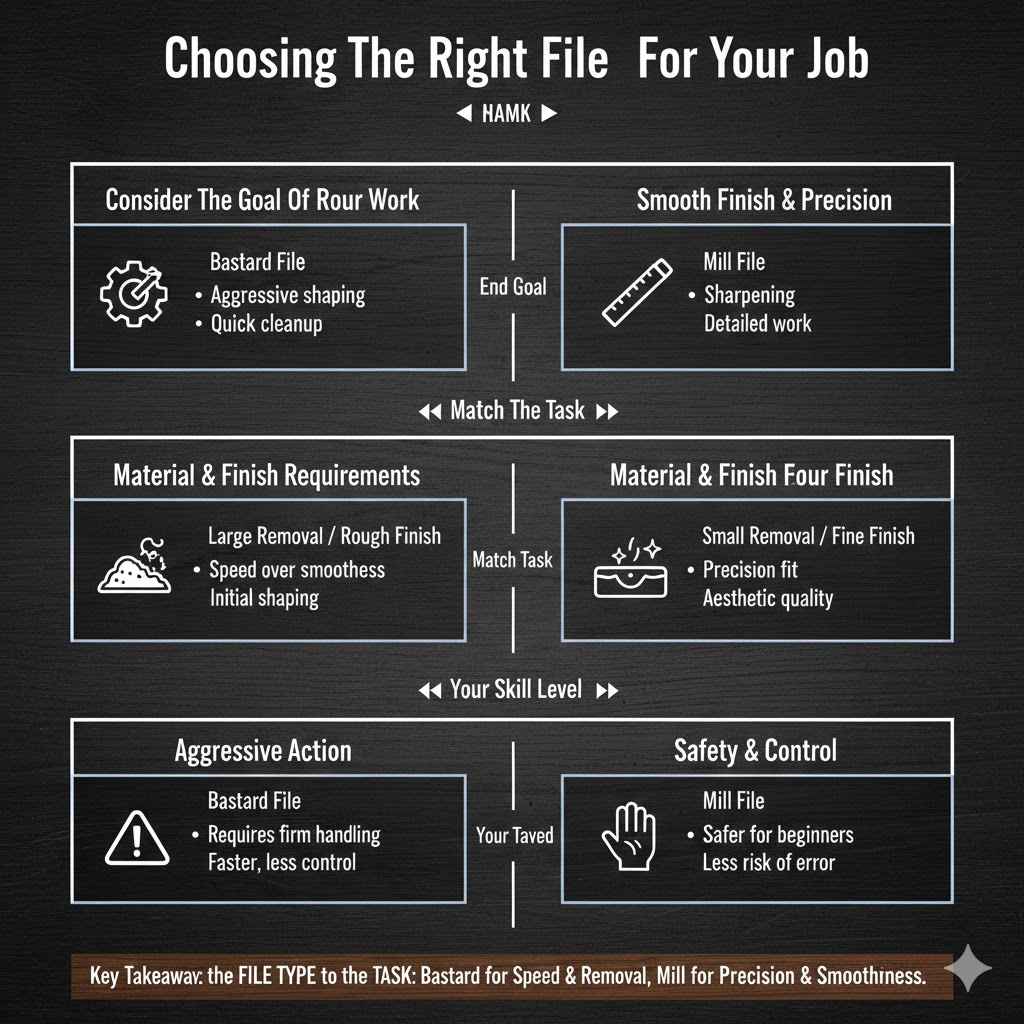
The core of this choice lies in two main factors: how much material you need to remove, and how smooth you need the final surface to be. If you need to remove a lot of material quickly, a bastard file is the way to go. If you need a smooth finish or are doing detailed work, a mill file is the better choice.
Let’s explore how to make this decision easily.
Consider The Goal Of Your Work
The most important factor is the end goal of your work. Are you trying to quickly reshape a rough piece of metal, or are you trying to create a smooth, polished surface? If your goal is rapid material removal, aggressive shaping, or quickly cleaning up large burrs, a bastard file is the appropriate tool.
Its design is optimized for speed and efficiency in these rougher tasks.
On the other hand, if your objective is to create a fine finish, sharpen a delicate edge, or make precise adjustments to ensure a perfect fit, then a mill file is the better choice. Its single-cut teeth provide control and a smooth result, essential for these finer applications. Always think about what the final product should look like and feel like.
Material To Be Removed
The amount of material you need to remove also plays a significant role. For large amounts of material, especially in the initial stages of shaping, the aggressive nature of the bastard file is beneficial. It can take off substantial portions of metal quickly, moving you closer to your final dimensions much faster.
If you only need to remove a small amount of material, such as for fine-tuning a fit or carefully honing an edge, a mill file is more suitable. Its gentle cutting action allows for precision, ensuring you don’t accidentally remove too much metal. This controlled removal is crucial when working with small tolerances or valuable pieces.
Surface Finish Requirements
The desired surface finish is often the deciding factor. If the surface will be painted, polished, or is meant to be aesthetically pleasing, a mill file is the preferred tool for finishing. It leaves a smoother surface that requires less subsequent work, if any, to achieve the desired look.
A smooth surface also feels better to the touch and can indicate a higher quality of craftsmanship.
If the surface finish is not critical, or if it will be further processed by other means (like grinding or polishing), then the rough finish left by a bastard file might be acceptable, or even beneficial, as it provides a good surface for subsequent aggressive processes. The key is to match the file’s output to the next step in your process or the final requirement.
Safety And Control
While both types of files require safe handling, the level of control offered by each can influence the choice. For intricate work or when dealing with delicate materials, the controlled, less aggressive cutting of a mill file provides greater safety and reduces the risk of accidental damage. Its smoother action is easier to manage for beginners.
Bastard files, due to their aggressiveness, require more deliberate handling to maintain control. While effective for their intended purpose, they can remove material very quickly, meaning a slip or an overly enthusiastic stroke can lead to unintended alterations. Therefore, for tasks demanding high precision and minimal risk of error, the mill file offers superior control, especially for those with less experience.
Frequently Asked Questions
Question: What is the main difference between a mill file and a bastard file
Answer: The main difference is the tooth pattern. A mill file has single-cut teeth for smoother, slower material removal, while a bastard file has double-cut teeth for faster, more aggressive material removal.
Question: Which file is better for sharpening tools
Answer: A mill file is generally better for sharpening tools because its single-cut teeth allow for precise control and a smooth, sharp edge without removing too much material.
Question: Can I use a bastard file for finishing metal
Answer: No, a bastard file is not ideal for finishing metal because it leaves a rough surface. You would typically use a mill file or finer file for finishing work after using a bastard file for rough shaping.
Question: Which file removes metal faster
Answer: A bastard file removes metal faster because its double-cut teeth are more aggressive and designed for rapid material removal.
Question: Are mill files good for shaping rough metal
Answer: Mill files are not designed for shaping rough metal. They are too slow and gentle for that purpose. A bastard file is much better suited for quickly shaping rough metal stock.
Summary
Understanding the difference between a mill file and a bastard file comes down to their teeth. Mill files have one set of teeth for smooth, precise work. Bastard files have two sets of teeth for fast, rough work.
Choose a mill file for finishing, sharpening, and fine adjustments. Reach for a bastard file when you need to remove a lot of metal quickly. Knowing this will help you pick the right tool for your job.
Happy filing!