How Many Watts Does a Sawzall Use? (12-15 Amp = 1,440-1,800 W)
A corded Sawzall-style reciprocating saw is rated at 12 to 15 amps, which works out to a maximum of about 1,440 to 1,800 watts on a 120-volt outlet (amps x volts), but the saw only reaches that number under heavy load. A cordless model draws nothing from the wall; its “watts” come from the battery. This guide gives the model-by-model math, what changes the draw, and how to size a generator or circuit for it.
How Many Watts Does a Sawzall Use?
Best 12-Amp Corded Pick
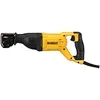 |
DEWALT 12 Amp Corded Reciprocating Saw (DWE305) A 12-amp corded saw rated 0-2,900 strokes per minute, a good reference point for a saw that stays inside a standard 15-amp household circuit.
|
As an Amazon Associate we earn from qualifying purchases.
Watts are volts multiplied by amps, and a saw’s nameplate lists amps. On a 120-volt US outlet, a 12-amp saw is rated for up to 1,440 watts (12 x 120) and a 15-amp saw for up to 1,800 watts (15 x 120). Those are ceilings for a saw working hard, not what it pulls while the blade spins in the air.
Strictly speaking, amps x volts gives volt-amperes, and a motor’s real power in watts is slightly lower because of its power factor. For sizing an outlet or a generator, though, the volt-ampere figure is the safe one to plan around, and it is the one this page uses. Older versions of this article quoted several different ranges (900-1,000 W, 1,200-1,800 W and 800-1,500 W) with no model behind them, so the table below replaces those guesses with published ratings.
Sawzall Wattage by Model: Amps x Volts
The amp ratings below come from the manufacturers’ own product pages (DEWALT’s DWE305 spec page and Milwaukee’s 6538-21 page); the watt column is our arithmetic at 120 volts, not a figure either brand publishes.
| Corded saw | Rated amps | Max watts (amps x 120 V) | Speed (strokes/min) |
|---|---|---|---|
| DEWALT DWE305 | 12 A | 1,440 W | 0-2,900 |
| Milwaukee 6519-31 Sawzall (listed as no longer available) | 12 A | 1,440 W | 0-2,800 |
| Milwaukee 6538-21 Super Sawzall | 15 A | 1,800 W | Not listed on the page |
12 amps x 120 volts = 1,440 watts; 15 amps x 120 volts = 1,800 watts. Source for the amp ratings: DEWALT DWE305 specifications.
The takeaway: the range people search for is really two numbers. A mid-size 12-amp saw tops out around 1,440 W, and a heavy-duty 15-amp saw around 1,800 W. A 15-amp saw is the point where a single ordinary 15-amp household circuit has no room left for anything else running at the same time.
What Amps and Volts Mean on the Nameplate
- Volts (V): the electrical pressure. US wall outlets supply about 120 V; a cordless battery is far lower (18 V nominal for most 18/20 V-class packs).
- Amps (A): how much current the motor is rated to pull. This is the number printed on corded saws and the one that scales with cutting effort.
- Watts (W): amps x volts. Kilowatt-hours on your electric bill are watts x hours of use divided by 1,000.
A higher amp rating does not mean a better cut on its own. It usually means a motor built to keep its speed while pushing a blade through thicker or harder material, which is why demolition-oriented saws sit at 15 amps while lighter saws sit near 12. For a comparison of what a reciprocating saw can and cannot do against other saws, see our circular saw vs Sawzall breakdown.
Corded vs Cordless: Where the Power Comes From
A cordless Sawzall has no wall wattage at all. The energy comes from the battery, which is rated in volts and amp-hours; multiply the two for watt-hours (Wh), the battery’s total energy. A pack that is 18 V nominal and 5.0 Ah stores about 90 Wh (18 x 5.0), so even a hard hour of cutting draws a small fraction of what a corded saw’s nameplate implies, because the saw stops using energy when you stop cutting.
| Cordless saw | Voltage | Speed | Notes from the manufacturer page |
|---|---|---|---|
| DEWALT DCS367B (tool only) | 20V MAX (18 V nominal) | Up to 2,900 strokes/min | 5 lb tool-only weight; brushless motor; battery not included |
| Milwaukee M18 FUEL 2720-21 kit | 18 V system | Not listed on the page | Kit includes an M18 REDLITHIUM XC5.0 battery, charger and case; brushless POWERSTATE motor |
The 20 V versus 18 V labels are the same voltage class: 20 V is the maximum voltage right off the charger, and 18 V is the nominal working voltage, according to DEWALT’s own listing. When you compare cordless saws, compare battery amp-hours and brushless versus brushed motors rather than the 18/20 number. If you plan to swap between saw bodies, our notes on whether Sawzall blades are universal cover the blade side.
What Makes a Sawzall Draw More Power
The nameplate is a ceiling. In practice the draw rises and falls with the job:
- Material: cutting nail-embedded 2x4s or metal pipe loads the motor far more than trimming a green branch.
- Blade condition: a dull or wrong-TPI blade forces the motor to work harder for the same cut, so it draws more and heats up.
- Pressure and speed setting: leaning on the saw slows the blade, which raises current. Let the blade do the cutting at a steady speed.
- Extension cord: a long, thin cord drops voltage, and a motor that gets less voltage pulls more current for the same work. Use a heavy-duty cord rated for the saw’s amps.
- Startup: electric motors pull a short surge when they start, higher than their running draw.
Reciprocating saws are also a poor fit for fine work regardless of wattage; for controlled cuts on wood, a circular saw or handsaw is a better tool. For a similar walk-through on another saw, see how many watts a miter saw uses.

Can a Generator or Household Circuit Run a Sawzall?
Yes for a single saw, with headroom. Start from the saw’s rated amps: a 12-amp saw needs a supply that can deliver 1,440 W, and a 15-amp saw needs 1,800 W, before adding anything else on the same circuit or generator such as a shop light, a work-site radio, or a dust extractor.
- Household circuit: a standard US 15-amp branch circuit carries a maximum of 1,800 W. The common electrical-code guideline of loading a circuit to about 80 percent for continuous use leaves roughly 1,440 W, so a 15-amp saw should have a circuit to itself.
- Portable generator: choose one whose running-watt rating clears the saw’s nameplate watts with margin, and check its surge rating as well, since the saw’s motor pulls a brief surge at startup. Confirm the exact figures in the saw’s and the generator’s manuals; do not size to the low end of a generic range.
- Cordless instead: if you only have a small generator or none at all, a cordless saw sidesteps the whole question and its charger draws far less than the saw’s nameplate.
What It Costs to Run a Sawzall
Electricity cost is watts x hours / 1,000 x your rate per kilowatt-hour. As a deliberate worst case, a 12-amp saw at its full 1,440 W for one hour is 1.44 kWh; at an example rate of $0.17 per kWh (use the rate on your own bill), that is about 24 cents. Real cutting is intermittent and below the nameplate, so a typical job costs a few cents. Electricity is never the real cost of a Sawzall; blades and the saw itself are.
Frequently Asked Questions
How many watts does a Sawzall use?
A corded Sawzall is rated for up to about 1,440 watts at 12 amps or 1,800 watts at 15 amps on a 120-volt outlet (amps x volts). It draws that only under heavy load. A cordless model draws no wall power while cutting and stores energy in its battery instead.
How many amps does a Sawzall pull?
Published corded ratings run from 12 amps (DEWALT DWE305, Milwaukee 6519-31) to 15 amps (Milwaukee 6538-21 Super Sawzall). The nameplate is the maximum the motor is rated for, so real-world current while cutting is usually lower.
Can I run a Sawzall on a generator?
Usually yes, if the generator’s running watts comfortably exceed the saw’s nameplate watts (1,440 W for 12 A, 1,800 W for 15 A) and its surge capacity covers the brief startup draw. Check both the saw and generator manuals rather than relying on a general rule.
Is a cordless Sawzall as powerful as a corded one?
Modern brushless cordless saws such as the DEWALT DCS367B list the same top speed as the corded DWE305 (up to 2,900 strokes per minute), but they run only as long as the battery lasts. Corded saws hold full power for as long as you have an outlet.
Bottom Line
Plan on about 1,440 watts for a 12-amp corded Sawzall and about 1,800 watts for a 15-amp one, use a heavy-duty cord and a dedicated circuit, and remember the nameplate is a ceiling rather than a constant. If you would rather not think about wall power at all, a cordless saw trades that question for battery capacity.
Sponsored / affiliate links. As an Amazon Associate I earn from qualifying purchases. I may earn additional commission from eligible campaigns.