SawStop Compact vs. Jobsite Saw Pro: Which Fits Your Shop?
Both SawStop saws use the exact same flesh-detection safety brake, so the Compact-vs-Jobsite decision actually comes down to size, dado support, and how far you need to roll the saw – not safety.
That surprises a lot of shoppers who assume the pricier Jobsite Saw Pro must be “safer” too. It isn’t – SawStop’s Active Injury Mitigation (AIM) technology is identical across both models. What actually changes between them is how much table you get, whether you can cut a dado joint, and whether the saw folds onto a mobile cart or has to be carried. Below is a real spec-by-spec breakdown, plus which one we’d point you toward depending on your shop.
Quick Verdict: Compact for Small Shops, Jobsite Pro for Everything Else
If your shop space is genuinely tight – a shed, a one-car garage shared with a vehicle, a basement corner – the Compact’s smaller footprint and 68-pound weight are the whole story. For nearly everyone else, the extra rip capacity, dado support, and rolling cart on the Jobsite Saw Pro are worth the added cost and 16 pounds. Here’s the model we’d send most readers toward:
Best All-Around SawStop Pick
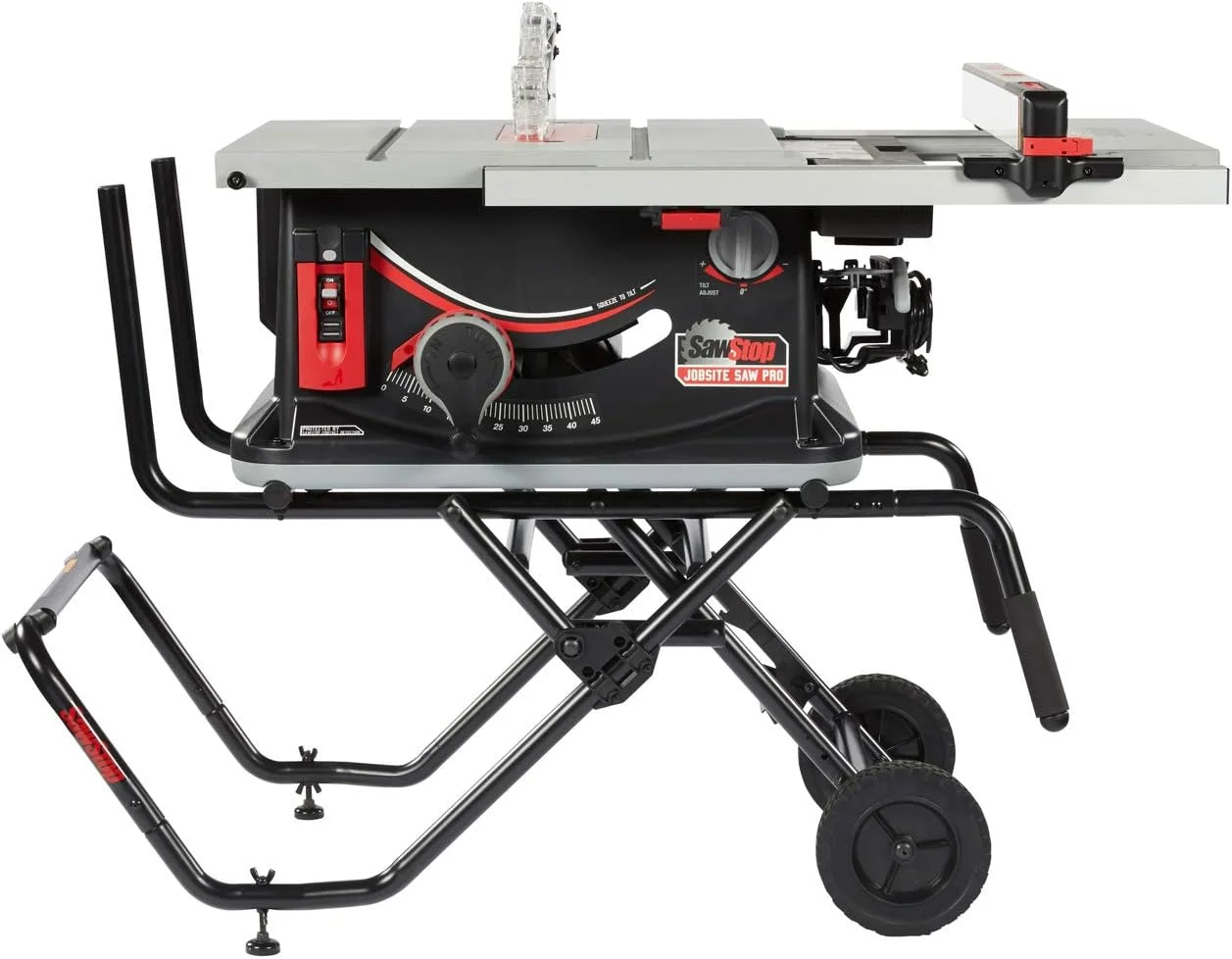 |
SawStop Jobsite Saw Pro (JSS-120A60) – $1,899 The saw most readers in this comparison end up buying – more rip capacity, dado support, and a mobile cart the Compact simply can’t match.
|
Spec Comparison Table
These numbers come from SawStop’s own published specs and current retailer listings, not marketing copy:
| Spec | SawStop Compact (CTS-120A60) | SawStop Jobsite Saw Pro (JSS-120A60) |
|---|---|---|
| Weight | 68 lbs | 84 lbs (plus mobile cart) |
| Footprint / table size | 23" x 22-5/8" tabletop, benchtop-only | Stows at 26.5" L x 29" W x 45" H on its cart |
| Rip capacity | 24-1/2" right, 9-1/2" left of blade | Roughly 25" right of blade with the standard fence |
| Motor | 1800W direct-drive | 1.5 HP continuous, up to 4 HP peak, 15A |
| Dado capability | Not supported | Supports stacked dado sets |
| Safety brake | SawStop flesh-detection AIM brake | Same SawStop flesh-detection AIM brake |
| Mobility | Carry handles, no wheels | Built-in folding mobile cart with wheels |
| Typical street price | Around $974 | $1,400–$1,900 depending on retailer and cart bundle |
Design and Build
The Compact is built around a direct-drive motor and a rack-and-pinion fence, packed into a 23-inch by 22-5/8-inch tabletop that weighs 68 pounds on its own. There’s no rolling stand included – you carry it by its built-in handles, which is fine for a saw this size but means two trips if you’re also hauling a stand. Blade changes are quick thanks to a one-turn elevation system, and depth of cut tops out at 3-1/8 inches at 0 degrees.
The Jobsite Saw Pro is a different category of tool. It ships with a folding mobile cart built in, so the whole saw wheels in and out of a truck bed or storage closet without being lifted onto a separate stand. Its fence is a Hi-Low T-style design with an Ergolock mechanism, and the table depth in front of the blade is a full 8 inches – versus 6 inches on SawStop’s standard (non-Pro) jobsite saw – which matters when you’re guiding long stock through a rip cut.
Safety Mechanism: Where the Two Saws Are Actually Identical
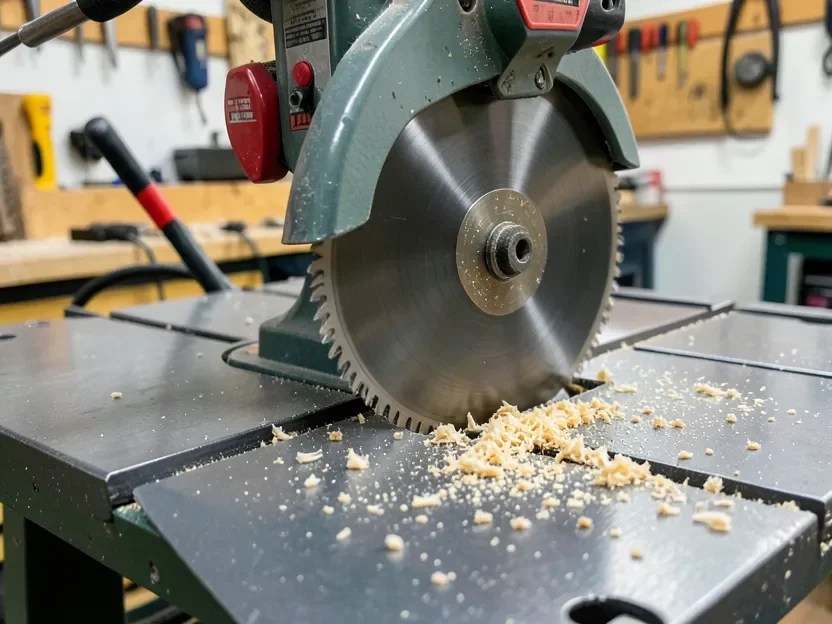
SawStop’s patented flesh-detection system is the reason the brand exists, and it’s the one spec that doesn’t change between these two saws. A low-voltage signal runs through the spinning blade; when the blade contacts skin, the change in electrical signal trips a spring-loaded aluminum brake that jams into the blade and drops it below the table – all in under 5 milliseconds. That’s fast enough in independent testing and real-world incident reports to turn what would be a serious laceration into a minor nick.
One thing most comparison articles leave out: triggering the brake destroys the brake cartridge and, in most cases, the blade too. Replacement cartridges run roughly $70–$100 depending on the model, and a damaged blade is a separate cost on top of that. It’s a worthwhile trade for the safety, but it’s a real ongoing cost of ownership for either saw, not just an upfront price difference – and it’s identical whether you buy the Compact or the Jobsite Saw Pro.
Performance and Cutting Capacity
Comparing the Compact’s 1800W spec directly against the Jobsite Saw Pro’s 1.5 HP continuous / 4 HP peak rating is where a lot of buyers get confused, because the two numbers are measured on different scales and aren’t directly convertible. What you can compare directly is real-world capability: the Jobsite Saw Pro’s higher continuous rating and larger table depth make it noticeably better at repeated rip cuts in thick hardwood, and it’s the only one of the two that accepts a stacked dado set for cutting grooves and joinery. The Compact keeps up fine on furniture-scale plywood and softwood work but will bog down faster on long runs through 8/4 hardwood.
Portability and Footprint
This is the Compact’s strongest argument. At 68 pounds with built-in carry handles and no cart, it’s genuinely a one-person, one-trip saw that tucks against a wall when not in use. The Jobsite Saw Pro’s mobile cart makes it easy to roll once assembled, but the saw-plus-cart combination is heavier overall and takes up more floor space even folded, at 26.5 by 29 by 45 inches stowed. If you’re setting up and breaking down in a shared garage every weekend, that difference adds up fast.
Price and Total Cost of Ownership
SawStop lists the Compact around $974 direct. The Jobsite Saw Pro runs anywhere from about $1,400 to $1,900 depending on the retailer and whether the mobile cart assembly is bundled in – current Amazon pricing for the cart-included version sits at $1,899. Factor in that both saws carry the same brake-cartridge replacement cost if the safety system ever triggers, so the ongoing cost of ownership gap is smaller than the sticker-price gap suggests.
Which One Should You Buy
Buy the Compact if: your shop space is genuinely limited, you don’t need dado cuts, and most of your projects are furniture-scale or smaller. Buy the Jobsite Saw Pro if: you need to cut dado joints, you regularly rip long or thick stock, or you move the saw between locations and want it on wheels rather than carried. Either way, you’re getting the same flesh-detection safety brake – you’re really just choosing how much saw you need day to day.
Frequently Asked Questions
What is the real difference between the SawStop Compact and the Jobsite Saw Pro?
Both use the identical SawStop flesh-detection safety brake, so safety isn’t the deciding factor. The real differences are size and capability: the Compact is a 68-pound benchtop saw with no dado support, while the Jobsite Saw Pro is a 84-pound saw on a mobile cart that supports stacked dado blades and has roughly 15 percent more rip capacity.
Can the SawStop Compact cut dado joints?
No. The Compact’s arbor and blade guard system don’t support stacked dado sets. If dado joinery is part of your regular workflow, the Jobsite Saw Pro is the only one of the two that can do it.
Is the SawStop Jobsite Saw Pro actually more powerful than the Compact?
The specs are measured differently, which causes confusion. The Compact lists an 1800W direct-drive motor while the Jobsite Saw Pro lists 1.5 HP continuous and up to 4 HP peak. In practice, the Jobsite Saw Pro handles thicker hardwood and repeated ripping better, but the wattage-versus-horsepower numbers alone aren’t a clean apples-to-apples comparison.
Which SawStop is better for a small home shop?
If your workspace is a corner of a garage or basement and you mostly build furniture-scale projects without dado joints, the Compact’s smaller footprint and lighter weight make it easier to store and move. Choose the Jobsite Saw Pro instead if you need the extra rip capacity, dado support, or plan to move the saw between job sites on its cart.
Conclusion
Both the SawStop Compact and the Jobsite Saw Pro share the same flesh-detection brake, so this isn’t a safety decision – it’s a capacity and space decision. If you need dado cuts, more rip capacity, or a saw that rolls rather than gets carried, the Jobsite Saw Pro earns its higher price. If your shop is small and your projects don’t call for dado joinery, the Compact does the job for a lot less money and a lot less floor space. Once you’ve picked a saw, check out our guide to SawStop table saw accessories for the fences, blades, and dust-collection add-ons worth buying next.
Sponsored / affiliate links. As an Amazon Associate I earn from qualifying purchases. I may earn additional commission from eligible campaigns.