5 Wood vs Driver: Essential Comparison
Comparing a 5 wood vs driver? A driver is for maximum distance off the tee, built for long, sweeping shots with a lower loft. A 5 wood is more versatile, offering a blend of distance and control, with a higher loft suitable for longer fairway shots and even some tee shots when accuracy is key. Choosing between them depends on your game needs.
Welcome to the workshop, everyone! Today, we’re tackling a question that many beginner golfers and DIY enthusiasts alike ponder when looking at their golf clubs: what’s the real difference between a 5 wood and a driver? It can seem a bit confusing, aiming to get the best launch distance and accuracy from your swings. But don’t worry, we’ll break it down step-by-step, making it as clear as a freshly planed piece of wood. By the end of this guide, you’ll know exactly when to reach for your driver and when your 5 wood is the perfect tool for the job. Let’s get started!
Understanding Your Golf Club Basics: Driver vs. 5 Wood
When you’re starting out in golf, or even if you’ve been playing for a while, understanding the clubs in your bag is crucial. Two of the longest clubs you’ll encounter are the driver and the fairway wood, specifically the 5 wood. While they both aim to send the ball sailing, they have distinct designs and purposes. Think of them like different tools in your woodworking shed – you wouldn’t use a saw to hammer a nail, right? They have specific jobs.
The driver is your longest club, designed for hitting the ball as far as possible, primarily from the tee box. On the other hand, a 5 wood offers a great balance between distance and control, making it a reliable choice for longer shots from the fairway or even some tee shots where accuracy is more important than sheer distance. Getting a feel for these differences will help you make better decisions on the course, leading to more confident swings and, hopefully, lower scores!
The Anatomy of a Driver
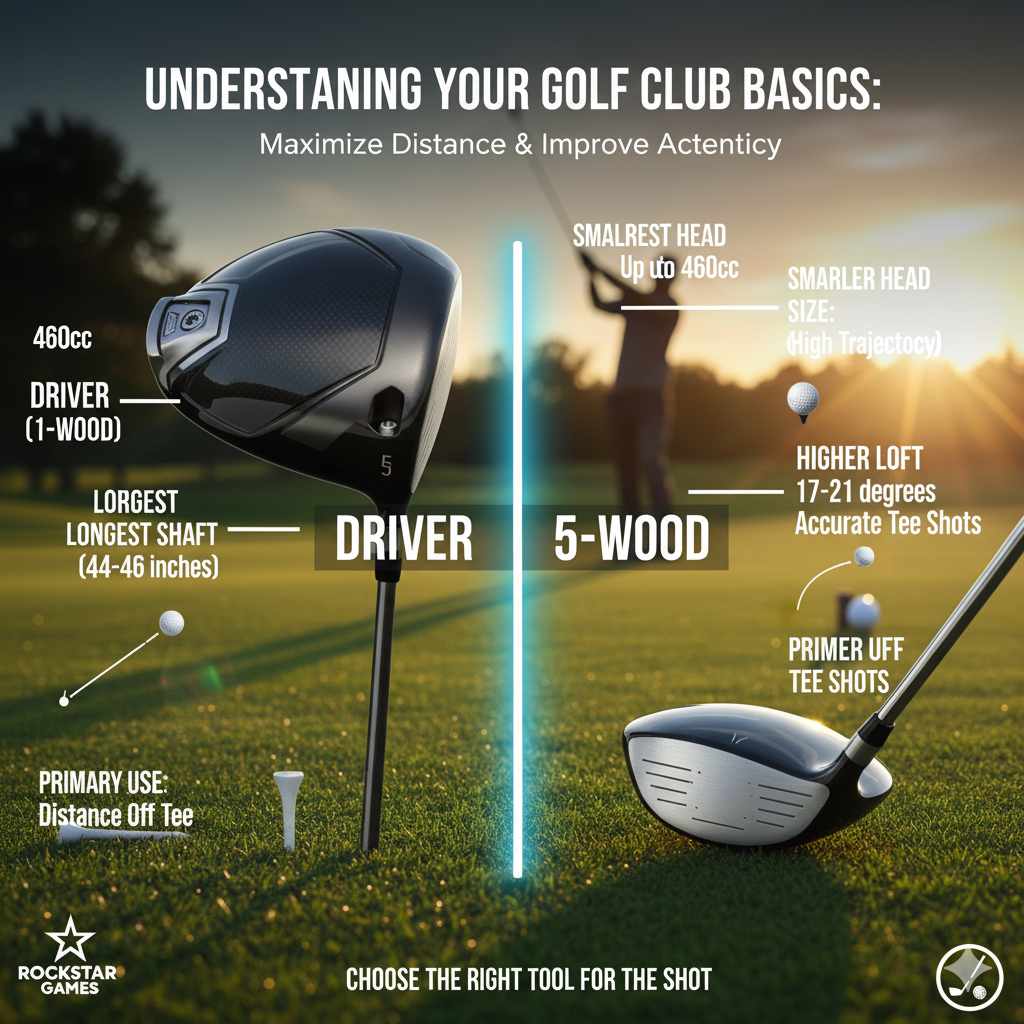
The driver, often called the 1-wood, is the king of distance in your golf bag. Its head is typically the largest, boasting a size up to 460cc (cubic centimeters), the maximum allowed by golf’s governing bodies, to maximize forgiveness and the sweet spot. This bigger head, combined with other design features, is engineered to help you hit the ball further than any other club.
Key characteristics of a driver include:
- Largest Head Size: Maximizes the hitting area for more forgiveness and power.
- Longest Shaft: Usually around 44 to 46 inches, allowing for greater clubhead speed.
- Lowest Loft: Typically ranges from 7 to 12 degrees. Loft is the angle of the clubface relative to the shaft. Lower loft helps the ball travel lower and further.
- Least Lie Angle: The angle between the shaft and the ground when the club is addressed. Drivers have a flatter lie angle.
These elements work together to generate maximum ball speed and distance. However, this design can also make the driver less forgiving on mis-hits and harder to control for beginners. It’s your go-to for those long, open holes where you just need pure distance.
The Anatomy of a 5 Wood
The 5 wood, part of the fairway wood family, is a versatile club that bridges the gap between your longest irons and your driver. It’s designed to deliver significant distance while offering more control and ease of use compared to a driver, especially from the turf.
Here’s what defines a 5 wood:
- Smaller Head Size: Although still a generous size, it’s smaller than a driver’s head, often ranging from 150cc to 200cc.
- Shorter Shaft: Typically around 41 to 43 inches, shorter than a driver’s shaft, which aids in control.
- Higher Loft: Usually between 17 to 21 degrees. This higher loft helps get the ball into the air more easily, providing a higher, softer landing trajectory.
- Steeper Lie Angle: Compared to a driver, the 5 wood’s lie angle is generally steeper, making it easier to hit off the ground.
The 5 wood is an excellent choice for golfers who struggle to consistently hit their driver off the tee, or for those longer approach shots from the fairway where you need distance but also want a good chance of hitting the green.
Key Differences: 5 Wood vs. Driver
While both clubs are designed to hit the ball long distances, their construction leads to significant differences in performance. Understanding these distinctions will help you choose the right club for the right situation on the golf course. Let’s dive into the specifics that set them apart.
1. Loft and Launch Angle
The most apparent difference lies in their loft. A driver has the lowest loft in your bag, typically between 7-12 degrees. This low loft is designed to produce a lower launch angle, ideal for maximizing distance when struck perfectly on a tee. The lower the loft, the less spin the ball tends to have, which also contributes to longer carry distances. For more on optimizing launch angle and spin, resources like USGA’s technical rules can offer deeper insights into equipment performance.
A 5 wood, conversely, has a much higher loft, usually in the 17-21 degree range. This higher loft results in a higher launch angle, making it easier to get the ball airborne, especially from the fairway. The increased loft also imparts more backspin, which helps the ball stop more quickly on the green. This makes the 5 wood a favorite for players who need a high, manageable trajectory.
2. Shaft Length and Swing Speed
The length of the shaft plays a critical role in how you swing the club and, consequently, the speed you can generate. Drivers have the longest shafts in a golf bag, often at 44 to 46 inches. The longer shaft allows for a wider arc during your swing, enabling golfers to generate higher clubhead speeds. More clubhead speed directly translates to more ball speed and greater distance.
A 5 wood’s shaft is considerably shorter, typically between 41 and 43 inches. This shorter length brings the clubhead closer to your body, offering more control and making it easier to manage your swing. While you might not generate the absolute peak clubhead speed you could with a driver, the increased control often leads to more consistent contact and better results, especially for amateur golfers.
3. Clubhead Size and Design
The physical dimensions of the clubhead also influence performance. Drivers are designed with the largest heads allowed, up to 460cc in volume. This large footprint increases the moment of inertia (MOI), making the club more stable and forgiving. A larger sweet spot means that off-center hits are less penalized, maintaining more distance and accuracy than with a smaller clubhead.
Fairway woods, including the 5 wood, have smaller heads. While still substantial, they are more compact than a driver. This design allows the club to be more easily maneuvered through the turf, making it ideal for hitting shots from the fairway or light rough. The more compact shape also influences how the club interacts with the ground, contributing to its versatility.
4. Versatility and Usability
This is where the 5 wood truly shines for many golfers, especially beginners. While the driver is optimized for pure distance off the tee, it can be challenging to hit consistently. The combination of a long shaft and low loft demands a precise swing to achieve optimal results.
The 5 wood, with its shorter shaft, higher loft, and more forgiving design, is much more versatile. It can be hit effectively from the tee on shorter holes or when accuracy is paramount. More importantly, it’s designed to be hit cleanly off the turf, a shot that many amateurs find difficult with a driver. The 5 wood’s ability to launch the ball high and far from various lies makes it an invaluable club for approach shots and when you need a reliable alternative to the driver.
5. Distance and Control Trade-off
The fundamental trade-off between these two clubs is distance versus control. The driver is engineered to maximize distance. Its design prioritizes speed and minimizing spin to achieve the longest carry. When struck well, the distance gained can be significant.
The 5 wood offers a compromise. It still provides substantial distance, often not too far behind a well-struck driver for many players, but with a greater emphasis on control. The higher loft and shorter shaft help in achieving a more consistent strike and a predictable ball flight. For golfers who don’t consistently hit their driver with great speed, a 5 wood might even yield similar or better distances due to its higher launch and accuracy.
When to Use Your Driver
The driver is your longest club for a reason, and it’s most effective in specific situations designed to leverage its maximum distance capabilities. Mastering when to pull it out of the bag is key to improving your game.
Tee Shots on Long Holes
This is driver territory. On par 4s and par 5s where you have a wide-open fairway and significant distance to cover, the driver is your best friend. Its design is optimized to get the ball airborne at a lower angle and with minimal spin, crucial for achieving maximum carry and roll.
Situations Demanding Maximum Carry
If you have a wide-open hole with no hazards in sight, and your primary goal is to gain as much yardage as possible off the tee, the driver is the club. It’s built for raw power and distance, making it the ultimate weapon for those long blasts down the fairway. For more on aerodynamic principles in golf clubs, resources like those from NASA, though not golf-specific, illustrate the physics of moving objects through air.
Dry, Firm Fairway Conditions (Rarely for Amateurs)
While less common for many amateur players, if you’re playing on a course with very firm and fast fairways, the driver’s low loft can encourage extra roll after landing. However, this is a highly advanced consideration, and for most golfers, sticking to tee boxes with the driver is the safest bet.
When to Use Your 5 Wood
The 5 wood is often called a “fairway finder” or a “go-to” club by many because of its incredible versatility and reliability. It’s a club that can save strokes in many different scenarios for golfers of all skill levels.
Long Approach Shots from the Fairway
This is a primary role for the 5 wood. When you’ve hit a good drive but still have a significant distance to the green (say, 180-220 yards), the 5 wood is perfect. Its higher loft provides more lift and a softer landing, increasing your chances of reaching the green and holding it.
Tee Shots on Shorter Holes or When Accuracy is Crucial
On par 3s that are on the longer side, or on par 4s where the fairway is narrow or guarded by hazards, the 5 wood is often a smarter choice than the driver. You sacrifice a little potential distance for a much higher degree of control, reducing the risk of a wayward shot and keeping you in play.
Getting Out of Light Rough
The more compact head and design of the 5 wood allow it to glide through less severe rough areas more easily than a larger driver head. If you’re just off the fairway in light grass, a 5 wood can be a good option to advance the ball down the fairway again.
When You Struggle with Driver Consistency
For many golfers, particularly beginners or those with slower swing speeds, hitting the driver consistently is a challenge. The 5 wood, with its shorter shaft and higher loft, is generally much easier to control. If you’re finding you hit your driver erratically, switching to a 5 wood off the tee can lead to more fairways hit and a more stress-free round.
When a Higher, Softer Landing is Needed
If you’re facing a green with water in front or a narrow green, you want a club that launches the ball high and stops quickly. The 5 wood’s loft and design are perfect for this, giving you a better chance of landing the ball safely and keeping it on the green.
5 Wood vs Driver: A Quick Comparison Table
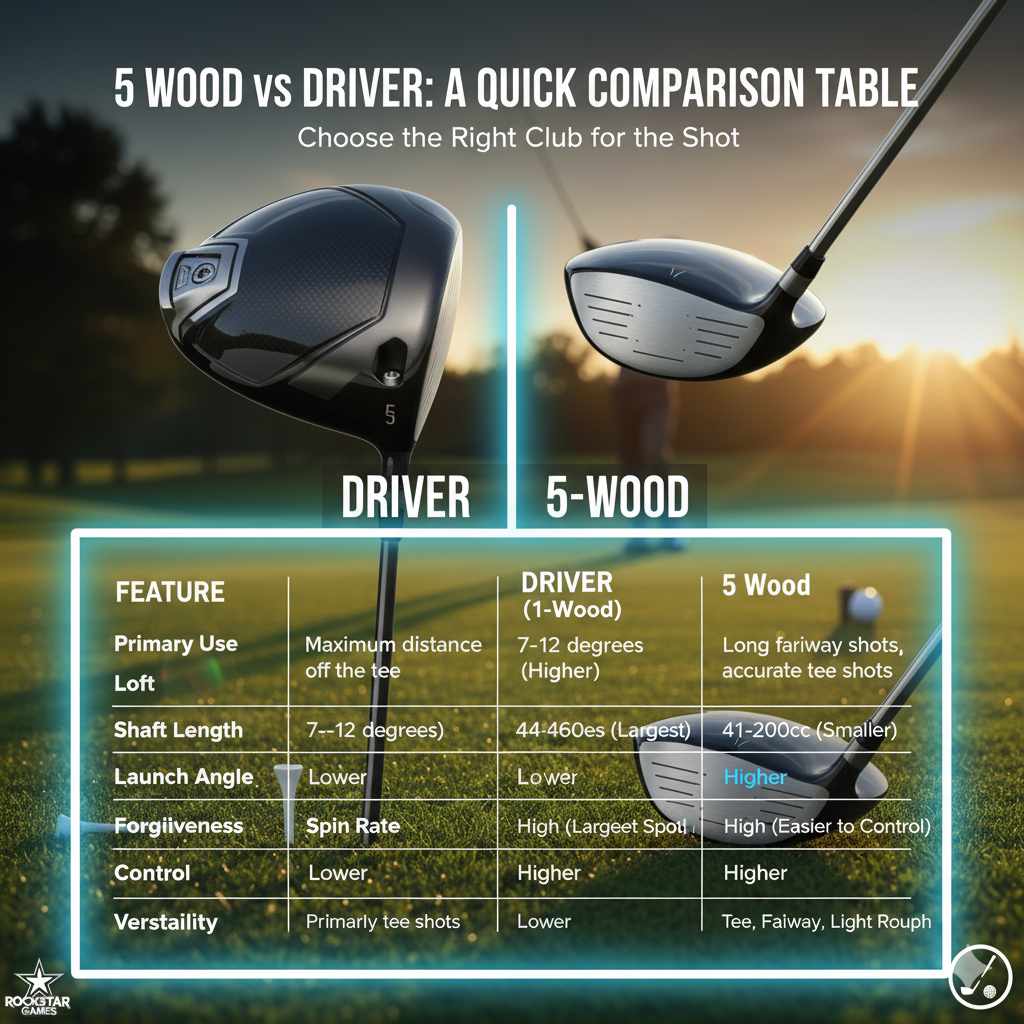
To make the differences even clearer, let’s look at a side-by-side comparison. This table highlights the core distinctions that influence how and when you’d use each club.
| Feature | Driver (1-Wood) | 5 Wood |
|---|---|---|
| Primary Use | Maximum distance off the tee | Long fairway shots, accurate tee shots |
| Loft | 7-12 degrees (Lower) | 17-21 degrees (Higher) |
| Shaft Length | 44-46 inches (Longer) | 41-43 inches (Shorter) |
| Clubhead Size | Up to 460cc (Largest) | 150-200cc (Significantly smaller than driver) |
| Launch Angle | Lower | Higher |
| Spin Rate | Lower | Higher |
| Forgiveness | High due to size, but requires good strike | High, easier to hit consistently |
| Control | Lower | Higher |
| Versatility | Primarily tee shots | Tee, fairway, light rough |
| Typical Distance | Longest | Second longest, good balance |
Optimizing Your Swing for Each Club
Knowing the differences is one thing, but executing effective swings with each club is another. Let’s look at some simple tips to help you get the most out of your driver and 5 wood.
Driver Swing Tips
Because the driver is so long and has a low loft, your swing needs to be optimized for upward contact with the ball. Think of it as hitting the ball on the “upswing” of your swing arc.
- Ball Position: Place the ball forward in your stance, generally off the heel of your lead foot. This encourages an upward strike.
- Tee Height: Tee the ball up high enough so that about half of the ball is above the top of your driver’s clubface at address.
- Stance Width: Use a wider stance for stability, which is beneficial given the longer swing.
- Weight Shift: Focus on a smooth, full shoulder turn and a proper weight shift to generate power. Avoid rushing the swing.
- Relaxed Grip: Grip the club firmly but not too tightly. A death grip can lead to tension and a loss of speed and fluidity.
5 Wood Swing Tips
The 5 wood is more forgiving and can be swung more like a larger iron or even a hybrid. It’s often easier to make solid contact with it, both off the tee and from the fairway.
- Ball Position: For shots off the fairway, position the ball slightly forward of the center of your stance. From the tee, you can tee it up slightly lower than your driver, or about the same height if you prefer.
- Address: Feel a bit more “down” on the ball than with the driver, preparing to strike it with a slightly descending or sweeping motion.
- Shaft Lean: You can allow for a bit of shaft lean forward at impact, especially when hitting from the turf, to help get under the ball.
- Compact Swing: Focus on a smooth, controlled swing. Because the shaft is shorter, a slightly more compact, repeatable swing can be very effective.
- Sweep the Turf: When hitting from the fairway, try to sweep the ball off the turf rather than digging into it. This will help you avoid digging the lead edge into the ground excessively.
Frequently Asked Questions (FAQ)
Here are some common queries beginners have about 5 woods and drivers:
Q1: Can I use my driver off the fairway?
Generally, no. Drivers are designed for tee box use. Their large heads, long shafts, and low lofts make them very difficult to hit cleanly off the turf. You’re likely to dig the club into the ground, leading to poor shots.
Q2: Is a 5 wood easier to hit than a driver for beginners?
Yes, for most beginners, a 5 wood is significantly easier to hit than a driver. The shorter shaft, higher loft, and more compact head make it more forgiving and easier to control.