Grabber Screws: Types, Made-in-USA Codes, Which to Buy
Grabber screws are a professional fastener brand from Grabber Construction Products, and the biggest thing most buyers get wrong is where they are made. Only Grabber items whose item number ends in the letter “A” are made in the United States, and Grabber lists those as special order. Everything else in the catalog follows the same naming logic, so once you can read the codes you can pick the right screw in about a minute.
This guide is built from Grabber’s own product pages and submittal sheet, not from hearsay. It covers what the catalog actually contains, how to decode thread, point, head and finish, which item to buy for wood studs versus metal framing, and the cost per screw we saw on Amazon listings. Anything we could not confirm from a Grabber document is left out or labeled.
Which Grabber Screw Should You Buy?
Best Grabber Pick for Wood Studs
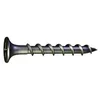 |
Grabber X500 #7 x 2″ Coarse Thread Drywall Screws, Gray Phosphate, 1 lb Box, $27.99 A small box of genuine Grabber coarse-thread screws, sized for a repair or a single room rather than a full job-site order.
|
For a typical interior job fastening gypsum board or sheet goods to wood studs, a coarse-thread bugle-head screw is the match, and that is what the X500 above is. Grabber’s own product page for a comparable coarse-thread drywall screw describes the use as “drywall to wood.” If your framing is steel instead, skip to the coarse versus fine thread section below, because a coarse thread is the wrong choice there.
We checked the listing through the Amazon product API the day we updated this page: the buy box showed the item in stock at $27.99. Prices and stock move, so confirm on the page before you order.
What Grabber Sells
Grabber’s screw catalog is organized by the material you are fastening into. The categories listed on the company site are drywall, heavy-gauge metal, light-gauge metal, cement board and sheathing, interior wood, exterior wood and composite, SuperDrive collated fasteners, and eye lags. The company also names several branded features, including the Scavenger head, the Vector point, Lag-Master, Tie-Master and UltraPro.
That makes Grabber more of a contractor supply line than a consumer brand. If you are framing with steel, our guide to metal framing covers the structural side, and Grabber’s screws are the fastener half of that job.
How to Decode a Grabber Screw
The drywall category alone lists more than 550 products, split by thread, point, finish, head and drive. These are the options Grabber’s site shows, with what each one is for.
| Feature | Options Grabber lists | What it means in practice |
|---|---|---|
| Thread | Coarse, Fine, Hi-Lo | Coarse for wood studs; fine for steel; Hi-Lo is a third option we did not test |
| Point | 23 degree Grabber, 23 degree Streaker, #3 drill, #3.5 pilot, sharp, Vector | Sharp points start in wood; drill points cut through steel |
| Finish | Phosphate, clear zinc, yellow zinc, NanoGard, GrabberGard gray, 305 stainless | Phosphate is the finish on every interior drywall item we read; the other finishes are alternatives Grabber offers |
| Head | Bugle, Scavenger | Bugle is the classic flared drywall head; Scavenger adds a second ring |
| Drive | Phillips, LOX | The items we read use a #2 Phillips recess; LOX is a different bit type |
Two of these deserve a closer look because they come up in searches: the Scavenger head and the fine-versus-coarse choice.
What Is a Scavenger Head?
Grabber describes the Scavenger head as a double bugle design with a secondary ring under the normal bugle head. Its stated purpose is to seat cleanly and reduce or eliminate paper burrs on drywall, which makes finishing easier. That is a claim from Grabber, not something we bench-tested, and it applies only to drywall work: the ring is irrelevant when you fasten into plain lumber. Grabber lists 79 Scavenger-head products in its drywall category, against 460 with a standard bugle head.
Coarse Thread Versus Fine Thread
The rule in Grabber’s own listings is simple. Coarse thread attaches gypsum board to wood. Fine thread with a drill point is for steel: the American-made item 16A, a #6 x 1-7/8 in. fine-thread screw, is described as attaching drywall or sheathing to steel measuring 33 mil or thicker. Grabber also lists a separate drywall-to-light-gauge-metal category, which is where its Streaker-point screws sit. Putting a coarse wood screw into steel framing, or a fine screw into a wood stud, is the mismatch to avoid.
Are Grabber Screws Made in the USA?
Only some are, and this is the correction most pages on the topic miss. Grabber’s submittal sheet states that Grabber screws with item numbers ending in “A” are manufactured in the United States, and that the American-made screws are special order inventory: you have to contact Grabber for current price and availability. That means a random box off a shelf or listing is not automatically American-made. Check the item number.
| Item number | Description (from Grabber) | Made in USA? |
|---|---|---|
| 300A | #6 x 1-1/4 in., bugle head, coarse thread, phosphate, bulk 8,000 | Yes, ends in A |
| 400A | #6 x 1-5/8 in., bugle head, coarse thread, phosphate, bulk 5,000 | Yes, ends in A |
| 16A | #6 x 1-7/8 in., bugle head, fine thread, drill point, phosphate, bulk 4,000 | Yes, described as American made |
| 408XX | #6 x 1-5/8 in., Scavenger head, coarse thread, phosphate, bulk 4,259 (20 lb box) | No A suffix; no USA statement on the page |
| X500 (our pick) | #7 x 2 in., coarse thread, gray phosphate, 1 lb box | No A suffix; not listed as American made |
We are being careful here on purpose. The X500 in our product box has no A suffix, so we are not claiming it is made in the USA. We also could not find a Grabber statement about where the non-A items are made, so we do not guess. If a domestic screw matters for your project, ask Grabber for an “A” item.
Driving Grabber Screws Correctly
Grabber’s submittal sheet for the American-made bugle-head series gives real installation numbers. Use a standard screwgun with a depth-sensitive nose piece. The sheet suggests at least 4 amps and 2500 RPM. The bugle head is fully seated when the head sits flush with the work surface, and overdriving can cause the fastener to fail or strip out the surface. For wood-to-wood connections, the sheet says minimum penetration should be 7 screw diameters, for example 1-1/4 in. for a #8 fastener.
Grabber’s page for the Scavenger-head 408XX is a little different: it recommends a #6 to #10 screwgun running up to 4,000 RPM. The spread between the two documents is a reminder to read the sheet for the exact item you buy rather than assume one setting fits all.
The same sheet lists what that series is approved to fasten: single-layer 3/8, 1/2 and 5/8 in. gypsum board and double-layer 1/2 and 5/8 in. board to wood studs and joists, insulation to wood, OSB or plywood to wood, and wood-to-wood applications. It also states that all Grabber screws are made in ISO 9001 certified facilities and that the fasteners comply with ASTM C1002 performance requirements.
Grabber Screws for Woodworking Projects
Grabber sells interior wood and exterior wood and composite lines, so it is more than a drywall brand. Still, a drywall-series screw is not a substitute for a screw with a published structural rating. If you are joining sheet goods, our guide on joining plywood with screws covers spacing and edge distance. If the job carries load outdoors, read whether deck screws are structural before choosing any fastener. Pilot hole sizes for solid wood are in our wood screw drill size chart.
What Grabber Screws Cost
These are Amazon listing prices we saw through the product API during this update. They are not equal comparisons because size, coating and quantity differ, but they show how strongly pack size drives the per-screw cost.
| Amazon listing | Pack | Listed price | Approx. price per screw |
|---|---|---|---|
| Grabber X500 #7 x 2 in., gray phosphate | 1 lb, about 140 screws | $27.99 | About $0.20 |
| Grabber 400YZ #6 x 1-5/8 in., yellow zinc | 5,000 per box | $172.99 | About $0.035 |
| Grabber 300YZ #6 x 1-1/4 in., yellow zinc | 8,000 per box | $213.99 | About $0.027 |
The takeaway: the small box costs roughly six to seven times as much per screw as the bulk boxes, though these are different sizes and coatings, so treat the ratio as a rough guide. For a single repair the 1 lb box is the sensible buy. For a whole room or house, bulk is the only way the math works.
Frequently Asked Questions
Where are Grabber screws made?
Grabber states that screws with item numbers ending in “A” are manufactured in the United States and are special order. Grabber’s pages we read do not give a country of manufacture for items without the A suffix.
What is a Scavenger head screw?
It is Grabber’s double bugle head with a secondary ring under the normal bugle head. Grabber says it seats cleanly in drywall and reduces or eliminates paper burrs.
Should I use coarse or fine thread Grabber screws?
Use coarse thread to fasten drywall to wood studs. Use fine thread with a drill point for steel framing, such as item 16A for steel 33 mil or thicker, or a Streaker-point fine-thread screw for light-gauge metal.
Are Grabber screws different from generic drywall screws?
Grabber lists a #2 Pro-Fit Phillips recess, ISO 9001 certified manufacturing and ASTM C1002 compliance. Other brands may meet the same standard, and we did not compare them side by side, so treat these as Grabber’s stated specifications rather than a proven advantage.
Conclusion
Grabber is a broad contractor line, and the item number tells you almost everything: the letter A means American-made special order, coarse means wood, fine with a drill point means steel. Match the thread to your framing, read the submittal sheet for the exact item, and buy a small box for small jobs and bulk for big ones.
Sponsored / affiliate links. As an Amazon Associate I earn from qualifying purchases. I may earn additional commission from eligible campaigns.