4×8 Plywood Actual Size: 47-7/8 or 48 x 96? It Depends on the Panel
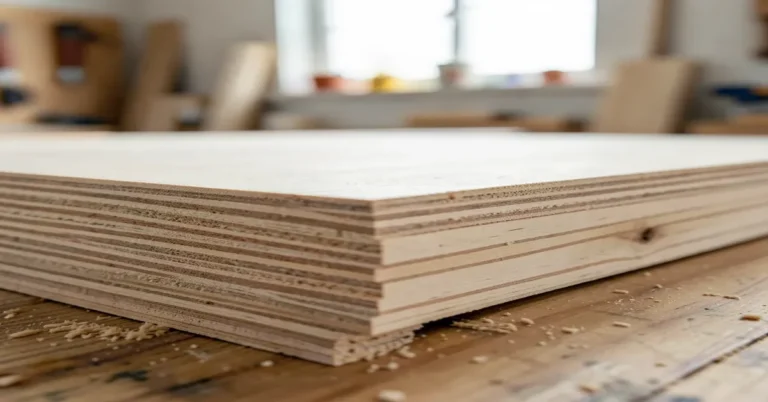
A sheet sold as 4×8 plywood is not one fixed size. Sheathing stamped Sized for Spacing is made 47-7/8 x 95-7/8 inches on purpose, while other panels are made to 48 x 96 and then allowed to run slightly under or over depending on the standard they follow. So the real answer is a range of roughly 47-3/4 to 48-1/16 inches wide, and the label on the rack will not tell you where your sheet falls. This guide shows the range, what drives it, and how it changes the cuts you plan.
Quick Answer
Plan on 47-7/8 x 95-7/8 inches for sheathing marked Sized for Spacing and on 48 x 96 inches minus up to 1/16 inch for most other plywood. Measure the sheet you actually bought at three points before you finalize a cut list.
4×8 Plywood Actual Size: What You Can Really Get
Best Caliper for Plywood Thickness
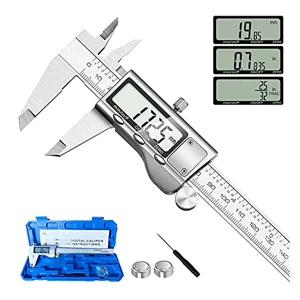 |
6 Inch Stainless Steel Digital Caliper (inch, mm, fraction): $15.18 A tape measure cannot tell 23/32 from 3/4. This caliper reads to 0.0005 inch and switches between inches, fractions and millimeters, which is what you need to check a real sheet.
|
Most size charts list a single number, 47-7/8 x 95-7/8. That number is real for one family of panels and a misconception for the rest. APA, the trade group that writes much of the plywood spec language, says panels may be produced slightly under the nominal 48 x 96 so that the 1/8 inch gap it recommends between panels on a roof or floor is already built in. That is the Sized for Spacing note on a trademark stamp. A cabinet-grade or hardwood sheet has no reason to be made undersize, and is generally specified at 48 x 96.
Separately, every panel standard allows a manufacturing tolerance on length and width. According to APA, PS 1 allows plus 0, minus 1/16 inch, PS 2 allows plus or minus 1/16 inch, and PRP-108 allows plus 0, minus 1/8 inch. Sized for Spacing has nothing to do with these tolerances: the tolerance is applied on top of whatever size the mill targeted. The table works out what each rule means for a sheet specified at 48 x 96.
| If the sheet follows | Width range (in) | Width range (mm) | Length range (in) | Length range (mm) |
|---|---|---|---|---|
| PS 1 (+0 / -1/16 in) | 47-15/16 to 48 | 1217.6 to 1219.2 | 95-15/16 to 96 | 2436.8 to 2438.4 |
| PS 2 (+/- 1/16 in) | 47-15/16 to 48-1/16 | 1217.6 to 1220.8 | 95-15/16 to 96-1/16 | 2436.8 to 2440.0 |
| PRP-108 (+0 / -1/8 in) | 47-7/8 to 48 | 1216.0 to 1219.2 | 95-7/8 to 96 | 2435.2 to 2438.4 |
| Made 47-7/8 x 95-7/8 (Sized for Spacing) under a PS 2 tolerance | 47-13/16 to 47-15/16 | 1214.4 to 1217.6 | 95-13/16 to 95-15/16 | 2433.6 to 2436.8 |
The ranges above are arithmetic from the tolerances APA publishes, not measurements of specific sheets. Which standard a given panel follows is printed in its trademark stamp or on the mill spec sheet, and the last row is only an example of how the two rules stack.
Why a Perfect 48 Inch Sheet Still Will Not Give You Four 12 Inch Strips
Here is the angle most size charts skip. The saw blade removes wood too. A standard full-kerf blade cuts about 1/8 inch, so cutting a sheet into equal strips costs one kerf between each pair of strips. Even a sheet that measures a full 48 inches across cannot yield four strips of exactly 12 inches, because 4 x 12 plus three kerfs is 48-3/8. The table shows the widest equal strips you can cut across the width with a 1/8 inch kerf.
| Sheet width | 2 equal strips | 3 equal strips | 4 equal strips |
|---|---|---|---|
| 47-3/4 in | 23-13/16 in | 15-13/16 in | 11-27/32 in |
| 47-7/8 in | 23-7/8 in | 15-7/8 in | 11-7/8 in |
| 47-15/16 in | 23-29/32 in | 15-7/8 in | 11-7/8 in |
| 48 in | 23-15/16 in | 15-29/32 in | 11-29/32 in |
Fractions are rounded down to the nearest 1/32 inch. The practical rule: design to a part width of 11-7/8 inches instead of 12 if you want four across, and 23-3/4 if you want two halves with room to square the edges. A thin-kerf blade (about 3/32 inch) gains back a hair, but it will not rescue a cut list built on 12.
Metric Sheets Run Slightly Larger Than 48 x 96
A metric sheet of 1220 x 2440 mm converts to 48.03 x 96.06 inches, which is a hair larger than the inch-based 48 x 96, not smaller. Imported birch and other European-style panels are often sold this way, so a sheet that looks oversize next to a US sheathing panel is not necessarily mis-cut. Baltic birch is commonly sold in a different 1525 x 1525 mm (5 x 5 ft) size, covered in our standard plywood sizes chart along with the other common sheet formats.
How to Check the Sheet You Actually Have
- Read the stamp first. Look for the words Sized for Spacing on the trademark. Our guide to reading the 4×8 plywood stamp explains the rest of the marks.
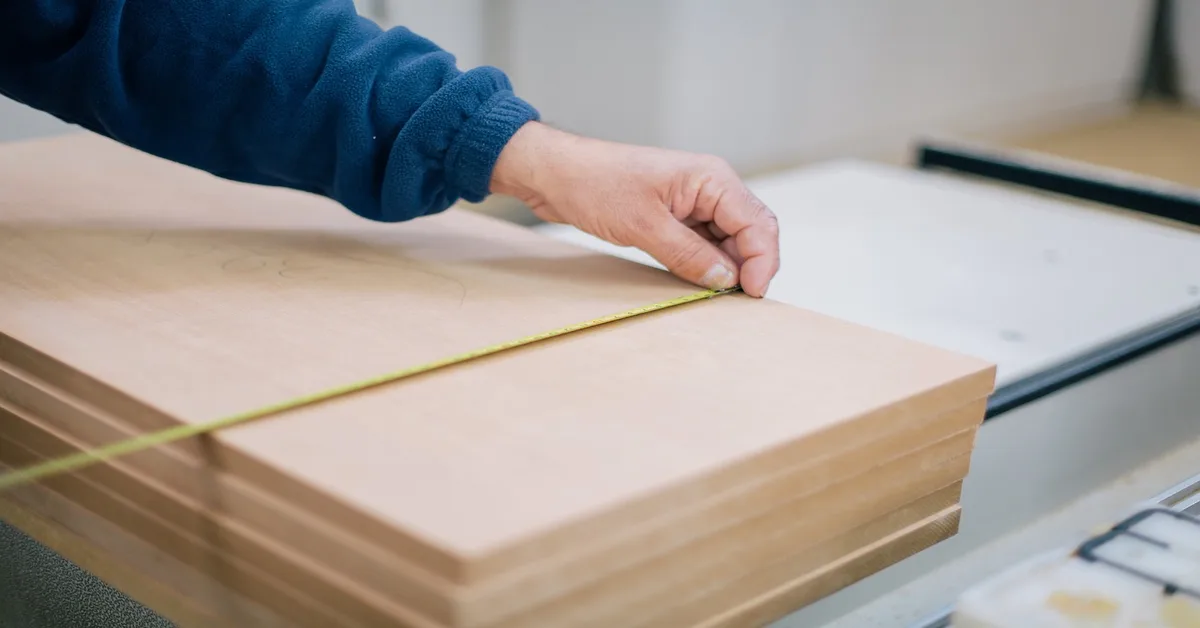
- Measure width at three points. Check the top, middle and bottom with the same tape, hooking the end on the edge. Sheets are not always perfectly square, so one reading can mislead.
- Measure the diagonals. Equal diagonals mean the sheet is square. A difference of more than 1/16 inch is worth knowing before you build a cabinet carcass from it.
- Measure thickness with a caliper. A tape cannot resolve 1/32 inch. Measure mid-edge, away from crushed corners, and write the number on the sheet.
- Cut from one reference edge. Rip the factory edge straight first, then measure every part from that edge so any sheet error stays on the offcut.
When the Difference Actually Matters
For framing, subfloors and roof decking the 1/8 inch gap is the point, and a sheet stamped Sized for Spacing lands cleanly on a 16 or 24 inch framing grid. For cabinets, drawers and built-ins the error shows up in joinery. A part cut to a fixed dimension from a sheet that is under size comes out short on the last piece, and a dado cut with a 3/4 inch bit is loose in plywood that is really 23/32. Thickness is its own topic, with a full nominal versus actual chart in our 23/32 versus 3/4 plywood guide, and the same labeling habit shows up in 5/8 plywood, which is really 19/32. If you work with thin sheets rather than full 4×8 panels, see our 1/8 plywood guide for thickness, weight and bending.
A worked example, shelf width in a 24 inch cabinet. Take a cabinet box 24 inches wide with two sides of 23/32 inch plywood. The opening between the sides is 24 minus 2 x 23/32, which is 22-9/16 inches. If you cut a fixed shelf for 22-1/2 inches because you assumed 3/4 inch sides, it sits 1/16 inch short of the opening in total. That is invisible on a shelf but it is a visible gap on a face frame or a door that has to sit flush. Measure the real thickness with the caliper, then size the part to the measurement instead of the label.
If a sheet comes out wider than your plan and you need to bring it down, our guide to trimming plywood covers a clean edge cut.
Frequently Asked Questions
What is the actual size of a 4×8 sheet of plywood?
It depends on the panel. Sheathing stamped Sized for Spacing is made 47-7/8 x 95-7/8 inches (about 1216 x 2435 mm). Other plywood is generally made to 48 x 96 inches and can come in up to 1/16 to 1/8 inch under that, depending on the standard it follows. Measure the sheet you bought.
Is 4×8 plywood really 48 by 96 inches?
Often it is within 1/16 inch of 48 x 96, but not always. APA says Sized for Spacing panels are made slightly under 48 x 96 to leave the recommended 1/8 inch gap between panels, so a framing-grade sheet can be 47-7/8 x 95-7/8.
What does Sized for Spacing mean on a plywood stamp?
It tells you the manufacturer made the panel slightly smaller than 48 x 96 inches so the 1/8 inch spacing gap APA recommends between panels is already accounted for. It appears on sheathing and similar structural panels, not on cabinet-grade plywood.
How many 12 inch strips can I cut from a 4×8 sheet?
Three full 12 inch strips plus a narrower fourth. Four strips of 12 inches need 48-3/8 inches with a 1/8 inch blade kerf, which is wider than any 4×8 sheet. Plan on strips of about 11-7/8 inches to get four across.
What size is 4×8 plywood in mm?
The nominal 48 x 96 inches is 1219.2 x 2438.4 mm. A sheet made to a metric size of 1220 x 2440 mm is about 48.03 x 96.06 inches, and a Sized for Spacing sheet at 47-7/8 x 95-7/8 inches is about 1216 x 2435 mm.
Sponsored / affiliate links. As an Amazon Associate I earn from qualifying purchases. I may earn additional commission from eligible campaigns.
 Baltic Birch Plywood Sheets Box of 45 - Laser Engraving Cutting, Scroll Saw Nature Veneer Color, Stronger Than Basswood, A/A Grade,12 x 12 x 1/8”, 3mm Thickness Perfect for Wood Burning
 LISHINE 8 Pack 12 x 12 x 1/4 Inch Baltic Birch Plywood 6mm Wood Sheet, Baltic Birch Sheets for Cricut Maker, Architectural Models, Drawing Painting, Wood Burning Laser