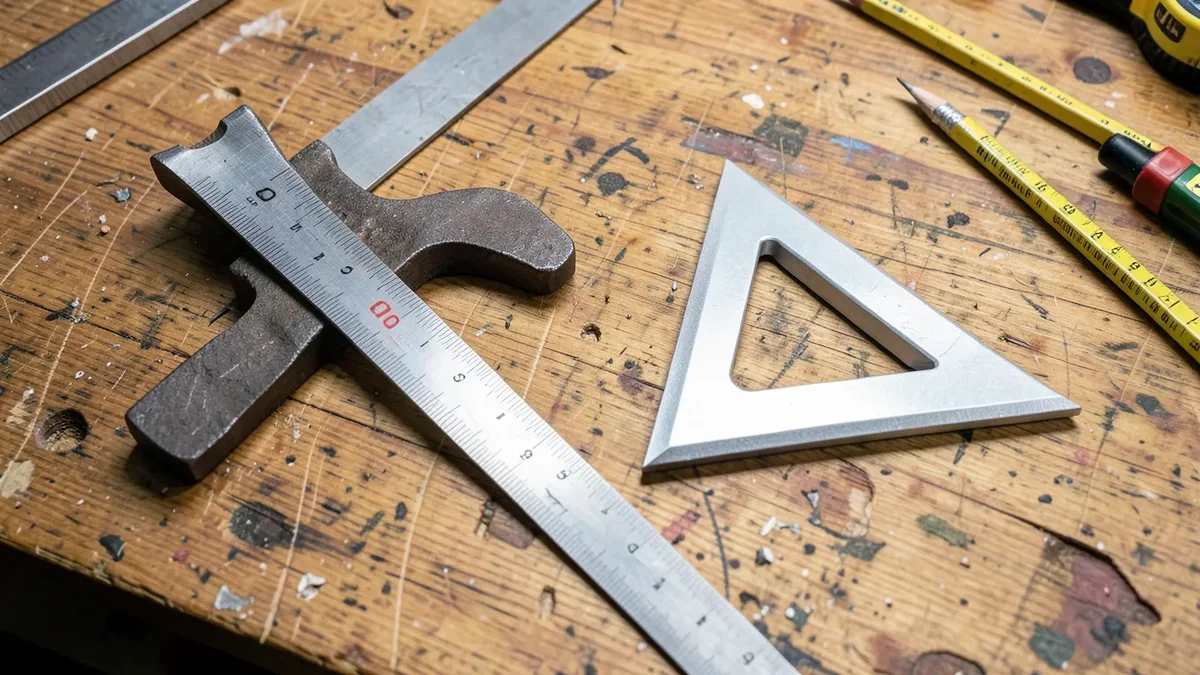
Combo Square vs Speed Square: Which One Is Actually More Accurate
A combination square is the more accurate tool for checking true 90° and 45° angles and for marking a consistent line parallel to an edge. A speed square is faster for rough layout, rafter angles, and using as a saw guide. They overlap on basic tasks, but they aren’t interchangeable – a framer keeps both in the tool belt for different reasons, not as a backup for each other.
The short version most comparisons skip: a combo square’s accuracy comes from its sliding, lockable ruler riding against a machined true edge, which is a fundamentally more precise mechanism than a speed square’s cast triangle. That’s why fine woodworkers reach for a combo square at the bench, while framers and roofers keep a speed square on their belt for speed, not precision. Here’s how the two actually differ in practice.
What a Combination Square Does
Best Speed Square for Framing & Roofing
 |
Swanson Tool Co S0101 7″ Speed Square – $9 The original design from the company that invented the tool in 1925 – a durable aluminum square that doubles as a saw guide and rafter layout tool.
|
A combination square is a ruler (the “blade”) paired with a sliding head that locks at any point along it. The standard head checks 90° and 45° angles against a true edge, and most also include a small level vial and a scratch awl for marking. Because the head locks to the blade, you can set it once and repeat the exact same measurement or line across multiple pieces – something a speed square can’t do.
It’s the tool for laying out dado and mortise lines, checking a board edge for square before you cut it, marking a consistent line parallel to an edge (rip lines, reveal lines on cabinet doors), and depth-gauging (how deep a rabbet or dado actually is). Combo square heads swap onto the same blade – a protractor head or a center-finding head turns the same ruler into a different layout tool, which is the real reason cabinetmakers own one over a speed square.
What a Speed Square Does
The speed square (also called a rafter square) is a single cast triangle, invented in 1925 by carpenter Albert J. Swanson, who was looking for one tool that combined a try square, miter square, saw guide, and protractor. Swanson started hand-building them for other tradesmen who wanted one after seeing his; it went into wider commercial sale in 1930, and he founded Swanson Tool Co. in 1945 to manufacture it at scale – a century-old design that still hasn’t needed much changing.
Hook the square’s lip over a board edge and it instantly gives you a 90° or 45° reference with no measuring or locking required, which is what makes it fast. The printed common/hip-valley rafter scales let a roofer read a rafter cut angle directly off the tool using the “one-number method” Swanson also popularized, without doing the trigonometry by hand. It also doubles as a saw guide – hook it against the board and run a circular saw against the fence edge for a straight 90° or 45° cut.
Which One Is Actually More Accurate?
This is where a lot of comparisons hand-wave. A combination square is the more accurate tool, mechanically, because the blade slides against a machined true edge on the head and locks in place – there’s no play once it’s tightened, and you can verify square by flipping the head to the other side of the blade and checking that the line matches. A speed square is a single cast piece with no moving parts, so its accuracy is fixed by how precisely it was manufactured and how square its lip has stayed after being dropped or knocked around on a job site – there’s no way to check or adjust it in the field.
In practice, this means: use the combo square when the cut or joint actually needs to be dead-on (cabinetry, fine joinery, setting up a table saw fence). Use the speed square when you need “close enough, fast” – rough framing, rafter layout, marking a quick cut line on a 2×4.
Material, Size, and Cost
| Spec | Combination Square | Speed Square |
|---|---|---|
| Typical material | Steel blade, cast iron or steel head | Cast aluminum or polymer |
| Common sizes | 6″, 12″, 16″, 24″ blades | 7″ (standard) or 12″ (rafter/framing) |
| Moving parts | Sliding, lockable head | None – single rigid piece |
| Best for | Repeatable precision marking, depth gauging | Fast angle checks, rafter layout, saw guide |
| Typical price | $15-$50 | $8-$20 |
Which One Should You Buy First?
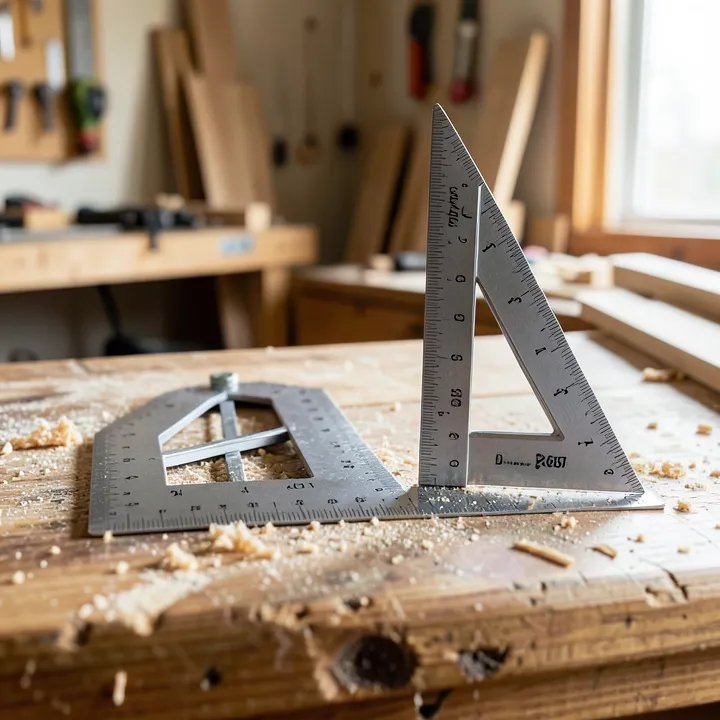
If you’re building furniture, cabinets, or anything where joints need to actually fit tight, get the combination square first – it’s the tool that checks your work is square, not just marks a rough angle. If you’re framing, doing rough carpentry, or roofing, the speed square earns its place on your belt faster because you’ll use it dozens of times a day for quick reference angles and as a saw guide. Most people building anything beyond one or two projects end up owning both within a year, since they solve different problems rather than competing for the same job.
Frequently Asked Questions
Is a combination square the same as a speed square?
No. A combination square is a sliding ruler and head used for precise, repeatable marking and depth measurement, while its triangular cousin is built for something else entirely – quick angle checks, rafter layout, and doubling as a saw guide. They’re both squares, but built for different jobs.
Which type of square is more accurate?
A combination square is mechanically more accurate, because its blade slides and locks against a machined true edge, and you can verify it’s reading true by flipping the head to the blade’s other side. Its rigid triangular counterpart has no such adjustment – once manufactured, its precision is fixed, and years of being dropped or knocked around on a job site is the only thing that changes it, with no way to check or correct that drift in the field.
What is a combo square used for?
A combo square is used for checking 90° and 45° angles against a true edge, marking a line parallel to an edge, gauging depth on rabbets and dadoes, and (with a swapped head) laying out centers or angles other than 90/45. It pairs naturally with a mechanical pencil for marking the actual layout lines once you’ve set the square.
What’s the difference between a combination square and a try square?
A try square is a fixed 90° tool with no moving parts – it only checks square, nothing else. A combination square does everything a try square does, plus 45° checks, depth gauging, and repeatable marking along a locked blade, because its head slides and locks in place. A try square is simpler and cheaper; a combination square is more versatile for the same reason a speed square trades precision for speed.
Conclusion
Don’t think of this as a competition with one winner. A combination square is the more precise, repeatable tool for bench work and fine joinery. A speed square is the faster tool for framing, roofing, and quick angle checks, and it doubles as a saw guide. Most woodworkers and builders end up with both, reaching for whichever one matches how much precision the cut actually needs.
Sponsored / affiliate links. As an Amazon Associate I earn from qualifying purchases. I may earn additional commission from eligible campaigns.