Best Belt Sander for Floors: 7 Compared vs Renting (2026)
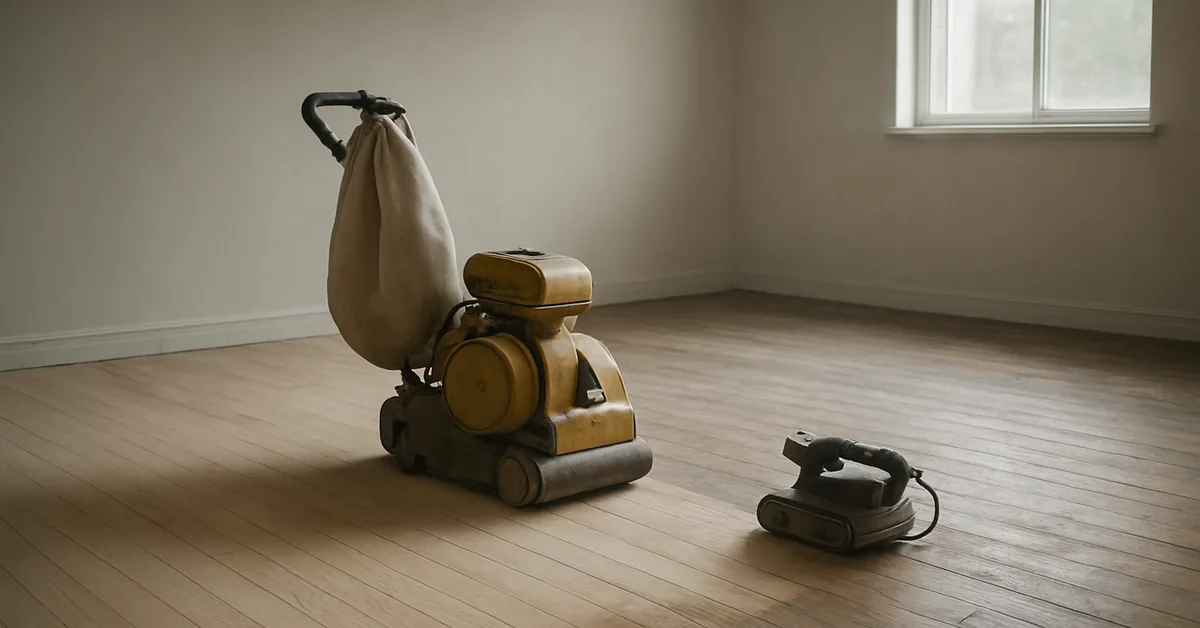
For a whole room, the honest answer is that you rent rather than buy: an 8-inch walk-behind drum sander cuts a path twice as wide as the best handheld belt sander and costs $68 a day. Buy a handheld instead — the Makita 9403 ($392.00) is the pick — when the job is stairs, closets, patches and edges — or dried paint splatters, where a handheld sander is often the last resort after scraping alone will not lift it (see our guide on getting paint off hardwood floors for the non-sanding methods to try first).
That distinction matters more than any ranking, because “best belt sander for floors” hides two completely different jobs. See our full step-by-step refinishing guide for how the drum-sander rental and the handheld belt sander actually fit together on a real job, plus the one drum-sander habit that prevents the most common DIY mistake. One is resurfacing 300+ square feet of open floor. The other is fixing the parts a floor machine physically cannot reach. The table below prices both, using rental rates and purchase prices pulled on August 2, 2026.
Belt Sanders for Floors, Compared
Every price here came from the Amazon Creators API on August 2, 2026; every spec came from the manufacturer’s own published sheet. Where a manufacturer does not publish a figure, the cell says so rather than guessing.
| # | Model | Belt size | Amps | Belt speed | Weight | Price | Verdict |
|---|---|---|---|---|---|---|---|
| 1 | Makita 9403 | 4″ × 24″ | 11 | 1,640 ft/min fixed | 12.6 lb | $392.00 | Fastest cut of any handheld here |
| 2 | WEN HB424V | 4″ × 24″ | 10 | 660–1,310 ft/min | Not published | $82.32 | Same 4″ path for a fifth of the money |
| 3 | Makita 9903 | 3″ × 21″ | 8.8 | 690–1,440 ft/min | 9.5 lb | $319.00 | Light enough to control on a stair tread |
| 4 | SKIL 7510-01 | 3″ × 18″ | 6.0 | Not published | 6.4 lb | $63.98 | Pressure light warns before you dig in |
| 5 | DEWALT DCW220B | 3″ × 21″ | 20V battery | 1,050 ft/min max | 9.26 lb bare | $227.95 | No cord to drag across wet finish |
| 6 | Makita 9404 | 4″ × 24″ | 8.8 | 690–1,440 ft/min | 10.3 lb | $394.67 | Dial it down for pine and fir |
| 7 | CRAFTSMAN CMEW213 | 3″ × 21″ | 7.0 | 800 ft/min max | Not published | $97.46 | 3-year warranty at under $100 |
Sources: prices via Amazon Creators API, August 2, 2026. Belt size, amps, belt speed and net weight from makitatools.com (9403, 9404, 9903), skil.com (7510-01), dewalt.com (DCW220B) and craftsman.com (CMEW213). WEN publishes amps and belt speed for the HB424V but not a net weight; SKIL publishes weight but not belt speed. Those cells are left as “not published” rather than filled with a retailer’s estimate.
The Number Nobody Puts in These Roundups: How Far You Actually Walk
Sanding path width is the spec that decides whether a floor job is an afternoon or a weekend, and no competing roundup converts it into anything you can feel. So here it is converted, for a 300-square-foot room sanded through three grits (40, 60, 80 — the standard progression on oak).
The arithmetic is simple: floor area divided by path width gives the linear distance the machine has to travel, once per grit.
| Machine class | Path width | Machine weight | Distance covered, 3 grits, 300 sq ft | Posture |
|---|---|---|---|---|
| 12″ × 18″ orbital floor sander | 18″ | — | 600 ft (0.11 mi) | Standing, walking |
| 8″ walk-behind drum sander | 8″ | 115 lb | 1,350 ft (0.26 mi) | Standing, walking |
| Handheld belt sander, 4″ × 24″ | 4″ | 12.6 lb | 2,700 ft (0.51 mi) | On your knees |
| Handheld belt sander, 3″ × 21″ | 3″ | 9.5 lb | 3,600 ft (0.68 mi) | On your knees |
How this was calculated: 300 sq ft ÷ path width in feet × 3 grit passes, with no overlap allowance. Real passes overlap, so treat these as floor values, not ceilings. Path widths: 8″ drum and 115 lb machine weight from the Essex Silver-Line SL-8 specification page; 12″ × 18″ orbital pad size from the rental abrasive spec (the 18″ dimension is the working width); handheld belt widths and weights from the manufacturer sheets cited above.
Two-thirds of a mile, on your knees, is what a 3-inch belt sander signs you up for in one average bedroom. That is the real argument against using a handheld belt sander as your primary floor machine — not that it cannot cut, but that it cuts a 3-inch stripe at a time while you kneel on the grit you just made.
Rent or Buy? The Break-Even, in Dollars
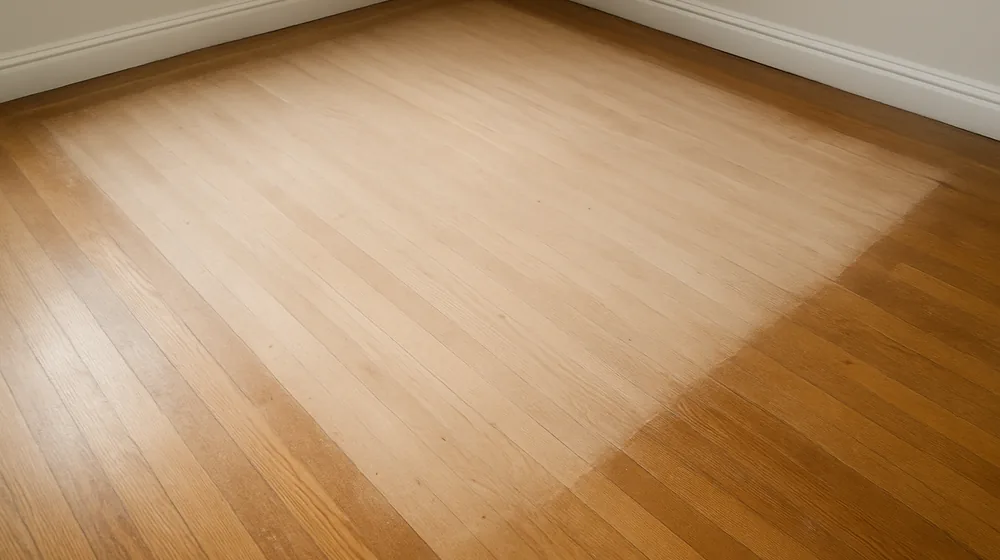
Floor sanding is the classic rent-versus-buy decision, and it is worth doing the arithmetic once because the answer is lopsided. A genuine 8-inch walk-behind drum floor sander — the Essex Silver-Line SL-8, 1.5 HP, 115 pounds — lists at $4,999.00 on Amazon. The same class of machine rents for $68 a day.
That is 74 rental days before ownership breaks even ($4,999.00 ÷ $68). At Home Depot’s published $75-a-day rate it is still 67 days. Since a typical DIY room takes one to two days, you would need to sand somewhere between 37 and 74 separate rooms before buying beat renting. For anyone who is not a flooring contractor, buying the floor machine never pays back.
| Route for one 300 sq ft room | Machine cost | Abrasives | Total | Do you keep anything? |
|---|---|---|---|---|
| Rent drum sander + edger, 2 days | $136 + $96 = $232 | 3 belts @ $12.95 + 6 discs @ $1.95 = $50.55 | $282.55 | No |
| Rent orbital sander + edger, 2 days | $104 + $96 = $200 | 3 sheets @ $6.50 + 6 discs @ $1.95 = $31.20 | $231.20 | No |
| Buy the WEN HB424V handheld | $82.32 | 3 belts @ $2.17 = $6.51 | $88.83 | Yes — the tool |
| Buy the Makita 9403 handheld | $392.00 | 3 belts @ $2.17 = $6.51 | $398.51 | Yes — the tool |
| Buy the 8″ drum floor sander outright | $4,999.00 | $38.85 | $5,037.85 | Yes — and 74 days to break even |
Sources: rental day rates and rental abrasive prices from a published US rental rate card (drum sander $68/day, belts $12.95 each; orbital floor sander $52/day, sheets $6.50 each; floor edger $48/day, discs $1.95 each), retrieved August 2, 2026. Cross-checked against national chains the same day: Home Depot drum sander $75/day, Lowe’s $73/day, Sunbelt $73/day, United Rentals 8″ drum $86/day, Herc 8″ drum $90/day. Purchase prices and consumer belt prices via Amazon Creators API, August 2, 2026 (4″×24″ belts, 18-pack of 40/60/80 grit, $38.99 ÷ 18 = $2.17 each). Assumes one abrasive per grit for a 300 sq ft room; old shellac and adhesive residue will burn through more.
One more line worth knowing before you book anything: renting by the week rather than by the day changes the whole-house maths. A drum sander plus edger costs $272 + $144 = $416 for a full week. Doing four rooms as four separate two-day rentals costs $232 × 4 = $928. Same machines, same work, $512 difference — purely from how you book it.
Note also what the rented abrasives cost. A drum-sander belt is $12.95; a 4-inch belt for the handheld in your hand is $2.17. That six-fold gap is a real part of the rental bill that no roundup mentions, and it is the one line item that gets worse the rougher your floor is.
Is a Handheld Belt Sander Even the Right Tool for a Floor?
Worth answering plainly, because the search phrase blends two tools that are not interchangeable, and half the pages ranking for it quietly swap between them.
A “belt floor sander” in the trade means a walk-behind machine — Lagler, Bona, Essex Silver-Line — where a continuous belt runs over a weighted drum and you steer it like a lawnmower. A “belt sander” on Amazon means a 3-to-4-inch tool you hold in two hands. They share a working principle and nothing else. Searching Amazon for a floor machine returns almost nothing usable: the consumer results are 5-inch palm sanders, 12″ × 18″ abrasive sheets, and benchtop drum sanders for boards, not floors. The genuine walk-behind machines that do appear start at $4,999.
So the honest answer depends on the job, and it is worth being specific about where the line falls:
- A whole room, 150 sq ft or more: rent a floor machine. A handheld will do it, but you are looking at half a mile on your knees per room and a real risk of a wavy floor.
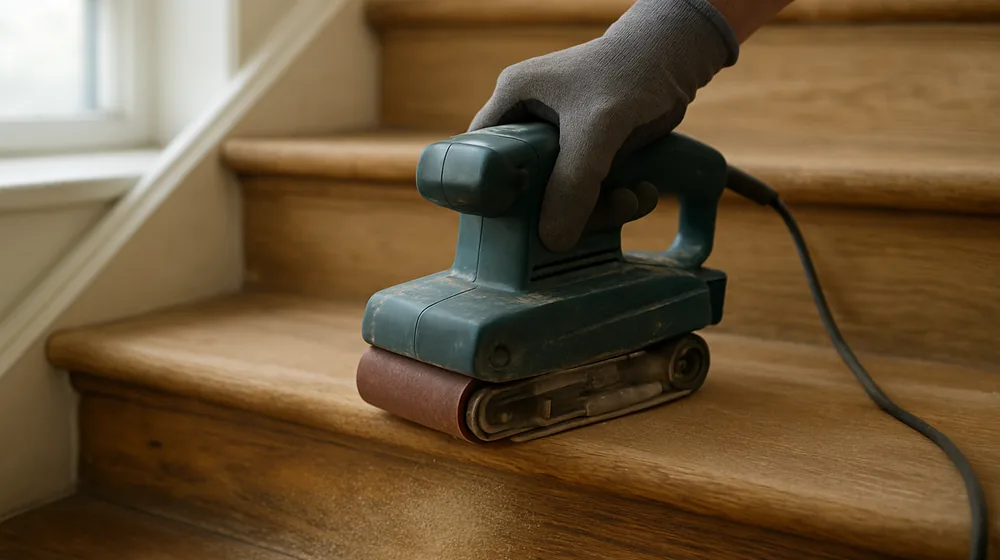
- Stairs, treads and landings: handheld belt sander, every time. No walk-behind machine fits a tread, and a 3″ × 21″ is the standard tool for the job.
- The perimeter band a floor machine leaves: an edger is faster, but a handheld belt sander used carefully along the grain does the same work if you already own one.
- Closets, thresholds and under-radiator strips: handheld. A 115-pound drum sander does not go in a closet.
- A patch repair or a few replaced boards: handheld, and renting a floor machine for a 6 sq ft patch would be absurd.
If your job is the first bullet, the picks below still matter — you will want one for the edges regardless. If your job is any of the others, a handheld is not a compromise, it is the correct tool. Our comparison of drum and random-orbital floor machines covers the rental side of that decision in more depth.
Best Belt Sanders for Floors
1. Makita 9403 — #1 Best Overall
#1 BEST OVERALL
$392.00
Belt: 4″ × 24″ | Motor: 11 A | Speed: 1,640 ft/min | Weight: 12.6 lb | Noise: 84 dB
The 9403 is the most motor and the widest belt you can get in a tool you still hold in your hands: 11 amps driving a 4-inch belt at a fixed 1,640 feet per minute. On a floor that combination matters twice over. The 4-inch width halves your pass count against a 3-inch machine, and the fixed high speed means it does not bog down when the belt loads with old finish — which is exactly when a smaller sander stalls and starts burnishing instead of cutting.
Makita also rates it at 84 dB, the lowest of the 4-inch machines here, and seals the motor and bearings behind what they call labyrinth construction. Floor sanding is the dustiest work in the house, and dust ingress is what kills sanders; that sealing is a genuine reason this model has stayed in the catalogue for decades.
Main drawback: no variable speed. On pine, fir or old-growth softwood the 9403 removes material faster than a beginner can react, and 12.6 pounds of tool with a 40-grit belt will dish a soft board in seconds. If your floor is softwood, buy the 9404 instead — same body, same belt, with a speed dial.
Good: fastest cut here; sealed motor; lowest noise of the 4-inch group; flush-to-wall on the nose and both sides. Less good: $392.00 is real money for a tool most homeowners use for one project; fixed speed; heaviest handheld in this list.
2. WEN HB424V — Best Value 4-Inch Belt Sander
BEST VALUE 4-INCH
$82.32
Belt: 4″ × 24″ | Motor: 10 A | Speed: 660–1,310 ft/min | Dust port: 1.2″ | Warranty: 2 yr
This is the value argument of the whole list. The HB424V gives you the same 4-inch sanding path as the Makita 9403 — the spec that actually determines how long your floor takes — plus a variable-speed dial the Makita does not have, for $82.32 against $392.00. On the linear-distance maths above, both machines cover the same 2,700 feet per room.
The 10-amp motor is only one amp shy of the Makita’s, and the 660-to-1,310 ft/min range covers softwood at the bottom end and hardwood near the top. It also converts to a benchtop sander with the included mounting clamps and rubber pad, which is genuinely useful once the floor is done.
Main drawback: WEN does not publish a net weight for this tool, which is an odd omission on a machine whose handling is the whole question — and the two-year warranty is the shortest here against Makita’s build reputation and CRAFTSMAN’s three years. This is a tool bought for a project, not for a career.
Good: full 4-inch path at a fifth of the price; variable speed; benchtop conversion included; lock-on switch for long passes. Less good: unpublished weight; shortest warranty; the top speed is 330 ft/min below the 9403, so it cuts slower on hardwood.
3. Makita 9903 — Best Belt Sander for Stairs and Landings
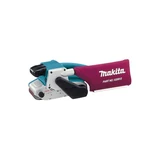
BEST FOR STAIRS
$319.00
Belt: 3″ × 21″ | Motor: 8.8 A | Speed: 690–1,440 ft/min | Weight: 9.5 lb | Noise: 85 dB
A stair tread is about 10 inches deep and 36 inches wide, with a nosing at the front you must not flatten. That geometry rules out every walk-behind machine and rewards a sander you can control one-handed at the end of a pass. At 9.5 pounds with a 3-inch belt, the 9903 is the tool most flooring crews reach for on stairs.
The variable speed dial matters more here than anywhere else in this list. Run it at the bottom of its 690 ft/min range on a tread and you can feather right up to the nosing without rounding it over; run a fixed-speed machine there and you will take the crisp edge off in one pass. Makita’s auto-tracking belt system also means you are not re-centring the belt every few minutes while balanced on a staircase.
Main drawback: at $319.00 it costs nearly as much as the far more capable 4-inch 9403, and its 3-inch belt makes it the slowest realistic choice for open floor — 3,600 feet of travel per room against the 9403’s 2,700. Buy it for stairs and edges, not as your only sander.
Good: lightest Makita here; variable speed down to 690 ft/min; auto-tracking belt; flush-to-wall design that suits perimeter work. Less good: expensive for a 3-inch machine; slow on open floor; 85 dB is the loudest of the Makitas.
4. SKIL 7510-01 — Best for Beginners
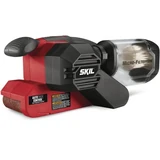
BEST FOR BEGINNERS
$63.98
Belt: 3″ × 18″ | Motor: 6.0 A | Weight: 6.4 lb | Vac: fits 1-1/4″ hose
Almost every belt-sander disaster on a floor comes from the same mistake: leaning on the tool. A belt sander cuts by its own weight, and pushing down concentrates the cut into a dish you then have to blend out across the whole board. SKIL’s pressure-control indicator is a light that comes on when you are applying the right amount and goes out when you are not — a genuinely useful piece of feedback for someone who has never run one.
At 6.4 pounds it is also the lightest tool here by a clear margin, which cuts both ways: less mass means a gentler cut and far less damage when your attention wanders. Combined with the 6-amp motor — the smallest in this list — it is the most forgiving machine here, and it takes a standard 1-1/4-inch shop vac hose so you are not relying on a dust bag.
Main drawback: it is slow. A 3″ × 18″ belt on a 6-amp motor is the least aggressive combination here, and on a floor with a thick polyurethane build-up you will spend real time getting through the finish. That gentleness is exactly why it suits beginners, and exactly why it is wrong for a whole floor.
Good: cheapest here at $63.98; pressure feedback; lightest at 6.4 lb; shop-vac compatible; flush edge sanding. Less good: slowest material removal; shortest belt at 18 inches; SKIL does not publish a belt speed figure.
5. DEWALT DCW220B — Best Cordless for Edges and Closets
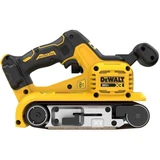
BEST CORDLESS
$227.95
Belt: 3″ × 21″ | Power: 20V MAX | Speed: 1,050 ft/min max, 25-position dial | Weight: 9.26 lb bare
The case for cordless on a floor is not convenience, it is the cord itself. Dragging a live cord across a floor you are about to finish means scuff marks, snagged corners and a cable that is permanently in the path of the belt. Working a room perimeter — where you are constantly turning, backing into corners and stepping over your own lead — is where that gets old fastest.
The 25-position speed dial is unusually fine-grained and useful for edge work where you want a slow, controlled cut. DEWALT quotes up to 95% dust collection with an AIRLOCK-compatible extractor, and up to 97% on their own particleboard test with a dust extractor attached — the best dust numbers of anything here, which matters when the alternative is breathing old floor finish.
Main drawback: $227.95 is the bare tool. No battery, no charger. If you are not already on DEWALT’s 20V platform the real cost is meaningfully higher, and sanding is one of the most battery-hungry things you can ask a cordless tool to do — a full floor perimeter will run several batteries flat.
Good: no cord to manage; 25-speed dial; best-in-list dust collection; brushless motor. Less good: tool-only price is misleading; battery consumption is high under sanding loads; 1,050 ft/min max is slower than the corded 4-inch machines.
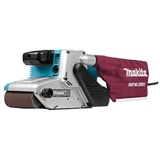
6. Makita 9404 — Best for Pine and Softwood Floors
BEST FOR SOFTWOOD
$394.67
Belt: 4″ × 24″ | Motor: 8.8 A | Speed: 690–1,440 ft/min | Weight: 10.3 lb
Old houses are full of pine, fir and hemlock floors, and they punish aggressive sanders. Softwood has a hardness a fraction of white oak’s, and the early wood between the growth rings cuts away faster than the late wood — which is how you end up with a washboard surface that only shows once the finish goes on and the light rakes across it.
The 9404 is the 9403’s body with a speed dial: same 4-inch belt and 2.3 pounds lighter, running 690 to 1,440 ft/min instead of a fixed 1,640. Dropping to the low end of that range on softwood is the single most effective thing you can do to avoid dishing boards, and it is why this is the 4-inch machine to buy if your floor is not oak or maple.
Main drawback: it costs $2.67 more than the 9403 while giving up 2.2 amps and 200 ft/min at the top end. On hardwood the 9403 is simply the better machine, so this only makes sense if you genuinely have softwood floors — buying it “just in case” means paying more for less cut.
Good: full 4-inch path with variable speed; 10.3 lb is lighter than the 9403; auto-tracking belt; 16.4 ft cord. Less good: most expensive here; weaker motor than the 9403 it sits beside; overkill unless softwood is the actual problem.
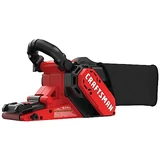
7. CRAFTSMAN CMEW213 — Best Under $100 for Occasional Repairs
BEST UNDER $100
$97.46
Belt: 3″ × 21″ | Motor: 7.0 A | Speed: 800 ft/min max | Warranty: 3 yr
Most people searching for a belt sander for floors do not have a whole house to resurface. They have a few damaged boards, a threshold that stands proud, or a set of stairs. For that work the CMEW213 is enough tool, and the three-year limited warranty is the longest in this list — from a brand you can walk into a store and return.
The angled belt design lets it work closer to an adjoining surface than most 3-inch machines, which is the specific thing you want when you are sanding up to a wall, a stair riser or a door casing. Tool-free belt changes matter more than they sound when you are stepping through three grits on a small area.
Main drawback: 800 ft/min is the slowest published belt speed here — roughly half the Makita 9403’s 1,640 — and there is no variable speed. It is a repair tool, and asking it to resurface an open floor is asking for a long weekend and an uneven result.
Good: 3-year warranty; under $100; angled belt for close work; tool-free belt release; on-board dust bag. Less good: slowest belt speed in the list; fixed speed only; CRAFTSMAN does not publish a net weight.
How We Picked These
Nobody at Woodworking Advisor put these seven specific machines on a floor for this article, and you should be sceptical of any roundup that claims otherwise for a category where a single honest test means renting a house’s worth of flooring. What this article does instead is compile numbers that are checkable, and be explicit about where each one came from.
- Specifications came from each manufacturer’s own published sheet — makitatools.com, skil.com, dewalt.com, craftsman.com and wenproducts.com — not from marketplace listings. This matters: one major retailer lists the DEWALT DCW220B at 1.0 lb, which is wrong by a factor of nine against DEWALT’s own published 9.26 lb.
- Prices were pulled live from the Amazon Creators API on August 2, 2026 and are buy-box prices at that moment. They move; the linked pages are authoritative.
- Rental rates came from a published US rental company rate card, cross-checked the same day against Home Depot, Lowe’s, Sunbelt, United Rentals and Herc Rentals figures.
- Floor-machine specifications — the 8″ drum width, 115 lb weight and 1,800 RPM used in the comparison — came from the Essex Silver-Line SL-8 manufacturer specification page.
- Selection covered the real axis of choice in this category: 3-inch against 4-inch belts, fixed against variable speed, corded against cordless, and $63.98 against $394.67.
The limits are worth stating too. Without hands-on comparison there is nothing here about long-term reliability, how each tool balances after an hour, or how well the dust bags actually seal. Where a manufacturer does not publish a figure, the tables say “not published” rather than borrowing a number from a listing. And the linear-distance figures are arithmetic from published path widths, not stopwatch results — the calculation is shown so you can check it.
What to Consider When Buying a Belt Sander for Floors
Belt Width Decides How Long the Job Takes
This is the spec that matters most and gets the least attention. A 4-inch belt covers a third more floor per pass than a 3-inch belt, which on a 300 sq ft room is the difference between 2,700 and 3,600 linear feet of travel across three grits. If you are buying a handheld specifically for floor work, buy 4 inches. The price gap between the WEN HB424V at $82.32 and a 3-inch machine is small enough that width should decide it.
Weight: Heavy Cuts Faster, Heavy Also Gouges
A belt sander is designed to cut under its own mass. The 12.6 lb Makita 9403 removes material noticeably faster than the 6.4 lb SKIL for exactly that reason — and will dish a soft board just as much faster if you stop moving. The 115 lb walk-behind drum machines take this to its logical end: enormously fast, and capable of carving a permanent trough in your floor if you let one sit still for two seconds. Heavier is better only in proportion to how confident you are.
Variable Speed Is Not Optional on Softwood
On oak and maple a fixed 1,640 ft/min is fine. On pine, fir or heart pine it is too much, and the result is a washboard surface that only reveals itself under finish. If your floor is softwood, treat a speed dial as a requirement, not a feature — the Makita 9404 and the WEN HB424V both have one.
Dust Collection and Why the Bag Is Not Enough
Old floor finish can contain lead, and floor sanding generates more airborne dust than any other job in a house. An on-board bag catches the coarse stuff and lets the fine fraction — the part that matters — straight through. Look for a machine that accepts a vacuum hose: the SKIL 7510-01 fits a standard 1-1/4-inch shop vac port, and the DEWALT reaches up to 95% capture with an extractor attached. A shop vacuum with the right CFM is not an accessory on this job.
Flush-to-Wall Sanding and the Perimeter Problem
Every walk-behind floor machine leaves an unsanded band around the room — that is what edgers exist for. A handheld that sands flush on its nose and sides, as all three Makitas here do, can work that band directly. If you are renting a drum sander and already own a flush-capable handheld, you may be able to skip the $48-a-day edger rental entirely.
Belt Speed, and Why Slower Is Sometimes the Point
Published belt speeds here run from CRAFTSMAN’s 800 ft/min to Makita’s 1,640 — a two-fold spread. Faster removes finish quicker and clogs less. Slower gives you time to react, which is worth more on a floor than on a workbench because a floor mistake is visible from across the room forever.
Abrasive Cost Over the Life of the Job
Consumables are a real line item and they differ wildly by machine class. A drum-sander belt runs $12.95 each at rental counters; a 4″ × 24″ belt for a handheld works out at $2.17 in an 18-pack; edger discs are $1.95. Budget more than you think — floors with adhesive residue or thick shellac destroy abrasive far faster than bare wood.
Room Size: The Number That Decides Everything
Under roughly 150 square feet, a handheld is defensible. Over that, rent. The break-even is not really about money — at $282.55 for a rented drum-and-edger day pair against $88.83 for a WEN you keep, the handheld looks cheaper on paper. It is about the 2,700 to 3,600 feet you cover on your knees, and the fact that a wavy floor cannot be un-sanded.
How to Sand a Floor With a Belt Sander
Before You Start: Dust, Lead and Containment
Floor sanding produces more fine airborne dust than any other job in a house, and in a home built before 1978 that dust may carry lead from old finishes and paint. This is the part of the job worth over-preparing.
- Test before you sand in a pre-1978 house. Lead test swabs are inexpensive and take minutes. If the result is positive, sanding is the single worst way to disturb it — stop and get advice on lead-safe practices rather than making the dust airborne.
- Wear a rated respirator, not a nuisance mask. An N95 is the floor; a P100 cartridge respirator is better, and the paper masks sold beside the sanding belts are not adequate for a full day of floor dust.
- Seal the room off. Tape plastic sheeting over doorways and any vents, and switch the HVAC system off before you start. A running furnace fan will distribute floor dust through the entire house.
- Connect the sander to a vacuum where you can. The on-board bag catches chips and lets the respirable fraction through. Eye and ear protection are worth having too — the Makitas here run at 84–85 dB.
If you have decided a handheld is right for your job — stairs, a patch, a small room or the perimeter band — this is the sequence that keeps the surface flat.
- Clear and prep the room. Remove everything, pull shoe moulding, and countersink every protruding nail. A nail head will destroy a belt instantly and can tear a gouge across three boards.
- Start with 40 grit along the grain. Never across it. Cross-grain scratches from a coarse belt will still be visible after two finer passes.
- Keep the sander moving before it touches down. Start the motor, let it reach speed, then lower it onto the floor while already moving forward — and lift it while still moving. A belt sander set down stationary cuts a dish in under two seconds.
- Let the tool’s weight do the work. No downward pressure. If it is not cutting, the belt is worn or the grit is too fine, not too gentle.
- Overlap each pass by about a third. Work in long straight runs parallel to the boards, not in short strokes.
- Step up through 60 then 80 grit. Vacuum between every grit — a stray 40-grit particle under an 80-grit belt leaves a scratch you will only see under finish.
- Do the perimeter and corners last. Use the flush side of the sander against the baseboard, or an edger, and blend the band into the field.
- Check with raking light before finishing. Hold a work light low and near-parallel to the floor. Dishes and cross-grain scratches show instantly at that angle and are invisible from standing height.
Our full walkthrough of sanding and refinishing wood floors covers the finishing stages, and the grit selection guide explains where each number in that sequence earns its place.
Frequently Asked Questions
Can you use a handheld belt sander on a whole floor?
Physically yes, practically rarely. A 4-inch belt sander covers about 2,700 linear feet across three grits in a 300 sq ft room, and a 3-inch machine about 3,600 feet — roughly two-thirds of a mile, on your knees. It also makes a flat result harder, because you are blending hundreds of narrow passes by hand rather than steering one wide drum. Under about 150 square feet it is reasonable. Above that, rent a floor machine.
Is it worth renting a drum floor sander rather than buying one?
Almost always. A genuine 8-inch walk-behind drum sander lists at $4,999.00 against a rental rate of about $68 a day, so ownership breaks even after 74 rental days. At one to two days per room that is 37 to 74 separate rooms. Unless you sand floors for a living, rent — and rent by the week if you have more than one room, because a week costs $272 against $68 a day.
What grit sandpaper should I use on hardwood floors?
On oak, maple or ash the standard progression is 40, then 60, then 80, finishing at 100 if you want a finer surface for a penetrating oil. Start coarser only if there is heavy finish build-up or a genuinely uneven floor. Never skip more than one step in the sequence — each grit’s job is to remove the scratches left by the one before it.
How do I sand the edges a floor sander cannot reach?
Every walk-behind machine leaves a band of unsanded floor against the baseboard. The purpose-built answer is a 7-inch floor edger, which rents for about $48 a day. The alternative is a handheld belt sander that sands flush on its nose and sides — all three Makitas here do — worked along the grain and blended into the field. Corners behind radiators usually still need a scraper or a detail sander.
Will a belt sander gouge a hardwood floor?
Yes, easily, and it is the most common failure on this job. Gouges come from two things: letting the machine sit still while running, and pushing down on it. Lower a moving sander onto the floor and lift it while it is still moving, let the tool’s own weight supply the pressure, and keep every pass parallel to the boards. On softwood, drop the belt speed as well — this is where a variable-speed model earns its price.
Can I use a belt sander on engineered hardwood?
Only with real caution, and often not at all. Engineered flooring has a wear layer that can be as thin as 0.6 mm, and a belt sander at 40 grit will cut through that into the plywood core in a single careless pass. Check your wear-layer thickness before touching it — if it is under about 2 mm, a screen-and-recoat is a far safer route than sanding to bare wood. If you are not sure which you have, board width is a useful tell: solid strip flooring is usually 3.25 inches wide or narrower, and anything noticeably wider is more likely to be engineered.
Final Thoughts
If you are buying one handheld belt sander for floor work, buy the Makita 9403 at $392.00 — the widest belt and the strongest motor of anything you can hold — or the WEN HB424V at $82.32 if you want the same 4-inch path without the Makita price. For stairs, the Makita 9903. For a first-timer, the SKIL 7510-01 and its pressure light.
But the number worth leaving with is the one in the second table: a 3-inch handheld asks you to cover 3,600 linear feet on your knees to sand one average bedroom, while a rented 8-inch drum sander does the same room in 1,350 feet, standing up, for $282.55 including the edger and the abrasives. The belt sander you buy is for the stairs, the closets, the patches and the perimeter — the places the rented machine cannot go. Choose it for that job and it is the right tool. Choose it as a substitute for a floor machine and you have bought yourself a very long weekend.
Planning the wider project? Start with the wood flooring guide, check what refinishing costs per square foot before you commit, and if your floors are only tired rather than damaged, screening and recoating skips the sanding entirely. Sanding down to bare wood instead? Compare real cure-time and cost data in our best paint for wood floors guide.
Sponsored / affiliate links. As an Amazon Associate I earn from qualifying purchases. I may earn additional commission from eligible campaigns.