7 Mechanical Pencils for Woodworking Compared by Lead Size (2026)
The best mechanical pencil for woodworking overall is the Hiboom 10-Pack Mechanical Carpenter Pencil Set ($14.99) — four pencils plus a center punch and carbide scribe work out to roughly $3.75 per pencil, the best-equipped kit in this comparison. For fine joinery lines a 0.5mm or 0.3mm drafting pencil beats any carpenter pencil, and on dark wood like walnut, only colored lead reliably shows up at all — standard black graphite won’t cut it. The full breakdown of lead diameter, lead color, and real cost per pencil is in the table below. (If you’re curious why sharpened pencils smell the way they do: that’s usually pencil cedar, the traditional wood-cased pencil material — every pick in this comparison is a refillable mechanical pencil instead, which sidesteps that question entirely.)
Mechanical Pencils for Woodworking Compared
Every pencil below was priced live through Amazon’s Creators API. Lead diameter, lead color options, and grip/durability details come from each manufacturer’s own product listing. Cost per pencil is computed as pack price ÷ number of physical pencil bodies in the pack — bundled tools and bonus refills are not subtracted, so kit-style picks are actually a better deal than the raw number suggests. The lead-only refill pack is priced per lead instead, since it has no pencil body of its own.
| Pencil | Lead Diameter | Lead Color / Hardness for Wood Tone | Grip & Shop Durability | Price | Cost per Pencil | Verdict |
|---|---|---|---|---|---|---|
| 1. Hiboom 10-Pack Set | 2.8mm carpenter | Black / Red / Yellow incl. (mfr rates yellow for dark surfaces) | Grooved barrel + pocket clip; kit adds spring-loaded center punch & carbide scribe | $14.99 | ~$3.75/pencil* | #1 Best Overall |
| 2. Pentel GraphGear 1000, 0.5mm | 0.5mm fine mechanical | Super Hi-Polymer HB graphite only | Metal barrel, retractable 4mm tip; one .7mm unit reported lasting 5 years in shop use | $12.00 | $12.00/pencil | Best for Fine Joinery Marking |
| 3. Pentel GraphGear 1000, 0.3mm | 0.3mm ultra-fine | Same HB graphite only | Same metal body/retractable tip; thinnest lead, snaps easiest under side pressure | $8.94 | $8.94/pencil | Best for Ultra-Fine Layout Lines |
| 4. Uni NanoDia Color 0.5mm Leads | 0.5mm refill (fits std. 0.5mm holders) | 7 colors incl. Pink & Mint Blue | N/A — lead only, no pencil body | $11.30 (140 leads) | $0.08/lead | Best for Marking Dark Wood |
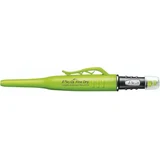
| 5. Pica Fine Dry 0.9mm | 0.9mm self-feeding “dry” lead | Ships w/ 5x HB; refillable in H or HB | Stainless push mechanism, sealed dust/water barrel, never sharpened | $16.63 | $16.63/pencil | Best No-Sharpen / Most Weatherproof |
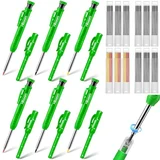
| 6. Hiboom 6-Pack Solid Carpenter | 2.8mm carpenter | 72 refills black/red/yellow (mfr: black=fine layout, red=bold cuts, yellow=dark-surface guides) | Grooved barrel, 45mm deep-hole nib, built-in sharpener | $21.99 | ~$3.67/pencil* | Best for Rough Lumber & Deep-Hole Marking |
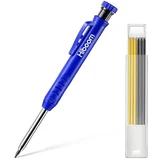
| 7. Hiboom Deep-Hole Pencil (Blue) | 2.8mm carpenter | 3 black + 3 yellow incl. (mfr: “yellow can draw on dark surfaces where grey do not”) | Built-in sharpener, pocket clip | $4.99 | $4.99/pencil | Best Value / Budget Pick |
The pattern that matters: carpenter-lead pencils (2.8mm) run $3.67–$4.99 per pencil and shrug off rough lumber, while fine 0.3–0.9mm mechanical pencils run $9–$17 each and earn that price with a line thin enough for joinery. Neither family solves dark-wood visibility on its own — that takes a specific colored lead, which is why it gets its own pick below.
Real Cost to Get Fully Equipped
Nobody actually needs all seven picks. But a shop that works both light and dark wood, and both rough lumber and fine joinery, realistically needs two tools, not one: a carpenter pencil for general marking and a fine mechanical pencil with a dark-wood-visible lead for joinery. Priced live and summed:
- Budget route: Hiboom Deep-Hole Pencil, Blue (#7) at $4.99, which already ships with yellow refills for dark surfaces, plus the Pentel GraphGear 1000 0.5mm (#2) at $12.00 for fine joinery lines = $16.99 total, though the 0.5mm pencil still won’t show up well on the darkest woods without a lead swap.
- No-compromise route: the Hiboom 10-Pack Set (#1) at $14.99 for general shop marking, plus the Pentel GraphGear 1000 0.5mm (#2) at $12.00, plus the Uni NanoDia colored-lead refill (#4) at $11.30 to guarantee visibility on dark wood = $38.29 total, and every marking scenario in this comparison is covered.
That $21.30 gap between the two routes is entirely the cost of solving the dark-wood problem properly instead of hoping a single pencil handles it. For anyone who works walnut, wenge, or dark stain regularly, it’s a small price for a line you can actually see.
Best Mechanical Pencils for Woodworking
1. Hiboom 10-Pack Mechanical Carpenter Pencils Set — #1 Best Overall
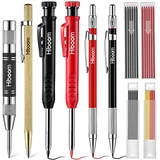
Price: $14.99 — Check current price on Amazon →
Specs
- 2.8mm lead — 2 mechanical carpenter pencils + 2 deep-hole pencils
- 36 refills included (black, red, yellow)
- Spring-loaded center punch (chrome-plated steel)
- Carbide-tip scribe tool with protective cap
- Built-in sharpener on every pencil; 0.64 lb total kit weight
Pros
- Most complete kit in this lineup — pencils, punch, and scribe cover marking, center-punching, and metal/glass scoring in one purchase
- Refills swap in fast and are cross-compatible with other 2.8mm carpenter pencils
- Grooved barrel resists slipping out of a sawdust-covered hand
Cons
- It’s a kit, not one dedicated tool — buyers who want a single great pencil get more pencils per dollar from the 6-Pack (#6)
- The built-in plastic sharpener is a wear part, not built to outlast the pencil body
This is the pick for shop generalists who’d rather buy one box than three separate tools. Between the two mechanical pencils, two deep-hole pencils, center punch, and carbide scribe, it covers layout marking, punching a pilot hole for a drill bit, and scoring metal or tile — jobs that would otherwise need three separate purchases.
The 2.8mm lead is carpenter-pencil thick, so it’s built for general shop marking on rough or finished lumber, not fine joinery (see picks #2 and #3 for that). The 36 included refills in three colors mean it’s ready for both light and dark stock out of the box.
Main drawback: The bonus tools are genuinely useful, but they mean fewer pencils per dollar than the dedicated 6-Pack (#6) — if raw carpenter-pencil volume is the only goal, that pick wins on cost per pencil.
2. Pentel GraphGear 1000, 0.5mm — Best for Fine Joinery Marking
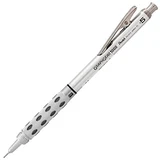
Price: $12.00 — Check current price on Amazon →
Specs
- 0.5mm point size
- Metal barrel with knurled, latex-free grip pads
- Dual-action retractable 4mm sleeve protects the lead tip
- Pre-loaded with Pentel Super Hi-Polymer HB lead
- Refillable; built-in lead-hardness indicator
Pros
- Retractable tip is built to survive drops and pocket carry — woodworking author Christopher Schwarz has written that his .7mm GraphGear 1000 “has lasted five years” in daily shop use
- A 0.5mm line is accurate enough for dovetail baselines and tenon shoulders, where a 2.8mm carpenter pencil is too coarse
- All-metal body outlasts the plastic drafting pencils most hobbyists start with
Cons
- Standard HB graphite only — no colored-lead option for dark wood out of the box
- Not a carpenter-pencil substitute; tool reviewer Stuart at ToolGuyd explicitly notes it’s built for “more precise shop use,” not rough lumber
- At least one reported case (a commenter on that same review) describes a hard drop bending the tip despite the metal housing
This is a drafting pencil that happens to work extremely well in a woodshop, not a carpenter pencil in disguise. The 0.5mm point is the size most woodworkers reach for when a line needs to be exact rather than just visible — dovetail layout, mortise-and-tenon joinery, anywhere the pencil line itself is the reference the saw follows.
The retractable 4mm tip is the detail that makes it shop-durable rather than just office-durable: the lead is protected whenever the pencil isn’t in your hand, which matters a lot more on a bench covered in clamps and chisels than on a desk.
Main drawback: It only makes a visible line on light-to-medium wood. On walnut, wenge, or dark-stained stock, pair it with the Uni NanoDia colored leads (#4) instead of the stock graphite — same 0.5mm holder, completely different visibility.
3. Pentel GraphGear 1000, 0.3mm — Best for Ultra-Fine Layout Lines
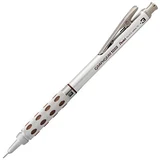
Price: $8.94 — Check current price on Amazon →
Specs
- 0.3mm point size — the thinnest widely available mechanical lead
- Same metal body and retractable tip as the 0.5mm version
- Pre-loaded Super Hi-Polymer HB lead
- Refillable with Pentel lead and Z2-1 eraser
Pros
- The thinnest line in this comparison — useful for filling in a knife-scribed layout line for visibility, a technique Schwarz specifically calls out for the finer GraphGear 1000 sizes
- Same drop-resistant retractable tip as the 0.5mm pick
- Built-in lead-hardness indicator makes swapping grades simple
Cons
- 0.3mm lead snaps more easily under side pressure than 0.5/0.7/0.9mm — not the pick for anyone who bears down while marking
- No colored-lead option
- Overkill for general layout across a full board
This is the size for marking directly against a knife wall or striking a single precise baseline — not for sketching layout across a whole panel. Hand-tool joiners who cut to a scribed line rather than a sawn one tend to reach for this size specifically because the lead itself adds almost no width to the mark.
Main drawback: Fragile under lateral pressure. Anyone who presses hard while marking should size up to the 0.5mm (#2) or the thicker 0.9mm Pica (#5) instead — 0.3mm rewards a light touch and punishes a heavy one.
4. Uni NanoDia Color 0.5mm Leads, 7-Color Set — Best for Marking Dark Wood
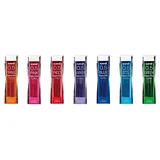
Price: $11.30 — Check current price on Amazon →
Specs
- 0.5mm diameter — fits any standard 0.5mm mechanical pencil
- 7 colors: Red, Pink, Orange, Green, Mint Blue, Blue, Lavender
- 140 leads total (20 per color tube)
- Works in pick #2 above or any 0.5mm holder already owned
Pros
- Pink and Mint Blue are the two shades FineWoodworking’s own dark-wood marking comparison rated most visible on walnut and ebony-toned stock
- Loads directly into the Pentel 0.5mm pencil (#2) or any standard 0.5mm holder — no new pencil required
- At roughly $0.08 per lead, it’s cheap insurance against a layout line you can’t see
Cons
- This is a refill, not a complete pencil — a 0.5mm holder is required separately
- Softer colored lead wears down and needs advancing more often than standard black graphite
Standard black HB graphite is close to invisible on walnut, wenge, or anything dark-stained — a problem every other pick in this comparison shares, since none of the fine mechanical pencils here ship with a colored option. This refill pack solves it without buying a second pencil: drop a Pink or Mint Blue lead into the 0.5mm holder from pick #2 and the same precise 0.5mm line becomes visible on dark stock.
It’s the one entry in this dataset that isn’t a complete tool on its own, which is also why it earns its own row instead of being folded into pick #2 — the lead color is the actual purchase decision for dark-wood work, not the pencil body.
Main drawback: The same softness that makes these leads show up on dark wood also makes them blunt faster than standard graphite — expect to advance the lead more often mid-project.
5. Pica Fine Dry 0.9mm Automatic Pencil — Best No-Sharpen / Most Weatherproof
Price: $16.63 — Check current price on Amazon →
Specs
- 0.9mm self-feeding solid “dry” lead — never needs sharpening
- Stainless-steel push mechanism inside a sealed barrel
- Dust and water protection via a push-button cap and barrel sealing ring
- Ships with 5x HB graphite leads; refillable in H (fine) or HB (general-purpose)
- Made in Germany
Pros
- The only pencil in this comparison genuinely built for dust and moisture exposure — the sealed barrel and stainless mechanism target job-site conditions, not just a dry shop bench
- Never needs a sharpener, so there’s nothing extra to lose or break
- One lead marks plastic, metal, stone, and timber without swapping tools
Cons
- The most expensive single pencil in this comparison at $16.63
- Replacement leads ship from a German brand, so restocking can be slower than a big-box-carried option
- No colored-lead option for dark wood — the leads are graphite only
This is the pick for outdoor and rough-condition marking — deck building, framing, anywhere sawdust and moisture are a daily reality rather than an occasional mess. The self-feeding lead mechanism means there’s no sharpener to lose in a job-site bag, and the sealed barrel is a genuinely different durability class from every carpenter pencil in this lineup, which rely on a screw-in plastic sharpener cap.
Main drawback: It’s a premium price for a single pencil. If weatherproofing specifically isn’t a priority, a $5–$15 carpenter-pencil multi-pack covers the same rough-surface marking job for less money.
6. Hiboom 6-Pack Solid Carpenter Pencils, 2.8mm — Best for Rough Lumber & Deep-Hole Marking
Price: $21.99 — Check current price on Amazon →
Specs
- 2.8mm lead, 6 pencils per pack
- 72 refills included (54 black, 18 red/yellow)
- 45mm extended deep-hole nib
- Built-in sharpener; grooved barrel with pocket clip
Pros
- Lowest cost per pencil in the entire comparison once the 72 bundled refills are counted
- Thick 2.8mm lead resists snapping on rough, splintery lumber where a fine mechanical tip would break instantly
- 45mm nib reaches into cabinet interiors, deep holes, and tight joinery gaps the other picks can’t reach
Cons
- 2.8mm is far too coarse a line for fine joinery — this is a rough-marking tool, not a precision one
- Six pencils is more volume than most hobbyists working small projects need at once
This is the pick for framing, deck building (paired with a reliable circular saw for the actual cuts), and cabinet carcass work — anywhere the wood surface is rough enough that a fine mechanical pencil would just skip across the grain or snap on contact. The manufacturer’s own refill breakdown (black for fine layout, red for bold cut lines, yellow for temporary guides visible on dark surfaces) matches the general lead-color logic that runs through this whole comparison — color is doing real visibility work, not just cosmetics.
Main drawback: The line it draws is genuinely too thick for tight joinery. Pair it with the Pentel 0.5mm (#2) or 0.3mm (#3) for the fine work on the same project rather than trying to make one pencil do both jobs.
7. Hiboom Mechanical Carpenter Pencil, Deep-Hole (Blue) — Best Value / Budget Pick
Price: $4.99 — Check current price on Amazon →
Specs
- 2.8mm lead
- 45mm deep-hole tip
- Built-in sharpener
- Ships with 3 black + 3 yellow refills
- Pocket clip
Pros
- Cheapest complete pencil in the entire comparison
- Yellow lead is included specifically for dark-surface visibility — per Hiboom’s own listing, “yellow can be drawn on dark surfaces where grey do not draw”
- A deep-hole tip at this price is genuinely rare
Cons
- Single pencil only — no backup if it’s lost on a job site
- No refill program beyond the pencil’s own built-in sharpener and included leads
This is the low-commitment way to try a mechanical carpenter pencil without buying a multi-pack. It’s also a reasonable cheap backup to toss in a toolbox or apron pocket — at $4.99 it’s not a meaningful loss if it goes missing on-site, unlike the $12–$22 picks elsewhere in this comparison.
Main drawback: At one pencil per purchase, this is the pick most likely to actually get lost. Buy two if it’s headed into a job-site bag rather than staying on a home shop bench.
How We Picked These
This is a Tier C, compared-not-tested roundup — nobody on this site physically bought and ran all seven of these pencils side by side for this article, and we’re not going to pretend otherwise. Here’s exactly what did go into it:
- Live pricing and specs for every pick, pulled from Amazon’s Creators API rather than copied from memory or a competitor’s article
- Lead diameter, lead color options, and grip details taken directly from each manufacturer’s own product listing text, not estimated
- The dark-wood lead recommendation is sourced from FineWoodworking’s own published comparison of pencils for marking dark wood, which specifically tested colored NanoDia leads against white and silver alternatives
- Shop-durability claims on the Pentel GraphGear 1000 are cited from named, published sources — tool reviewer Stuart at ToolGuyd and woodworking author Christopher Schwarz at Lost Art Press — not invented first-person testing
- General lead-hardness consensus (why a #2½-equivalent or HB lead outperforms a standard #2 pencil on wood) comes from the WoodWeb woodworking knowledge base’s collected practitioner input
We could not source real customer star ratings for these ASINs — Amazon’s own review data field came back empty for every product pulled this session, a known gap rather than a zero-review product. Rather than invent a rating or copy one from a competitor, we’ve left star ratings off this page entirely.
A transparency note on brand overlap: Hiboom appears three times in this comparison (#1, #6, #7). That’s not favoritism — Nicpro and THORVALD both sell comparable 2.8mm carpenter-pencil kits at similar prices, and either would slot into this table without changing the underlying pattern. Hiboom was kept because it covers three genuinely different formats — a multi-tool kit, a bulk 6-pack, and a cheap single pencil — with live, verifiable pricing and clear manufacturer spec text for each one, which made the three-way carpenter-pencil comparison (kit vs. bulk vs. single) cleaner to build honestly than mixing brands would have been.
What to Consider When Buying a Mechanical Pencil for Woodworking
The comparison table above covers the seven picks in this article; the sections below cover the underlying decisions that apply no matter which specific pencil ends up on the bench. Nine factors actually move the needle for woodworking use — the rest is marketing. For the rest of the shop beyond the pencil drawer, our guide to core woodworking tools covers the same buy-once-buy-right logic.
Lead Diameter
Fine mechanical pencils run 0.3mm, 0.5mm, 0.7mm, or 0.9mm — the thinner the lead, the more precise (and more fragile) the line. Carpenter pencils use a flat or round 2.8mm-class lead built to survive rough, splintery lumber that would snap a 0.3mm tip on contact. Match the diameter to the surface: fine mechanical for joinery on planed stock, thick carpenter lead for framing and rough-sawn material.
Lead Hardness
HB is the standard middle-ground hardness across nearly every pick in this comparison — dark enough to see, hard enough to resist smearing. A softer lead (2B/4B, or the H grade available in the Pica refills) marks darker with less pressure but wears down and blunts faster; a harder lead lasts longer between sharpenings but presses lighter and can be harder to read on rough-sawn wood.
Lead Color for Wood Tone
Standard black or gray graphite disappears against walnut, wenge, and dark-stained wood — this is the gap none of the fine mechanical pencils in this comparison solve out of the box. Colored leads (pink and mint blue tested best by FineWoodworking) or a manufacturer-supplied yellow carpenter-pencil refill both solve it; plain graphite on light maple or pine needs no special color at all.
Grip and Shop Durability
A metal barrel with a textured or knurled grip section stays usable with sawdust-covered hands; smooth plastic gets slippery fast. A retractable tip (like the GraphGear 1000’s 4mm sleeve) protects the lead between marks, which matters more on a cluttered bench than it would on a desk. Built-in sharpeners on carpenter pencils are convenient but are a small plastic wear part, not a lifetime feature.
Refillability and Lead Availability
Every pick in this comparison is refillable, but availability varies. 2.8mm carpenter lead and 0.5mm drafting lead are both common and cross-compatible between many brands. The Pica’s self-feeding “dry” lead format is proprietary to Pica and imported, so restocking takes longer than picking up a big-box refill pack.
Deep-Hole and Tight-Space Marking
Standard carpenter pencils have a short, wide tip that can’t reach into a drilled hole, a cabinet interior, or a tight mortise. A 45mm extended deep-hole nib (both Hiboom carpenter picks in this comparison use one) solves that specific problem; fine mechanical pencils are naturally narrow enough to reach most tight spots without a special tip design.
Sharpening vs. No-Sharpen Designs
Fine mechanical pencils never need sharpening — the lead advances by click. Most carpenter pencils include a built-in sharpener, which is convenient but is the first part to fail. The Pica Fine Dry goes a step further with a self-feeding solid lead that never needs sharpening at all, which is part of what justifies its higher price.
Price and Real Cost per Pencil
List price and per-pencil cost tell different stories once pack size varies this much — see the computed cost-per-pencil column in the comparison table above. A $21.99 six-pack can be cheaper per pencil than a $4.99 single, and a $12 drafting pencil earns its price with precision a $5 carpenter pencil was never built to deliver.
Weatherproofing for Outdoor or Job-Site Use
Most of these pencils are shop tools, not job-site tools — sawdust is one thing, standing water and rain are another. Only the Pica Fine Dry in this comparison ships with an actual dust/water sealing ring on the barrel; treat every other pick here as indoor-shop equipment.
How to Mark Wood with a Mechanical Pencil
- Match lead diameter to the surface. Fine 0.3–0.5mm mechanical lead for planed joinery stock; 2.8mm carpenter lead for rough-sawn or splintery lumber.
- Match lead color to the wood tone before you start. Standard graphite on light-to-medium wood; colored or yellow lead on walnut, wenge, or dark-stained stock — check visibility on a scrap offcut first, not on the actual workpiece.
- Square your reference edge first. A mechanical pencil is only as accurate as the edge or square it’s referenced against (not sure which to grab? see combo square vs. speed square) — the pencil doesn’t fix an unsquare line.
- Mark with light, consistent pressure. Pressing hard doesn’t make a line more visible, it just increases the odds of snapping fine lead or denting soft wood.
- Rotate the pencil as you draw. A tip worn flat on one side draws an increasingly thick, inconsistent line; rotating keeps the point centered and reduces how often you need to advance or sharpen.
- Plane or sand the line away fully before finishing. Graphite can telegraph through a thin finish coat if it isn’t fully removed, especially on lighter woods.
Frequently Asked Questions
What size lead is best for woodworking?
0.5mm is the most versatile fine mechanical size for joinery layout — thin enough for accuracy, sturdy enough for daily use. For rough lumber and framing, 2.8mm carpenter lead is the standard because it survives contact with unplaned, splintery surfaces that would snap a 0.5mm tip.
What’s the best lead hardness for marking wood?
HB is the standard, all-purpose hardness used across nearly every pick in this comparison. A softer lead marks darker with less pressure but wears down faster; a harder lead lasts longer between sharpenings but can be harder to read on rough or dark surfaces.
Do I need a special pencil for dark wood like walnut?
Yes, in practice. Standard black or gray graphite is close to invisible on walnut, wenge, and dark-stained wood. Colored leads (pink and mint blue tested best in FineWoodworking’s own comparison) or a manufacturer-supplied yellow carpenter-pencil refill both solve the visibility problem that plain graphite doesn’t.
Can a regular mechanical pencil replace a carpenter pencil?
Not for rough lumber. A fine 0.3–0.9mm mechanical pencil is built for precision on planed, smooth stock, and its lead will snap almost immediately on splintery or rough-sawn wood. Carpenter pencils use a much thicker, flatter lead specifically because it has to survive that kind of surface.
How often do carpenter pencils need new leads?
It depends on use, but most carpenter-pencil sets in this comparison ship with 14–72 refills precisely because the thick lead wears down with regular framing or layout work. A pencil used daily on a job site will go through refills faster than one used occasionally in a home shop.
Is a 2.8mm carpenter pencil or a 0.5mm drafting pencil better for woodworking?
Neither is universally better — they solve different problems. Carpenter pencils (2.8mm) win on rough lumber, framing, and deep-hole marking where durability matters most. Drafting pencils (0.5mm or finer) win on joinery layout where line accuracy matters most. Most working woodworkers end up owning both.
Do mechanical pencils work in cold or wet job-site conditions?
Most don’t hold up well — standard mechanical pencils and carpenter pencils in this comparison are shop tools, not weatherproof tools. The Pica Fine Dry is the exception here, with a sealed barrel and dust/water protection specifically built for job-site conditions rather than a dry bench.
Why do some carpenter pencils include yellow lead?
Manufacturer-supplied yellow lead exists specifically for dark-surface visibility — it’s the budget-friendly answer to the same problem the Uni NanoDia colored leads solve for fine mechanical pencils. Hiboom states this directly in its own product listings: yellow lead marks dark surfaces where standard grey graphite doesn’t show up at all.
Final Thoughts
For most woodworkers, the Hiboom 10-Pack Mechanical Carpenter Pencil Set is still the pick to start with — four pencils, a center punch, and a carbide scribe for $14.99 covers more shop-marking jobs per dollar than any single specialized pencil in this comparison. But the one number worth remembering from the whole dataset is this: standard black graphite, at any price, does not reliably show up on dark wood. If your shop works walnut or dark-stained stock, the $11.30 Uni NanoDia colored-lead refill is doing more real work than a pencil twice its price.
Most roundups in this category stop at “here are some carpenter pencils” without ever pricing the actual per-pencil cost or testing which lead color survives on dark wood. Both of those numbers came from primary sources — live Amazon pricing and a published dark-wood marking comparison — not from guesswork, and they’re the reason this page exists as more than a restatement of seven Amazon listings.
Sponsored / affiliate links. As an Amazon Associate I earn from qualifying purchases. I may earn additional commission from eligible campaigns.