Dust Collector Static Electricity: How to Control It
If shocks happen only while dust moves through the collector and stop when you touch a grounded metal part, it is usually nuisance static; if the shock comes from a tool, motor, or outlet, treat it as a wiring fault. Left alone, it can create nuisance shocks and may point to a bonding problem in the dust path. This guide shows how to find the source, fix bonding, and judge when grounding alone is not enough.
Why dust collector static shocks happen
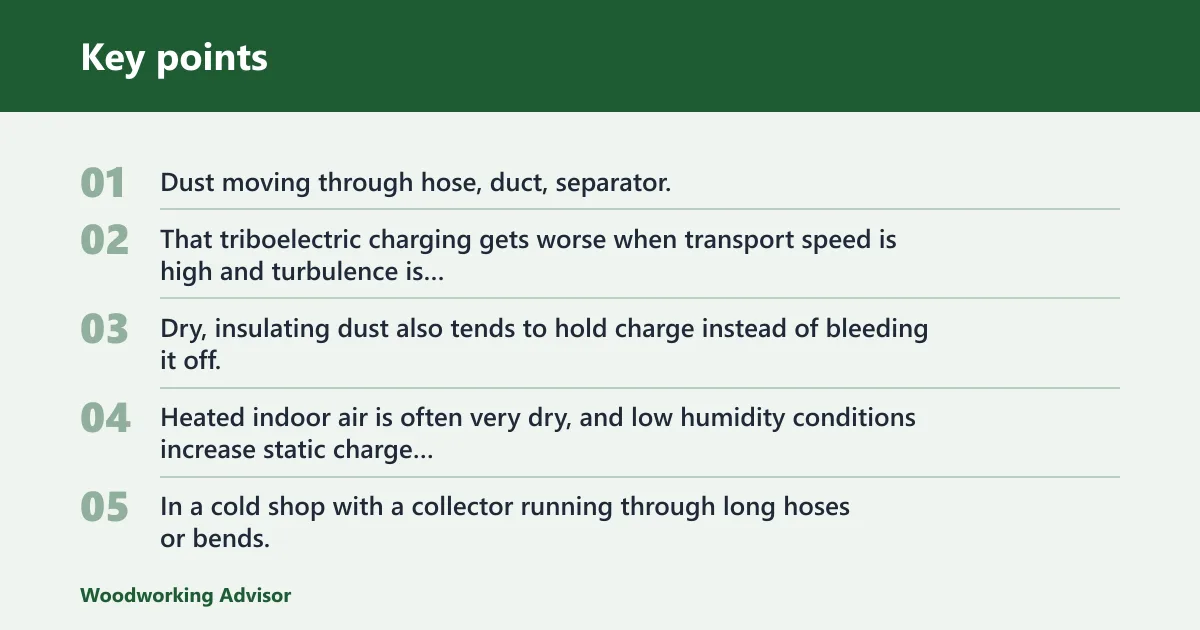


Dust moving through hose, duct, separator, and filter media creates charge by contact and separation. That triboelectric charging gets worse when transport speed is high and turbulence is strong. Dry, insulating dust also tends to hold charge instead of bleeding it off.
Winter makes the problem show up faster. Heated indoor air is often very dry, and low humidity conditions increase static charge accumulation in dust systems. In a cold shop with a collector running through long hoses or bends, the symptom is usually a snap at the machine port, the metal drum, or a separator lid.
Where the shock usually starts
The point of discharge is not always the point where charge forms. A hose can charge the dust stream, a separator can break continuity, and a metal lid can become the first easy path to you. If the shock happens when you touch one location but not another, check that location first.
Say a 4-inch hose shocks you each time a small collector with a metal drum and a plastic separator lid is emptied. The hose is a likely source, but the separator may be the place where charge is forced to jump to a grounded metal part.
Why airflow, turbulence, and dust load matter
Higher transport velocity and tighter bends raise charge generation because they increase friction and turbulence. In small woodworking systems, that can mean the same collector feels harmless in one setup and starts making noise with shocks after a duct change.
The practical point is simple: if the system was quiet before a layout change, do not assume the collector motor suddenly became the cause. Start with the path the dust travels.
Bonding vs. grounding in your shop
Bonding ties conductive parts together so they sit at the same electrical potential. Grounding gives static a path into earth. Both matter, but they do different jobs. Bonding keeps metal parts from sitting at different voltages; grounding gives that connected metal a place to dump charge.
What bonding does between metal parts
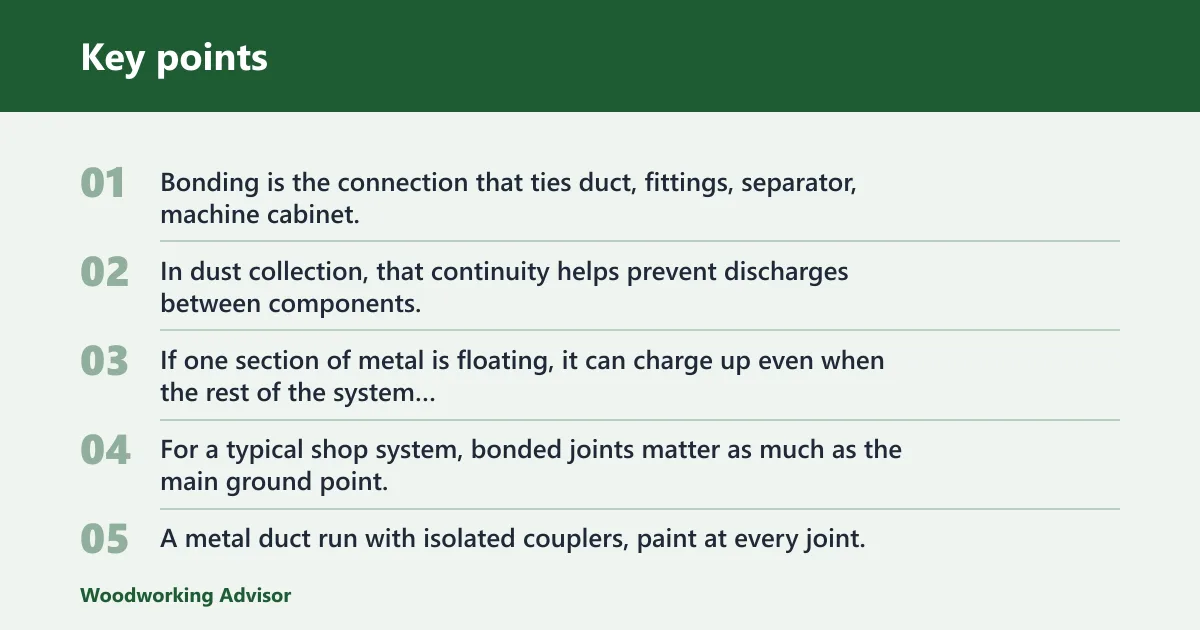
Bonding is the connection that ties duct, fittings, separator, machine cabinet, and collector body together. In dust collection, that continuity helps prevent discharges between components. If one section of metal is floating, it can charge up even when the rest of the system is grounded.
For a typical shop system, bonded joints matter as much as the main ground point. A metal duct run with isolated couplers, paint at every joint, or plastic inserts between sections can break the conductive path.
What grounding does, and what it does not do
Grounding works only if the parts carrying the charge are conductive. It does not make an insulating hose or PVC duct behave like metal. It also does not fix a broken bond between two metal parts that are supposed to be continuous.
That is why a wire wrapped around plastic duct can create false confidence. The wire may be grounded, but the duct wall is still an insulator, so charge on the dust stream may have no useful path to the grounded conductor.
Why a grounded wire on PVC can still leave the system unsafe
PVC ductwork is generally treated as an insulator, so it cannot be grounded effectively in the same way metal ductwork can. A wire on the outside may help provide a local discharge path if it contacts a conductive fitting or an exposed charged area at a break or joint, but it does not make PVC conductive ductwork. Do not treat it as proof that the whole system is safe.
For combustible dust transport, conductive ductwork is the better choice because the metal path can be bonded across joints and accessories. If the system includes metal blast gates, separators, sensors, or a cyclone, those parts need continuous connections too.
Is PVC ducting safe for dust collection static?
PVC can move air and dust, but it is a poor material for static control because it insulates. A grounding wire on PVC may reduce some visible nuisance, yet it does not solve the core problem of charge moving through a nonconductive wall. For combustible-dust service, that is a weak arrangement.
What the wire-around-PVC approach can and cannot solve
A wire spiral or external conductor can sometimes bleed off charge that reaches the wire, but it cannot guarantee that charge on the dust stream or inner wall reaches earth. It also does nothing if the real break is a plastic separator lid, a nonconductive hose cuff, or a filter housing with poor continuity.
Suppose a 2.5-inch shop vac hose crackles on each sanding pass and shocks only when the plastic end cap is grabbed. The wire may reduce the snap, but it does not change the fact that the hose and cap are still insulating parts. That is a control, not a cure.
When to consider conductive ductwork instead
If you are moving fine dust through a fixed system and static is recurring, conductive ductwork is the cleaner answer. It is the right choice when you want one continuous path from machine port to collector, with every joint and accessory bonded. That matters most where combustible dust is a concern, not just annoyance.
For a mixed system that already exists, replace the most problematic plastic sections first: long runs, separator inlets, and the first hose off the machine. Then test again before changing the whole layout.
How to reduce static in the system
The best fix is usually a sequence, not a single trick. Start with the conductive path, then decide whether humidity control or part replacement is needed. Bond metal parts across every joint, use conductive ductwork where the system and dust hazard call for it, and add anti-static filter media only where the collector design supports it.
Bond the metal parts first
Connect all conductive parts so they share the same electrical potential. That includes duct, gates, separator bodies, collector housing, and metal machine ports. If paint, powder coat, or gaskets interrupt the connection, add a bonding jumper where the manufacturer allows it.
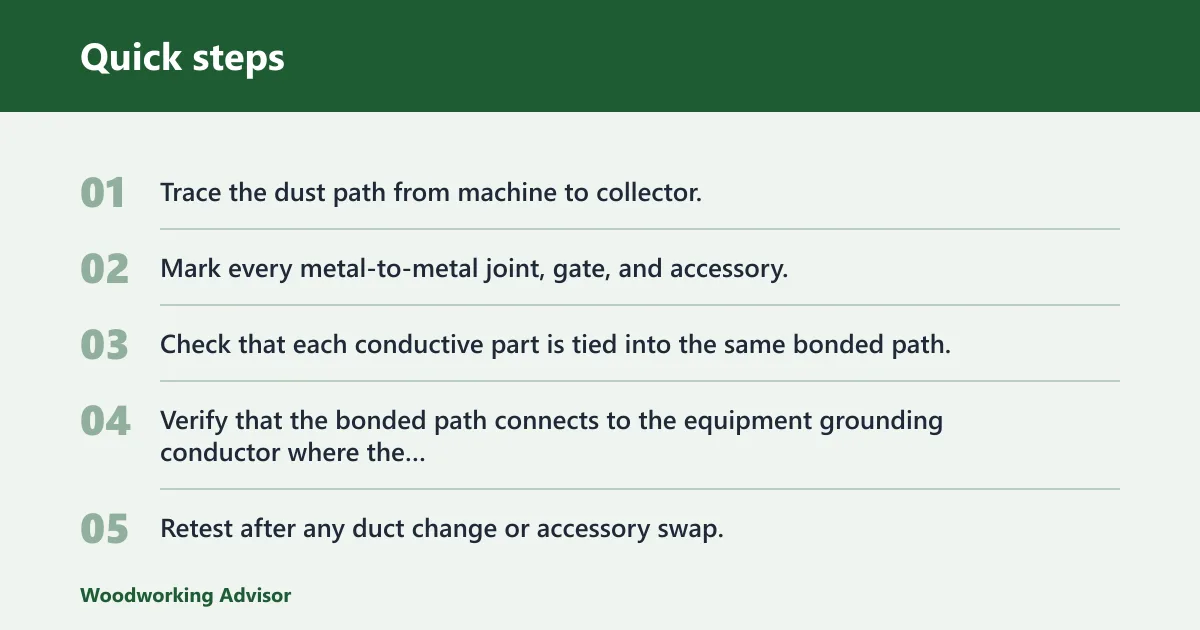
- Trace the dust path from machine to collector.
- Mark every metal-to-metal joint, gate, and accessory.
- Check that each conductive part is tied into the same bonded path.
- Verify that the bonded path connects to the equipment grounding conductor where the collector is designed for that connection.
- Retest after any duct change or accessory swap.
Use anti-static media where the model supports it
Anti-static filter media can reduce charge buildup on filter cloth. Many standard filter cloth materials are non-conductive and can store static charge, while anti-static needle felt uses conductive fibers such as stainless steel or carbon fibers. That helps most where the filter itself is part of the charging path.
This is not universal. Check the manufacturer’s listing for your model, because some small collectors use replacement cartridges or bags that are not offered in anti-static form.
Control humidity if your shop air is very dry
Humidity helps because low humidity conditions increase static charge accumulation in dust systems. In a heated winter shop, even a small rise in humidity can make shocks less frequent. It does not replace bonding or grounding, but it can reduce how often charge builds to a noticeable snap.
Use humidity control as a support measure, not as the main fix. If the duct path is open, dry air alone will not make a PVC system conductive.
Dust collector static matrix
This table helps you narrow the source before you buy parts or rewrite the duct layout. Read the source column first, then check whether grounding or bonding can help. If both are weak fixes, the next action is usually a material or layout change.
| Symptom | Likely source | Does grounding help? | Does bonding help? | Is humidity a factor? | Next action |
|---|---|---|---|---|---|
| Small snap when touching a metal drum | Separator or drum | Yes, if metal is conductive | Yes | Often yes | Check continuity across lid, drum, and separator joints |
| Shock at hose end only | Hose | No, if hose is nonconductive | Only if hose is conductive | Often yes | Replace with conductive hose or shorten the plastic run |
| Shock when emptying a trash can under the collector | Operator and container | Sometimes | Sometimes | Yes | Bond the metal container and verify collector continuity |
| Crackling in the hose during sanding | Hose and machine port | Limited | Yes, if parts are conductive | Yes | Reduce turbulence, then test hose material and end fittings |
| Shock at a PVC blast gate | PVC gate or duct | No | Usually no | Yes | Swap to conductive ductwork or a metal gate |
| Static only after long duct runs | Duct and elbows | Yes for metal runs | Yes | Sometimes | Inspect joints and confirm every metal section is bonded |
| Filter bag or cartridge clings dust and shocks on touch | Filter media | Limited | No, unless the media is conductive | Yes | Check for anti-static filter media compatibility |
| No shock, but frequent crackle in dry winter air | Multiple sources | Maybe | Yes on metal parts | Yes, strongly | Test continuity, then add humidity control if the shop air is very dry |
How to read the table: if the likely source is PVC or another insulator, grounding will not solve the whole problem. If the source is metal and the shock is brief and local, bonding and continuity checks may be enough. If the symptom points to filter media or a long plastic hose, the next step is usually a part change.
How to test continuity and resistance
Use a low-resistance ohmmeter to test bonded components at their connection points, not on a random surface. The goal is to verify that the parts you expect to be continuous are actually continuous. That means testing across joints, couplers, gates, and accessories after the system is assembled.
What a passable reading means
For a shop owner, that means a bonded metal run should read very low resistance from one metal component to the next and to the grounding point. If a reading is unstable, high, or open, the bond is suspect.
Check the manufacturer’s listing for your model before making any changes to the grounding path. Do not assume a clamp on one section proves the whole system is acceptable.
Where the standard fits in practice
NFPA 77 also points to bonding requirements for dust-handling equipment. In practical terms, that means every conductive part in the dust path should be tied together and verified, including ductwork, dampers, sensors, and rotary valves when they are part of the system.
Test resistance every year and after system modifications. That is especially important after adding a separator, swapping hose, or moving a collector to a new corner of the shop.
When static needs a bigger fix
Sometimes the system can stay in service with better bonding and a little humidity control. Other times the layout itself is the problem. If the collector still shocks you after continuity checks, or if major sections remain PVC and cannot be made conductive, the right answer is retrofit or replacement.
Keep, retrofit, or replace
Keep the system as-is when the shocks are rare, the conductive parts test continuous, and the collector only shows nuisance static during dry weather. Add humidity control and recheck joints if symptoms return.
Retrofit the system when the main issue is a few plastic sections, a separator lid, or a nonconductive hose run. Replace the worst offenders first, then retest. That is the usual path for a mixed shop system.
Replace or redesign when the layout depends on long PVC runs, the collector cannot be bonded correctly, or the system is used for dust where static ignition risk is part of the hazard analysis. In that case, conductive ductwork with bonded accessories is the safer long-term answer.
A common first-timer mistake is to add one grounding wire, feel one small snap disappear, and call the job done. If the rest of the system is still insulating, the source has only moved.
Frequently asked questions
Why does my dust collector shock me in winter?
Winter indoor air is usually drier, and low humidity conditions increase static charge accumulation in dust systems. Heated shops make the problem more noticeable because dust moving through hoses, ducts, and filters keeps building charge while the air gives it fewer chances to leak away naturally.
How do I ground a dust collection system correctly?
Ground the conductive parts through the equipment grounding conductor and make sure every metal section is bonded so the whole system shares the same electrical potential. Grounding only works on conductive materials, so it is not a fix for PVC or other insulators.
Do I need anti-static hose for a dust collector?
It depends on the system. Anti-static hose is useful when the hose is a major charge source or when nuisance shocks keep returning at the machine port. It is less useful if the real problem is a broken bond, a nonconductive separator, or a long PVC run.
How does humidity affect dust collector static electricity?
Low humidity makes static buildup worse because dry air and dry dust hold charge longer. That is why winter shop conditions often produce more shocks. Humidity control can reduce symptoms, but it should support a bonded, continuous conductive path rather than replace it.
What resistance to ground should a dust collection system have?
Use a low-resistance ohmmeter and look for very low readings at every bonded connection point. In practice, the important sign is continuity across the conductive parts and a stable connection to the grounding path. If the reading is high or inconsistent, fix the joint before relying on the system.
Sponsored / affiliate links. As an Amazon Associate I earn from qualifying purchases. I may earn additional commission from eligible campaigns.