Dust Collector CFM Chart
Use a dust collector CFM chart to size for delivered airflow, not blower rating: plan for about 350 to 450 CFM at a 4-inch port for single machines, and about 600 to 800 CFM or more for larger tools after duct loss. Undersized airflow leaves chips in the hood, clogs filters faster, and makes a garage shop colder and dustier than it needs to be. This guide shows how winter air, long duct runs, and stiff flex hose change the CFM you actually need at the machine.
What CFM do you actually need?
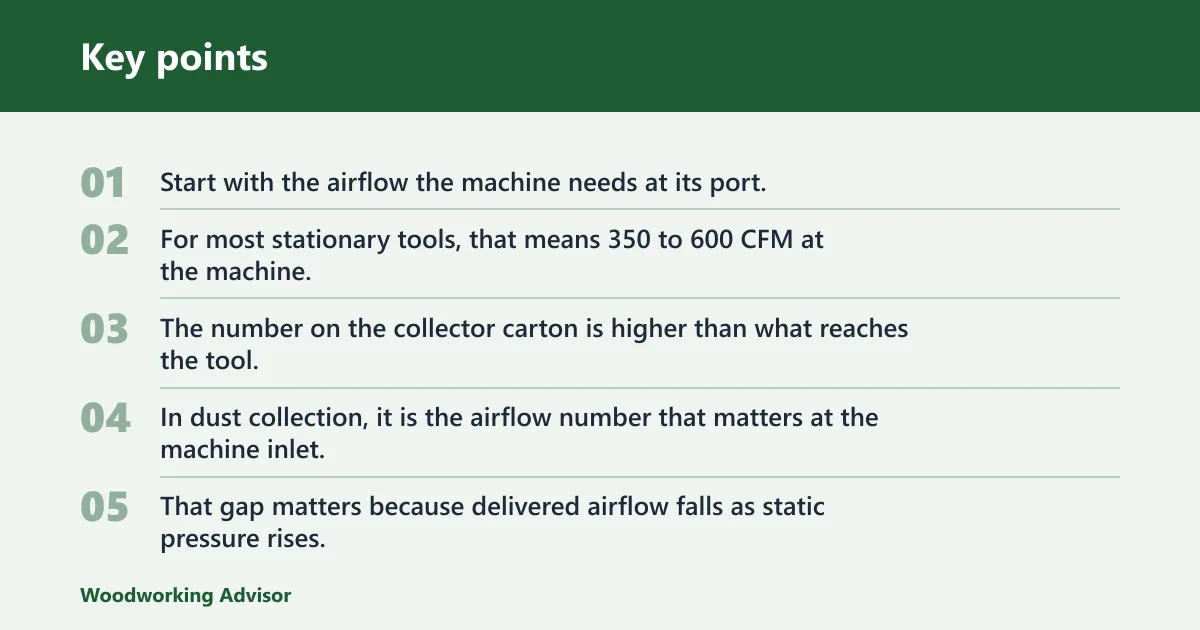


Start with the airflow the machine needs at its port, then work backward through duct loss. For most stationary tools, that means 350 to 600 CFM at the machine. The number on the collector carton is higher than what reaches the tool, especially in a winter shop with long runs, elbows, flex hose, and cold starts.
CFM means cubic feet per minute. In dust collection, it is the airflow number that matters at the machine inlet, not the free-air figure on the box. That gap matters because delivered airflow falls as static pressure rises.
CFM versus box ratings
Collector labels usually show free-air performance. That is the best-case number, with little resistance. Once you add duct, fittings, gates, hose, and a filter, actual airflow drops. A collector that appears large enough on paper can still fall short at the tool.
For that reason, size dust collection from the tool backward. A 1 HP collector moves about 650 to 800 CFM, a 2 HP collector moves about 1,200 to 1,500 CFM, and a 3 HP cyclone moves 1,700 or more CFM. Those figures leave room for losses in real ductwork.
Why the largest machine sets the target
Most one-person shops run one machine at a time with blast gates. That means you do not size for every tool open at once. You size for the largest machine you expect to run, plus the losses created by the shortest practical path from collector to tool.
Picture a garage shop where the collector sits in one corner and the table saw is across the room. The saw may need 350 to 450 CFM at the port, but the run includes several feet of duct, a couple of elbows, and a short flex connection. The collector has to deliver more than 450 CFM at the machine to make that happen.
Chip collection versus fine dust capture
Chip collection is easier than fine dust capture. Chips and shavings move with less resistance, while fine dust takes more airflow and better hood capture to stay airborne until it reaches the collector. If you want visible chips gone, you need less airflow than if you want better capture of the material that reaches the lungs.
That difference matters for health risk. A system that clears chips but leaves a haze of fines near the cut is not doing the same job as a system that pulls dust from the source. When in doubt, leave more airflow margin for fine dust work.
Dust collector sizing table
This checklist table turns machine CFM into a winter-shop decision. It uses published machine needs, then adds common penalty factors that cut delivered airflow in small shops: longer runs, flex hose, extra elbows, and cold-start resistance. The minimum collector and duct combination below is the smallest practical match that still gives usable airflow.
| Tool | Published machine CFM | Likely winter penalty factors | Minimum collector and duct combination |
|---|---|---|---|
| Table saw, contractor style | 350 to 450 CFM | Long run, one flex hose section, one or two elbows, cold-start risk, overarm guard if fitted | 1 HP collector with a short 4-inch branch for a compact layout; 2 HP if the run is long or the guard adds demand |
| Table saw, cabinet style | 350 to 450 CFM | Heavier internal losses, overarm guard, longer duct run, filter load in winter | 2 HP collector with 5-inch or 6-inch main, then a short 4-inch or 5-inch branch |
| Jointer up to 6 inches | 350 to 450 CFM | Short hose, one elbow, gate loss, cold air startup | 1 HP collector for a short run; 2 HP if the collector is remote or the branch is long |
| Jointer 8 inches | 350 to 450 CFM | Longer hood path, more leakage risk, elbows, winter hose stiffness | 2 HP collector with 5-inch or 6-inch duct to preserve branch velocity |
| 12-inch planer | 500 CFM | High chip load, long run, flex hose, cold motor starts, filter loading | 2 HP collector with 6-inch main and the shortest practical branch |
| 15-inch planer and larger | 600 to 900 CFM | High demand, long run, multiple elbows, larger port losses, winter pressure drop | 3 HP cyclone with 6-inch main; 7-inch or 8-inch duct only where the run and collector can support it |
| Drum sander | 550 to 600+ CFM | Fine dust load, long run, filter loading, cold-start risk, multiple fittings | 3 HP cyclone with 6-inch duct or larger; keep the run short and the branch straight |
A common first-timer mistake is connecting a drum sander to a small collector through a long 4-inch hose and expecting clean air. The connection exists, but the delivered airflow may be too low for the machine’s real need, so dust settles in the hood and escapes into the room.
How much airflow do common machines need?
Most stationary tools need 350 to 600 CFM at the machine. A table saw and a jointer usually sit in the lower half of that range. A planer or drum sander asks for more, especially when the shop run is long or the ducting is undersized.
Table saws and overarm guards
A 10-inch table saw is documented at 350 to 450 CFM. Cabinet saws often collect better than contractor saws because the lower cabinet is more enclosed, but an overarm guard adds demand. If you add the guard, plan for the top and bottom pickups together, not the cabinet alone.
That makes the duct path part of the saw choice. A saw on a short 4-inch branch may work acceptably. The same saw at the end of a long run with extra elbows may need a larger main and a stronger collector to keep the actual airflow in range.
Jointers, including 6-inch and 8-inch models
A jointer up to 8 inches wide is listed at 350 to 450 CFM. Small and mid-size jointers usually do not demand the same airflow as a large planer, but they still suffer if the line is too long or the flex hose is too restrictive. The hood needs enough velocity to keep chips moving.
Planers from 12-inch to 15-inch-plus
A 12-inch planer is documented at 500 CFM. A 15-inch planer and larger can need 600 to 900 CFM. That is where a 4-inch branch often becomes the limit, because the machine may want more air than the duct can carry without loss.
Use a larger collector and a larger main for these machines. A 2 HP unit can cover many 12-inch planer setups. Larger planers usually point you toward a 3 HP cyclone, especially if the shop layout forces a long run.
Drum sanders and other high-demand tools
Drum sanders are high-demand tools. They usually sit at 550 to 600+ CFM because they create fine dust, not just chips. Other high-demand tools, such as wide planers and some enclosed sanding setups, follow the same pattern: more air, straighter duct, and fewer losses.
Why does airflow drop in a winter shop?
Winter shops lose airflow for reasons that have nothing to do with the label on the collector. Longer garage-to-tool runs, stiff flex hose, extra elbows, cold-start resistance, and denser air all reduce delivered CFM. The machine can be connected and still underperform.
Long runs and extra elbows
Every extra foot of duct and every fitting adds static pressure. A straight, short path helps preserve airflow. A layout with several turns can turn a collector that looks adequate on paper into one that struggles to move chips at the hood.
Suppose the collector sits in a shed and the planer is at the far end of the garage. The run has two elbows, a blast gate, and a short flex connection. The published collector rating may still look good, but the machine sees less airflow because the path costs pressure.
Flex hose losses
Flex hose is useful, but it costs more airflow than smooth pipe. Woodcraft reports a 1 HP collector rated at 650 CFM moved about 420 CFM through 6 feet of 4-inch flex hose. That is a clear reminder that a short flex connection can cut the usable number fast.
Use flex hose only where movement is needed, and keep it short. In a winter shop, stiff hose can also make bends tighter than intended, which adds another layer of restriction.
Cold-start and garage-shop issues
Cold starts are harder in unheated spaces. The collector, hose, and filter all begin the day cold, and the system may not move air as freely at first. Cold air is denser, so the system has to work harder to achieve the same real-world cleanup at the machine.
That is why winter-shop sizing should include margin. If a warm-season layout barely works, the same layout may fall short in January.
How do I size a dust collector by duct diameter?
Use duct diameter to keep branch velocity high enough to carry chips. A common rule is to keep branch lines at 4,000 feet per minute or faster. If the duct is too large for the airflow, velocity drops and chips can settle out before they reach the collector.
What 4-inch duct can and cannot do
A 4-inch duct carries about 349 CFM at 4,000 FPM. That makes it workable for many single-tool branches, but it is often restrictive for larger tools and long runs. Air Handling Systems publishes 350 CFM for a 4-inch branch and 300 CFM in a 4-inch main, which shows how quickly the practical limit appears.
4-inch duct is usually the bottleneck when the machine needs more than the branch can move. If the collector is large but the branch is small, the duct, not the blower, sets the limit.
When 5-, 6-, 7-, and 8-inch duct make sense
A 5-inch duct carries about 545 CFM at 4,000 FPM. A 6-inch duct carries about 785 CFM at 4,000 FPM. Those sizes fit larger planers, wider jointers, and longer mains where a 4-inch branch would choke the system.
Seven-inch and 8-inch duct are reserved for larger mains and higher-demand systems where the collector can support them. A larger duct is not automatically better. If airflow is too low for the diameter, chip-carrying velocity falls and performance drops.
Keeping branch velocity near 4,000 FPM
- Start with the machine’s published CFM need.
- Add margin for elbows, flex hose, and winter startup losses.
- Choose the smallest duct diameter that still keeps branch velocity near 4,000 FPM.
- Use blast gates so only one branch is open in a one-person shop.
- Move up to a larger main only when the duct and collector can still maintain usable airflow.
Blast gates matter because a one-man shop usually opens one branch at a time. That lets you size the system for one tool, not for every machine at once. If multiple branches open together, total demand rises and the collector has less airflow to give each tool.
What collector size matches the chart
For a small or medium shop, the collector size should match the largest tool and the duct path, not the sum of all tools. A 1 HP unit can work for short, compact runs. A 2 HP unit is a better fit for many small shops. A 3 HP cyclone is the safer choice for long runs or higher-demand machines.
1 HP, 2 HP, and 3 HP ranges
A 3 HP cyclone moves 1,700 or more CFM and is the better match for a demanding shop layout.
Those ranges are not direct promises at the tool. They are starting points. The final number depends on duct diameter, filter resistance, hose length, and the number of fittings between the collector and the machine.
When to move up in size
Move up when the chart says the tool needs more airflow than the branch can carry, or when the machine is far from the collector and the path includes several losses. If you run a 15-inch planer, a drum sander, or a cabinet saw with an overarm guard, a larger collector usually makes the system more usable.
Use the larger size when fine dust capture matters more than basic chip pickup. The margin helps the system hold airflow after the filter loads up and the shop gets colder.
Frequently asked questions
How many CFM dust collector do I need?
Most stationary tools need 350 to 600 CFM at the machine. Use the larger end of that range for planers, drum sanders, and any setup with long duct runs, flex hose, or extra elbows. If your layout is a garage shop, add margin for winter losses.
What CFM dust collector do I need?
Pick the collector by delivered airflow, not the carton rating. For many small shops, a 2 HP unit is the practical middle ground, while a 3 HP cyclone is the better fit for long runs or larger tools. Match the collector to the largest machine you will run through that branch.
How much airflow does a table saw need?
Cabinet saws often need similar airflow at the port, but an overarm guard adds demand. If the saw sits far from the collector, size the duct and collector so the machine still gets that range at the hood.
How much CFM does a planer need?
A 12-inch planer is documented at 500 CFM. That higher range is why many planer setups need a 2 HP or 3 HP collector, especially if the duct path is long or includes flex hose.
What size dust collector do I need for a jointer?
A short, straight branch may work with a 1 HP collector, but a longer run usually benefits from a 2 HP unit and a larger main. Keep the branch short enough to preserve velocity.
Why is my dust collector losing suction at the tool?
The usual causes are static pressure loss from long runs, too many elbows, restrictive flex hose, a clogged filter, or duct that is too large for the airflow. The machine may be connected, but the delivered CFM can still be below what the tool needs to clear chips or fine dust.
Sponsored / affiliate links. As an Amazon Associate I earn from qualifying purchases. I may earn additional commission from eligible campaigns.