Finishing Wax vs Paste Wax: What Is the Difference?
“Finishing wax” and “paste wax” usually differ by label, not by fixed chemistry. The real variables are the wax blend and any solvents, oils, or resins in the can. Pick the wrong one, and you can soften an existing finish, leave a cloudy film, or make later recoating harder. This guide explains what those labels usually mean, how to compare ingredients, and how to match wax to your finish and maintenance needs.
| Factor | Finishing Wax | Paste Wax | Winner |
|---|---|---|---|
| What the label usually signals | Often a furniture-focused marketing label; may be paste wax or a blended wax with additives | Generic product term for a solid or semi-solid wax in a can | Paste Wax |
| Chemistry clarity | Varies by brand; can include carnauba, beeswax, synthetic waxes, tint, or scent | Usually easier to compare by base wax and solvent carrier on the label | Paste Wax |
| Finish compatibility control | Only as good as the listed ingredients and cure guidance | Same product class, but the generic term makes ingredient checking more direct | Tie |
| Recoat and repair risk | Can be low or high, depending on additives and how heavily it is applied | Also depends on blend, but many plain paste waxes are easier to strip when needed | Paste Wax |
| Best use case | Maintenance coats on finished furniture when the label names the exact wax type | General buying choice when you want to judge chemistry, sheen, and solvent carrier yourself | Paste Wax |
Why wax names don’t match ingredients
Most of the time, the difference is labeling rather than chemistry. Paste wax is the broader term for a wax you rub on, let haze, and buff off. Finishing wax often points to a furniture-oriented blend sold for final sheen or maintenance.
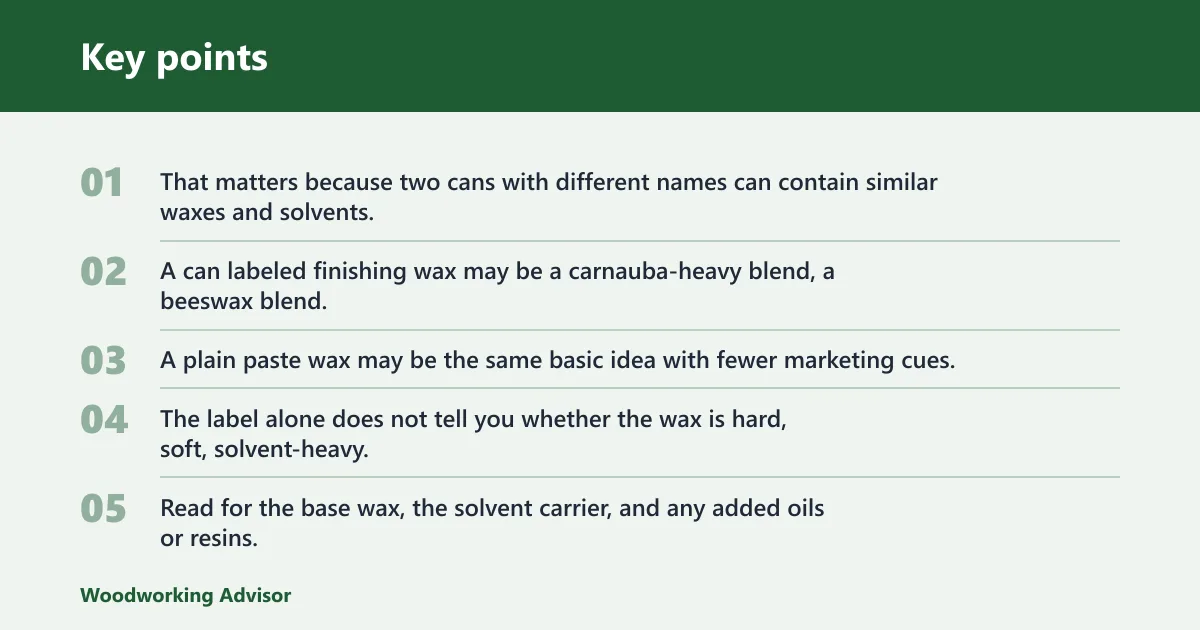
That matters because two cans with different names can contain similar waxes and solvents. A can labeled finishing wax may be a carnauba-heavy blend, a beeswax blend, or a blend with tint and scent. A plain paste wax may be the same basic idea with fewer marketing cues.
Label versus chemistry
The label alone does not tell you whether the wax is hard, soft, solvent-heavy, or suitable for your finish. Read for the base wax, the solvent carrier, and any added oils or resins. Those details affect drying, odor, gloss, and how much residue is left behind.
Where the terms overlap
Both products are generally applied in a thin coat and buffed off after the haze forms. Both can add sheen and a modest amount of short-term moisture resistance. Both can cause trouble if they go on too soon over an uncured finish or stay too thick in pores and corners.
Why product names vary by brand
Brands use “finishing wax” when they want the product to sound like a final step for furniture or trim. “Paste wax” sounds more technical and broader. Neither name guarantees better performance, so ingredients and intended finish type matter more than the front label.
Wax decision matrix
This matrix groups common wax products by the details that change performance: base chemistry, solvent carrier, sheen, cure window, and recoating risk. Use it to compare ingredients, not just product names.
| Wax type | Base chemistry | Solvent carrier | Sheen after buffing | Cure window before use | Use / avoid / test first | Recoating risk |
|---|---|---|---|---|---|---|
| Pure or hard paste wax | Often carnauba-rich | Mineral spirits or naphtha | Satin to high gloss | Apply only after the finish is fully cured | Use on fully cured polyurethane, varnish, shellac, lacquer, oil, and painted surfaces; test first on satin finishes | Medium if left heavy; low if stripped before repair |
| Beeswax blend | Beeswax with softer waxes or oils | Often mineral spirits | Soft satin | Full cure still matters; drying to the touch is not enough | Use for decorative furniture and antiques; test first on tabletops; avoid on fresh film finishes | Medium to high because oily blends can leave residue |
| Furniture finishing wax | Can be carnauba, beeswax, synthetic wax, or a mix | Mineral spirits, naphtha, or low-odor solvents | Matte to gloss, depending on buffing | Follow the finish schedule first, then the wax label | Use when the label names the finish and cure limits; test first on shellac and lacquer; avoid if the ingredients are vague | Medium; varies by additives and application thickness |
| Low-VOC or silicone-free wax | Often blended wax with fewer oils | Low-odor or reduced-VOC solvent | Satin to gloss | Same cure rule applies | Use for repair work and occupied homes; test first on painted surfaces; avoid silicone-containing polishes nearby | Lower for future repairs if cleanly removed |
Use / avoid / test first by finish type
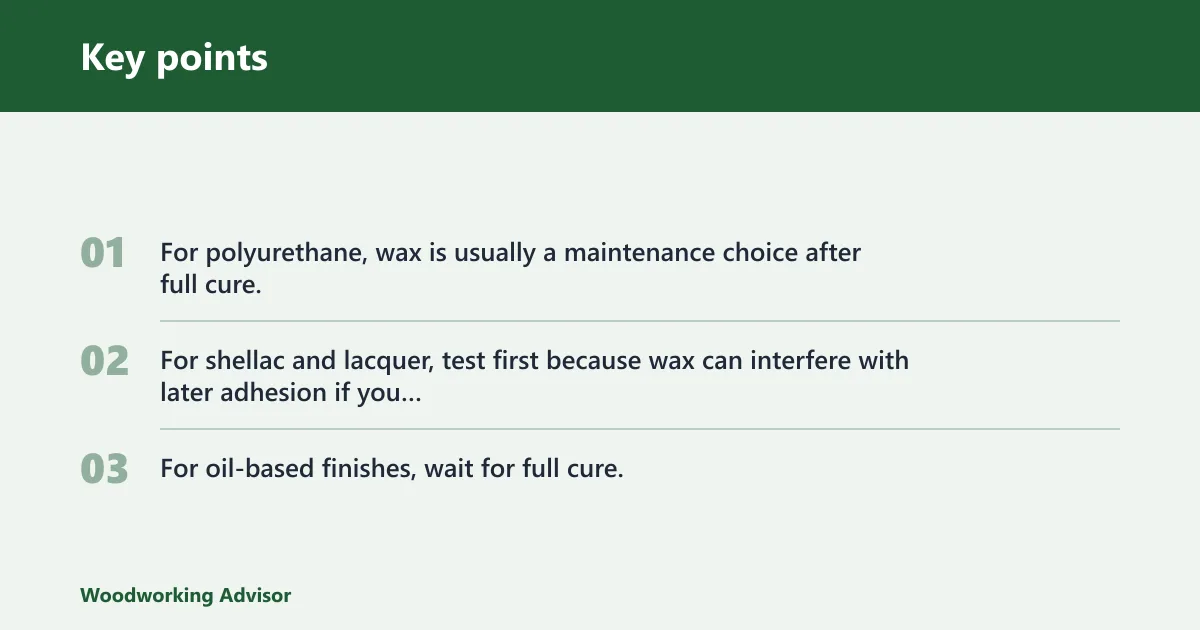
For polyurethane, wax is usually a maintenance choice after full cure, not a structural finish. For shellac and lacquer, test first because wax can interfere with later adhesion if you need to repair or recoat. For oil-based finishes, wait for full cure, which often takes days to weeks depending on the product and coat thickness.
What is inside each wax?
Wax products differ most by base wax and solvent, not by the name on the lid. Carnauba, beeswax, and synthetic waxes each change hardness, gloss, and buffing behavior. Additives then shift odor, spread, tint, and cleanup.
Carnauba: harder, higher-gloss blends
Carnauba is a hard plant wax. It is often blended with softer waxes because pure hard wax can be difficult to spread. In furniture and automotive waxes, it is valued for a harder feel and a brighter sheen after buffing. (Wikipedia)
Beeswax: softer, easier-to-buff blends
Beeswax is softer and easier to work. It buffs more easily into a mellow sheen, but it usually offers less durability than carnauba-heavy blends. That makes it common in traditional furniture waxes, especially when a softer look is the goal.
Solvent carriers, additives, and scent
Mineral spirits and naphtha are common solvent carriers. They control spread and drying, then evaporate before buffing. They also affect odor and flammability, so good ventilation matters. Some products add tint, fragrance, or slip agents, which can be useful on furniture and risky in repair work.
Can you use paste wax over polyurethane or varnish?
Yes, but only after the film finish has fully cured. On polyurethane or varnish, wax is usually a maintenance layer that changes feel and sheen more than protection. If you apply it too soon, or too heavily, you can trap solvent, soften the surface, or interfere with later recoating.
Fully cured film finishes only
Polyurethane is a film finish, so wax belongs on top of a cured film, not inside the film. A fully cured coat is harder to mar and less likely to react with the solvent carrier. Dry to the touch is not enough; the finish must have finished curing.
Shellac and lacquer caution points
Shellac is more sensitive to contamination than many other finishes. Lacquer also needs caution because wax can interfere with future adhesion. If you may need to spot-repair, recoat, or touch up later, wax should be used sparingly and only when the finish schedule allows it.
Oil-based finishes and cure time
Oil-based finishes often need the longest wait. Some oils are ready in days; others need weeks, especially with cooler temperatures or thicker coats. If the surface still smells strongly of solvent or feels soft, it is too early for wax.
How much protection does wax really provide?
Wax changes the surface more than it protects the wood. It can improve slip, reduce surface drag, and add some short-term resistance to fingerprints and moisture. It does not match the heat, alcohol, or standing-water resistance of a cured film finish.
What wax changes on the surface
Wax sits on top of the finish and changes reflectivity. Buffing can move a surface from matte toward satin or gloss without adding much thickness. That is why technique matters: heavier buffing usually means more sheen, not more real protection.
Heat, alcohol, and water resistance
Wax tends to have limited resistance to hot mugs, alcohol spills, and standing water. A tabletop finished with wax may look good, but it still needs coasters and quick cleanup. For high-wear surfaces, wax is a maintenance aid, not the primary defense.
Say your side table has a cured polyurethane top and you want a softer feel. A thin wax coat may help the hand feel and sheen, but a wet glass left overnight can still mark the surface. The wax changes appearance more than its resistance to abuse.
Choose finishing wax if… / Choose paste wax if…
Choose the label that gives you the clearest ingredient list. For furniture and trim, that usually means picking the product with the better-described blend, not the fancier name. If both cans list the same base wax and solvent, the practical difference is often small.
Choose Finishing Wax if…
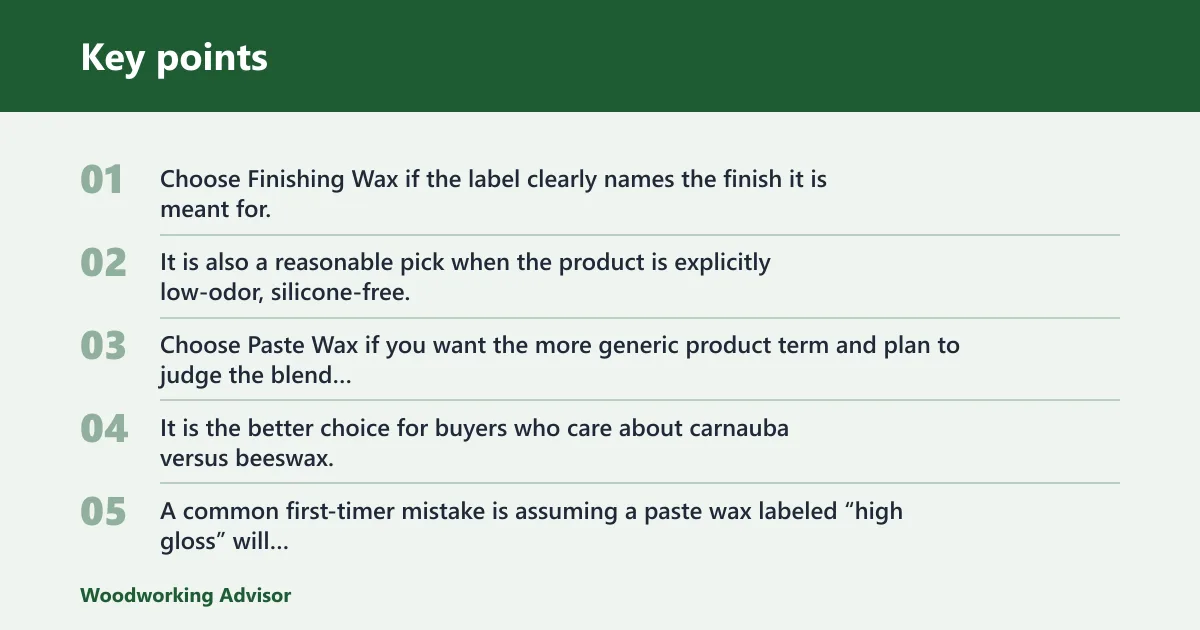
Choose Finishing Wax if the label clearly names the finish it is meant for, and you want a furniture-oriented maintenance coat. It is also a reasonable pick when the product is explicitly low-odor, silicone-free, or tinted for a decorative touch on already finished wood.
Choose Paste Wax if…
Choose Paste Wax if you want the more generic product term and plan to judge the blend yourself. It is the better choice for buyers who care about carnauba versus beeswax, solvent carrier, and future removal more than the marketing label on the front of the can.
A common first-timer mistake is assuming a paste wax labeled “high gloss” will outperform a finishing wax without checking the product’s intended use. A “high gloss” can still haze if it contains heavy additives or if it is buffed over an uncured finish. The safer choice is the can that matches your finish type, cure window, and recoating plans.
How do you remove old wax before refinishing?
Old wax must come off before refinishing if you want reliable adhesion. Solvent cleanup removes surface wax, but you also need to check for silicone contamination and greasy buildup. Sanding alone often smears residue around instead of removing it.
Solvent cleanup and residue checks
Start with a clean cloth dampened with mineral spirits or the solvent recommended by the finish maker. Wipe small areas and change cloths often. If the cloth picks up brown or gray residue, keep cleaning until the surface stops transferring contamination.
Silicone contamination warning signs
Silicone contamination is commonly reported to cause fisheyes, poor adhesion, and repeated finish failures. The signs include crater-like defects, crawling finish, or spots that refuse to wet out. Once silicone is present, the repair plan often needs stronger cleaning and more aggressive surface prep.
When sanding is not enough
Sanding helps, but it does not always remove wax from pores, corners, or open grain. On carved trim and porous wood, the residue can stay hidden and later ruin a new coat. Use sanding, cleaning, and a careful inspection together rather than relying on one step.
- Wipe the surface with the right solvent and fresh cloths.
- Inspect corners, pores, and edges for greasy feel or haze.
- Sand lightly only after residue is removed.
- Clean again before recoating.
- Test a small area if silicone contamination is suspected.
Frequently asked questions
What is the difference between finishing wax and paste wax?
Usually, there is no fixed chemistry difference. “Paste wax” is the broader product term, while “finishing wax” is often a furniture label for a similar blend. The better comparison is not name versus name, but base wax, solvent carrier, additives, and whether the finish is fully cured.
Is finishing wax the same as furniture wax?
Often, yes in practice. Many products labeled finishing wax are sold for furniture, and many furniture waxes are simply paste wax blends with a marketing label. Check the ingredient list instead of assuming the name tells you the chemistry or the cleanup risk.
How long should finish dry before applying wax?
Wait until the finish is fully cured, not just dry to the touch. For some shellac or lacquer coats, that may be relatively short; for oil-based finishes and some polyurethane systems, it can be days or weeks. Follow the finish maker’s cure guidance before waxing.
Does wax protect wood or just change the sheen?
It does both, but the protection is limited. Wax adds some short-term resistance to fingerprints, light moisture, and surface drag. It changes sheen more than it changes durability, and it does not replace a cured film finish on tabletops, cabinets, or other high-wear surfaces.
Sponsored / affiliate links. As an Amazon Associate I earn from qualifying purchases. I may earn additional commission from eligible campaigns.