Water Based Polyurethane in Cold Weather
Water-based polyurethane is often applied only when the finish, wood, and room stay at or above about 50°F, though a label may set a higher minimum. Below that, it can dry slowly, stay tacky, blush, or fail to bond well. This guide explains the temperature cutoff, the warning signs, and when to stop instead of coating.
Cold weather application risks
Sometimes, but only if the finish, the wood, and the space all stay warm enough. If any one of those is too cold, the film can stay tacky longer than expected, blush white, or cure poorly. The safest call is to proceed only when all three conditions are inside the product’s minimum range.
When to proceed
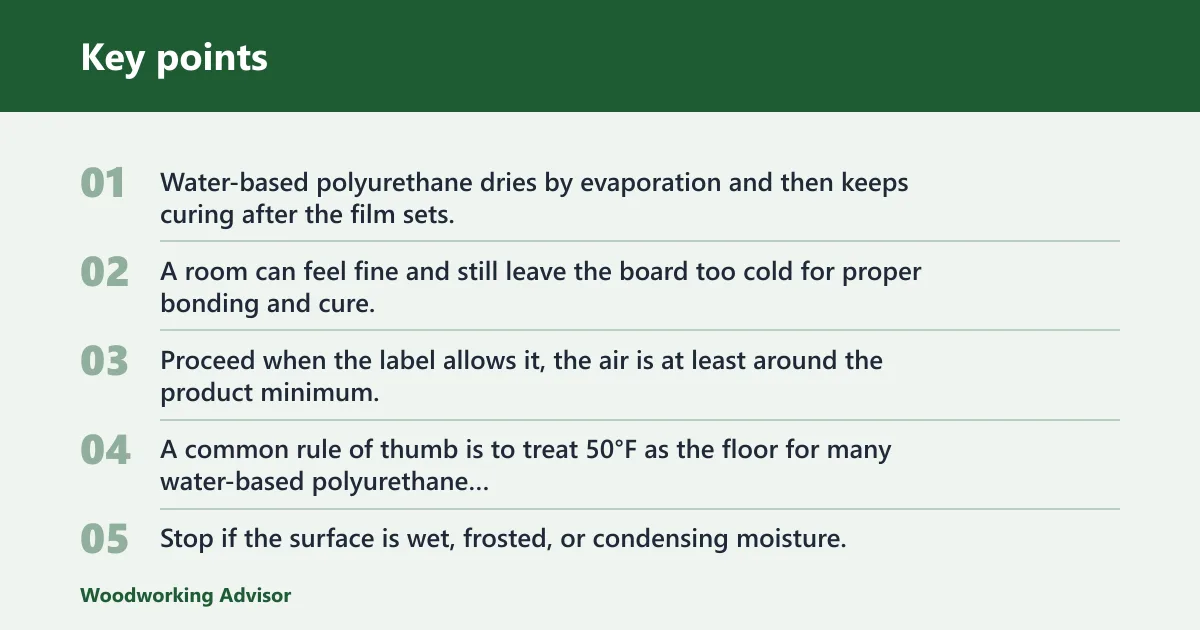
Water-based polyurethane dries by evaporation and then keeps curing after the film sets. Cold slows both stages. A room can feel fine and still leave the board too cold for proper bonding and cure.
Proceed when the label allows it, the air is at least around the product minimum, the substrate is also warm enough, and the wood surface is dry. A common rule of thumb is to treat 50°F as the floor for many water-based polyurethane products.
When to stop and wait
Stop if the surface is wet, frosted, or condensing moisture. Stop if the substrate is much colder than the room. Stop if the label says not to coat below a specific minimum. Cold conditions often turn a simple “slow dry” into a finish problem that shows up later as tackiness, soft film, or poor adhesion.
Suppose a garage sits at 52°F, but a plywood panel on a concrete slab reads 43°F. That panel is the risk point. The room may look acceptable, yet the cold board can slow coalescence and leave you with a sticky surface long after the can’s normal dry window.
Why slow dry time is the first warning
Cold weather problems often start as extended open time and delayed dry time. The finish still looks usable at first. Then dust sticks to it, moisture stays trapped, or the top skins over while the lower layers remain soft.
Water-based polyurethane temperature limits
The best application range is warm, dry, and stable. Many labels set a minimum application temperature around 50°F. Another page calls 70°F to 85°F the ideal application temperature, and one guide says polyurethane dries fastest at 70°F to 77°F with moderate humidity.
Why the ideal range matters
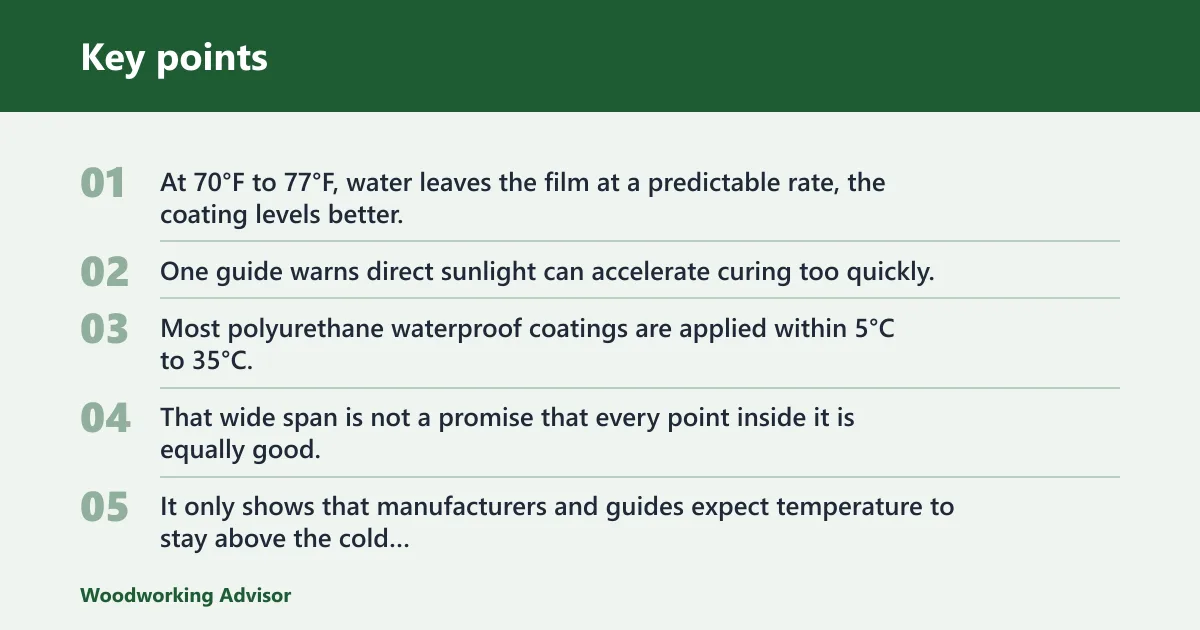
At 70°F to 77°F, water leaves the film at a predictable rate, the coating levels better, and recoating timing is easier to judge. That does not mean hotter is better. Direct sunlight can accelerate curing too quickly, which can leave lap marks or uneven film build.
Most polyurethane waterproof coatings are applied within 5°C to 35°C. That wide span is not a promise that every point inside it is equally good. It only shows that manufacturers and guides expect temperature to stay above the cold edge where film formation becomes unreliable.
What happens near 41°F and below freezing
Around 41°F can make polyurethane take over three times longer to dry. Another notes that cold weather can leave polyurethane tacky to the touch. Below freezing, drying can stall or fail entirely because water-based systems need the film to coalesce as water leaves.
That is why “it will probably dry eventually” is not a good plan. If the product cannot form a continuous film before the temperature drops again, you can end up with a weak or cloudy coat that needs to be removed and redone.
Cold weather polyurethane decision table
Use this table as a proceed-or-wait check. Compare the air, the wood, and the humidity, then choose the action that matches the highest risk factor. If the product label sets a stricter limit, follow the label instead of the table.
| Air temp | Substrate temp | RH | Risk level | Expected dry-time impact | Recommended action |
|---|---|---|---|---|---|
| 35°F | 35°F to 40°F | Any normal indoor RH | High | Drying may stall; tacky film likely | Wait or warm both space and wood first |
| 41°F | 41°F to 45°F | 40% to 70% | High | Can take over three times longer to dry | Do not coat unless the label allows colder use |
| 50°F | 50°F to 55°F | 40% to 70% | Moderate | Drying slows; recoats need extra time | Proceed only with dry wood and steady heat |
| 60°F | 60°F to 65°F | 40% to 70% | Low to moderate | Slower than ideal, but workable | Proceed if ventilation is balanced and the surface is dry |
| 70°F | 70°F to 75°F | 40% to 70% | Low | Near normal dry and recoat timing | Proceed if the label and moisture checks pass |
How to read the table
The air number alone is not enough. A cold slab, a freezer-cold panel, or a damp basement wall can push the substrate below the safe line even when the thermostat says the room is warm enough. Check the wood, not just the air.
Why substrate temperature matters more than you think
Air temperature and board temperature are not the same thing. Substrates can differ from air temperature by 5 to 10°C. That gap is large enough to change dry time, adhesion, and film quality, especially in unheated rooms or over concrete floors.
Cold wood changes the coating from underneath
A cold panel slows evaporation at the wood surface, so the coating may skin over unevenly. That can trap water, stretch open time, and leave the lower layers soft. If the board is cold enough, the film may also lose proper bite into the surface.
Picture a shelf panel stored near a garage door and another stored in the center of the room. The center panel may be ready while the edge panel stays colder, and the edge panel is the one more likely to show tackiness or uneven sheen after coating.
Concrete floors, sun, and room layout
Concrete can chill the bottom face of sheet goods and solid stock. Sunlit surfaces can do the opposite by heating one side faster than the other. That uneven temperature makes the finish behave differently across the same board, which can show up as lap marks or patchy gloss.
How humidity changes dry time and film quality
Moderate humidity is easier to manage than very high humidity. One competitor notes ideal humidity is no less than 40% RH and no higher than 70% RH. Another page gives relative humidity at or below 85% as a ceiling for application, but higher humidity still slows drying and raises defect risk.
High humidity and blush
High humidity keeps water in the film longer. In cold weather, that can create whitening or blush, especially when the surface cools below the dew point. The coating may look cloudy while it is still wet, and the haze can linger if the film never dries properly.
What to watch for in basements and garages
Cold basements and detached garages often combine low temperature with damp air. That is the roughest mix for water-based polyurethane because the finish needs both heat and evaporation. If the air feels clammy, the film may dry slowly even when the clock says it should be ready.
What happens when the surface is damp
The wood should be dry, or only slightly damp if the product instructions allow that condition. Rain-wet wood, condensation-wet wood, or wood with visible frost is a no-go. Moisture can cause blistering, pinholes, poor adhesion, and a soft or milky film.
How to check moisture before you coat
- Use a thermometer to check air temperature and substrate temperature separately.
- Use a hygrometer to confirm relative humidity.
- Use a moisture meter on the wood, especially on thick stock and sheet goods.
- Press a plastic sheet to the wood and tape the edges for a short condensation test.
- If moisture appears under the plastic, wait before coating.
That plastic-sheet test is simple, but it catches a common cold-shop mistake: the surface feels dry while hidden moisture is still moving out of the wood. If the panel is at or below the dew point, the finish can fail even when the grain looks clean and ready.
How to finish in a cold garage
Use steady heat, dry wood, and controlled airflow. Do not rely on a space heater alone if the slab, stock, and cans are still cold. Warm the room and the workpieces to near room temperature before coating, then keep conditions steady through the full dry and recoat window.
Balanced ventilation, not strong drafts
Ventilation matters indoors, but strong drafts can cause uneven thickness and dust contamination. High wind speeds can do exactly that. For water-based polyurethane, you want enough airflow to keep the room fresh and help evaporation, but not so much that the film skins unevenly.
How to handle recoat timing
Cold weather can more than triple dry time, so a fixed clock is risky. Follow the product label for recoat timing, then add time if the temperature is near the low end of the range. If the surface feels cool, slightly rubbery, or prints under light pressure, wait longer.
A common first-timer mistake is brushing a second coat the next morning because the surface “looks dry.” In a 50°F garage, that coat can drag, cloud, or bond poorly if the first coat has not cured enough to accept it.
Exterior water-based polyurethane outdoors
Exterior use is possible only with products designed for that exposure. Interior polyurethane is not the same thing as an exterior-rated system. Weather resistance depends on the chemistry and the full coating stack, not just the word “polyurethane” on the label.
Interior versus exterior-rated products
Some water-based polyurethanes are made for interior floors, furniture, and trim. Others are marketed for exposed surfaces and include better UV resistance. Even then, the result depends on the whole system, including prep, film thickness, and whether the product is intended as a topcoat or part of a larger finish schedule.
When outdoor application is a bad idea
Do not apply if rain is expected within 4 to 6 hours. One guide gives that window as a reason to postpone application. Moisture, fog, dew, and cold night air can all interrupt drying before the film has enough strength to handle exposure.
For exterior trim, a clear topcoat may help only if the base system is designed for it. Standard interior polyurethane exposed outdoors can break down faster, especially where sunlight and moisture cycle through the surface.
Frequently asked questions
Can you apply water-based polyurethane in cold weather?
Yes, but only if the finish, the wood, and the room stay warm enough and the label allows it. A practical cutoff for many products is about 50°F. Below that, dry time stretches, tackiness becomes more likely, and adhesion risk rises fast.
What is the best temperature for water-based polyurethane?
The best range is usually around 70°F to 77°F, with moderate humidity. Some product guidance puts the ideal application temperature at 70°F to 85°F. That range gives better leveling, faster dry time, and a more predictable recoat schedule.
How cold is too cold for water-based polyurethane to dry?
Near 41°F, dry time can become more than three times longer. Below freezing, drying may stop or fail to form a sound film. If the substrate is that cold, warm the space and the wood before you coat, or wait for a better day.
How long does water-based polyurethane take to dry in cold weather?
There is no safe fixed number because the label, film thickness, temperature, and humidity all matter. One quick-drying product may dry in 4 to 6 hours in room conditions, but cold weather can extend that well beyond a normal schedule. Always check the film, not just the clock.
How do you use water based polyurethane in a cold garage?
Warm the garage, the wood, and the can to near room temperature first. Keep humidity moderate, avoid strong drafts, and confirm that the substrate is dry before coating. Then use the label’s recoat window, but add time if the film still feels cool or rubbery.
What is the difference between water-based and oil-based polyurethane in cold weather?
Water-based polyurethane is usually more sensitive to cold because it dries by evaporation and film formation. Oil-based products also slow down in cold weather, but they often tolerate slightly different conditions and dry more slowly overall. In either case, the label minimum still controls the decision.
Is water-based polyurethane weather resistant outdoors?
Only some exterior-rated products are suited for outdoor exposure, and even then the system matters. Standard interior polyurethane is not a good choice for weathered surfaces. If the product is not clearly rated for exterior use, treat it as an indoor finish.
Sponsored / affiliate links. As an Amazon Associate I earn from qualifying purchases. I may earn additional commission from eligible campaigns.