Half-Lap Joint Calculator: Exact Cut Depths and Fits
For a half-lap joint, use the board’s actual thickness and cut each lap to exactly half that thickness; if the stock measures 3/4 in., each cut is 3/8 in. deep. I have seen nominal sizes throw the fit off by enough to leave a proud edge, a recess, or a weak overlap. This guide gives the calculator math, the layout numbers, and a shop check I use before I cut real parts.
How is this calculated?
Press Calculate to see the math with your numbers.
What is a half-lap joint?
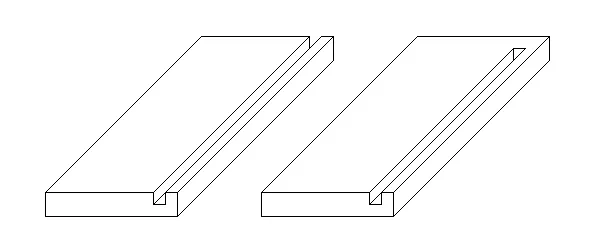
A half-lap joint removes half the thickness from each mating piece, so the two boards overlap and lie flush when assembled. Standard half-laps need both crossing boards to be the same thickness. When the stock matches, the faces line up cleanly and the joint clamps and glues without fuss.
Cross-lap vs. corner-lap joints
A cross-lap joins two members that cross in the middle, often for frames, grids, stretchers, and freestanding crosses (see how to make a wooden cross stand up for a worked example). A corner-lap is used where two pieces meet at an edge or corner and one face needs to stay flush. The joinery principle stays the same. The layout changes because the visible shoulders move to different edges.
Why flush faces matter in the finished joint
Flush fit is the goal because the top and bottom faces should align when the boards have the same actual thickness. If the cut is too shallow, the joint sits proud. If it is too deep, the faces recess and the overlap loses bearing. Both conditions show and both can weaken glue contact.
Where half-laps fit best in shop work
Half-laps work well where wide glue area, simple layout, and repeatable machine setup matter more than maximum strength. I reach for them on shelves, face frames, light assemblies, and shop jigs. They are a poor choice when the parts must resist heavy racking or when material thickness varies too much to trust a half-depth cut.
Do you use actual or nominal lumber size?
Use actual thickness, not the label. Nominal lumber size can be very different from the measured part in hand, and that difference changes the half-lap depth right away. The calculator needs a measured thickness input because the target cut depth is half the actual stock thickness, not half the stamp on the bundle.
Measure actual thickness with calipers
Measure stock with digital calipers in a few places and use the average of the readings. That method catches small twist, milling variation, and thickness drift from one edge to the other. For half-laps, a few thousandths matter because they move the finished faces toward proud or recessed.
Why 1x and 2x labels mislead half-lap layout
Nominal lumber size is only a naming system. A 1x or 2x label does not tell you the actual thickness needed for a half-lap layout. A board sold as 3/4-inch stock may not measure 3/4 inch, so a 50% depth based on the label can be wrong before the saw ever starts.
Why construction lumber, hardwood stock, and MDF do not behave the same
Construction dimensional lumber, hardwood boards, and MDF do not belong in the same setup. Construction stock is usually rougher and more variable. Planed solid wood / MDF is a true-to-size material type and fits well with exact 50% depth work. Hardwood plywood belongs in its own mode because its actual thickness is often undersized relative to the label.
How do you calculate half-lap cut depth?
The cut depth rule is simple: half-lap depth equals half the actual stock thickness. If two boards are the same thickness, each one gets the same cut depth and the faces end up flush. If the thicknesses differ, the assembly will be proud on one side or recessed on the other unless the layout is adjusted.
The 50% depth rule
The target cut depth formula is half the actual stock thickness. The calculator page shows 3/4-inch plywood actual thickness as 0.718 inches and gives a 0.359-inch half-depth target. It also warns that setting 0.375 inches based on nominal 3/4-inch plywood cuts too deep.
How equal thickness gives a flush joint
Equal thickness gives equal removal. That is why a standard half-lap can close flush without extra trimming when both crossing boards match. If one part is thicker, the same 50% cut leaves more material on one face than the other. The joint still goes together, but the faces will not line up cleanly.
How unequal thickness creates a proud or recessed face
Unequal thickness shifts the mating plane. A thicker board cut at 50% leaves more material on both sides of the overlap, so the assembly can sit proud. A thinner board does the opposite and can leave a recessed face. The gap is often small, but it shows after glue-up and finish.
Half-lap calculator inputs and outputs
A half-lap joint calculator should ask for actual thickness, board width, and material type. It should output cut depth, shoulder width, and mating layout. The shoulder width is the uncut portion that remains on each board, and the board width determines the mating board’s cut length when laying out shoulder-to-shoulder.
| Input | What it affects | Typical result |
|---|---|---|
| Actual thickness | Cut depth | Half of measured thickness |
| Board width | Shoulder location | Mating cut length |
| Material type | Depth mode | Solid wood, MDF, or plywood setting |
| Plywood mode | Undersized sheet stock | Separate actual-thickness entry |
Half-lap tolerance table: proud vs. recessed error
This table shows why small thickness errors matter. The error from a thickness mismatch appears in the finished joint as either proud or recessed reveal, depending on which board is off. The values below assume the half-lap is cut to the correct 50% depth for the measured stock, then the stock varies afterward.
| Common stock thickness | Exact 50% cut depth | Error if stock is off by 1/64 in. | Error if stock is off by 1/32 in. |
|---|---|---|---|
| 3/4 in. nominal hardwood plywood, 0.718 in. actual | 0.359 in. | 0.0156 in. proud or recessed | 0.0313 in. proud or recessed |
| 1/2 in. sheet stock, 0.500 in. actual | 0.250 in. | 0.0156 in. proud or recessed | 0.0313 in. proud or recessed |
| Planed solid wood / MDF, 0.750 in. actual | 0.375 in. | 0.0156 in. proud or recessed | 0.0313 in. proud or recessed |
| 5/8 in. stock, 0.625 in. actual | 0.3125 in. | 0.0156 in. proud or recessed | 0.0313 in. proud or recessed |
How do you set a saw for a half-lap joint?
Set the saw or router to the calculated depth, then sneak up on the final fit with scrap. For a table saw, a dado stack or flat-top grind blade is the cleanest option. For a router table, fence position and bit depth must both be controlled closely. Slightly undersized setup is safer than cutting too deep.
Table saw setup with dado stack or flat-top blade
Use a dado stack when the joint width is wide enough to justify it, or use a flat-top grind blade with repeated passes if the cutter width is limited. Set the blade just under the target depth, such as 0.370 inches for a 0.375-inch target. That leaves room for a fine cleanup pass instead of an overcut that ruins the fit.
Router table setup and fence control
On a router table, set the bit depth from the actual thickness, not from the label. A sacrificial fence helps reduce tear-out, especially across the end grain of the lap. Fence placement matters because an offset fence changes the shoulder line and can shift the mating piece even when the depth is correct.
Why test cuts on scrap come before the real work
Test cuts on scrap reveal blade kerf, fence placement errors, and reference mistakes before the real parts are touched. A joint that looks right on paper can still bind if the gauge references the wrong face or if cleanup passes remove more than intended. One dry fit on scrap is cheaper than remaking a rail.
Step-by-step saw or router workflow
- Measure the actual thickness in three places and average the readings.
- Calculate half the measured thickness for the target depth.
- Mark the shoulder line and mating cut length on both boards.
- Set the saw or router just under the target depth.
- Cut scrap first and check for flush fit.
- Adjust depth in small steps until the joint closes without force.
- Cut the real parts and fine-tune with a chisel or sanding block if needed.
What causes a half-lap joint to sit proud or recessed?
Proud or recessed joints usually come from thickness mismatch, incorrect depth, or setup drift. Even a good 50% cut can fail if the boards were not the same thickness at the start. Fence, gauge, kerf, and cleanup errors can also move the finished face away from flush.
Thickness mismatch between boards
If the two boards are not the same actual thickness, equal half-depth cuts do not produce equal faces. That is the most common reason a half-lap ends up proud or recessed. Standard half-laps need both crossing boards to be the exact same thickness for a flush assembly.
Fence, gauge, or reference errors
A fence set from the wrong face, a stop block that creeps, or a gauge referenced from the wrong edge can throw off both shoulder width and cut length. Those errors are easy to miss because the joint may still assemble. It simply assembles in the wrong place.
Kerf, cleanup passes, and sloppy depth control
Blade kerf affects how much waste remains between passes, and cleanup passes can remove more material than planned. That is why a slightly undersized initial setup is safer. It is easier to take another thin pass than to rebuild a joint that is already too deep.
When to avoid a half-lap joint
Use another joint when the parts will see heavy racking, the material thickness varies too much, or the finished face cannot tolerate a reveal. A mortise-and-tenon is a better choice for high-stress frames. A bridle joint gives better alignment on open-frame work. Pocket screws are faster when speed matters more than broad glue area.
Engineering force calculators for toggles are a good reminder that geometry can multiply load fast. Engineering ToolBox gives an equal-length-arm formula, P = F a / 2 h, and notes that a 90 kg effort force equals 883 N in its example, with a resulting force of 3393 N. In joinery, a small geometry error can also create a much bigger fit problem than expected.
What is a 1310 u joint?
A 1310 U-joint is a driveline universal joint size used in mechanical equipment, not a wood joint. It belongs in shafts and couplers, where the yokes let torque move through changing angles. It has no direct role in half-lap layout, though the shared term can confuse search results.
Frequently asked questions
What is a half lap joint?
A half lap joint is a wood joint where each piece loses half its thickness at the overlap so the two parts sit in the same plane. It is common in frames, grids, and simple assemblies because it gives a broad glue area and straightforward layout.
How strong is a half lap joint?
A half-lap joint is strong in shear and has more glue area than a simple butt joint. Its strength drops when the cut is too deep, too shallow, or used in parts that need high racking resistance. For heavy structural work, a mortise-and-tenon is usually the better pick.
How to make a half lap joint step by step?
Measure the actual thickness, calculate half of it, mark the shoulder lines, set the saw or router just under depth, cut scrap first, then cut the real pieces. Dry fit before glue-up. If the fit is tight, trim in small increments with a chisel or sanding block.
How do you calculate half-lap joint cut depth?
Use the actual measured thickness and divide by two. That is the target cut depth. A board that measures 0.718 inches needs a 0.359-inch lap, not a nominal 3/8-inch guess. If the two boards are not equal, the flush fit will be off.
Do you use actual or nominal lumber size for a half-lap joint?
Use actual thickness. Nominal lumber labels are not reliable for lap depth because the board in hand may be thinner or thicker than the stamp suggests. A caliper reading, averaged from three places, is the right input for a half-lap joint calculator.
What is the difference between plywood and solid wood for half-lap calculations?
Plywood needs its own calculator mode because sheet goods are often undersized relative to the label. Solid wood and MDF can be treated as true-to-size material when they are planed accurately. For plywood, the actual thickness matters even more because the nominal label can mislead the depth setting.
How do you set a saw for a half-lap joint?
Set the blade or bit just under the target depth, cut a test piece, and sneak up on the final fit. Use a dado stack or flat-top grind blade on a table saw, or a router table with a sacrificial fence. The goal is controlled removal, not one risky full-depth cut.
What causes a half-lap joint to sit proud or recessed?
The usual causes are thickness mismatch, wrong depth, bad fence placement, or over-cleanup after the first pass. A proud joint means too much material remains on one face. A recessed joint means too much was removed. Both can often be traced back to the original measurement.
What is a 1310 u joint?
A 1310 U-joint is a universal joint size used in drivetrains. It is a mechanical coupling, not a woodworking joint. If it appears in search results for half-laps, it is usually just a related term from general joinery or repair searches, not a part of the calculator workflow.
Sponsored / affiliate links. As an Amazon Associate I earn from qualifying purchases. I may earn additional commission from eligible campaigns.