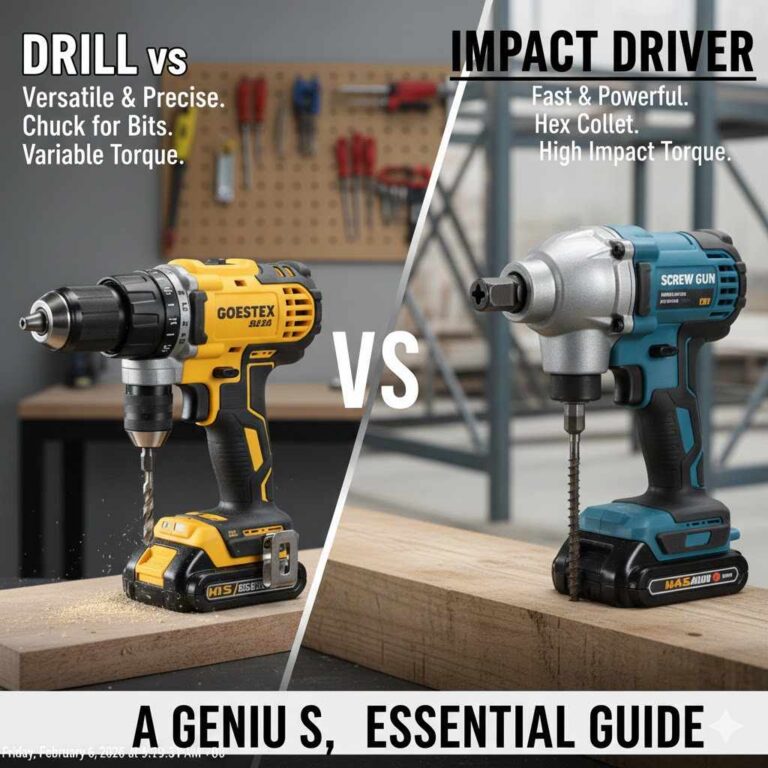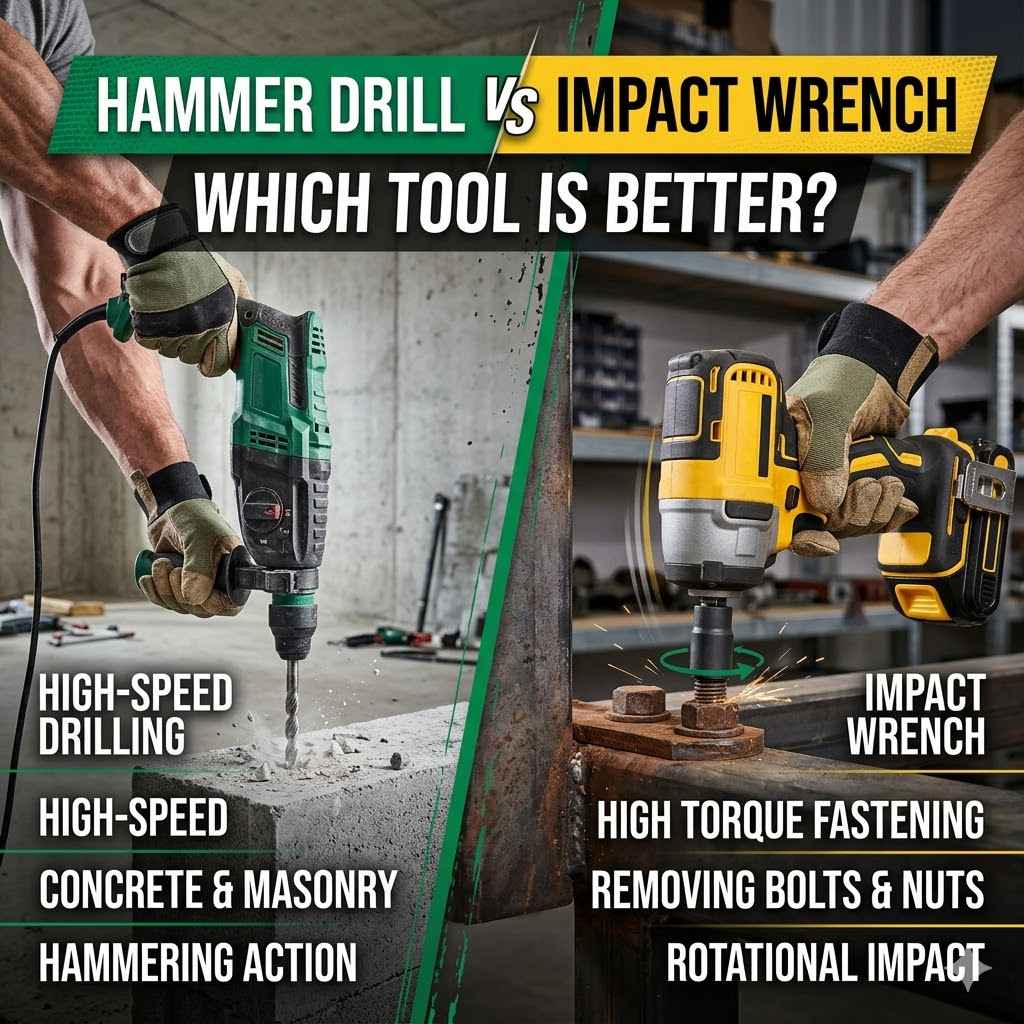
Hammer Drill vs Impact Wrench Which Tool Is Better
Picking the right tool can feel tricky when you’re starting out with DIY projects. You see a hammer drill and an impact wrench and wonder, what’s the difference? Will one work better for my needs?
It’s a common question because both tools seem powerful, but they do different jobs. Don’t worry, we’ll break it down simply. This guide will help you figure out exactly which tool is best for you.
Let’s get started and make your next project easier.
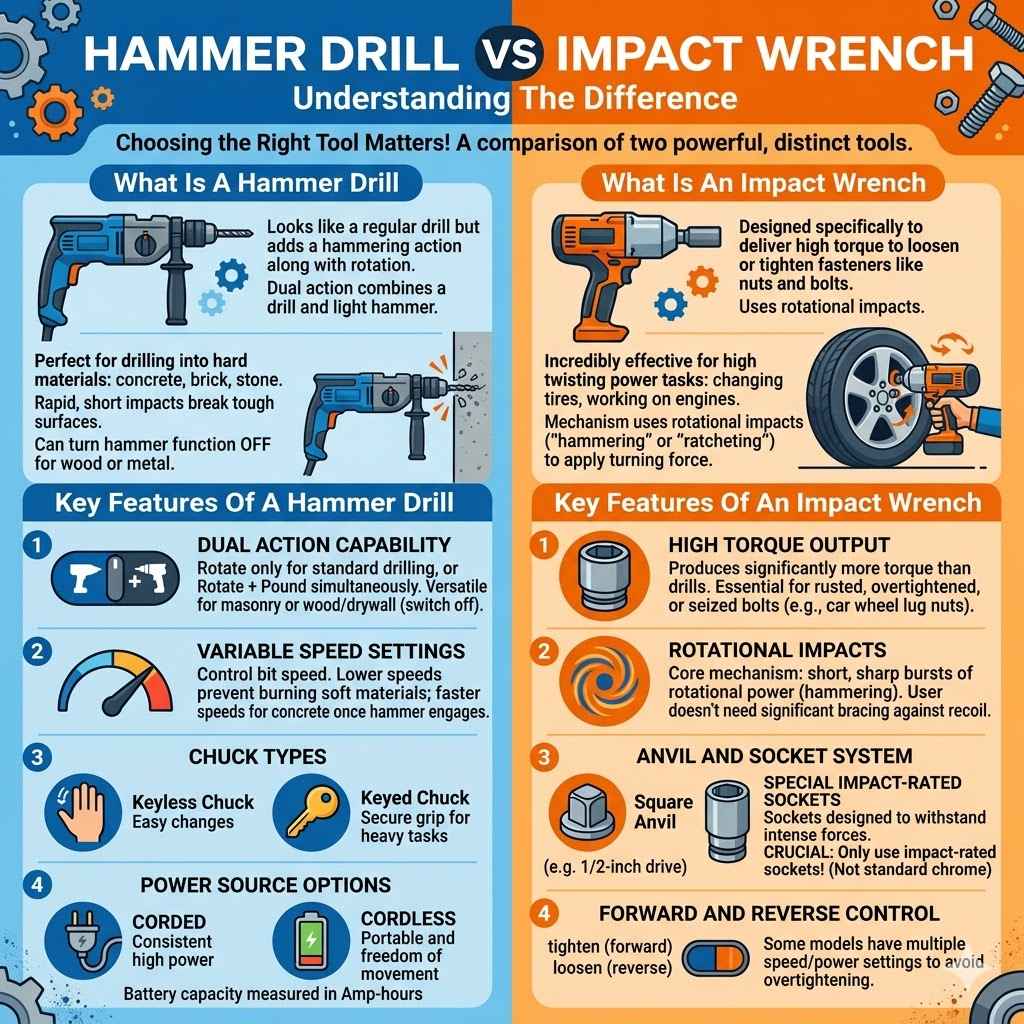
Hammer Drill vs Impact Wrench Understanding The Difference
When tackling various home improvement tasks, having the correct power tool makes a huge difference. Two popular choices often come up, leaving many DIYers scratching their heads: the hammer drill and the impact wrench. While both offer significant power, their design and intended use are distinct.
Understanding these differences is key to choosing the right tool for your specific job, ensuring efficiency and preventing damage to materials or the tool itself. This section will explore the fundamental characteristics of each tool, helping you identify their unique strengths and limitations.
What Is A Hammer Drill
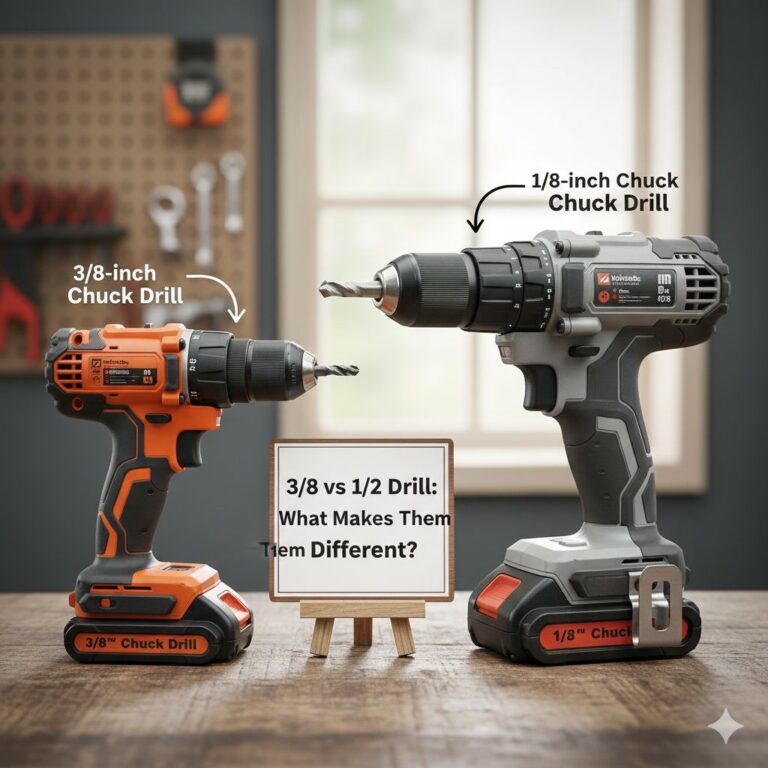
A hammer drill looks much like a regular drill but with an added feature. This feature allows it to perform a hammering action along with its usual rotation. Think of it as combining a drill and a light hammer into one tool.
This dual action is perfect for drilling into hard materials like concrete, brick, and stone. The hammer function delivers rapid, short impacts, which helps to break apart the tough surface, allowing the drill bit to penetrate more effectively.
The hammering mechanism in a hammer drill typically involves a series of cams or gears that create an oscillating motion. This motion, combined with the rotation of the drill bit, gives the tool its percussive power. It’s important to note that the user can usually turn this hammer function off.
This means it can also be used as a regular drill for tasks like screwing into wood or metal, making it a versatile tool for many general-purpose jobs around the house.
The power of a hammer drill is measured in Amps for corded models and Volts for cordless ones. Higher amperage or voltage generally means more power. The speed is also a key factor, usually measured in revolutions per minute (RPM).
Many hammer drills also feature variable speed settings, giving the user more control over the drilling process. This control is vital when working with different materials; you can use a slower speed for delicate tasks and a faster speed for tougher jobs.
Key Features Of A Hammer Drill
- Dual Action Capability
This is the defining feature. The hammer drill can either rotate a bit (like a standard drill) or rotate and pound simultaneously. This allows it to bore holes into masonry and concrete, which a regular drill would struggle with. For wood or drywall, you simply switch off the hammer action and use it like a normal drill. This versatility means one tool can handle many different tasks, from hanging shelves to assembling furniture. - Variable Speed Settings
Most hammer drills come with variable speed triggers. This means you can control how fast the drill bit spins. For soft materials like wood, you might use a slower speed to prevent burning. For harder materials like concrete, a faster speed can help with efficiency once the hammer action is engaged. This level of control is essential for precise work and for getting clean results. - Chuck Types
Hammer drills commonly use either a keyless chuck or a keyed chuck. A keyless chuck is easier to tighten and loosen by hand, making bit changes very quick. A keyed chuck requires a special key to tighten and loosen, offering a very secure grip, which can be beneficial for heavy-duty tasks where bit slippage is a concern. - Power Source Options
You can find hammer drills that are corded, meaning they plug into an electrical outlet, or cordless, powered by rechargeable batteries. Corded models generally offer consistent, high power. Cordless models provide portability and freedom of movement, which is great for working in areas without easy access to power outlets. Battery capacity (measured in Amp-hours) determines how long a cordless drill can run on a single charge.
What Is An Impact Wrench
An impact wrench is designed specifically for one main purpose: delivering high torque to loosen or tighten fasteners like nuts and bolts. Unlike a hammer drill, an impact wrench doesn’t primarily drill holes. Instead, it uses rotational impacts, often called “hammering” or “ratcheting,” to apply a powerful turning force.
This makes it incredibly effective for tasks that require a lot of twisting power, such as changing tires or working on engines.
The mechanism inside an impact wrench is different from a hammer drill. When the trigger is pulled, a rotating mass is spun up by the motor. This mass then strikes an anvil, which delivers a sudden, powerful rotational force to the output shaft.
This “impact” action is what gives the tool its name and its immense power. The impacts happen very quickly, thousands of times per minute, allowing the user to overcome stubborn fasteners with ease.
Impact wrenches are rated by their torque output, measured in foot-pounds (ft-lbs) or Newton-meters (Nm). This torque rating tells you how much twisting force the tool can deliver. They also have a speed rating, usually in revolutions per minute (RPM), but the torque is the more critical specification for most users.
You’ll often see different sizes of impact wrenches, such as 1/2-inch drive, which is common for automotive work, or 3/8-inch drive for lighter applications.
Key Features Of An Impact Wrench
- High Torque Output
This is the primary advantage of an impact wrench. They can produce significantly more torque than most drills, including hammer drills. This is essential for loosening bolts that are rusted, overtightened, or seized. For example, removing lug nuts from a car wheel often requires a lot of force, and an impact wrench handles this with ease, whereas a regular drill would struggle or be unable to do it at all. - Rotational Impacts
The core mechanism involves hammering impacts that provide rotational force. This is different from the forward-and-back hammering action of a hammer drill. The impacts are short, sharp bursts of rotational power. This allows the user to apply force without having to brace against significant recoil, which can happen with other high-torque tools. - Anvil And Socket System
Impact wrenches use a square anvil on the front where special impact-rated sockets attach. These sockets are designed to withstand the intense forces generated by the tool. It’s crucial to use only impact-rated sockets; standard chrome vanadium sockets can shatter under the stress, posing a safety hazard. The anvil size, like 1/2-inch, determines the size of the sockets you can use. - Forward and Reverse Control
Most impact wrenches have a switch or trigger setting to control the direction of rotation, allowing you to tighten (forward) or loosen (reverse) fasteners. Some models also have multiple speed or power settings, giving you more control over the torque applied, which can be useful to avoid overtightening.
Hammer Drill vs Impact Wrench Which Tool Is Better
The question of Hammer Drill vs Impact Wrench Which Tool Is Better hinges entirely on the task at hand. These tools are not interchangeable; they excel in different areas. A hammer drill is a versatile tool for drilling, especially into tough materials, while an impact wrench is a specialized powerhouse for driving and removing fasteners.
Understanding their core functions will quickly clarify which one you need.
If your primary goal is to make holes, particularly in masonry, concrete, or brick, a hammer drill is your go-to. Its percussive action is designed to chip away at hard surfaces, allowing the drill bit to bore through. For general-purpose drilling and screwdriving in wood, metal, or plastic, a hammer drill can also function as a regular drill by disengaging the hammer mode.
This makes it a valuable addition to any toolbox for a wide range of building and repair jobs.
On the other hand, if your work involves significant amounts of nuts and bolts, especially those that are difficult to turn by hand or with a standard wrench, an impact wrench is the superior choice. Its high torque output makes quick work of tasks like assembling or disassembling machinery, performing automotive repairs, or building structures with heavy-duty hardware. The sheer power of an impact wrench means you can tackle jobs that would be physically exhausting or impossible with other tools.
Consider the materials you will be working with. For concrete walls, you need a hammer drill. For stubborn lug nuts on a car wheel, you need an impact wrench.
Many DIYers eventually find value in owning both, as they complement each other in a comprehensive toolkit. The decision often comes down to prioritizing the most frequent or demanding tasks you anticipate performing.
Drilling Applications
When it comes to drilling holes, the hammer drill is the undisputed champion. Its ability to combine rotation with a percussive hammering action makes it exceptionally well-suited for breaking through dense and hard materials. This includes common construction materials like concrete, brick, stone, and tile.
Without the hammer function, drilling into these substances with a regular drill would be extremely slow, difficult, and could even damage the drill bit or the material itself.
The effectiveness of a hammer drill in these applications comes from its design. The hammering mechanism generates thousands of impacts per minute, which help to pulverize the material in front of the drill bit. This action loosens small particles, allowing the rotating bit to clear them away and continue its penetration.
For instance, when hanging a heavy shelf on a brick wall, you’ll need to drill pilot holes for anchors. A hammer drill will make short work of this, whereas a standard drill might just spin uselessly or overheat.
For softer materials like wood, drywall, or plastic, the hammer function on a hammer drill can be turned off, and it operates just like a standard drill. This means a single hammer drill can handle a wide variety of drilling tasks, from installing drywall screws to creating precise holes for dowels in woodworking. The variable speed and torque settings further enhance its versatility, allowing for delicate work and more demanding applications.
Examples of Drilling Applications:
- Hanging heavy artwork or shelving on concrete or brick walls.
- Installing electrical boxes or conduit in masonry.
- Drilling pilot holes for anchors in stone or stucco.
- Creating openings for plumbing or ventilation in hard surfaces.
- General drilling tasks in wood and metal when the hammer function is off.
Fastening Applications
When your task involves driving or removing nuts and bolts, the impact wrench shines. Its primary design is to deliver immense rotational force with high-speed impacts. This makes it ideal for fasteners that are tight, rusted, or require a significant amount of torque to move.
Think about automotive maintenance, construction, or any job where you encounter stubborn hardware.
The rotational impacts of an impact wrench are different from the hammering of a hammer drill. Instead of pushing forward, the impacts are side-to-side rotational blows that effectively break free seized fasteners. This means you can remove lug nuts from a car wheel in seconds, which would be a difficult and time-consuming manual task.
Similarly, assembling structures with large bolts is made much faster and easier.
It’s important to distinguish this from screwdriving. While some impact drivers (a related tool, often smaller than an impact wrench) are designed for driving screws, impact wrenches are generally too powerful for small screws. Using an impact wrench on small screws can easily strip the screw head, damage the material, or drive the screw too deep.
For general screwdriving, a standard drill or a dedicated impact driver is more appropriate.
Examples of Fastening Applications:
- Automotive Repair
Changing tires, working on engines, suspension components, and exhaust systems all involve nuts and bolts that often need significant torque to loosen or tighten. An impact wrench makes these tasks faster and less physically demanding. - Construction and Framing
Building decks, fences, or framing houses often requires driving large lag bolts or nuts onto threaded rods. An impact wrench can quickly drive these fasteners, significantly speeding up the construction process. - Machinery Assembly and Disassembly
Working with heavy equipment or machinery usually involves large, tight bolts. An impact wrench is invaluable for efficiently breaking these fasteners loose and reassembling components. - DIY Projects Requiring Strong Fasteners
Any DIY project that uses large bolts for structural integrity, such as building sturdy furniture or outdoor structures, benefits from the power of an impact wrench.
When To Choose Which Tool
The decision between a hammer drill and an impact wrench boils down to the specific job you’re undertaking. There’s no single “better” tool; rather, there’s a “right” tool for the task. If your project involves making holes, especially in hard materials like concrete or brick, the hammer drill is your clear choice.
Its percussive action is designed to penetrate these surfaces efficiently.
Conversely, if your work primarily involves driving or removing nuts and bolts, particularly those that are overtightened or rusted, the impact wrench is the tool you need. Its high torque output is specifically engineered for this purpose, making quick work of challenging fasteners. For example, changing a car tire is a perfect scenario for an impact wrench, while drilling anchor holes in a concrete wall calls for a hammer drill.
Consider the versatility. A hammer drill can often double as a regular drill, making it a good all-around tool for many DIYers. An impact wrench is more specialized, focusing on high-torque fastening.
If you only have the budget for one tool, think about which type of task you’ll perform most often. Many serious DIYers and professionals eventually own both, as they serve complementary roles in a well-equipped toolbox.
Scenario 1: Hanging A Mirror On A Brick Wall
- Identify the location and mark where you need to drill.
- Select a drill bit suitable for masonry and the size of your anchor.
- Set your hammer drill to hammer mode and an appropriate speed.
- Drill a pilot hole into the brick.
- Insert the anchor and then proceed to hang your mirror.
Scenario 2: Changing A Flat Tire On Your Car
- Loosen the lug nuts slightly by hand or with a lug wrench while the car is still on the ground.
- Jack up the car safely.
- Use an impact wrench with the correct size socket to quickly remove the lug nuts.
- Remove the flat tire and mount the spare.
- Use the impact wrench to snug the lug nuts back on, then lower the car and tighten them fully with a torque wrench to the manufacturer’s specifications.
Key Differences Summarized
| Feature | Hammer Drill | Impact Wrench |
|---|---|---|
| Primary Function | Drilling holes, especially in hard materials | Driving and removing nuts and bolts |
| Action | Rotation + Forward/Backward Hammering | Rotation + High-Speed Rotational Impacts |
| Power Measurement | Amps (corded), Volts (cordless), RPM | Torque (ft-lbs or Nm), RPM |
| Best For | Masonry, concrete, brick, stone, general drilling | Stubborn fasteners, automotive, construction, heavy-duty bolting |
| Versatility | High, can be used as a regular drill | Specialized for fastening |
Can A Hammer Drill Substitute For An Impact Wrench
While a hammer drill is a versatile tool, it generally cannot effectively substitute for an impact wrench when it comes to high-torque fastening tasks. The fundamental difference lies in how they deliver force. A hammer drill’s action is rotational combined with a forward and backward hammering motion.
This is perfect for pulverizing material to create holes but doesn’t provide the same kind of direct rotational impact needed to break free stubborn bolts.
The torque output of most hammer drills is significantly lower than that of an impact wrench. Trying to remove a tightly seized bolt with a hammer drill would likely result in the drill struggling, the bit slipping, or the user applying a lot of body weight without success. In some cases, you might even risk damaging the drill’s internal gearing if you push it too hard in an application it’s not designed for.
Impact wrenches are built with a specific mechanism designed to deliver short, powerful bursts of rotational force. This mechanism is far more effective at overcoming resistance in fasteners than the hammering action of a hammer drill. While you can drive screws with a hammer drill (by turning off the hammer mode), it’s not the same as dealing with a large nut or bolt that requires substantial twisting power.
Limitations of Using A Hammer Drill for Impact Wrench Tasks:
- Insufficient Torque
Most hammer drills lack the necessary torque to loosen or tighten large, stubborn nuts and bolts efficiently. This means you’ll struggle with tasks like removing lug nuts from a car or assembling heavy machinery. - Incorrect Impact Mechanism
The forward-and-backward hammering of a hammer drill is not designed to provide the rotational impact needed to break seized fasteners free. It’s for drilling into hard surfaces, not for twisting bolts. - Risk of Damage
Pushing a hammer drill beyond its intended use for high-torque fastening can strain its motor and gearing, potentially leading to premature wear or failure. - Slower and Less Efficient
Even if a hammer drill can eventually move a fastener, it will be a much slower and more physically demanding process compared to using an impact wrench.
Can An Impact Wrench Substitute For A Hammer Drill
An impact wrench is not designed for drilling holes and therefore cannot substitute for a hammer drill in drilling applications. The core function of an impact wrench is to deliver high torque for fastening and unfastening nuts and bolts. It achieves this through a mechanism that delivers rapid, rotational impacts.
This mechanism is not compatible with standard drill bits used for creating holes.
Impact wrenches utilize a square anvil on the front to hold special impact-rated sockets. They do not have a chuck designed to grip drill bits. While adapters exist that can allow you to attach a socket to a drill, there are very few (if any) reliable adapters that allow you to securely attach a drill bit to an impact wrench’s anvil.
Even if you could find such an adapter, the impact action of the wrench is optimized for rotational force on fasteners, not for the cutting action required for drilling.
Furthermore, the intense torque delivered by an impact wrench can be too much for many drill bits and materials when attempting to drill. This could lead to broken drill bits, damaged materials, or a loss of control. For drilling concrete, brick, or stone, the specific percussive hammering action of a hammer drill is essential.
An impact wrench, even with its high torque, cannot replicate this vital function.
Reasons An Impact Wrench Cannot Replace A Hammer Drill:
- Lack of a Drill Bit Chuck
Impact wrenches have an anvil for sockets, not a chuck for drill bits. This fundamental design difference prevents their use with standard drilling accessories. - Wrong Type of Impact Action
The rotational impacts of an impact wrench are for turning fasteners, not for the forward-and-backward hammering needed to break through hard materials like concrete. - Unsuitable for Cutting and Boring
Drilling requires a cutting action from the bit, which is not what an impact wrench’s mechanism is designed to facilitate. - Risk of Damage and Safety Hazards
Attempting to drill with an impact wrench could lead to broken bits, damaged workpieces, and potential safety risks due to the tool’s powerful, uncontrolled torque.
Real-World Examples and Statistics
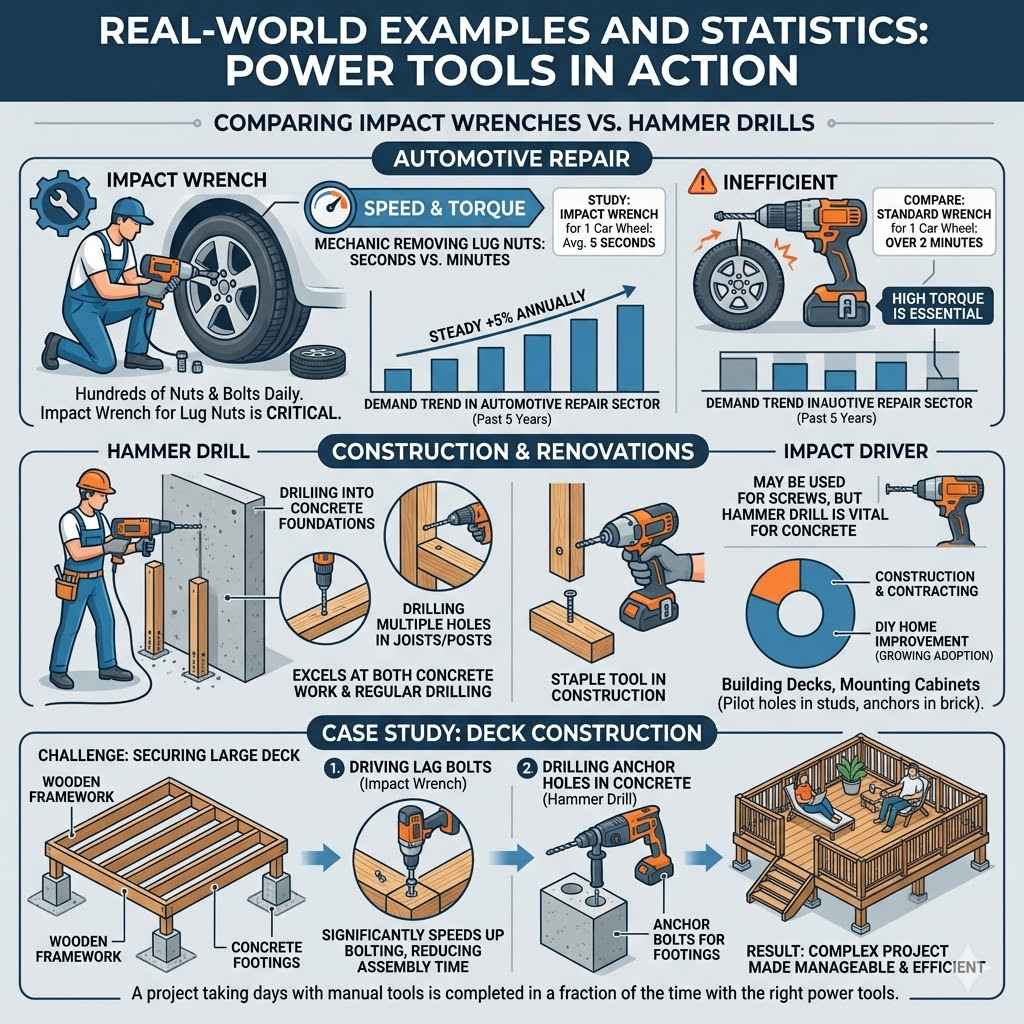
To illustrate the practical difference, consider these scenarios. In automotive repair, a mechanic faces hundreds of nuts and bolts daily. For tasks like removing lug nuts to swap a tire, an impact wrench can do the job in seconds.
A hammer drill, even on its highest setting, would be incredibly inefficient, if not entirely incapable, of this task. The high torque of the impact wrench is essential here.
On the other hand, a construction worker building a deck needs to drill numerous holes into joists and posts for bolts and screws. They also need to drill into concrete for the foundation posts. A hammer drill excels at both.
While an impact driver might be used for screws, the hammer drill is vital for the concrete work. The statistics back this up: a study by a tool manufacturer showed that using an impact wrench to remove lug nuts on a typical car wheel took an average of 5 seconds per wheel, compared to over 2 minutes with a standard wrench.
Another example comes from home renovations. Installing new cabinets often involves drilling pilot holes into studs behind drywall and then driving screws. A hammer drill (used as a regular drill) is perfect for this.
If the cabinets need to be mounted on a brick wall, the hammer drill’s primary function becomes critical for creating the necessary holes for anchors. Without it, the job would be significantly harder and less secure.
According to industry reports, the demand for impact wrenches in the automotive repair sector has seen a steady increase of around 5% annually over the past five years, highlighting their indispensable role in that field. Conversely, hammer drills remain a staple in construction and general contracting, with their adoption in DIY home improvement continuing to grow as homeowners tackle more ambitious projects.
Case Study: Deck Construction
- Challenge: Building a large wooden deck requires securing many structural beams and planks. This involves driving large lag bolts and, if attaching to a concrete patio, drilling into concrete.
- Tool Selection: An impact wrench is ideal for quickly driving the numerous lag bolts into the wooden framework. For the concrete footings, a hammer drill is necessary to create holes for anchor bolts.
- Result: Using an impact wrench significantly speeds up the bolting process, reducing assembly time. The hammer drill efficiently creates the concrete anchor holes. Together, these tools make a complex project manageable and efficient. A project that might take days with manual tools can be completed in a fraction of the time with the right power tools.
Frequently Asked Questions
Question: What is the main difference between a hammer drill and an impact wrench
Answer: A hammer drill combines rotation with a forward-and-backward hammering action to drill holes, especially in tough materials like concrete. An impact wrench uses rapid rotational impacts to deliver high torque for tightening or loosening nuts and bolts.
Question: Can I use a hammer drill to change my car tires
Answer: No, a hammer drill generally does not have enough torque to effectively loosen or tighten car lug nuts. An impact wrench is specifically designed for this high-torque task.
Question: Can I use an impact wrench to drill holes in concrete
Answer: No, an impact wrench is not designed for drilling holes. It lacks the necessary chuck for drill bits and its impact mechanism is rotational, not percussive for drilling through materials.
Question: Which tool is better for assembling furniture
Answer: For assembling furniture with screws, a regular drill or a dedicated impact driver is usually best. An impact wrench is typically too powerful for small screws and can strip them or damage the material. A hammer drill can be used if you turn off the hammer function.
Question: Do I need both a hammer drill and an impact wrench
Answer: It depends on your projects. If you do a lot of concrete drilling, you need a hammer drill. If you frequently work with nuts and bolts, especially on cars or in construction, an impact wrench is very useful.
Many people eventually own both for full versatility.
Summary
Choosing between a hammer drill and an impact wrench depends on your task. Hammer drills excel at creating holes in hard materials, while impact wrenches are powerhouses for nuts and bolts. They are not interchangeable.
For drilling concrete, a hammer drill is essential. For stubborn bolts, an impact wrench is the clear winner. Select the tool designed for your specific job to work efficiently and safely.