Hardwood Flooring Colors for White Cabinets: Warm vs. Cool Tone Guide
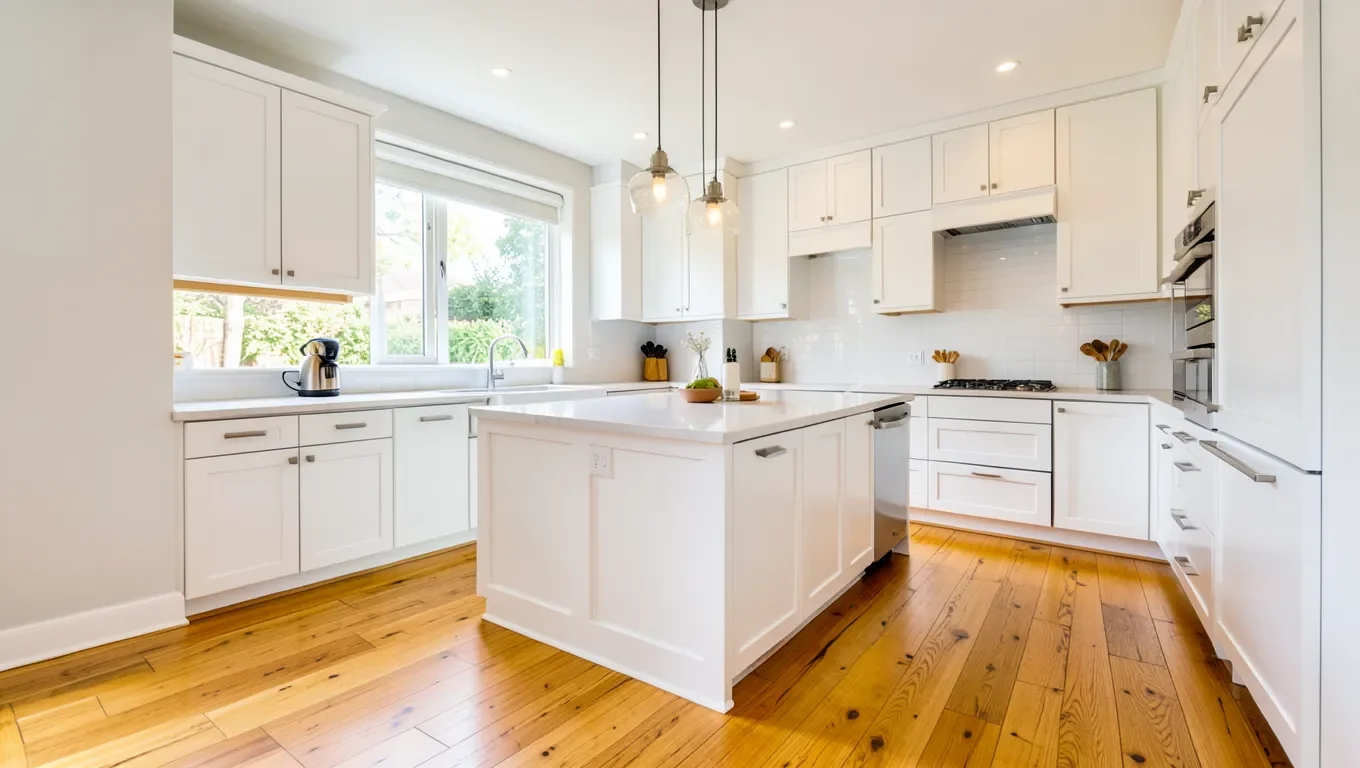
Warm-toned hardwoods like honey oak and golden hickory create a classic, high-contrast look against white cabinets, while cooler, grayer woods like gray-washed oak lean into a more modern, tonal look that reads almost monochromatic. Both are legitimate design directions, not just a matter of taste – the right one depends on whether you want the kitchen to feel classic and warm or clean and contemporary, plus how much natural light and floor space you’re actually working with.
Warm Contrast or Tonal Harmony: Two Real Approaches
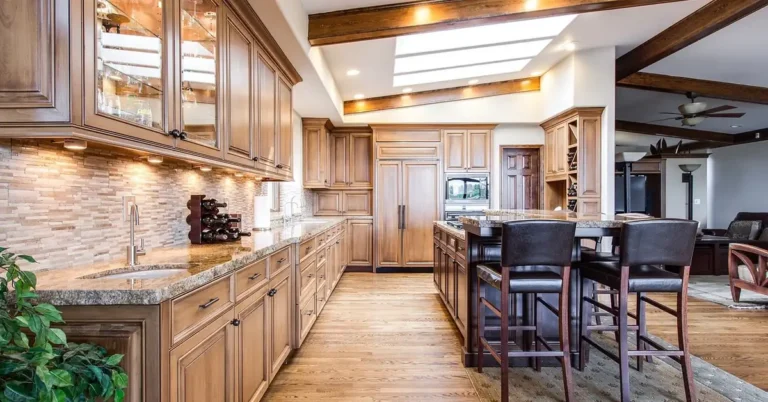
Interior designers generally work with one of two color relationships when they pair a wood tone with a painted surface: complementary contrast or tonal harmony. Complementary contrast pairs the crisp white of the cabinets with a warm-toned floor – honey oak, golden hickory, or natural maple – so the two surfaces read as clearly different materials playing off each other. It is the classic farmhouse-kitchen look. Tonal harmony instead keeps everything closer to the same temperature: a gray-washed or ash-toned floor sits near the cool end of the same neutral palette as the white cabinets, so the whole room reads as one continuous, quiet surface instead of two competing ones. Neither approach is “correct” – they’re just different design goals, and knowing which one you’re aiming for before you start looking at floor samples saves a lot of second-guessing later.
Best Cleaner For Hardwood Under White Cabinets
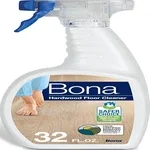 |
Bona Hardwood Floor Cleaner Spray, 32 fl oz – $8.97 White cabinets show every streak and dull spot on the floor below them, so a residue-free, pH-neutral cleaner matters more in this kitchen layout than in most.
|
Warm-Toned Hardwoods for a Classic Contrast Look
If you want the classic warm-contrast look, you’re choosing a hardwood with visible yellow, gold, or amber undertones. Honey oak is the most common starting point – it has enough natural variation and grain character to keep a large floor from looking flat, and it has been paired with white cabinets in kitchens for decades, so it reads as timeless rather than trendy. Golden hickory pushes the warmth further, with more color variation board to board, which works well in a kitchen that also has warm metal fixtures like brass or oil-rubbed bronze hardware. Natural maple sits at the lighter, subtler end of the same family – less grain drama than oak or hickory, which suits a kitchen that wants warmth without visual noise.
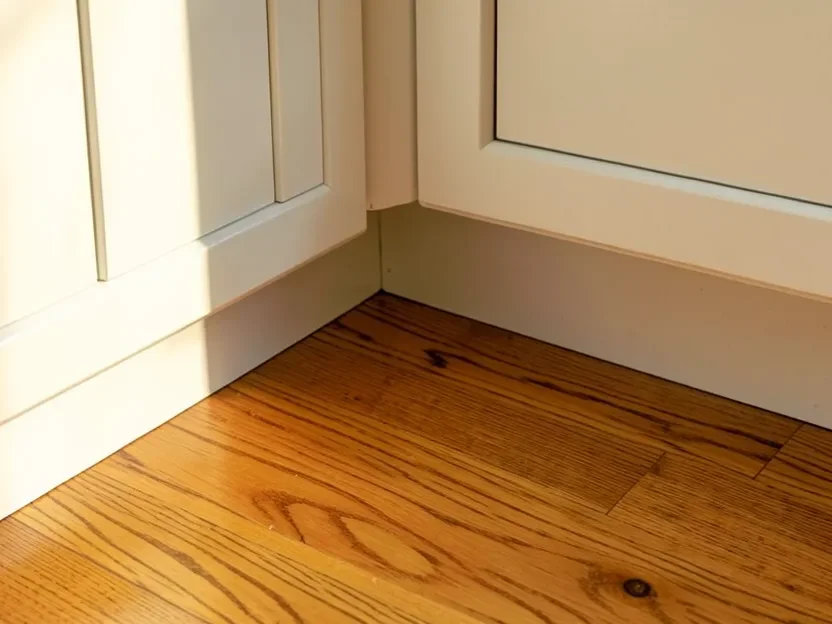
A practical note on grain and finish: a pronounced, open grain (oak, hickory) shows texture and hides everyday scuffs better than a tight, smooth grain (maple, birch). A satin or matte finish also hides foot traffic and light scratching better than a high-gloss finish, which is worth factoring in for a kitchen floor specifically, since it takes more abuse than flooring anywhere else in the house.
Cool and Gray-Washed Hardwoods for a Modern, Monochromatic Kitchen
For the tonal-harmony route, you’re looking for a hardwood with gray, ash, or driftwood undertones rather than yellow or orange ones. Gray-washed oak is the most widely available option in this category – it keeps oak’s grain character but strips out the warm amber cast, so it sits closer to the white cabinets on the color wheel instead of contrasting with them. Whitewashed or limewashed oak goes a step further toward a near-monochromatic look, which suits a minimalist or Scandinavian-influenced kitchen. European white oak with a natural (not stained) finish also tends to run cooler and grayer than American red oak, which is worth knowing if you’re comparing species rather than just finish colors.
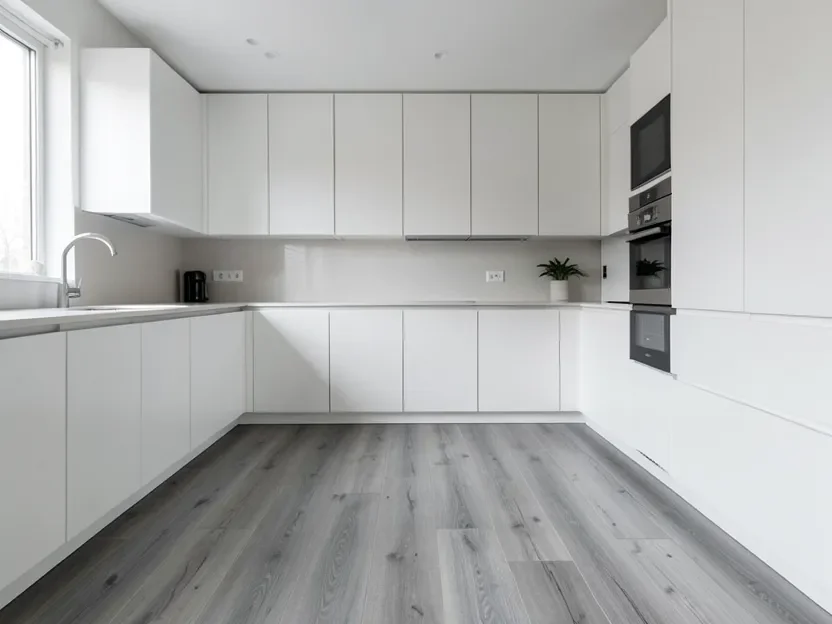
The tradeoff worth knowing before you commit: a monochromatic gray-on-white kitchen shows dust, pet hair, and water spots more readily than a warm-toned floor, simply because there’s less color variation in the wood to camouflage them. It’s not a reason to avoid gray-washed floors, but it does mean more frequent light cleaning if the room gets daily kitchen traffic.
Why Very Dark Floors Can Shrink a Small Kitchen
There’s a real, well-documented interior-design principle at work here, not just a stylistic preference: high contrast between a dark floor and a light ceiling/cabinet line draws a hard visual boundary around the room, and the eye reads that boundary as the edge of the space. In a large kitchen, that boundary just adds drama. In a small or galley-style kitchen, it can make the walls feel like they’re closing in, because the strong dark-to-white transition at floor level emphasizes exactly where the room stops.
Espresso and ebony-stained hardwoods are the classic example of this. They look striking in photos and in large, open-concept kitchens, but in a smaller footprint they tend to visually shrink the room rather than ground it. Mid-tone woods (natural oak, walnut without a heavy stain, medium hickory) avoid this problem because they don’t create the same sharp light-to-dark line at the base of the white cabinets – the eye reads the floor and the cabinets as part of one continuous, more neutral space instead of two contrasting zones. If your kitchen is under roughly 150 square feet, or it’s a narrow galley layout, a mid-tone floor is generally the safer choice for keeping the room feeling open, even if you like the look of a dark floor elsewhere in the house.
Matching Undertones So Floor and Cabinets Don’t Clash
“White” cabinets are rarely a true neutral white – most have either a warm undertone (cream, ivory, slightly yellow) or a cool undertone (a faint blue or gray cast). This matters more than the floor color itself, because a floor and a cabinet with opposing undertones can clash even when both colors look fine on their own in a showroom. A warm-undertone white cabinet generally pairs best with a warm-toned floor (honey oak, golden hickory) rather than a cool gray-washed one, since two competing undertones in the same small room tend to fight each other instead of blending. Cooler, more blue-gray whites pair more naturally with gray-washed or ashy floors for the same reason – matching temperature, not matching exact shade.
The only reliable way to check this is to bring a real flooring sample into the actual kitchen and look at it next to the cabinets under the room’s own lighting, both during the day and with the kitchen lights on at night. Undertones shift noticeably under warm incandescent light versus cool LED light versus daylight, and a pairing that looks perfect on a showroom sample can read completely differently once it’s sitting under your actual overhead lighting.
Keeping Hardwood Floors Looking Sharp Under White Cabinets
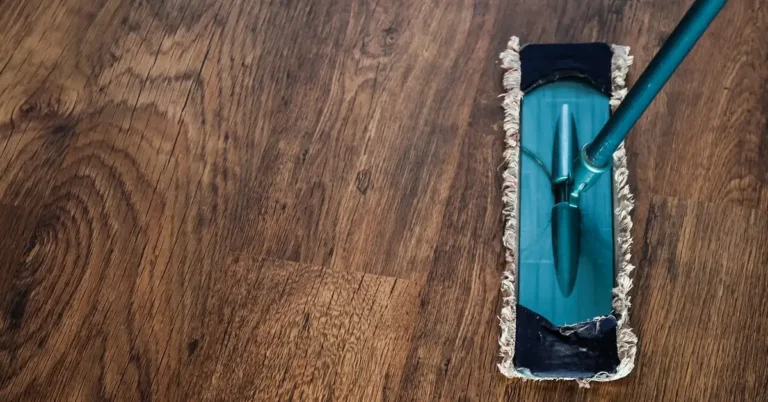
White cabinets are unforgiving of a dull, hazy, or streaked floor beneath them, since there’s no busy pattern or dark tone to hide it. A few habits keep a hardwood floor looking its best in a white kitchen specifically: sweep or dry-mop daily to keep grit from scratching the finish (grit is the main cause of dulling on a light-colored floor, since scratches scatter light and show up as a whitish haze), use a cleaner formulated for sealed hardwood rather than an all-purpose or vinegar-based cleaner (both can leave a dull residue film that’s especially visible against bright white cabinetry), and place a mat at the sink and stove where water and grease exposure is highest. If you’re maintaining engineered hardwood rather than solid wood, the cleaning approach is similar, but avoid excess standing water near the seams, since engineered boards are more sensitive to moisture at the edges than solid hardwood.
Frequently Asked Questions
What Color Hardwood Floors Go With White Cabinets?
Both warm and cool tones work, depending on the look you want. Warm tones like honey oak or golden hickory create a classic contrast against white cabinets, while cooler, gray-washed oak creates a more modern, monochromatic look. Match the floor’s undertone (warm or cool) to the cabinet’s undertone to avoid a clash.
Should My Hardwood Floors Match My Cabinets?
No, they don’t need to match exactly, and most designers recommend against trying to match them precisely. It’s better to choose a deliberate relationship instead: either a warm floor against white cabinets for contrast, or a cooler, grayer floor for a closer tonal match. What matters most is that the undertones don’t fight each other.
Should Flooring Be Lighter Or Darker Than Cabinets?
With white cabinets, mid-tone or lighter flooring is the safer choice, especially in a smaller kitchen. Very dark flooring (espresso or ebony) against white cabinets creates a strong contrast that can visually shrink a small room by emphasizing the boundary between floor and cabinets. Mid-tone woods read as more neutral and spacious.
What Color Floor Tile Goes With White Kitchen Cabinets?
If you’re using tile that mimics hardwood, the same warm-versus-cool logic applies: light warm tones like honey or golden oak-look tile create a classic, airy contrast, while gray or driftwood-toned tile creates a more modern, tonal look. Avoid stark white tile with stark white cabinets, since the lack of any contrast can make the floor plane disappear visually.
Bottom Line
Start by picking a direction, not a specific plank: warm contrast (honey oak, golden hickory) for a classic look, or cool tonal harmony (gray-washed oak) for a modern one. Check your cabinet’s actual undertone before choosing the floor’s undertone, keep the floor mid-tone rather than very dark if the kitchen is small, and use a cleaner made for sealed hardwood so the floor doesn’t dull under all that bright white cabinetry.
Sponsored / affiliate links. As an Amazon Associate I earn from qualifying purchases. I may earn additional commission from eligible campaigns.