Swiffer WetJet on Hardwood Floors: Honest Review
Swiffer WetJet is usually safe on properly sealed hardwood floors if you mist lightly, use the hardwood cleaner, and stop at the first sign of excess moisture, dulling, or finish haze. Used on waxed, oil-finished, damaged, or unsealed wood, it can leave residue, raise grain, or push water into open edges, which gets expensive fast. This guide tells you when WetJet is acceptable, when it is a bad idea, and the exact warning signs that mean you should stop using it.
Verdict


Based on the product details and published guidance, the standard WetJet is a reasonable light-cleaning tool for sealed floors only. The safer wood-specific option is WetJet Wood, which is positioned as a quick-dry cleaner for finished hardwood. Neither one is a fit for unfinished, waxed, or oiled floors, and neither should be treated like a wet-drenching mop.
Pros and cons
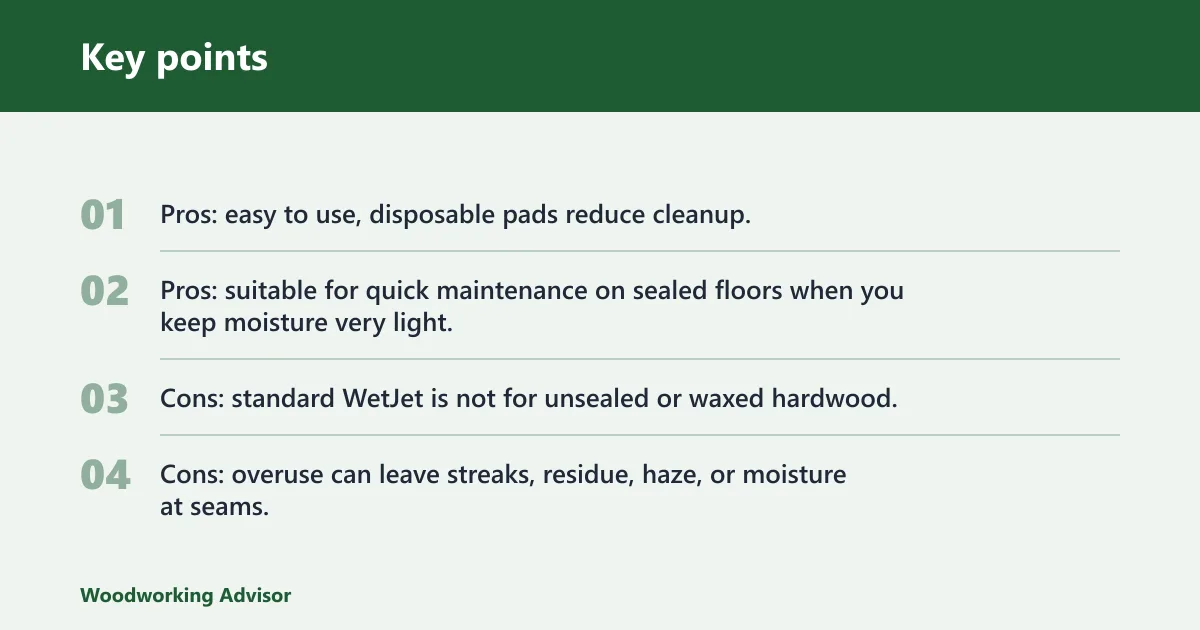
- Pros: easy to use, disposable pads reduce cleanup, and the wood formula is aimed at finished hardwood.
- Pros: suitable for quick maintenance on sealed floors when you keep moisture very light.
- Cons: standard WetJet is not for unsealed or waxed hardwood.
- Cons: overuse can leave streaks, residue, haze, or moisture at seams.
Specs at a glance
| Feature | Standard WetJet | WetJet Wood |
|---|---|---|
| Cleaning system | Spray mop with disposable pads and solution refills | Spray mop with wood-specific cleaner |
| Intended surface | Hard sealed surfaces | Finished hardwood |
| Cleaner position | Standard multi-surface formula | Quick-dry, lower-residue wood formula |
| Best use case | Light maintenance on approved sealed floors | Light maintenance on finished wood that allows spray cleaning |
| Disposable pads | Yes | Yes |
| Buyer caution | Check finish type before use | Check finish type before use |
Standard formula vs WetJet Wood
The standard WetJet is the broader spray mop system. The wood-specific version is the safer choice when you are cleaning finished hardwood, because the published product position is that it is designed for wood and dries faster with less residue. That does not make it safe for every wood floor.
One starter kit listing for WetJet hardwood includes 10 pads, and another listing includes cleaning solution and batteries. That convenience matters if you want a grab-and-go routine, but convenience is not the same as suitability for every finish.
Who it
WetJet fits homeowners with sealed hardwood, factory-finished engineered wood, or other approved hard sealed floors who want a light maintenance tool and are willing to follow the floor maker’s care guide. It is not for waxed floors, oiled floors, unfinished hardwood, or any floor with damaged finish, open seams, or unknown care instructions.
Before you buy, check three things: the finish listed in the floor paperwork, the manufacturer’s approved cleaners, and whether the floor allows only damp cleaning. Finished hardwood with a sealed coating can usually handle only very light moisture, but it is not waterproof. Engineered wood is more dimensionally stable than solid wood, yet it still needs the same finish check.
Who should avoid it completely?
Skip WetJet if your floor is waxed, oiled, unfinished, or showing wear at seams and edges. The review page says the WetJet solution is designed specifically for hardwood floors, but it also says the product is not suitable for unsealed or waxed hardwood floors. That warning should be treated as a hard stop.
A common first-timer mistake is to assume engineered wood is automatically safe because it moves less than solid wood. Picture a 12-by-14-foot family room with factory-finished engineered planks: if the finish is approved and the passes are light, WetJet may be fine. If the seams already look dark or raised, stop and switch to a dry method.
Finish checks before you buy
Check the floor paperwork or manufacturer care sheet for the finish type. If it says polyurethane, factory finish, or another sealed surface and allows spray cleaning, WetJet can be considered. If the finish is wax, oil, or unfinished wood, the answer is no.
Warranty language matters. Many floor makers require approved cleaners only, and some warranties exclude damage from excessive water or nonapproved products. If the care guide does not spell it out, contact the manufacturer before using any spray mop.
Swiffer wetjet decision table
| Floor type | WetJet verdict | Risk level | Safest cleaning method |
|---|---|---|---|
| Sealed polyurethane | Usually acceptable with very light misting | Low to moderate | Microfiber dust mop first, then a microfiber mop with a wrung-out pad |
| Factory-finished engineered wood | Usually acceptable only if the maker allows spray cleaning | Low to moderate | Dry dust mop first, then lightly damp microfiber cleaning |
| Waxed floors | Bad idea | High | Dry dust mop, then floor-maker-approved minimally damp care |
| Oiled floors | Bad idea unless the floor maker approves a specific product | High | Use the manufacturer’s approved oil-floor cleaner and care method |
| Unfinished hardwood | Do not use | Very high | Dry cleaning only unless a floor professional gives a specific plan |
Sealed polyurethane: Do this instead — dust mop first, then use a microfiber mop with only a wrung-out pad if the finish maker allows damp cleaning.
Factory-finished engineered wood: Do this instead — use the floor maker’s approved cleaner and keep the mop nearly dry, especially at seams and transitions.
Waxed floors: Do this instead, avoid spray mops and use the wax-system care method your floor maker specifies.
Oiled floors: Do this instead, follow the product line approved by the floor maker; standard wet cleaners can disrupt the finish.
Unfinished hardwood: Do this instead, use dry cleaning only until a hardwood specialist or the manufacturer gives an exact cleaning plan.
Is Swiffer WetJet safe on hardwood floors?
Swiffer WetJet is safe on hardwood floors only when the floor is sealed, the maker allows spray cleaning, and you keep the application very light. It is not a general yes for every wood floor. Excess liquid, puddling, and slow drying are the problem, not just the fact that the floor is wood.
Finished hardwood with a sealed coating can tolerate only light damp cleaning because the finish is the barrier. Once liquid reaches worn spots, seams, or open edges, the risk changes fast. That is why the same mop can be acceptable on one floor and a bad idea on another.
What makes finished wood safer
Sealed hardwood has a protective finish, often polyurethane or a factory-applied coating. That layer gives you a margin for very light moisture. It does not make the floor waterproof, and it does not protect against standing water or repeated wet passes.
Factory-finished engineered wood is often a better moisture candidate than site-finished solid wood because the core is more dimensionally stable. Even so, the top finish still determines whether a spray mop is allowed.
Why over-wetting causes problems
Moisture can dull the finish, leave haze, and work into seams. If the liquid sits too long, it can also cause tacky residue or swelling at plank edges. The problem is not only volume. Dwell time matters too.
Suppose a hallway gets cleaned with several passes in the same spot because a footprint will not lift. If the floor stays wet long enough to bead or pool, stop, dry it, and switch to a drier method before continuing.
How fast drying changes the verdict
A fast-drying cleaner lowers risk because it reduces the time liquid stays on the finish. That is why the wood-specific WetJet formula is the better choice when a spray mop is already approved. But quick-dry is not a pass for unsealed wood.
The Houzerio guidance is blunt on that point: the QuickDry formula does not change the risk on unsealed surfaces. A faster formula still needs a protective finish underneath it.
What works
WetJet works best as a light maintenance tool on approved sealed floors. The safest routine is simple: dry clean first, use the least liquid needed, and dry the floor quickly afterward. That sequence matters more than brand name alone.
Quick dust pickup before wet cleaning
A microfiber dust mop should be the first step before any wet cleaning. It removes dust, grit, and hair without adding moisture. That reduces the chance of grit being dragged across the finish and makes the wet pass more effective.
Dry first, then damp. That order is hard to improve on for hardwood.
Light damp cleaning on approved sealed floors
On sealed polyurethane or approved factory-finished engineered wood, WetJet can be used as a light maintenance mop when the cleaner is applied sparingly. Keep passes short and even. Do not keep going over the same plank until it looks wet.
The standard WetJet cleaner is meant for hard sealed surfaces, and the review page says the hardwood version is designed specifically for hardwood floors. That still leaves the finish check in your hands.
Lower-residue use with wood-specific formula
WetJet Wood is the more sensible pick if you want the Swiffer format for a finished hardwood floor. It is positioned as a quick-dry, lower-residue option. That matters on wood because residue can look like haze, especially in bright light.
Standard WetJet can still work on approved sealed floors, but wood-specific cleaner is the better fit when the floor is finished hardwood and the manufacturer allows spray cleaning.
What does not?
WetJet is a poor choice when it leaves film, streaks, or water at seams. It is also a bad fit for finishes that are meant to be maintained with specific oils or wax care. Once those warnings appear, stop using it.
Residue, streaks, and haze
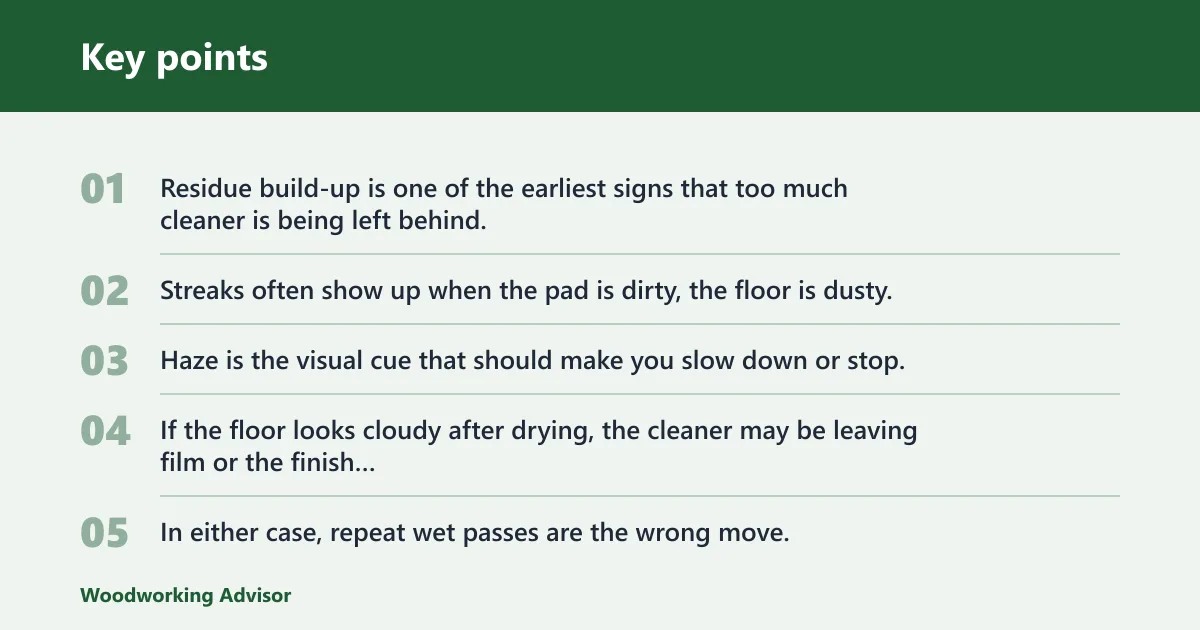
Residue build-up is one of the earliest signs that too much cleaner is being left behind. Streaks often show up when the pad is dirty, the floor is dusty, or the mop is laying down more solution than the finish can take. Haze is the visual cue that should make you slow down or stop.
If the floor looks cloudy after drying, the cleaner may be leaving film or the finish may already be reacting to moisture. In either case, repeat wet passes are the wrong move.
Seam swelling and moisture damage
Seam swelling, cupping, and darkened edges are more serious than streaks. They point to liquid getting where it should not. At that stage, stop wet cleaning at once and dry the area with a clean towel or dry microfiber cloth.
Do not keep mopping in the hope that the floor will “even out.” That can drive more liquid into the same weak points.
Why waxed and oiled floors are high risk
Waxed floors can be stripped or dulled by wet cleaners. Oiled floors can react badly to standard spray formulas unless the floor maker approves that exact product. Houzerio’s guidance treats waxed and oiled floors as a different story for a reason.
These finishes are not interchangeable with polyurethane. Treat them as separate categories and check the maker’s care guide before using any spray mop.
What should you use instead?
For many hardwood floors, a microfiber dust mop and a microfiber mop with a wrung-out pad are safer than a spray mop. They give you more control over moisture and are less likely to leave liquid in seams or around board edges. If the floor maker names a specific cleaner, follow that first.
Microfiber dust mop first
Use the dust mop to remove grit before any damp cleaning. That step reduces abrasion and keeps the wet pass from pushing debris around. It is the safest routine step for nearly every hardwood floor type.
Microfiber mop with wrung-out pad
When you need a light damp clean, a microfiber mop with a wrung-out pad is the safer backup. The pad should feel nearly dry, not soaked. That is the right scale for sealed hardwood that only tolerates minimal moisture.
This method is slower than a spray mop on some days, but it gives you better control and less chance of over-wetting.
When a manufacturer-approved cleaner is better
If your floor maker lists a specific cleaner, use that product or an approved equivalent. That matters most for waxed, oiled, and some engineered floors. Warranty language often depends on following those instructions exactly.
Say your 8-year-old kitchen floor is factory-finished engineered wood and the care sheet lists only a neutral pH cleaner. That is your answer. The spray mop is optional only if the maker says it is allowed.
Should you buy it?
Buy WetJet if your hardwood is sealed, the floor maker allows spray cleaning, and you want a simple maintenance tool for light dirt. Skip it if your floor is waxed, oiled, unfinished, or already showing moisture problems. The deciding factor is finish type, not marketing language.
Cost and convenience also matter. WetJet is convenient because it uses disposable pads and refill bottles, but microfiber routines are often cheaper over time and give you more control. A wood-safe routine does not need to be fancy. It needs to be dry enough.
Cost and convenience versus safer routines
Disposable pads are convenient, and the starter kit format reduces setup friction. That convenience can be worth paying for on approved sealed floors. It does not replace the need to verify the finish first.
If you already own a microfiber dust mop and a good wrung-out mop, that setup is often the safer and less wasteful choice for routine hardwood cleaning.
Alternatives

Bona PowerPlus Premium Motion Spray Mop for Hardwood Floors is the more obvious alternative if you want a hardwood-focused spray mop from another brand. Based on the listed specs and buyer feedback patterns, it is aimed squarely at wood floors with a dedicated cleaning solution and microfiber pad. The drawback is the higher price point, and it still depends on your floor being a finish that allows spray cleaning.

O-Cedar Genuine ProMist MAX Spray Mop Head Replacement is not a full floor system, but it is a useful lower-cost route if you already use a compatible mop and want reusable microfiber. The advantage is control and washability. The drawback is that a replacement head alone does not solve the finish question, and it does not give you a ready-made wood formula.
Frequently asked questions
Can you use Swiffer WetJet on engineered hardwood?
Yes, sometimes. Factory-finished engineered hardwood is usually more moisture-stable than solid wood, but it still is not waterproof. Use WetJet only if the manufacturer allows spray cleaning and keep the application very light, with no puddling, standing water, or repeated wet passes.
Will Swiffer WetJet damage polyurethane hardwood floors?
It can if you over-wet the floor or let liquid sit. Properly sealed polyurethane can handle very light damp cleaning, but excess moisture can dull the finish, leave haze, and work into seams. If the floor starts looking cloudy or tacky, stop using the mop.
What is the difference between WetJet Wood and standard WetJet?
WetJet Wood is positioned as the wood-specific, quick-dry option for finished hardwood, while standard WetJet is the broader spray mop system for hard sealed surfaces. The wood version is the better fit for approved hardwood floors because it is designed to leave less residue and dry faster.
Is Swiffer safe on waxed or oiled hardwood floors?
No, not as a routine choice. The review page says WetJet is not suitable for unsealed or waxed hardwood floors, and oiled floors are also a high-risk category unless the floor maker approves a specific care method. Wax and oil finishes need finish-specific cleaning, not standard spray mopping.
Does Swiffer void hardwood floor warranties?
It can if the floor maker does not approve that cleaner or cleaning method. Warranties often require approved products and can exclude moisture damage from excess water. Check the care guide first, and if it is unclear, ask the manufacturer before using any spray mop on the floor.
What are signs that a mop is over-wetting hardwood?
Look for puddling, darkened seams, tacky residue, haze after drying, dull spots, or boards that begin to cup or swell at the edges. Those signs mean the floor is getting more liquid than it should. Stop immediately, dry the area, and switch to a drier cleaning method.
Sponsored / affiliate links. As an Amazon Associate I earn from qualifying purchases. I may earn additional commission from eligible campaigns.