How is Project Cost Calculated: 5 Pro Insights
Project cost is calculated by estimating expenses for labor, materials, and overhead, then summing them. This includes direct and indirect costs.
Accurate project cost calculation is crucial for budgeting and resource allocation. It involves estimating expenses for labor, materials, equipment, and other resources required to complete the project successfully. The process includes analyzing various factors and costs associated with the project to come up with an estimate.
Effective cost calculation allows for better financial planning and ensures that the project stays within budget constraints. By understanding how project cost is calculated, organizations can make informed decisions and allocate resources effectively. Proper cost calculation is essential for the successful completion of any project, as it directly impacts the financial health and overall success of the endeavor.
Breaking Down Project Cost Calculation
The process of calculating project cost involves considering various key components, including direct and indirect expenses. Direct expenses are those directly related to the project, such as materials and labor, while indirect expenses encompass overhead costs like utilities and insurance.
When calculating project cost, it’s crucial to factor in all these elements to ensure an accurate estimation. Additionally, considering real estate assets, order of magnitude estimates, and parametric forecasting can further refine the cost calculation process. By accounting for these crucial components, project managers can effectively determine the overall funds needed to successfully complete a project.
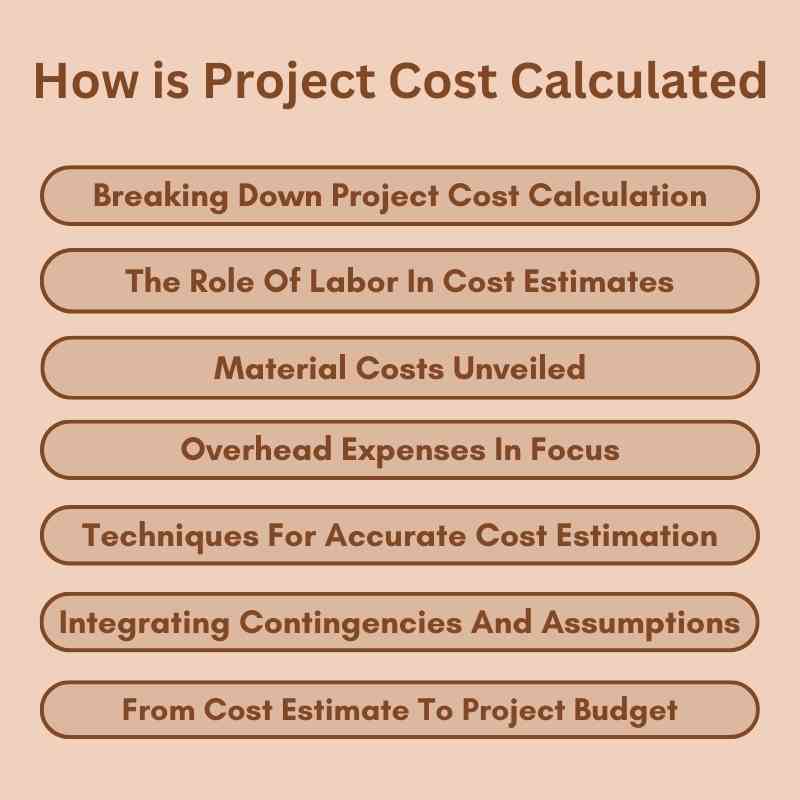
The Role Of Labor In Cost Estimates
The role of labor is crucial in calculating project costs. Labor hours are a key factor in estimating the overall cost of a project. Understanding the impact of salaries is essential in accurately determining labor costs. By calculating the number of hours worked by the labor force and multiplying it by the hourly salary rate, the actual labor cost can be determined. Additionally, it is important to consider any overtime or additional labor costs that may arise during the project. These calculations help provide a realistic estimate of the labor expenses involved in the project, allowing for better cost management and budgeting.
Material Costs Unveiled
When calculating project costs, it’s crucial to consider the price per unit of essential materials. This involves carefully assessing the quantity needed for the project to ensure accurate cost estimates. Additionally, factoring in the cost of labor, overhead expenses, and potential contingencies is vital for a comprehensive understanding of project costs. By diligently evaluating these elements, project managers can develop precise cost calculations that contribute to the overall success of the project.
Overhead Expenses In Focus
Project cost calculation involves considering various overhead expenses such as utility fees, rent, and insurance. By factoring in the actual material and labor costs, a comprehensive estimate can be made to cover all the necessary expenses for a successful project.
| Identifying project overheads: | It is essential to identify all the overhead expenses that are associated with a project, such as rent, utilities, insurance, salaries of support staff, and any other indirect costs. These expenses are not directly related to the production of goods or services but are necessary for the smooth functioning of the project. |
| Calculating total overhead costs: | After identifying the overhead costs, the next step is to calculate the total overhead costs. This can be done by adding up all the overhead expenses incurred during the project. The total overhead costs are then divided by the total number of units produced or services provided to arrive at the overhead cost per unit. This information is useful in determining the overall cost of the project. |
Note: The above table provides information on identifying project overheads and calculating total overhead costs associated with a project. It is crucial to identify all the indirect costs and calculate the total overhead costs to determine the overall cost of the project.
Techniques For Accurate Cost Estimation
Accurate cost estimation is crucial for the success of any project. Two common techniques used for project cost calculation are bottom-up estimating and parametric forecasting. Bottom-up estimating involves breaking down the project into smaller components, estimating the cost of each component, and then adding them up to get the total project cost. Parametric forecasting, on the other hand, involves using mathematical models and historical data to estimate costs.
When estimating costs, it’s important to consider all elements of cost estimation, including real estate assets, non-capital costs, order of magnitude estimates, reference costs, and catalogues and pricing tables. It’s also crucial to add contingency to the cost estimate to account for unexpected expenses.
Overall, project costs involve direct costs, indirect costs, and profit. Determining the total project cost requires accounting for all expenses, fees, and resources needed to complete the project. By carefully considering all elements of cost estimation and using appropriate techniques, project managers can accurately estimate project costs and ensure the success of their projects.
Integrating Contingencies And Assumptions
Project cost calculation involves integrating contingencies and assumptions to ensure that there are enough funds to complete the project without any financial hurdles.
- Adding contingency funds: Contingency funds are added to cover any unforeseen expenses that may arise during the project. It is usually a percentage of the total project cost.
- Factoring in assumptions and exclusions: Assumptions are made based on historical data, expert opinion, and project scope. Exclusions are items that are not included in the project cost, such as taxes and permits.
By including contingency funds and factoring in assumptions and exclusions, project managers can ensure that the project is completed within the allocated budget and timeline.
From Cost Estimate To Project Budget
Project cost is calculated by estimating the expenses for labor, materials, and overhead. This estimate is then used to create a project budget, which allocates funds for each aspect of the project. By carefully calculating the cost, businesses can ensure that the project stays within budget and on track for success.
| Budgeting Basics | |
| What is the difference between budget and estimate? | Cost estimate is an approximation of the project cost while budget is a plan for the project cost. |
| How do you calculate cost estimates? | There are two methods of cost estimation: bottom-up estimating and parametric estimating. Bottom-up estimating involves estimating the cost of each individual task, while parametric estimating involves using statistical data to estimate costs based on the project’s parameters. |
| What is a baseline cost estimate? | A baseline cost estimate is the initial cost estimate that serves as a starting point for budgeting and cost control. |
| What are the assumptions and exclusions of cost estimates? | Cost estimates are based on assumptions about the project’s scope, schedule, and resources. Exclusions are items or activities that are not included in the estimate. |
Note: The above table provides basic information on budgeting and cost estimation. It explains the difference between budget and estimate, two methods of cost estimation, baseline cost estimate and assumptions and exclusions of cost estimates.
Evaluating And Adjusting The Cost Estimate
When evaluating and adjusting the cost estimate, it’s important to consider baseline cost adjustments. Project changes should also be carefully responded to. Adjustments to the baseline cost estimate may be necessary due to unforeseen circumstances or changes in project scope or requirements. It’s important to regularly review and update the cost estimate to ensure accuracy and account for any changes that may impact the overall project cost. By staying proactive and responsive to changes, project managers can better manage and control project costs, leading to a more successful and efficient project completion.
Frequently Asked Questions
How Do You Calculate Actual Cost Of A Project?
To calculate the actual cost of a project, follow these steps: Multiply the number of units of materials by the price per unit to find the actual material cost. Multiply the total labor hours used by the salary of direct workers per hour to determine the actual labor cost.
Add up all overhead expenses, such as utility fees, rent, and insurance, to get the actual overhead cost. Sum these three costs to find the total actual cost of the project.
What Is Project Cost With An Example?
Project cost refers to the total funds needed to complete a business transaction or work project. Direct costs are expenses directly involved in the project, while indirect costs are necessary but not directly related. For example, in construction, project costs include labor, materials, equipment, overhead, and other expenses.
Calculating project costs involves analyzing factors such as labor hours, material quantities, and pricing to estimate the total cost.
How To Calculate The Cost Of A Construction Project?
To calculate the cost of a construction project, review bid package, conduct site visit, perform material takeoff, solicit pricing, evaluate labor requirements, determine insurance and bonding costs, calculate overhead and indirect costs, and account for profit and contingency.
What Is Included In Total Cost Of Project?
The total cost of the project includes all expenses, fees, and resources required, covering fixed, variable, direct, and indirect costs.
Conclusion
To accurately calculate project costs, it is crucial to consider various factors such as labor, materials, equipment, overhead, and other associated expenses. By conducting a thorough analysis of these elements, a comprehensive estimate of the total cost can be determined.
This estimation process plays a crucial role in successful project management, ensuring that financial resources are adequately allocated. With a well-calculated project cost, businesses can plan and execute their projects more effectively, leading to greater success and profitability.