8×8 Wooden Shed Weight: 1,200-1,900 lb (Estimate by Build)
An empty, stick-built 8×8 wooden shed most likely weighs between 1,200 and 1,900 lb, with a middle estimate near 1,600 lb. That is our own estimate, built from published lumber densities and sheathing weights for a typical floor-framed, shingled shed, not a reading from a manufacturer scale. The 800 to 900 lb figure this page used to give is hard to reproduce: it would need thin panels, light lumber and almost no floor.
The number matters when you are choosing a foundation, deciding how many people to line up to move it, or checking whether a trailer or dolly can handle it. Below is where the weight comes from, how it changes with your build, and what to do about moving and anchoring.
How Much an 8×8 Wooden Shed Weighs
Best Shed Anchor Kit Pick
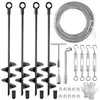 |
Fabulas 4-Pack 18-Inch Ground Anchor Shed Kit, $40.99 Weight alone is not anchoring, and an auger kit is a simple way to tie an 8×8 shed down once it is in place.
|
These three builds use the same 8×8 footprint and differ only in lumber species, panel thickness and roofing. All three are estimates, and all are for an empty shed.
| Build | Framing and panels | Estimated empty weight |
|---|---|---|
| Light | Spruce or white pine framing, 3/8 in siding and roof panels, 3/4 in floor, lighter shingles | about 1,200 lb |
| Middle | Mid-density framing, 5/8 in siding, 15/32 in roof panels, 3/4 in floor, mid-weight shingles | about 1,600 lb |
| Heavy | Southern pine or treated framing, thick siding, heavier shingles | about 1,850 lb |
If your shed is a pre-built model with a metal roof and thinner panels, expect it toward the low end. If it has a heavy plank floor, thick T1-11 style siding or heavier shingles, expect the high end or more. A kit sold without floor, shingles or paint will weigh less on the pallet than the finished shed will once you build it out.
Where the Weight Comes From, Piece by Piece
The middle build is the one most sheds resemble. This is how its weight adds up, with the light and heavy builds alongside so you can see which parts swing the most.
| Component | Light (lb) | Middle (lb) | Heavy (lb) |
|---|---|---|---|
| Framing lumber (skids, floor frame, wall frame, roof frame) | 532 | 607 | 772 |
| Floor deck, 3/4 in panel | 141 | 150 | 160 |
| Wall sheathing or siding | 219 | 426 | 459 |
| Roof sheathing | 81 | 125 | 137 |
| Shingles | 161 | 201 | 242 |
| One 2×2 ft window | 32 | 32 | 32 |
| Fasteners, hardware and trim (3%) | 35 | 46 | 54 |
| Total, empty | 1,199 | 1,588 | 1,856 |
Here is the part most shed weight articles miss. Swapping framing species moves the total by about 240 lb, from 532 lb of lightweight spruce framing to 772 lb of southern pine. Panel thickness and roofing move it by about 400 lb, from 602 lb to 998 lb across the floor deck, siding, roof panels and shingles. In other words, what covers the frame matters more than what the frame is made of, so if you are trying to keep the weight down, thinner siding and lighter roofing help more than hunting for a lighter lumber species.
How We Estimated It
Every line above is volume times density, or area times a published weight per square foot. We modeled a plain gable shed with these assumptions.
- Floor: three 4×4 skids, 2×6 floor frame at 16 in on center, and a 3/4 in floor deck, 64 sq ft.
- Walls: 6.5 ft tall, 2×4 studs at 16 in on center, single bottom plate and double top plate, plus 10% extra lumber for corners, the door opening, the window and blocking.
- Roof: gable roof at a 4:12 pitch with about a 6 in overhang, 2×4 rafters at 24 in on center, a 2×6 ridge board, collar ties and about 81 sq ft of roof surface.
- Actual lumber sizes (a 2×4 is 1.5 by 3.5 in), not nominal sizes, so the volumes are real.
For lumber density we used the USDA Forest Products Laboratory Wood Handbook. Table 5-3b lists specific gravity at 12% moisture content: 0.35 for Engelmann spruce and eastern white pine, 0.40 for Sitka spruce, red spruce and ponderosa pine, and 0.51 for loblolly pine. Table 4-6b converts those to density at 12% moisture: about 24.5 lb per cubic foot at 0.35, 28.0 at 0.40 and 35.6 at 0.51. The light, middle and heavy builds use those three values. Panel and roofing weights come from the City of Santa Paula building-material weights table, which lists 3/8 in plywood or OSB at 1.0 to 1.2 lb per sq ft, 15/32 in at 1.4 to 1.7, 5/8 in at 1.8 to 2.1, 3/4 in at 2.2 to 2.5, asphalt shingles at 2.0, fiberglass shingles at 3.0 and a window with frame and sash at 8.0. We used the low end of each range for the light build, the midpoint for the middle build and the high end for the heavy build.
As a cross-check, that same city table lists 2×4 framing at 16 in on center at 1.1 lb per sq ft of wall. A plain 2×4 wall at our middle density works out to about 1.2 lb per sq ft, so the method agrees. Our shed’s wall framing runs higher, about 1.5 lb per sq ft, because of the extra corner, door and window studs and the triple plates. Our wood shed weight calculator uses simpler assumptions and gives a lower range of 1,000 to 1,400 lb for an 8×8, so use it for a quick check and this page when you need to plan for the heavier builds.
Empty, Loaded and Wet: Three Different Weights
The estimate above is dry, empty weight. Two things add to it in real life.
Contents. Tools, a mower, bags of soil or cement and stored lumber add up quickly. For foundation planning, assume 300 to 800 lb of contents on top of the shed itself. That is a planning assumption, not a measured figure, so weigh your own gear if you store heavy things. Loaded, the middle build is then roughly 1,900 to 2,400 lb spread over 64 sq ft, or about 30 to 38 lb per sq ft.
Moisture. The Wood Handbook figures assume 12% moisture. Framing at 0.40 specific gravity weighs about 28.0 lb per cubic foot at 12%, 30.0 at 20% and 34.9 at 40%. Applied to the 607 lb of middle-build framing, that is roughly 650 lb at 20% and 757 lb at 40%, about 43 to 150 lb more. Pressure-treated lumber can arrive wet from the yard, and treated skids and floor framing sit closest to the ground, so they are the parts most likely to be heavy. For more on treated lumber near soil, see our guide on whether pressure-treated wood rots.
Moving an 8×8 Shed Safely
At roughly 1,600 lb, an 8×8 shed cannot be carried. Four people lifting it would each be holding about 400 lb, and the frame can rack or the floor can pull loose from the walls long before anyone could carry it any distance. The safer options are:
- Empty it completely, and remove or secure loose shelves, the door and any window glass.
- On a shed with skids, jack one end at a time and slide dollies or pipe rollers under the skids, then roll it slowly on level ground.
- For a longer move or a tight yard, hire a shed mover with a trailer or a hydraulic dolly rather than improvising.
- Move it slowly, keep it level and watch for the walls twisting, since a racked frame can crack siding or bind the door.
If the shed has no skids and sits on a plain floor frame, do not lift it by the floor edge or the walls. That is where a mover needs to add a support frame first. This is general safety guidance rather than a substitute for a professional, so if the shed is on a slope, near power lines or close to your house, get help.
Foundation, Anchoring and Permits
A loaded 8×8 shed puts about 30 to 38 lb per sq ft on the ground, which is modest, so ground bearing is rarely the issue. The problems are drainage, frost movement and keeping the floor level. A compacted gravel pad or concrete blocks under the skids handles most yards. If your floor deck is thin, our note on using 1/2 inch plywood for a shed floor covers what it can and cannot carry.
Do not treat 1,600 lb as anchoring. A shed is a light, box-like structure with a large roof and walls, and wind can lift or slide it, so many manufacturers and local codes require ground anchors or tie-downs. Follow the manufacturer’s instructions and your local requirements for the type and spacing of anchors, and choose anchors that suit your soil.
On permits, the model 2021 International Residential Code exempts one-story detached accessory structures of 200 sq ft or less from a building permit, and an 8×8 is only 64 sq ft. Local rules often differ, and setbacks and zoning still apply, so call your building department before you build or place one.
Other Shed Sizes at a Glance
Scaling the same model to other lengths, with the 8 ft width held constant, gives these estimates. They are scaled from the 8×8 model, so treat them as ballpark numbers rather than measured weights.
| Size | Light (lb) | Middle (lb) | Heavy (lb) |
|---|---|---|---|
| 8×6 | about 1,000 | about 1,300 | about 1,500 |
| 8×8 | about 1,200 | about 1,600 | about 1,850 |
| 8×10 | about 1,400 | about 1,900 | about 2,200 |
A larger shed does not weigh proportionally more, because the end walls and gables stay the same while the floor, roof and long walls grow. If you are working with different framing wood, our guides on how much hardwood weighs and the wood hardness scale help you compare species.
Sources and Limits
- USDA Forest Products Laboratory, Wood Handbook, FPL-GTR-190: Table 5-3b (specific gravity) and Table 4-6b (density by moisture content).
- City of Santa Paula, Weights of Building Materials: plywood and OSB, shingle, framing and window weights per square foot.
- ICC, 2021 International Residential Code, R105.2: work exempt from permit.
These are estimates from published material weights, not weighings of a real shed. Individual sheds vary with lumber, door and window choices, trim, insulation, paint and moisture. For an exact number for a specific model, ask the manufacturer for its assembled weight.
Frequently Asked Questions
How much does an 8×8 wooden shed weigh?
An empty, stick-built 8×8 wooden shed most likely weighs between 1,200 and 1,900 lb, with a middle estimate near 1,600 lb. That is an estimate from lumber and sheathing weights, not a manufacturer scale reading. Add 300 to 800 lb or more for what you store inside.
How heavy is an 8×6 wooden shed?
Using the same assumptions, an 8×6 wooden shed comes out around 1,000 to 1,500 lb empty, with a middle estimate near 1,300 lb. It is a scaled estimate, so confirm with the manufacturer if you are ordering a specific model.
How much does an 8×10 shed weigh?
An 8×10 wooden shed comes out around 1,400 to 2,200 lb empty, with a middle estimate near 1,900 lb. It is a scaled estimate from the 8×8 model, not a measured weight.
How do you move an 8×8 shed?
Empty it completely, then move it on jacks and dollies, pipe rollers under the skids, or with a professional shed mover. At roughly 1,600 lb it is far too heavy to carry by hand, which would put about 400 lb on each of four people. Move it slowly and keep the frame from racking.
Does an 8×8 shed need to be anchored down?
Plan on it. A shed’s dead weight is not a substitute for anchoring, and many manufacturers and local codes call for tie-downs or ground anchors. Follow the manufacturer’s instructions and your local requirements for the anchor type and spacing.
Do I need a permit for an 8×8 shed?
Often not for the building itself, but it depends on where you live. The model 2021 International Residential Code exempts one-story detached accessory structures up to 200 sq ft (an 8×8 is 64 sq ft), yet many towns set lower limits or require zoning approval and setbacks. Call your local building department before you build or place it.
Sponsored / affiliate links. As an Amazon Associate I earn from qualifying purchases. I may earn additional commission from eligible campaigns.