How Long Does Boeshield Last? Winter Recoat Timeline
Boeshield T-9 is commonly reported to last about 3 to 6 months on indoor steel, but in a damp winter garage it is a common rule of thumb to inspect monthly and recoat exposed surfaces every 1 to 3 months. Skip that schedule and rust can start on cast iron, vise jaws, and bare hardware. This guide gives a winter recoat timeline by tool surface, exposure, and storage conditions.
What Boeshield T-9 is and what it protects

- Helps prevent rust on tools and machinery
- Dries to a thin waxy protective film
- Useful for maintenance or off-season storage
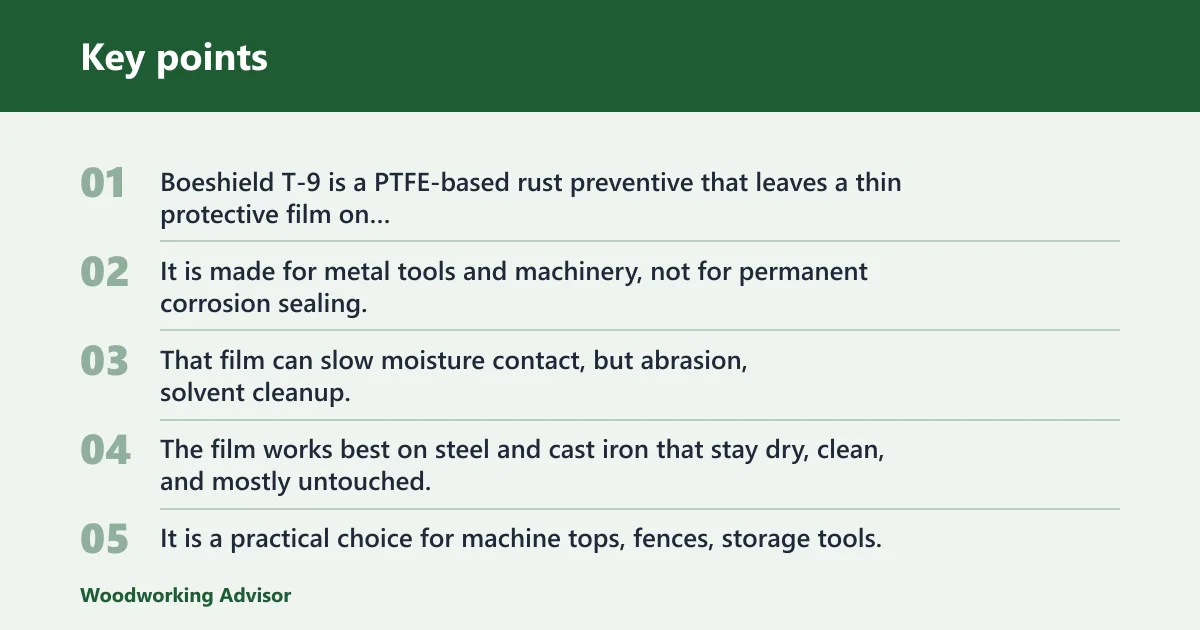
Boeshield T-9 is a PTFE-based rust preventive that leaves a thin protective film on clean metal. It is made for metal tools and machinery, not for permanent corrosion sealing. That film can slow moisture contact, but abrasion, solvent cleanup, and winter condensation shorten its effective life.
The film works best on steel and cast iron that stay dry, clean, and mostly untouched. It is a practical choice for machine tops, fences, storage tools, and parts that see seasonal exposure. It is less suitable for friction surfaces that need a completely residue-free finish, or for workpieces you plan to glue, finish, or machine immediately.
Do not treat it as a permanent coating. Rust preventive coating life depends on film durability, abrasion, cleanup, humidity, and how often you touch the surface. A winter garage or basement shop pushes those conditions the wrong way.
How long does Boeshield T-9 last?
Boeshield T-9 lasts as long as the surface keeps an intact protective film, so the real answer is use-dependent rather than fixed. On protected indoor steel, the window is often measured in months; on high-touch or frequently cleaned shop surfaces, the window can shrink to weeks. Visible dry spots are the clearest signal to recoat.
The answer changes by surface because wear is not the same everywhere. A table saw top loses film from stock movement. A fence loses film from hands and dust. A boxed-up hand tool may keep its coating far longer because it is touched less and sees less moisture exchange.
Visible wear does not always look dramatic. Boeshield can still be present even after the surface loses easy water beading, and a coated part can still feel slightly dry. The practical rule is simple: if water no longer beads consistently, or if the metal starts looking patchy, recoat before rust has a chance to start.
Typical protection windows by exposure
Use these as planning windows, not promises. The shorter end fits unheated or humid winter shops. The longer end fits clean, dry, lightly handled storage.
- High exposure: 1 to 3 months
- Moderate exposure: 3 to 6 months
- Low exposure: 6 to 12 months
Does Boeshield T-9 wear off in a humid shop?
Yes. In a humid shop, Boeshield T-9 wears down faster because the film faces condensation cycles, dust contamination, and more frequent wiping. A garage workshop with winter humidity swings is especially hard on rust protection because warm air can condense on cold cast iron, then dry into residue that attracts more dust.
Unheated and intermittently heated spaces create the worst pattern. A cold surface pulled into a warmer room can sweat, then dry, then sweat again. That cycle does not remove the coating all at once, but it weakens the film and makes rust more likely on exposed edges, corners, and fasteners.
Dust and sawdust matter too. They do not just sit on the surface; they can act like a light abrasive during daily use and wipe-downs. On machine tables and fences, that means Boeshield often needs more frequent attention than the same product on boxed tools or long-term storage items.
Suppose a cast-iron jointer table sits in a detached garage where nighttime temperatures drop below freezing and daytime heat comes and goes. Condensation forms on the morning surface, then the table gets wiped clean at lunch. That surface needs a shorter recoat interval than a similar table stored in a dry basement shop.
Boeshield reapplication matrix
This matrix translates Boeshield durability into a winter woodshop schedule. Use the exposure level that matches the surface, then recoat when the listed trigger appears. The trigger matters more than the calendar if the surface gets cleaned, scrubbed, or used hard.
| Shop surface | Exposure level | Expected protection window | Recoat trigger |
|---|---|---|---|
| Table saw top, cast iron | High | 1 to 3 months | Stock drags leave dull streaks, water stops beading, or the top was cleaned with solvent |
| Fence, miter gauge, sliding contact area | High | 1 to 3 months | Hands, dust, or friction leave dry patches; recoat after heavy use or cleaning |
| Machine top or drill press table | Moderate | 3 to 6 months | Patchy sheen, reduced water beading, or seasonal humidity change |
| Hand tools in daily use | High | 1 to 3 months | Edges, joints, or exposed steel feel dry after handling or wipe-down |
| Clamps, boxed tools, storage tools | Low | 6 to 12 months | Before long storage, after seasonal change, or after the package is opened and handled |
| Bare hardware, vises, and fasteners | Moderate | 3 to 6 months | Visible dry spots or any orange haze after condensation |
Table saw tops and cast-iron surfaces
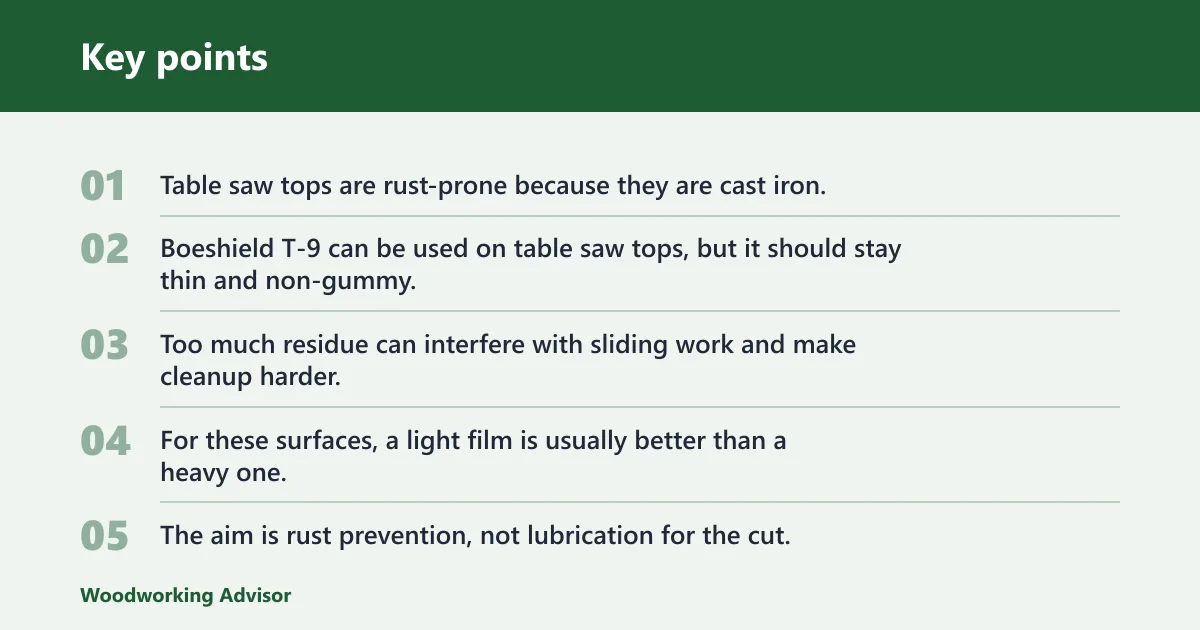
Table saw tops are rust-prone because they are cast iron, they see contact wear from stock, and they often sit in open air. Boeshield T-9 can be used on table saw tops, but it should stay thin and non-gummy. Too much residue can interfere with sliding work and make cleanup harder.
For these surfaces, a light film is usually better than a heavy one. The aim is rust prevention, not lubrication for the cut. If the top is used daily, inspect it monthly through winter and recoat when the surface stops beading water or starts to look dry in the travel path of the stock.
Fences, machine tops, and sliding contact areas
Fences and machine tops need special care because they mix corrosion risk with friction. Boeshield can help protect them, but residue should not build up where wood rides, clamps slide, or alignment depends on clean contact. If a surface must stay slick without contamination, a different maintenance approach may fit better.
Wax is often the better fit for some sliding surfaces because it can leave a lower-residue finish on exposed machine tops. Boeshield is more useful where protection from moisture matters more than a polished glide surface. On some shop machines, the right answer is Boeshield on hidden or storage-prone metal and wax on the working top.
Hand tools and stored tools
Hand tools have edges, joints, and fasteners that rust fast when they are handled often and stored in damp air. For in-use tools, wipe-down intervals matter as much as the initial spray. For stored tools, the longer window comes from less handling, not from a stronger coating.
Tools packed in a drawer or box for the season can often go much longer between applications, especially if they were cleaned and dried first. That said, a midwinter check is still smart if the shop has condensation issues or if the storage area sits against an exterior wall.
How often should you reapply Boeshield T-9?
Reapply Boeshield T-9 whenever the protective film has been cleaned off, worn thin, or exposed to a new season of humidity. For a winter woodshop, that usually means monthly checks on high-touch surfaces and a recoat every 1 to 3 months on exposed machine tops, fences, and bare hardware.
The clearest rule is this: recoat after solvent cleaning, after heavy handling or abrasion, and after seasonal storage or a major weather change. Solvent wipes can remove more film than they seem to, especially on smooth steel where the coating is already thin. If you clean the surface aggressively, treat that as a fresh start.
Say a fence gets wiped with mineral spirits to remove pitch. That is not a maintenance-free reset. Once the solvent flashes off, the old protective film may be partly gone, so the surface should be recoated instead of left bare through the next humid spell.
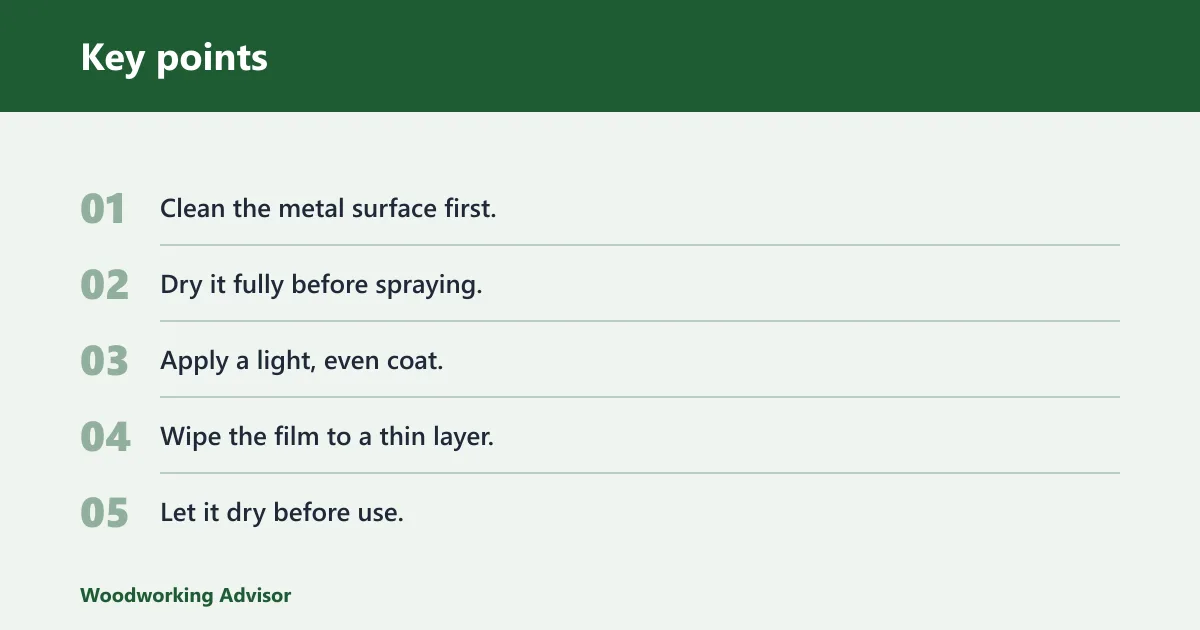
- Clean the metal surface first.
- Dry it fully before spraying.
- Apply a light, even coat.
- Wipe the film to a thin layer.
- Let it dry before use.
- Inspect monthly in winter.
Application method matters because Boeshield is a spray product. Overspray can land on workpieces, belts, grips, or friction surfaces you do not want coated. Apply it to clean, dry metal, then wipe it on level so the film stays thin and even. That reduces residue and keeps the coating from feeling greasy.
Where should you use Boeshield in a winter woodshop?
Use Boeshield where rust risk is high and residue will not interfere with work. It fits table saw tops, machine tables, fences, drill press columns, vise bodies, clamps, and storage tools that face winter humidity swings. It is also useful on bare hardware and steel parts that sit unused between projects.
For daily-use machine surfaces, pair the coating choice with the surface role. Boeshield handles rust prevention well. Wax can be better on some exposed sliding tops where you want a cleaner feel. Light oil works on certain hand tools and stored parts, but it can attract dust and may need more frequent wipe-downs.
A common first-timer mistake is spraying every metal surface the same way. A workbench vise, a cast-iron table, and a box of chisels do not need the same finish thickness or the same cleaning interval. Match the product to the job, then inspect the film before winter humidity has time to win.
Frequently asked questions
How long does Boeshield last?
Boeshield T-9 usually lasts 3 to 6 months on indoor steel, but that window shortens on high-touch or solvent-cleaned surfaces. In a winter garage shop, check exposed metal monthly and recoat when the film looks dry, water stops beading, or rust-prone areas start to show dull patches.
Can Boeshield T-9 be used on table saw tops?
Yes, but use a thin coat and keep residue off the working surface. Table saw tops are cast iron and rust easily, so protection matters. If the top feels greasy or leaves residue on stock, the film is too heavy and should be wiped back.
What is the difference between Boeshield T-9 and WD-40 for rust protection?
Boeshield T-9 is meant as a rust preventive with a protective film. WD-40 is better known as a water-displacing spray and light lubricant, not a long-term metal preservative. For winter woodshop storage, Boeshield usually fits better where you want longer rust protection and less frequent reapplication.
Does red hot expire?
If you mean a spray product labeled Red Hot, check the can for a date code or storage guidance. Aerosol products usually fail from poor storage, clogged valves, rusted cans, or lost pressure before they fail from age alone. If the product separates, sprays poorly, or smells off, replace it.
Will Boeshield keep tools from rusting all winter?
It can, but only if the tool is clean, dry, and inspected through the season. Boeshield is not a set-it-and-forget-it barrier in a damp garage. For exposed cast iron and hardware, plan on monthly checks and sooner if you clean the surface or see condensation.
How long does boeshield last: the practical answer is 1?
The practical answer is 1 to 3 months on exposed winter shop surfaces, 3 to 6 months on moderate indoor use, and longer on stored tools. The coating lasts until cleaning, abrasion, or humidity breaks the film. A visible dry patch is the cue to recoat.
How long does boeshield t9 last?
Boeshield T-9 lasts as long as its thin protective film stays intact. That can mean months on stored steel and only weeks on a saw top or fence that gets regular handling. In winter shops, recheck after every major temperature swing and after solvent wipes.
Sponsored / affiliate links. As an Amazon Associate I earn from qualifying purchases. I may earn additional commission from eligible campaigns.