Does Boeshield T-9 Dry? What Counts as Dry Time
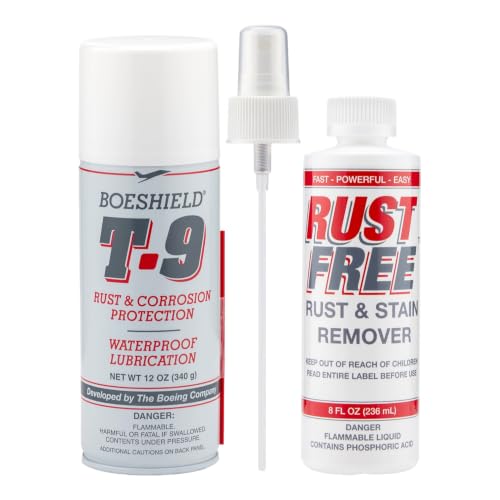
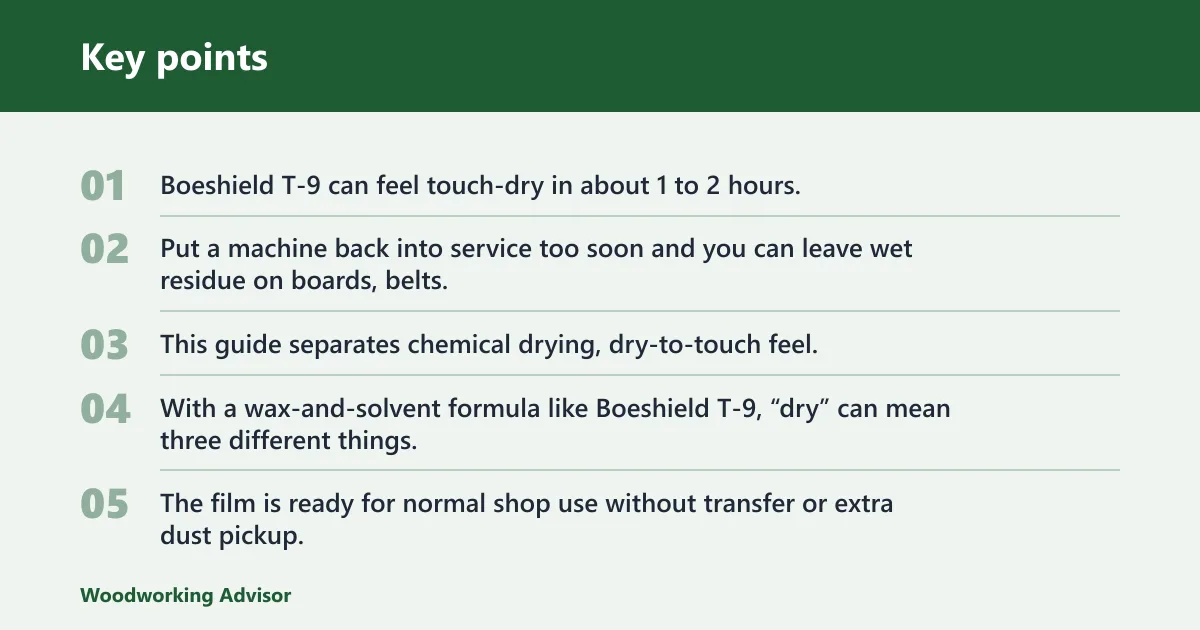
Boeshield T-9 can feel touch-dry in about 1 to 2 hours, while full solvent flash-off and normal shop use may take up to about 24 hours. Put a machine back into service too soon and you can leave wet residue on boards, belts, or hands, or trap oil where dust sticks. This guide separates chemical drying, dry-to-touch feel, and safe shop use so you know when Boeshield T-9 is dry enough.
Does Boeshield T-9 dry?

- Dries to a thin waxy protective film
- Penetrates and displaces moisture first
- Works on shop tools, hardware, and machinery
What “dry” means here
With a wax-and-solvent formula like Boeshield T-9, “dry” can mean three different things. The solvent has evaporated. The surface no longer feels wet. The film is ready for normal shop use without transfer or extra dust pickup.
Those are not the same checkpoint. A surface can stop looking wet before the film has fully settled, and it can still feel slightly waxy after the solvent is gone. That thin residue is part of the protectant film, not a sign that the product failed.
What happens as the solvent evaporates
Solvent evaporation does the real drying work. Thin, wiped coats lose solvent faster because there is less liquid to clear, more surface area exposed, and less material trapped in corners or around fasteners.
Temperature and ventilation matter too. Warm air and moving air shorten the tacky window; a cold, still shop can stretch it. Heavy spray buildup slows everything down, especially in recesses, seams, and other places where excess product pools.
That is why a cast iron table saw top wiped nearly dry can be ready sooner than the same product sprayed heavily into a bandsaw trunnion area or fence hardware.
Why a thin waxy film can remain
Boeshield T-9 is meant to leave behind a thin protective film after the solvent flashes off. That film may feel slightly waxy or slick even when it is dry enough for use. A waxy feel does not automatically mean the surface is still wet.
The risk is reading too much into the feel. A light film on a flat top may feel almost dry while a thicker pocket at an edge or bolt head still holds solvent underneath.
Boeshield drying table
The table below gives a practical way to judge drying by application thickness. It is a rule of thumb, not a lab result, so use the film thickness and the shop temperature together.
| Application thickness | Likely dry-to-touch window | Safe next-step use cue |
|---|---|---|
| Light wipe on cast iron | About 1 to 2 hours | Surface feels dry and no transfer shows on a clean rag |
| Normal spray with wiped excess | About 2 to 6 hours | Good for returning a table saw top or fence rail to light use after a final wipe check |
| Heavier spray in corners or around hardware | Several hours to overnight | Wait until sticky spots are gone before handling, clamping, or moving parts across it |
| Over-applied spots left pooling | Up to 24 hours or longer in cool, still air | Wipe back the excess first; do not put boards or belts across the area yet |
How do you know it is dry enough?
Use three checks: the surface should feel dry, it should not transfer residue to a clean rag, and it should not feel tacky under light finger pressure. For machine use, those checks matter more than the clock alone.
Dry enough for touch is helpful. Dry enough to machine on is the stronger standard. A surface can feel mostly dry and still smear if there is too much product in one spot or if the solvent is trapped under a heavy film.
Self-check table
| Condition | What it feels or looks like | What it means |
|---|---|---|
| Surface feels dry | No wet sheen, no obvious smear on a clean fingertip | Solvent has likely flashed off on the exposed areas |
| Safe to machine on | No residue transfer to a white rag after a light wipe test | Good for boards, saw tables, and hand contact |
| Likely to attract dust | Tacky patches, visible pooling, or greasy shine in corners | Excess product is still present and should be wiped back |
If a table saw top is sprayed and checked after about two hours, the center may feel dry while the miter-slot area can still leave a faint smear on a clean rag. The center may be ready, but the slot edge is not. Wipe the high spots again and give the heavy area more time.
Common failure cases
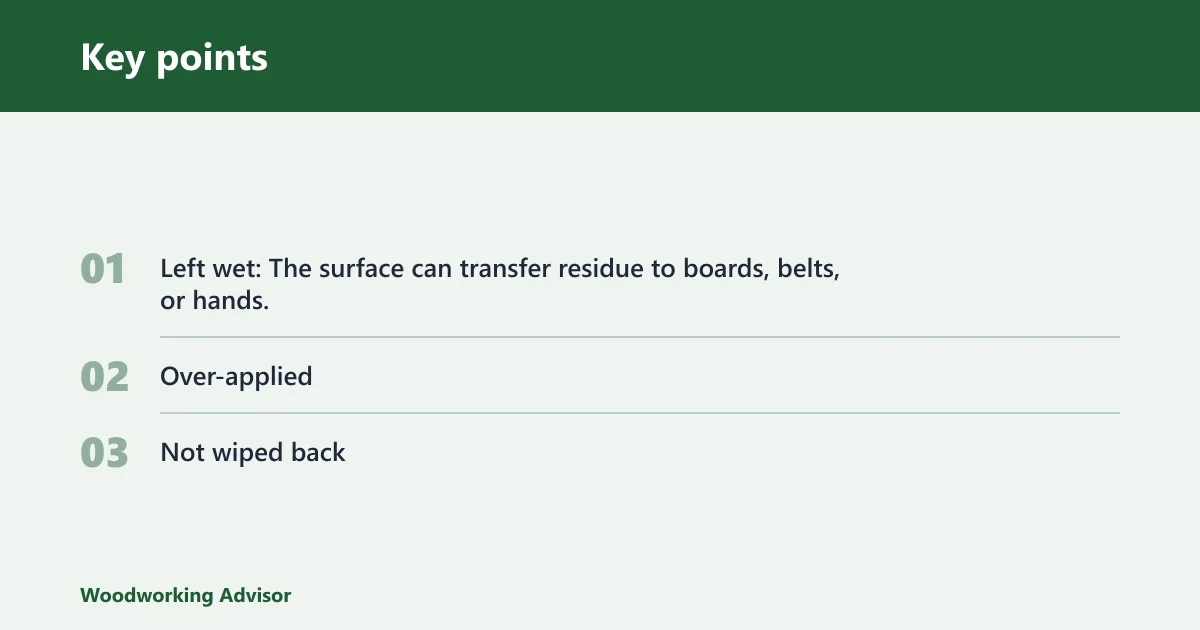
- Left wet: The surface can transfer residue to boards, belts, or hands.
- Over-applied: Pools stay tacky longer and can collect dust.
- Not wiped back: The film stays thicker than needed and can feel greasy even after the solvent has mostly gone.
How should you apply it on shop metal?
Boeshield T-9 works best on clean metal surfaces where corrosion matters and friction needs to stay low. Apply a thin, even coat, then wipe off the excess. That approach suits cast iron table saw tops, bandsaw tables, fence rails, and other shop metal surfaces.
Cast iron table saw tops
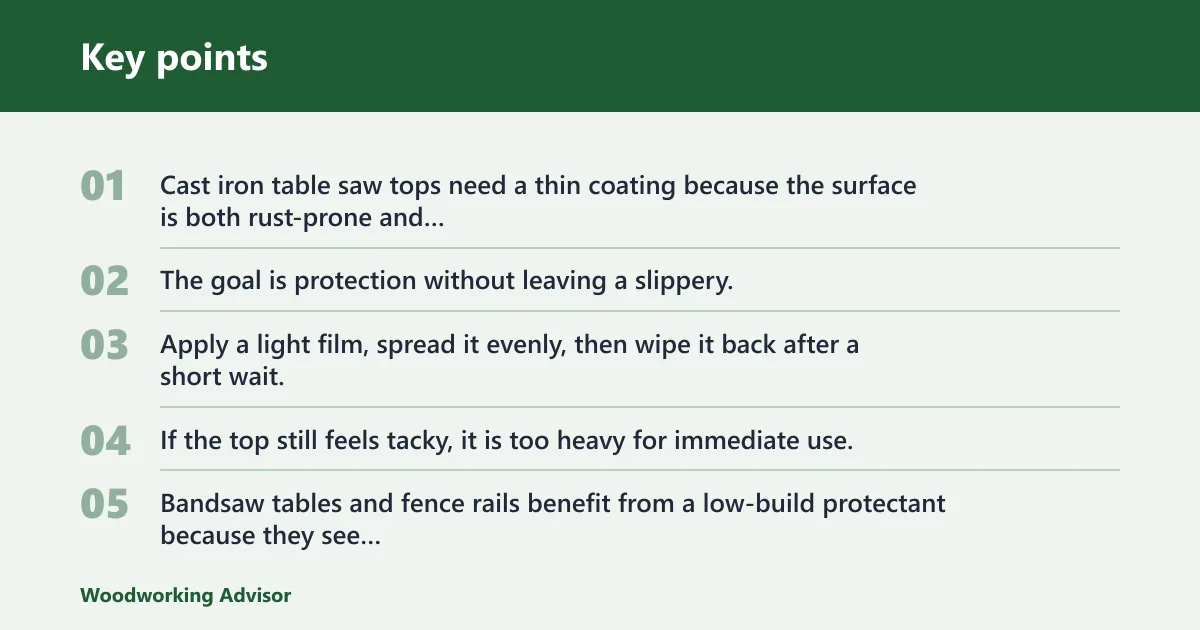
Cast iron table saw tops need a thin coating because the surface is both rust-prone and friction-sensitive. The goal is protection without leaving a slippery, residue-heavy layer that can transfer to stock.
Apply a light film, spread it evenly, then wipe it back after a short wait. If the top still feels tacky, it is too heavy for immediate use.
Bandsaw tables and fence rails
Bandsaw tables and fence rails benefit from a low-build protectant because they see repeated contact, dust, and adjustment. A thin Boeshield film can help prevent corrosion on these metal surfaces without building up like a heavy oil coat.
Fence rails especially need a clean feel. If too much product stays on the rail, dust can cling to the excess and make future adjustment less smooth.
What to do with heavy spots
Heavy spots are the main reason people think the product “doesn’t dry.” In most cases, it is not a drying problem. It is an application problem. The extra liquid simply needs to be wiped off and allowed more time.
A common first-timer mistake is spraying the ends of a cast iron top, walking away, and returning to a shiny patch an hour later. That patch is not the target finish. Wipe it until only a thin film remains, then recheck later.
Is Boeshield T-9 a dry lube?
Boeshield T-9 is generally described as a low-residue protectant with lubricating properties, but it is not the same as a true PTFE dry lube. After drying, it leaves a thin waxy film rather than the very low-residue coating woodworkers usually expect from a dedicated dry lubricant.
How it compares with PTFE dry lube
A PTFE dry lube is usually chosen when dust pickup matters most. It dries to a lower-residue surface film, so it is often the better fit for parts that should stay cleaner, such as certain guide surfaces, slides, and moving points where sawdust is a concern.
Boeshield is better when you want corrosion protection plus a light lubricating film on metal. If the job is mainly rust prevention on cast iron, fence rails, or tool bodies, Boeshield makes sense. If the job is a cleaner, drier working surface, a PTFE dry lube often fits better.
Where a lower-residue dry lubricant fits better
Choose a dedicated dry lubricant when dust pickup is the bigger problem than corrosion. That usually includes surfaces that stay exposed to airborne dust, repeated hand contact, or frequent movement where a wet-feeling film would be a drawback.
Boeshield is the better pick when the surface needs a protective film that can survive shop humidity and still leave the metal guarded after the solvent has flashed off.
Frequently asked questions
How long does Boeshield T-9 take to dry?
Most guidance puts Boeshield T-9 in a touch-dry range of about 1 to 2 hours for a thin coat, with working readiness often taking up to 24 hours depending on thickness, temperature, and ventilation. Heavier spray patterns and pooled spots take longer than wiped films.
Does Boeshield T-9 leave a greasy residue?
It can leave a waxy or slightly oily-feeling film if you apply too much or do not wipe the excess away. A properly thin coat should not feel wet. If it feels greasy after drying time, the surface likely needs another wipe and more time.
Can you use Boeshield T-9 on table saw tops?
Yes. A cast iron table saw top is one of the common uses, but the key is a thin, even coat. Wipe off the excess so the top stays slick enough for rust protection without leaving a transfer-prone layer on boards or push tools.
Is Boeshield T-9 safe on cast iron?
Yes, it is commonly used on cast iron tops and other shop metal surfaces for corrosion protection. The important part is application control. A light coat is fine; pooled product is not. Heavy spots can stay tacky longer and attract dust.
Will dust stick to Boeshield T-9 after it dries?
Some dust can stick if the film is heavy, uneven, or still tacky. A thin, wiped film is less likely to collect dust than an over-applied one. For dust-sensitive machinery, a dedicated dry PTFE lubricant may leave a cleaner-feeling surface.
What happens if you apply too much Boeshield T-9?
Too much product slows drying, leaves a greasy or tacky feel, and can create spots that hold dust. Excess can also transfer to workpieces or hands. The fix is simple: wipe the area back until only a thin film remains, then let it finish flashing off.
Sponsored / affiliate links. As an Amazon Associate I earn from qualifying purchases. I may earn additional commission from eligible campaigns.