Wood Stove in a Workshop: Sawdust, Clearances and Insurance
A wood stove can be insurable in a workshop only if it meets code clearances, has a listed hearth and chimney, keeps combustibles and dust out of the appliance zone, and your insurer approves the installation in writing. Miss any of that, and you risk a shop fire, denied claims, or a forced removal after inspection. This guide covers safe clearances, sawdust control, solvent storage, ventilation, and the documents insurers usually want.
Can you install one safely?
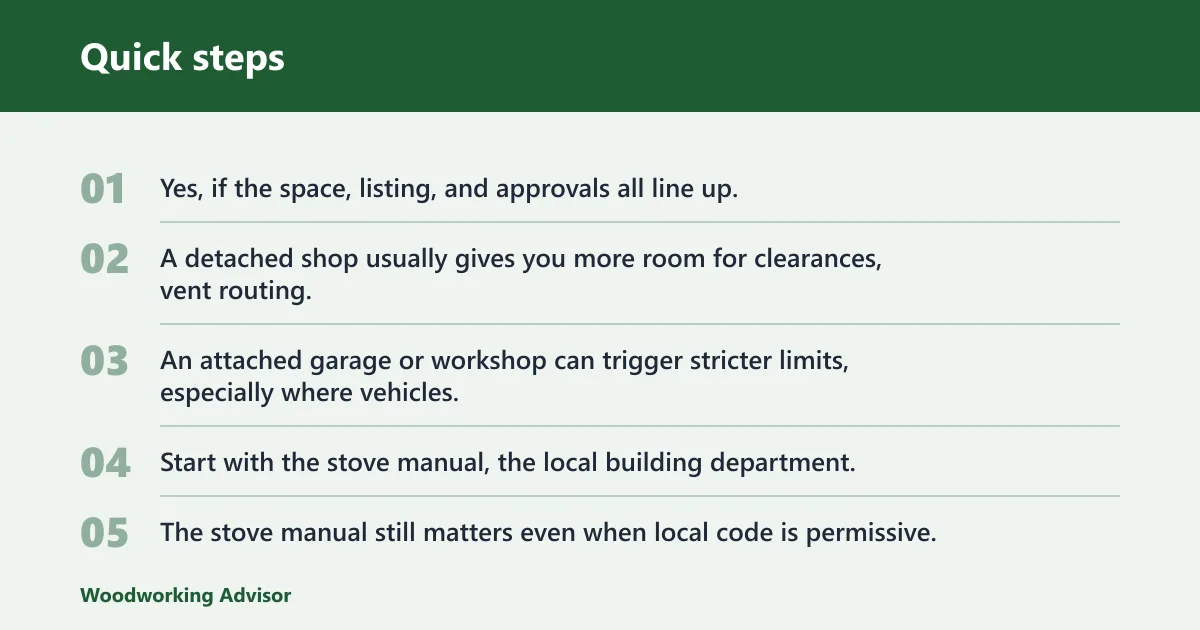


Yes, if the space, listing, and approvals all line up. A detached shop usually gives you more room for clearances, vent routing, and storage control. An attached garage or workshop can trigger stricter limits, especially where vehicles, fuel, and living spaces share walls or air. Start with the stove manual, the local building department, and your insurer before you buy or set pipe.
The stove manual still matters even when local code is permissive. Many manuals state whether a garage installation is allowed, and installation must follow the tested listing, not a general comfort rule. If the manual does not allow the setting, or if the authority having jurisdiction will not approve it, the project stops there.
Detached shop vs attached garage
A detached shop is usually easier to separate from fuel vapors, dust, and household air. An attached garage or mixed-use space can create conflicts because code treatment and insurer treatment may differ from a freestanding shop. Treat a true garage as the hardest case, not the easiest one.
That distinction matters because garages and shops have flammable vapors that can collect near the floor. If you also park vehicles, store gasoline, or keep finishing products in the same structure, the installation needs tighter control of storage, ignition sources, and airflow than a simple outbuilding.
The building department decides whether the installation meets the adopted code and local amendments. The insurer decides whether the risk is acceptable for coverage. Those are separate questions. A permit approval does not guarantee coverage, and an insurer’s acceptance does not replace a code inspection.
Ask the carrier before installation whether a wood stove in a workshop is acceptable, whether they want a permit, and whether they require an inspection report from the final sign-off. Some carriers care about building use, heat source type, and whether the space is attached to living quarters.
Why the stove manual still matters
Clearances, floor protection, connector pipe, and venting are all model-specific. The manual and listing control the installation geometry. IRC M1901 and NFPA 211 supply the code framework, but the appliance listing can call for more or less than the default 36 inches to combustible surfaces.
For one example stove, the unshielded clearances are 12 inches at the rear, 18 inches at the side, and 11 inches at the corner. With a modular wall heat shield and double-wall connector, that same stove can be listed for 2.5 inches in the tested configuration. That is not a general target for every unit.
Workshop hazards that change the answer
Sawdust, solvents, and workshop airflow can turn a compliant stove into a poor install if you ignore them. The biggest mistake is treating the stove as only a heat source. In a shop, it is part of the storage plan, cleaning plan, and ventilation plan.
Sawdust and shavings on floors and ledges
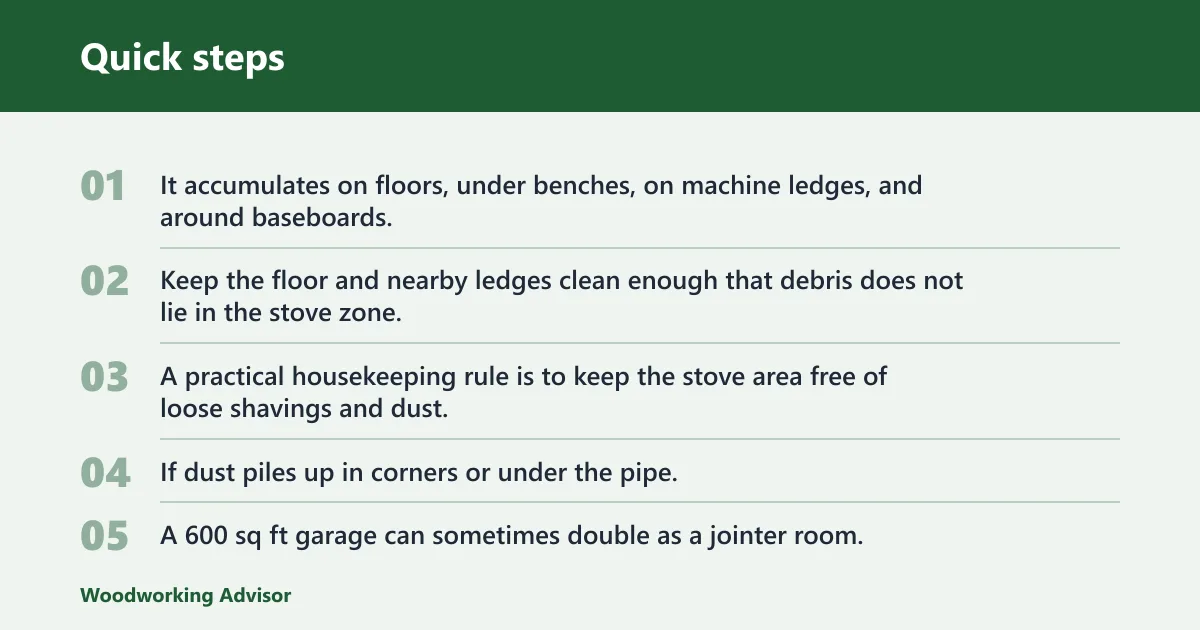
Fine wood debris is combustible fuel. It accumulates on floors, under benches, on machine ledges, and around baseboards. Keep the floor and nearby ledges clean enough that debris does not lie in the stove zone, the pipe zone, or the path where sparks and embers could escape during loading.
A practical housekeeping rule is to keep the stove area free of loose shavings and dust, then clean the whole room often enough that the buildup never has time to form a continuous layer. If dust piles up in corners or under the pipe, it can spread fire faster and can re-ignite after a stray ember lands.
A 600 sq ft garage can sometimes double as a jointer room. If sweeping happens only at the end of the month, the corners can hold enough fine dust to become part of the fire load. Daily debris removal near the stove and weekly cleanup of ledges and machine bases gives you a better chance of keeping ignition sources separated from fuel.
Solvents, gasoline, and finishing products
Gasoline, solvents, lacquer thinner, and many finishing products can send flammable vapors along the floor. Those vapors can move toward the stove even when the container itself sits a few feet away. Keep those products out of the stove room if you can, and never store them where they can warm up or spill near an ignition source.
Oily rags need separate handling too. Use a metal container with a tight lid or another approved storage method, and keep it away from the stove, the stove pipe, and the general dust collection path. Do not treat rag storage like lumber storage; the risk is different.
Dust collectors, exhaust fans, and make-up air
Dust collectors and exhaust fans can change room pressure. If the room goes negative, the stove can draft poorly, spill smoke during loading, or backdraft during startup. That risk is more likely in a tight shop with a strong dust collector, a bath fan, a dryer, or a big exhaust fan running at the same time.
Plan for make-up air before the stove goes in. If the shop is air-starved, the flue may not pull cleanly. A common first-timer mistake is assuming the chimney alone will solve weak draft; in a workshop, the fans and collector can overpower the pressure balance long before the chimney shows a problem.
Suppose a 1,200 sq ft shop with high ceilings uses a dust collector and a spray-exhaust fan in the same afternoon. Even if the stove is sized for the room, the exhaust can pull room air away from the firebox, then smoke spills when the door opens. The fix is airflow planning, not larger logs.
Clearances, hearths, and shields
Clearances come from the listing, the manual, and the code. IRC 2024 uses a 36-inch default clearance to combustible surfaces unless the appliance is listed for less. Reduced-clearance assemblies only count when the tested configuration matches the installation exactly.
Manufacturer clearances versus code minimums
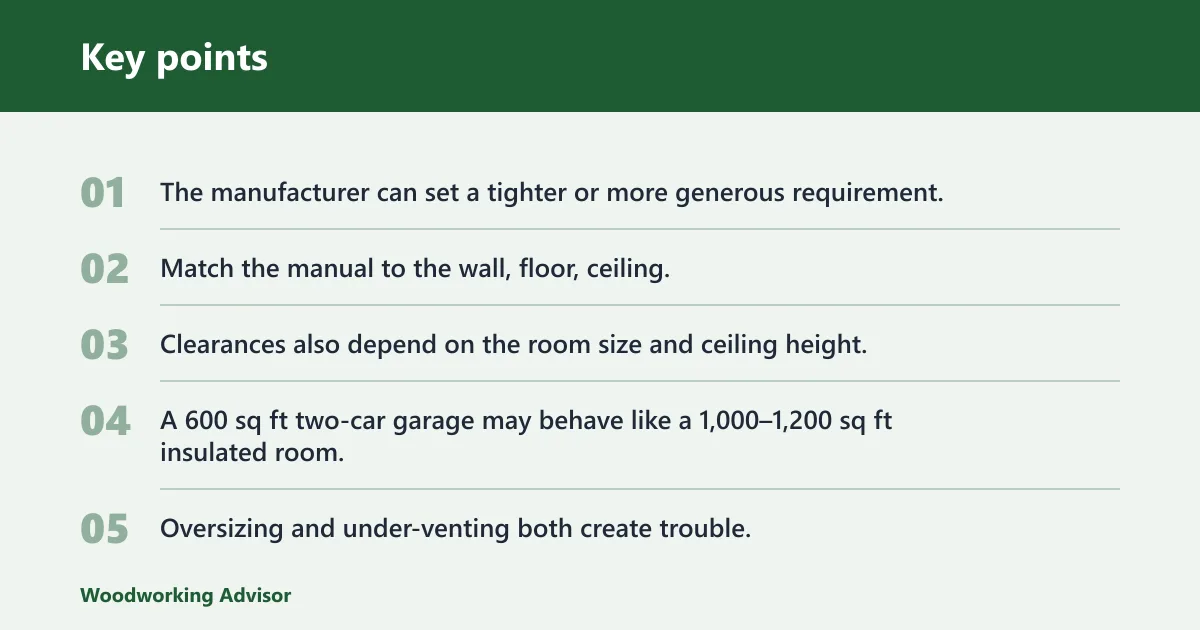
NFPA 211 and IRC M1901 frame the baseline. The manufacturer can set a tighter or more generous requirement, but you cannot assume a general home rule applies to a shop. Match the manual to the wall, floor, ceiling, and connector pipe layout you actually plan to use.
Clearances also depend on the room size and ceiling height. A 600 sq ft two-car garage may behave like a 1,000–1,200 sq ft insulated room, while a 1,200 sq ft shop with high ceilings can need a stove rated to 2,000 sq ft or more. Oversizing and under-venting both create trouble.
Hearth pad requirements on combustible floors
A hearth pad provides non-combustible floor protection when the floor is combustible. The pad usually extends in front of the loading door and to the sides, according to the manual. On some concrete floors, some manuals say no floor protection is required, but that is model-specific and not universal.
For combustible floors, one example pad extends 16 inches in front and 8 inches to the sides. Use the dimensions from the manual for the exact stove and floor type. Do not guess from an old install or from another brand’s brochure.
Wall heat shields and tested reduced clearances
A wall heat shield can reduce clearances only when it is listed and installed in the tested configuration. Many reduced-clearance setups pair a wall shield with double-wall connector pipe. If the manual does not show that exact arrangement, treat the shield as unproven for your install.
That is why a reduced clearance number should never be copied from a forum post. The shield, the pipe, the standoff gap, and the fasteners all matter. If any part changes, the clearance may change too.
Wood stove chimney rules for shops
Inside the room, single-wall stovepipe connects the stove to the vent system. It does not pass through a wall, ceiling, or roof. Once the vent leaves the room, the system changes to Class A chimney pipe with the required air-space clearance and the proper roof termination.
Single-wall stovepipe inside the room only
Single-wall stove pipe should not pass through a roof, wall, or ceiling. It belongs only in the heated room, where the manufacturer and code allow it. Because it runs hotter than insulated chimney, it needs larger clearance to combustibles than Class A pipe does.
That makes routing simple in one sense and strict in another. You can use it to connect the stove to the chimney connector section, but you cannot use it as a pass-through assembly. If the plan needs a wall or ceiling penetration, the connector must stop before that point.
Where Class A pipe is required
Where the chimney passes through a wall, ceiling, or roof, use Class A chimney pipe. It needs 2 inches of air-space clearance to combustibles. That spacing is not optional, and it must be maintained through the entire concealed or penetrated run.
The chimney also has to meet the 3-2-10 height rule. That rule governs the top of the chimney relative to the roof and nearby structure so draft and termination height are correct. If the roof route changes, verify the rule again before framing the penetration.
Do I need Class A pipe through the ceiling or wall in a garage workshop?
Yes. If the vent system goes through a ceiling or wall, Class A pipe is the usual requirement, not single-wall stovepipe. The pass-through assembly must keep 2 inches of air-space clearance to combustibles and follow the chimney manufacturer’s listed support and termination details.
What insurers will want to see
Most underwriters care less about how warm the stove feels and more about whether the install is documented. They may ask about wood heat, the building use, the venting, and whether a qualified authority inspected the work. A quiet install with no paperwork can become a coverage problem later.
Permits and final inspection records
Keep the permit application, permit card, and final inspection sign-off. If your local jurisdiction uses a separate mechanical or building inspection, keep that too. Those records show the stove was approved under the local rules that applied to the property.
The insurer may also want to know whether the shop is attached or detached, whether there are vehicles inside, and whether the stove sits in a separate room or open work area. Answer those questions directly. Do not rely on a photo alone as proof of compliance.
Maintenance and chimney service records
Keep records of chimney inspection and cleaning as needed. Annual inspection is a sensible baseline, but heavy use, low-burning, or visible creosote may call for more frequent service. Also keep any service notes that mention liner condition, connector condition, or creosote deposits.
Those records matter because smoky startups, slow burns, and overloaded pipe can create creosote. In a dusty shop, that residue is especially unwelcome. Re-ignition risk goes up when a hot flue meets a dirty chimney and a room full of fine combustible debris.
Questions to ask before you install
- Check whether coverage applies to a wood stove in a detached shop, attached garage, or mixed-use space.
- Do you require a permit, final inspection, or both?
- Do you want the stove manual and chimney listing on file?
- Do you need proof of chimney inspection and cleaning after installation?
- Are there restrictions for garages, vehicle storage, or flammable liquids?
- Will the policy change if the building use changes later?
Wood stove workshop checklist
This checklist is for the first pass before installation and before you call the job done. Keep the evidence with your policy file. If any line fails, fix it before lighting the stove.
| Hazard | What the homeowner must verify | Evidence to keep for insurance |
|---|---|---|
| Sawdust control | Floors, ledges, and machine bases near the stove are cleaned regularly, and loose shavings are kept out of the appliance zone. | Housekeeping log, inspection notes, and any permit or inspector comments that reference the stove area. |
| Solvent storage | Gasoline, solvents, finishing products, and oily rags are stored away from the stove and kept out of the room when possible. | Storage plan, cabinet or container documentation, and inspection records if the local authority reviewed storage separation. |
| Clearance measurements | Measured clearances match the stove manual and listing, including wall, rear, side, and corner distances. | Permit sign-off, final inspection report, and the specific stove manual or listing sheet used for the install. |
| Venting type | Single-wall stovepipe stays inside the room only, and Class A pipe is used where the system passes through a wall, ceiling, or roof. | Chimney invoice, installation record, and the vent manufacturer’s listing for the exact pipe system. |
| Alarm placement | Smoke and carbon monoxide alarms are typically installed and tested according to the building plan and local rules. | Alarm location notes, battery or test records, and any inspection checklist that confirms placement. |
| Permit and inspection | The installation was permitted and passed final inspection where required. | Keep the permit card, final inspection sign-off, and any correction notice with proof of closure. |
| Insurer questions | The carrier has been asked in writing about wood heat, workshop use, attached-versus-detached status, and documentation requirements. | Email or letter from the carrier confirming acceptance, required conditions, and any exclusions. |
| Fire response items | A fire extinguisher is in place, accessible, and not blocked by stock or machines. | Placement note and service tag if the extinguisher was maintained or replaced. |
Frequently asked questions
Can you put a wood stove in a workshop without violating code or insurance?
Yes, but only if the stove, hearth, chimney, clearances, and room use all fit the manual, local code, and insurer rules. An approved install can still fail coverage if the carrier was never told about it or if the building use changes after the policy is written.
What clearances does a wood stove need around sawdust and wood shavings?
Keep sawdust and shavings out of the stove zone entirely. Code clearances deal with combustibles at measured distances, but fine debris behaves like fuel spread across the floor. Clean often enough that loose dust does not sit near the stove, the connector, or the loading path.
Is a wood stove allowed in an attached garage or only a detached shop?
Attached garages are harder. Many manuals, local rules, and insurers treat them more cautiously because of vehicles, fuel, vapors, and shared structure. A detached shop usually gives more room for separation, but you still need the exact manual, permit, and insurer approval.
What chimney setup is required for a wood stove in a shop?
Use single-wall stovepipe only inside the room. Where the vent passes through a wall, ceiling, or roof, use Class A chimney pipe with 2 inches of air-space clearance to combustibles, then meet the 3-2-10 height rule at the roof line.
Do insurance companies cover a wood stove in a workshop?
Some do, some do not, and some add conditions. Coverage can vary by carrier and building use. Ask in writing before installation, and keep the permit, final inspection, and maintenance records ready. An undisclosed install can become a claims problem.
What combustibles should never be stored near a shop wood stove?
Keep gasoline, solvents, finishing products, oily rags, and loose scrap lumber away from the stove. Those items bring separate ignition risks, especially in garages and workshops where vapors can settle low. Store them in approved containers or outside the stove room whenever possible.
How does draft change in a workshop with dust collectors or exhaust fans?
Dust collectors and exhaust fans can pull room air away from the stove and chimney, which can weaken draft or cause smoke spillage. Plan make-up air, avoid running strong exhaust at startup, and size the vent system to the shop, not just the square footage on paper.
Sponsored / affiliate links. As an Amazon Associate I earn from qualifying purchases. I may earn additional commission from eligible campaigns.