How Long to Wait Before Staining Pressure-Treated Wood
Most pressure-treated lumber needs 2 to 4 weeks to dry in warm, dry weather before it will accept stain evenly — but that number can stretch to 2-3 months in a humid climate, and it drops to almost zero if the boards are stamped KDAT (kiln-dried after treatment). The only way to know for sure is to test the wood itself rather than count days on a calendar. For a quick lookup table by lumber type and climate before you dig into the full testing method below, see our treated lumber drying time chart.
The reason timing matters so much: pressure treatment forces a water-based preservative deep into the wood under pressure, which leaves fresh boards noticeably heavier and wetter than they look. Stain applied over wood that’s still holding that moisture won’t absorb evenly, tends to peel or flake within a season, and can trap moisture underneath that encourages mold. Waiting isn’t about being cautious for its own sake — it’s the difference between a stain job that lasts five-plus years and one that needs redoing next spring.
What “Pressure Treated” Actually Means Today
RECOMMENDED STAIN + SEALER
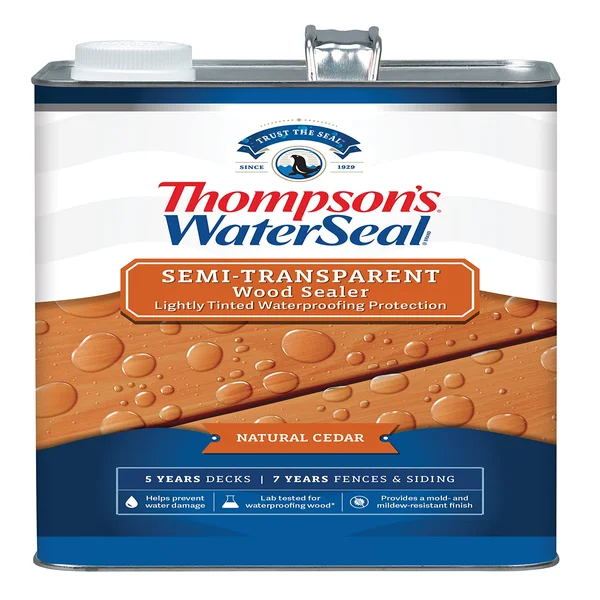 |
Thompson’s WaterSeal Semi-Transparent, Natural Cedar – $32 Once your pressure-treated wood passes the water-bead test, this combines stain and waterproofing in one product made specifically for treated lumber.
|
One correction worth making up front: CCA (chromated copper arsenate), still commonly listed as a current pressure-treatment type, has actually been phased out of residential and consumer lumber in the U.S. since 2003 due to the arsenic content — it’s now restricted to industrial, marine, and agricultural uses. Nearly all pressure-treated lumber sold at home centers today uses ACQ (alkaline copper quaternary) or copper azole (CA/MCA) instead, both of which are copper-based rather than arsenic-based. This matters for staining because it’s the copper content — not the specific chemical formula — that makes the wood resist rot and insects while also making it slower to dry and accept a finish.
The Water-Bead Test: Your Real Answer
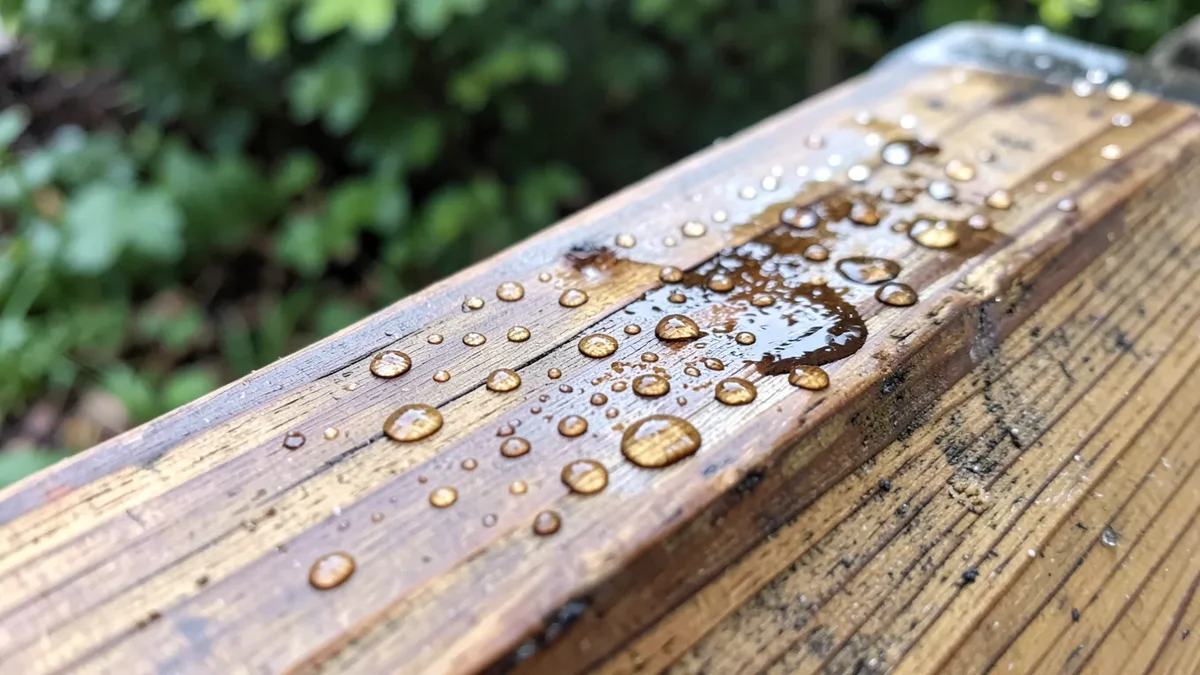
Skip the guesswork and test the wood directly. Splash a few tablespoons of water onto the surface in several different spots. If the water beads up and sits on top, the wood is still too wet to stain — the surface fibers are saturated and won’t let stain penetrate. If the water soaks in within a minute or two, the wood has dried enough to stain. This test costs nothing and is more reliable than any fixed waiting period, since drying time genuinely varies by climate, board thickness, and how the lumber was stored before you bought it.
For a more precise reading, a pin-type moisture meter (the same tool used for interior hardwood flooring) gives you an actual percentage: aim for a reading at or below 15% moisture content before staining. Test in several spots and at different points on the board, since the surface can read dry while the interior is still holding moisture, especially on thicker structural lumber like deck posts.
Check The Tag Before You Wait At All
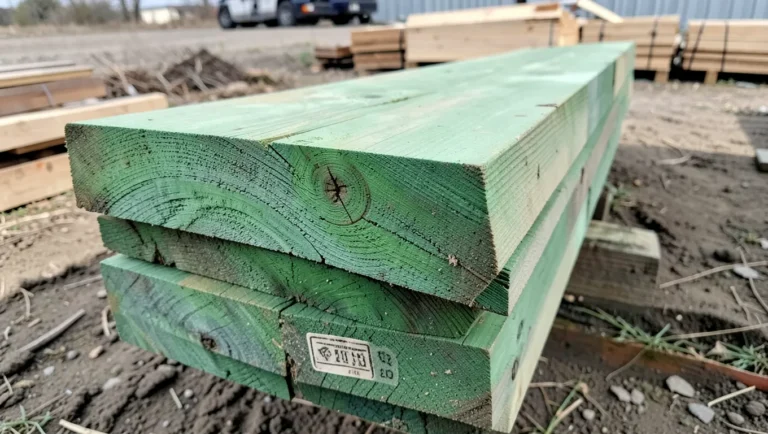
Before assuming you’re stuck waiting weeks, check the end tag stapled to the lumber when you bought it. Boards marked KDAT (kiln-dried after treatment) have already been through a controlled drying process at the mill and can typically be stained within days of installation, not weeks. Boards without that stamp are “wet” or “green” treated lumber and need the full drying period described above. This distinction is the single biggest reason two people can get completely different, equally correct answers to “how long do I wait” — they may be starting from two different products.
What Speeds Up Or Slows Down Drying
Sun and wind pull moisture out fastest, while humidity, shade, and rain slow the process considerably — a deck in full Arizona sun can dry in half the time of an equivalent deck in coastal Florida or the Pacific Northwest. Thicker lumber (like 4×4 posts) holds moisture longer than thin decking boards simply because there’s more wood for the moisture to work through. Stacking or storing lumber flat on the ground before installation also traps moisture underneath — standing boards on edge with airflow between them, when possible, speeds drying versus a flat stack.
Choosing And Applying The Stain
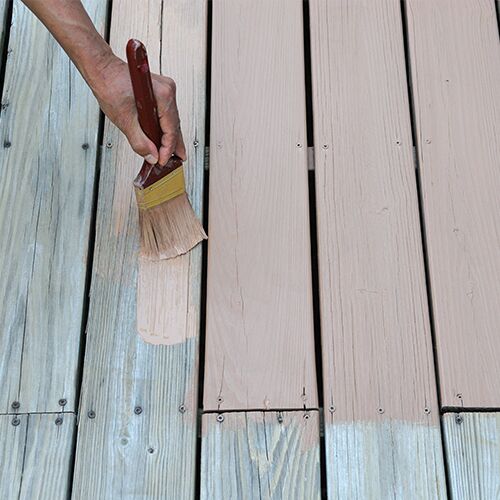
Oil-based stains penetrate deeper into wood fibers and generally hold up better against moisture, while water-based (acrylic) stains dry faster and clean up easier but can sit more on the surface. Whichever you choose, look for one rated for exterior use with UV blockers — without them, fading from sun exposure is often faster than any other form of wear. Clean the wood first to remove mill glaze, dirt, and any residue, let it dry fully, and consider a light sanding to open the grain before your first coat; this alone measurably improves absorption on lumber that’s on the borderline of “dry enough.”
Maintaining The Finish
Clean the stained surface every few months with mild soap and water, and inspect it once a year for fading, graying, or spots where water no longer beads on the surface — that’s the same water-bead test from earlier, now telling you it’s time to reapply rather than telling you it’s time to start. Most exterior stains need a fresh coat every one to three years depending on sun and weather exposure, and catching the fade early is much easier than restoring a deck that’s gone gray and started absorbing water again.
Frequently Asked Questions
How Long To Wait Before Staining Pressure-Treated Wood?
Typically 2 to 4 weeks in warm, dry weather, up to 2-3 months in a humid climate. Boards marked KDAT (kiln-dried after treatment) can often be stained within days. Confirm with the water-bead test rather than relying on a fixed number of weeks.
Can I Stain Pressure-Treated Wood Immediately?
Only if it’s KDAT lumber. Standard “wet” pressure-treated wood is still holding preservative moisture right after installation, and staining before it dries leads to poor absorption and early peeling.
What Happens If You Stain Too Early?
The stain sits on trapped moisture instead of soaking into the wood, which leads to uneven color, peeling or flaking within a season, and sometimes trapped moisture that encourages mold underneath the finish.
How Do You Know If Wood Is Dry Enough?
Splash water on the surface: if it beads up, the wood is still too wet; if it soaks in within a minute or two, it’s ready. A moisture meter reading at or below 15% confirms it more precisely.
Conclusion
There’s no single universal wait time for staining pressure-treated wood — it depends on your climate, the board thickness, and whether the lumber was kiln-dried after treatment. The water-bead test costs nothing and gives you a real answer in seconds, which beats guessing based on a calendar date every time.
Sponsored / affiliate links. As an Amazon Associate I earn from qualifying purchases. I may earn additional commission from eligible campaigns.