How Long to Wait Before Staining Treated Lumber (2026 Guide)
The calendar only gets you started: treated lumber is ready to stain when water soaks into it instead of beading on top, and that depends on how the boards were dried, how much air and sun they get, and what your local climate allows. Thompson’s WaterSeal asks for 30 days on new pressure treated lumber, which makes a good earliest date to start testing. This guide is the practical side: what changes the clock, what outdoor moisture data says about your region, and what to do while you wait. For label limits and moisture meter readings, see when pressure treated lumber can be stained.
How Long to Wait Before Staining Treated Lumber
Best Pre-Stain Brightener Pick
 |
DEFY Wood Brightener, 1 Gallon Concentrate: $32.74 Cleaning is one of the few jobs worth doing while the boards finish drying, and this brightener is the follow-up to a deck cleaner: it neutralizes cleaner residue and, per the maker, helps the wood take stain.
|
A fixed number of weeks is a guess. Two decks built the same day can be ready a month apart because one sits in open sun with air under it and the other is shaded, stacked tight or sitting low to the ground. So think of the wait as a starting estimate, and use the factors below to judge which way your boards will drift.
| What changes | Effect on drying | What you control |
|---|---|---|
| Kiln-dried after treatment (KDAT) | Boards leave the plant drier, so they typically have less water to lose; the tag on the end says how the lumber was treated and dried | Check the end tag before you buy |
| Wet-treated lumber | Comes soaked with preservative solution and has the longest way to dry | Buy it early and store it properly (see below) |
| Air on every face | Boards stacked tight dry from the outside in; boards with gaps dry from all sides | Use spacer sticks in a stack, and leave gaps on the deck |
| Sun versus shade | Shaded boards stay damp longer and are the ones most likely to still bead water | Test the shadiest boards, not the sunniest |
| Thickness | Thicker boards and posts have more water deep inside than thin decking | Test thick rails and posts separately from decking |
| Contact with the ground or soil | Boards near the ground pick up moisture from below | Test the lowest boards and the ends near footings |
The first row is the one to settle at the lumberyard. Our guide on how to dry pressure treated wood covers ways to speed things up once the boards are home.
Your Climate Sets the Floor: Outdoor Moisture by City
Wood outdoors drifts toward the moisture content of the surrounding air, called its equilibrium moisture content (EMC). A board can dry only down toward that number, not past it. Phil Mitchell of North Carolina State University calculated average monthly outdoor EMC for 252 US locations from NOAA 1981 to 2010 climate normals, updating an earlier Forest Products Laboratory table. Here is a slice of it, with a column we added: how many months a year the average sits at or below 13 percent. The 13 percent line is our own rough marker, not a stain label limit.
| City | Driest month (average EMC) | Dampest month (average EMC) | Months at or below 13% |
|---|---|---|---|
| Phoenix, AZ | 4.4% (Jun) | 9.0% (Dec) | 12 of 12 |
| Denver, CO | 8.0% (Jul) | 10.5% (Dec) | 12 of 12 |
| Salt Lake City, UT | 6.8% (Jul) | 14.9% (Dec) | 9 of 12 |
| Los Angeles, CA | 9.4% (Jan) | 11.7% (Jun) | 12 of 12 |
| Dallas, TX | 11.0% (Aug) | 12.9% (May) | 12 of 12 |
| Raleigh, NC | 11.6% (Apr) | 14.0% (Sep) | 8 of 12 |
| Atlanta, GA | 11.8% (Apr) | 13.5% (Aug) | 7 of 12 |
| Houston, TX | 13.8% (Oct) | 14.6% (Dec) | 0 of 12 |
| Miami, FL | 12.2% (Apr) | 14.4% (Sep) | 3 of 12 |
| Chicago, IL | 12.3% (May) | 15.1% (Dec) | 4 of 12 |
| Minneapolis, MN | 11.7% (May) | 14.9% (Dec) | 4 of 12 |
| Seattle, WA | 12.0% (Jul) | 16.9% (Dec) | 4 of 12 |
| Portland, OR | 11.2% (Jul) | 17.2% (Dec) | 5 of 12 |
Three things follow from the table. First, the dry Southwest and Denver barely have a problem: Phoenix never averages above 9.0 percent and Denver never above 10.5. Second, much of the country has a real dry window and a real wet one. Seattle and Portland average 16.9 and 17.2 percent in December and fall to roughly 11 to 12 percent only in midsummer. Third, Houston never averages below 13.8 percent in any month, so a Gulf Coast deck may never hit a number printed for drier regions.
These are long-term averages for open air, not a forecast for your deck. A sun-warmed board surface can run drier than the air in the afternoon and a shaded porch can run wetter. Treat the table as a map of when drying is easy, and always confirm on the actual boards. Source: Mitchell, NC State Wood Products Extension, 2016.
Plan Around Your Dry Window
Because drying slows or stalls when the air is damp, count the dry months, not just the elapsed ones. Here is what the table implies, with the practical consequence for a deck built in the wet part of the year. The planning advice is our interpretation of the data, not a measured drying time.
| Region (cities from the table) | Where the dry window sits | If the deck went in during the damp months |
|---|---|---|
| Southwest and Mountain West (Phoenix, Denver) | Most of the year; averages stay under about 10.5% | Little seasonal penalty, so start water tests at the 30-day mark |
| Salt Lake City | March through November at or below 13%; December averages 14.9% | A late-fall build will sit in damp air until spring thaws; test in March |
| Upper Midwest (Chicago, Minneapolis) | April through July at or below 13% (Chicago bottoms at 12.3%, Minneapolis at 11.7%) | Autumn and winter builds mostly wait for next spring; plan to stain in May or June |
| Pacific Northwest (Seattle, Portland) | May through August in Seattle; May through September in Portland | Builds after September are effectively waiting for next May |
| Southeast (Raleigh, Atlanta) | Roughly January through June, with a shorter window in late fall | Late-summer builds dry slowest; the humid months run July through September |
| Gulf Coast and Florida (Houston, Miami) | No true dry season: Houston never averages below 13.8% | Season matters little; rely on the water test and pick a dry week |
Remember the label limits too. Thompson’s requires air and surface temperatures above 50F during application and for 48 hours afterward, which rules out much of winter even when the lumber is dry.
The Water Drop Test, Done Like a Survey
The water test is the standard readiness check, and Thompson’s defines it plainly: if water absorbs and darkens the surface within five seconds, the surface is porous and considered ready. The usual mistake is testing one board in the sun. Treat it as a survey instead.
- Pick six or more spots: the sunniest board, the shadiest board, a board near the ground, a board in the middle of the deck, a thick rail or post, and a board end near a footing.
- Use a spoon or a few flicked drops on the top face, and time it with your phone.
- Test on a dry day after a dry night, so rain or dew is not the thing you are measuring.
- Write down each spot and retest the failures weekly.
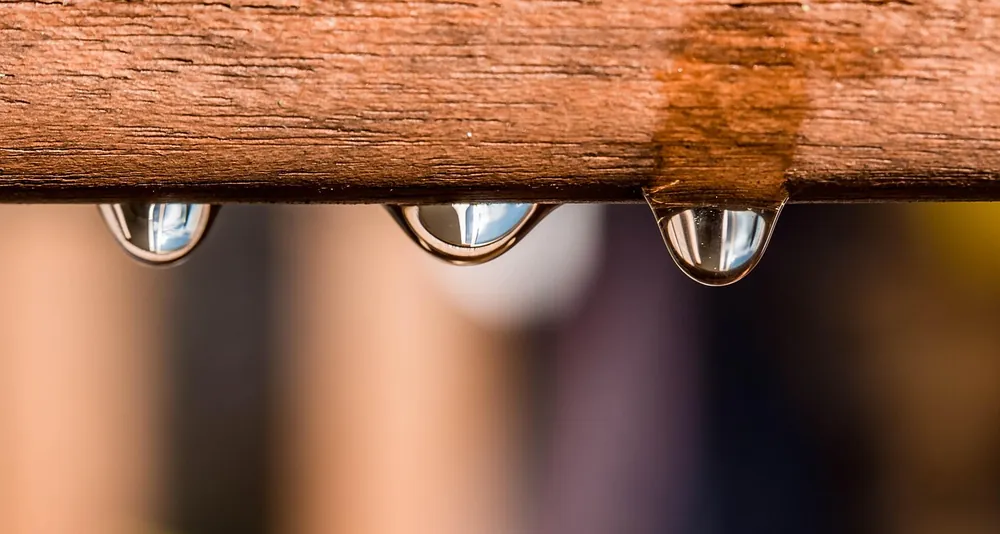
How to read the results: if every spot soaks in, you are ready. If only the sunny spots pass, wait, because the shaded boards are the ones most likely to take stain unevenly. If a board beads water but has clearly been outside for months, something other than moisture may be blocking absorption, such as mill glaze or a surface treatment, and cleaning and brightening before retesting is the next move. We have not tested these boards ourselves; the timing and threshold come from the Thompson’s label, and other products set their own, so check the can for the stain you plan to use.
What to Do While You Wait
Waiting does not have to mean doing nothing. These jobs are worth doing during the drying period:
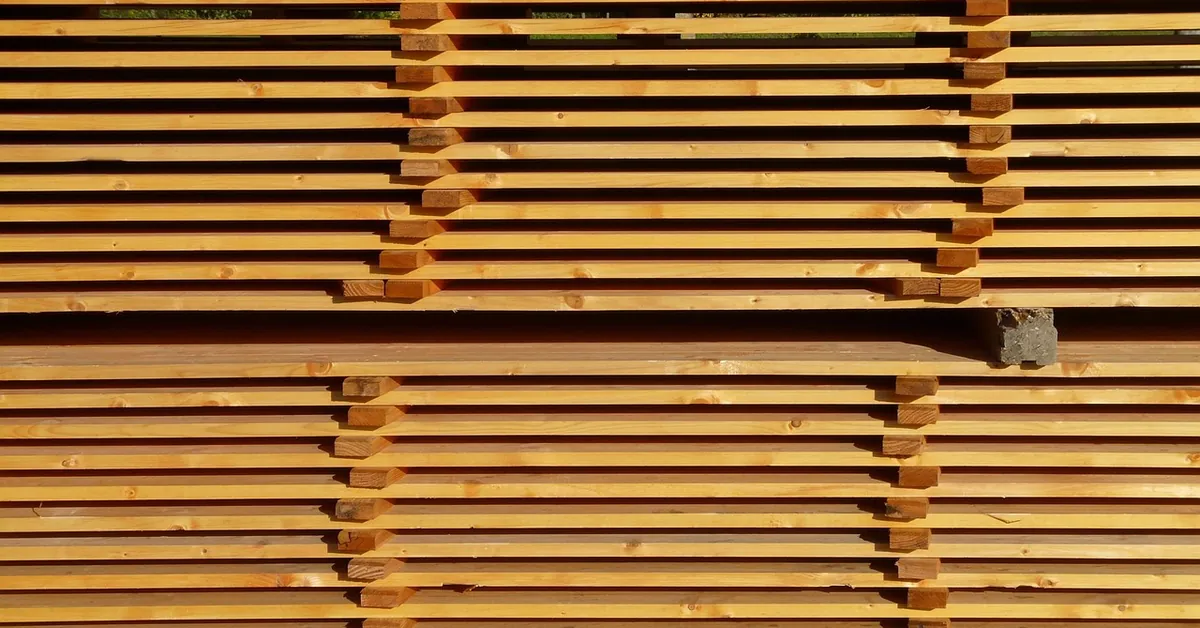
- Give the boards air. If lumber is still in a stack, separate each layer with spacer sticks so air reaches every face, and keep the pile off the ground.
- Seal the cut ends. The American Wood Council notes that AWPA recommends field-applied preservative on cut ends and drilled holes, and names copper naphthenate (specified in AWPA Standard M4, 2 percent copper) for exterior use. Check the product label for how long to wait before topcoating.
- Keep it swept. Leaves and debris hold moisture against the boards, and fallen leaves can leave tannin stains that brighteners are sold to remove.
- Do not wrap the deck in plastic. A tight cover traps moisture. If you must protect a stack from rain, cover only the top and leave the sides open.
- Plan the finish. Choose your color and applicator now. Our guides on Behr outdoor stain colors and applying stain to a deck cover the next two decisions.
Clean and brighten near the end of the wait
Once the boards pass the water test, the last prep step is cleaning. Thompson’s directions call for surfaces free of mildew, dust, dirt, oil and other contaminants, cleaned with a deck cleaner used per its label. A brightener is the common follow-up: the DEFY listing says its brightener neutralizes alkaline cleaners and strippers, removes rust and tannin stains and helps open the wood’s pores so stain absorbs. Rinse thoroughly, then let the deck dry before staining; guidance we found puts that at roughly 24 to 48 hours depending on weather, but the label of your product governs. Our DIY deck cleaner recipes cover the cleaning half.
Safety note: brighteners and deck cleaners are chemical products. Wear gloves and eye protection, keep them off plants, and follow the label for rinsing and disposal.
If It Has Already Been Months
Waiting longer is not free. Bare treated lumber left through a season turns gray and collects dirt and mildew, and a gray, dirty surface blocks stain just as damp wood does. If your boards have been outside for many months, the fix is the same sequence: clean, brighten, rinse, let dry, then run the water test again. If you are thinking about paint instead of stain, our guide on painting a treated wood deck covers that route.
Frequently Asked Questions
How long should you wait before staining treated lumber?
Plan on at least 30 days for new pressure treated lumber, which is the wait Thompson’s WaterSeal gives on its label, and expect longer in damp or shaded conditions. Kiln-dried-after-treatment boards can be ready sooner. The deciding check is the water test: stain when drops soak in and darken the wood instead of beading on top.
Can you stain pressure treated wood after one month?
Sometimes. One month is the label minimum for at least one major sealer brand, but it is a floor, not a promise. Boards in sun with air around them may pass the water test at 30 days, while shaded or tightly stacked boards often do not. Test several spots, including your wettest-looking board, before opening the can.
Does rain mean you have to wait longer to stain?
Rain re-wets the surface, so retest after a wet spell rather than assuming yesterday’s result still holds. Thompson’s label also says not to apply if rain is forecast within 24 hours. A short shower on wood that already passed the test usually just means waiting for the surface to dry and checking again.
Do you need to clean new treated lumber before staining?
Usually yes. Thompson’s directions call for surfaces free of mildew, dust, dirt, oil and other contaminants, cleaned with a deck cleaner used per its label. Brighteners are sold for the follow-up step, and the label of the one you use will give rinse and drying times, often a day or two.
Is spring or fall better for staining treated lumber?
Pick the dry stretch your own climate gives you, not a fixed season. The NC State outdoor moisture table shows most cities bottoming out in late spring or summer, though some, like Houston, barely move all year. Thompson’s label also asks for air and surface temperatures above 50F while you apply and for 48 hours after.
Bottom Line
Start testing at about 30 days, stain when water soaks in across every part of the deck, and count the dry months in your climate rather than the calendar months. Give boards air while they wait, seal field-cut ends, and clean the surface at the end. A shaded board that still beads water is the best sign to hold off.
Sponsored / affiliate links. As an Amazon Associate I earn from qualifying purchases. I may earn additional commission from eligible campaigns.