How to Remove Cat Urine From Wood Furniture (Vinegar Alone Won’t Work)
Vinegar and baking soda will mask the smell of cat urine on wood furniture for a few days, then it comes back – usually worse, and usually on a humid afternoon. That’s not bad luck. Cat urine leaves behind uric acid crystals that are insoluble in water, so a vinegar rinse and a baking soda dusting clean the surface without ever touching what’s actually causing the odor. The fix is an enzymatic cleaner that breaks the uric acid down chemically, plus a few wood-specific precautions that most “clean anything” guides skip entirely.
Why Cat Urine Odor Keeps Coming Back on Wood
Cat urine is roughly 95% water, but the rest is uric acid, urea, and trace fatty acids. As the liquid dries, the uric acid forms crystalline salts that bond to whatever surface they’re on – wood grain, finish pores, the seams around joints. Those crystals are not water-soluble. Vinegar’s acetic acid can neutralize some of the surface odor compounds and a fresh spill’s ammonia smell, which is why it seems to work at first. It does nothing to the uric acid salts themselves. Baking soda absorbs moisture and some airborne odor, but it sits on top of the crystals rather than breaking them apart. When humidity rises – a muggy week, a steamy kitchen, a closed-up room – the crystals reabsorb moisture and release odor again. That’s the “it keeps coming back” cycle almost every cat owner has fought with a wood dresser, headboard, or table leg.
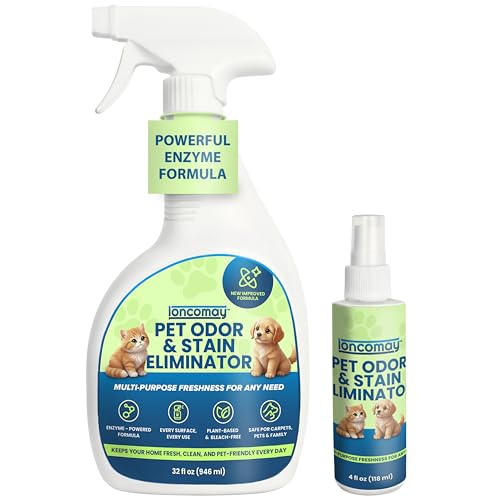
Best Enzymatic Pick for Sealed Wood
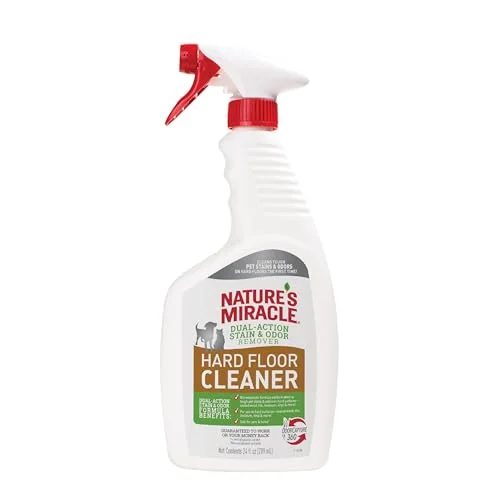 |
Nature’s Miracle Hard Floor Cleaner, 24 oz – $8.99 Formulated specifically for sealed wood and hard surfaces (not just carpet), so it breaks down the uric acid crystals covered above without clouding or discoloring a wood finish.
|
An enzymatic cleaner works differently. It contains bacterial cultures that produce enzymes engineered to metabolize uric acid specifically – they break the crystal down into ammonia and carbon dioxide, both of which off-gas as the cleaner dries. Once the crystal structure is gone, there’s nothing left to reactivate with humidity. That’s the entire reason enzymatic cleaners outperform vinegar, baking soda, or plain soap and water on pet urine: they remove the source molecule instead of covering it up.
Sealed vs. Unsealed Wood: Why It Changes Your Approach
Most cat-urine cleaning advice online treats “wood” as one surface, but sealed and unsealed wood behave completely differently and that distinction matters more than which cleaner you buy.
Sealed wood – furniture finished with polyurethane, lacquer, varnish, or a similar film finish – has a protective layer between the urine and the actual wood fibers. If the finish is intact and the urine is caught within a few hours, most of it sits on top of the finish rather than soaking into the wood itself. An enzymatic cleaner applied promptly, wiped rather than saturated, usually resolves both the stain and the odor without further work.
Unsealed or oil-finished wood – raw wood, some antiques, furniture finished only with tung oil or a penetrating oil – has no barrier. Urine soaks directly into the wood fibers, often within minutes, and can travel further than the visible stain. Enzymatic cleaners still work here, but they need contact time to reach the crystals that have migrated below the surface, and a single light wipe usually isn’t enough. For unsealed wood, apply the cleaner, cover the area with plastic wrap to slow evaporation, and let it sit for 12 to 24 hours so the enzymes have time to reach the deeper deposits before you wipe it away.
In both cases, resist the urge to saturate the wood the way you might saturate a carpet. Standing liquid on a wood surface for an extended period can raise the grain, cloud a finish into a white ring, or cause the wood itself to swell and crack at joints. Apply enough cleaner to keep the area wet through the working time on the product label, not a puddle.
If you’re dealing with a hardwood floor instead of a piece of furniture, the same enzymatic-first approach applies – see our guide to removing urine smell from hardwood floors for floor-specific sealant and refinishing advice.
Finding Every Spot: UV Light and the Nose Test
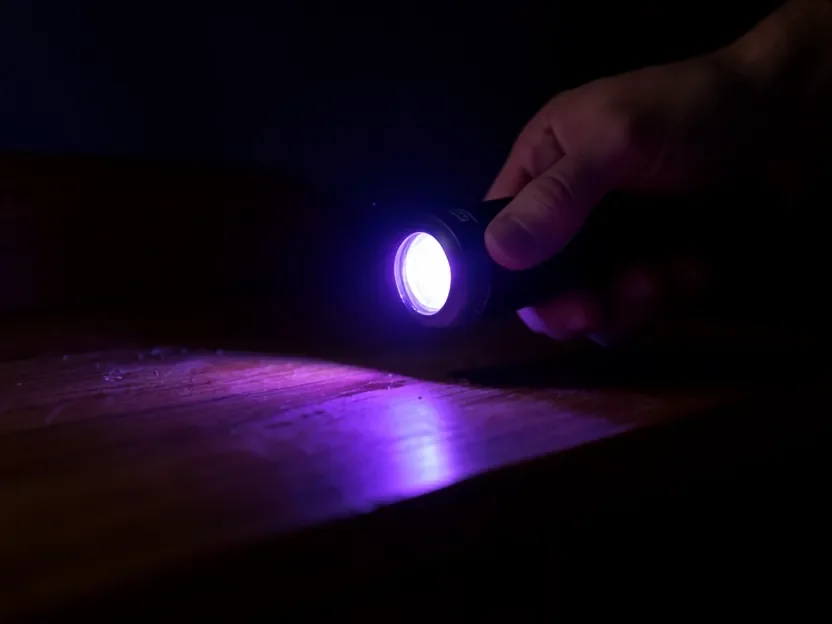
Cats often return to the same general area but not the exact same spot, and old stains can be nearly invisible on stained or dark wood. A UV (blacklight) flashlight is the fastest way to find them: in a darkened room, uric acid residue fluoresces a pale yellow-green under UV light, even on spots that look and smell clean to you. Run the light over the entire piece, not just the area you already suspect, and mark each spot with a small piece of painter’s tape before you turn the lights back on so you don’t lose track of where they were.
If you don’t have a UV light, your nose after a humid day is a reasonable substitute – the odor tends to intensify noticeably when moisture in the air reactivates dormant crystals, which is exactly the mechanism described above.
Step-by-Step: Enzymatic Cleaning Method
Once you’ve located and marked every affected spot, work through each one with this sequence:
- Blot, don’t scrub, any wet urine first. Press a clean paper towel straight down on fresh spots to lift as much liquid as possible before it soaks in further. Scrubbing pushes urine deeper into the grain.
- Test the cleaner on a hidden spot. The underside of a drawer front or the back of a leg works well. Wait 10 minutes and check for any color change or dulling in the finish before treating the visible area.
- Apply the enzymatic cleaner generously enough to keep the area wet for the full working time on the label – typically 10 to 15 minutes for sealed wood, longer for unsealed wood as covered above. Don’t wipe it off early; the enzymes need that time to finish breaking down the crystals.
- Blot the area dry with a clean, dry cloth. Avoid rubbing, which can push moisture into any nearby seams or joints.
- Let it air-dry fully before deciding whether a second treatment is needed. A lingering faint smell right after cleaning is normal while the area is still damp; judge the result once it’s bone dry.
- Repeat on any UV-marked spot that still fluoresces after the first treatment and full dry-out. Deep or old stains on unsealed wood sometimes need two or three passes.
What to Skip: Bleach, Ammonia, and Steam Cleaners
A few common “fixes” actively work against you on wood furniture. Ammonia-based cleaners smell chemically similar to a breakdown product of urine itself, which can actually encourage cats to remark the same spot. Bleach doesn’t neutralize uric acid and will strip or discolor most wood finishes on contact. Steam cleaners drive moisture and heat directly into the wood, which can set the stain permanently by bonding the uric acid more tightly to the fibers, and risks warping thin veneers. Stick with an enzymatic cleaner formulated for hard, sealed surfaces, applied with a cloth rather than a steam or spray-and-scrub tool.
When Sanding and Refinishing Is Actually Necessary
Most cat urine incidents on wood furniture don’t require refinishing. Reach for sanding only when: the finish has already visibly clouded, cracked, or lifted from prior moisture exposure; the odor persists after two full enzymatic treatments with proper dry-out time between them; or the wood shows swelling or soft, spongy spots indicating the urine reached bare wood under a compromised finish. In those cases, sand down to bare wood past the visibly affected layer, treat the raw wood with an enzymatic cleaner and let it dry completely (several days, not hours), then refinish with a fresh sealant. Refinishing over a surface that still holds active uric acid crystals just traps the odor under the new finish, where it can resurface months later.
Preventing Repeat Accidents
Once a cat has urinated in a spot outside the litter box, the lingering scent (even after cleaning) can draw them back unless the underlying behavioral cause is addressed too. A few things that actually reduce repeat incidents:
- Keep one litter box per cat plus one extra, in easily accessible locations – a common trigger for furniture accidents is a litter box that’s inconvenient, dirty, or being contested by another cat.
- Scoop daily; cats are more likely to avoid a soiled box than most owners expect.
- Rule out a UTI or bladder issue with a vet if a cat that previously used the litter box reliably suddenly stops – house-soiling is a common early sign of a medical problem, not just a behavior issue.
- Re-treat and re-check any previously soiled furniture with a UV light after a few weeks; a spot that wasn’t fully broken down the first time is a common relapse trigger.
Frequently Asked Questions
Does vinegar actually remove cat urine from wood furniture?
Vinegar neutralizes some surface odor and can help with a very fresh spill, but it does not dissolve the uric acid crystals that cause the lingering smell. For a stain or odor that has already dried, an enzymatic cleaner formulated for pet urine is significantly more effective because it breaks down the uric acid itself rather than masking it.
Is enzymatic cleaner safe on sealed wood furniture?
Most enzymatic cleaners labeled safe for sealed hard surfaces work well on sealed, finished wood furniture when you test a hidden spot first and avoid saturating the wood. Check the specific product’s label for “sealed wood” or “hard floor” compatibility, since some pet-stain formulas are designed only for carpet and upholstery and aren’t rated for finished wood.
Why does the cat urine smell come back after cleaning?
The smell returns when uric acid crystals were covered or masked rather than broken down – common with vinegar, baking soda, or fragranced cleaners. Those crystals reabsorb moisture from humid air and release odor again. Treating the spot with an enzymatic cleaner, with enough contact time for the enzymes to fully break down the crystals, resolves this instead of temporarily covering it.
When does cat urine damage on wood furniture require sanding and refinishing?
Sanding and refinishing is usually only necessary if the finish has already clouded or lifted, the odor persists after two full enzymatic treatments with proper drying time between them, or the wood shows swelling or soft spots indicating urine reached bare wood. Most surface-level stains on sealed wood resolve with cleaning alone.
Sponsored / affiliate links. As an Amazon Associate I earn from qualifying purchases. I may earn additional commission from eligible campaigns.