Is It Code to Treat Pressure-Treated Wood Where You Cut It? (IRC R317.1.1)
Yes, in most U.S. jurisdictions it is actually written into the building code: IRC Section R317.1.1 requires field-cut ends, notches, and drilled holes in pressure-treated wood to be treated with a preservative in accordance with AWPA Standard M4, or per the treated-wood manufacturer’s own instructions. That’s a real code citation, not a rule of thumb — but “it’s in the code” and “an inspector will check it” and “your treated-wood warranty requires it” are three different claims, and conflating them is exactly where most articles on this topic get sloppy.
Below is the actual distinction: what the code section says, why the cut matters physically, where code text and code enforcement diverge in practice, why this is separately a warranty condition regardless of any inspector, and how to treat a cut end correctly.
What IRC R317.1.1 Actually Requires
Section R317.1.1 (“Field Treatment”) of the International Residential Code states that field-cut ends, notches, and drilled holes of preservative-treated wood must be treated in the field in accordance with AWPA Standard M4, or with the preservative manufacturer’s own recommendations. The IRC is the model code adopted, with local amendments, by the large majority of U.S. states and municipalities for one- and two-family dwellings, so this provision is genuinely part of the base code text almost everywhere — it isn’t a fabricated or aspirational rule.
AWPA M4 (the standard the code points to) doesn’t just say “seal it” — it specifies which preservative to use based on where the wood ends up:
- Ground contact or fresh-water contact: copper naphthenate solution with a minimum of 2% copper metal
- Above-ground exterior: oxine copper (copper-8-quinolinolate)
- Interior, dry applications: a borate-based preservative
Copper naphthenate is the one homeowners run into most, since it’s the spec for the two most common DIY situations: deck posts touching soil or concrete, and fence posts. Here’s a well-reviewed, EPA-registered copper naphthenate preservative rated for both above-ground and ground-contact field cuts:
Best Copper Naphthenate End-Cut Preservative
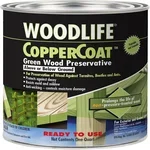 |
Wolman WOODLIFE CopperCoat Green Wood Preservative – $21.75 A ready-to-use copper naphthenate preservative labeled for the exact job R317.1.1 calls for: brushing onto field-cut ends, notches, and drilled holes on pressure-treated lumber.
|
One nuance worth flagging: the AWPA M4 ground-contact spec calls for a minimum of 2% copper metal, and this particular product’s label lists its concentration as equivalent to 1% metallic copper. For fence posts and above-ground cuts that’s not an issue. For a structural post base going directly into concrete or soil, it’s worth checking whatever spec sheet your lumber’s original treater provides — some call out a specific minimum concentration by name.
Why the Cut Actually Matters
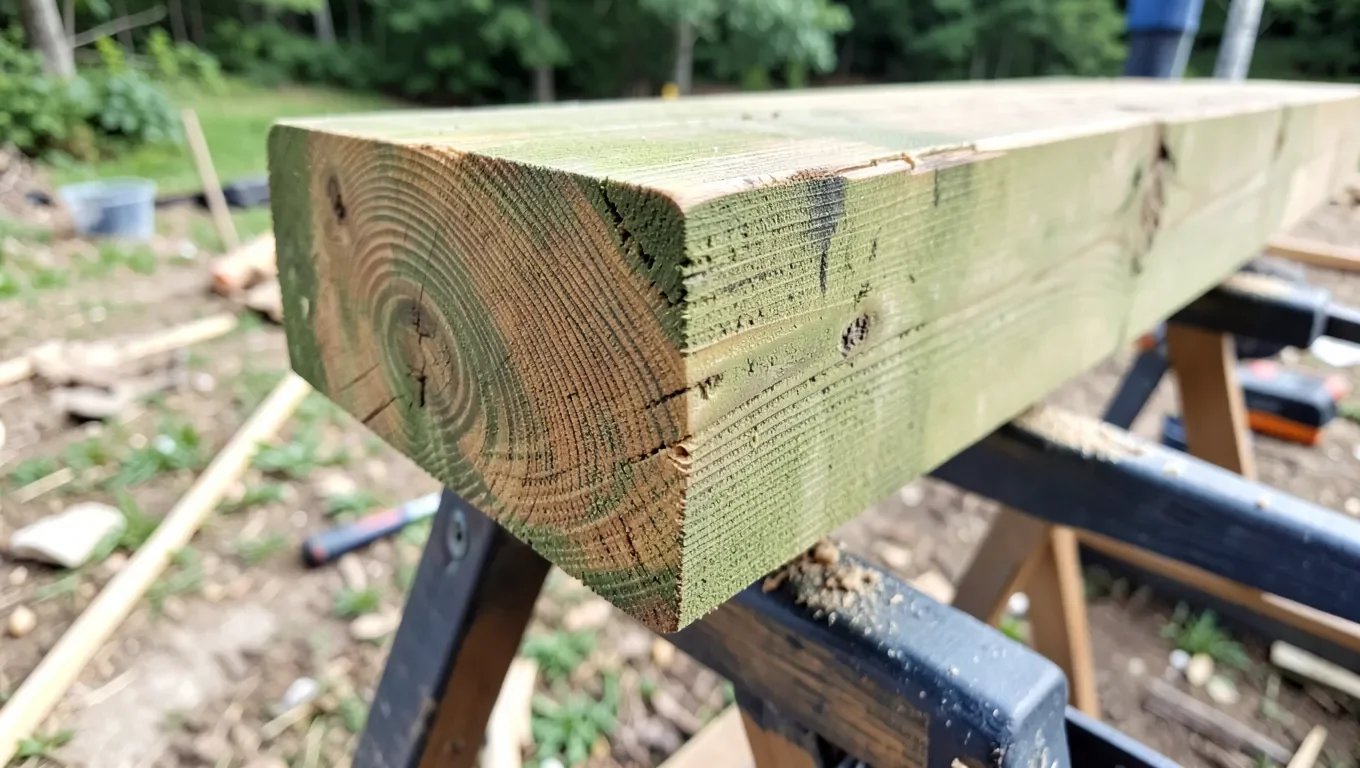
Pressure treatment forces preservative into the wood under vacuum and pressure in a sealed cylinder, but penetration isn’t uniform all the way through a piece of lumber. It’s deepest in the outer sapwood, which is permeable, and shallowest toward the center. In a 2x lumber board that’s usually enough to treat most of the cross-section. In thicker dimensional stock — a 4×4 or 6×6 post — the treatment commonly doesn’t fully reach the core, and species that resist penetration (Douglas fir is the classic example) are typically incised with small slits first just to get partial penetration at all, still leaving the innermost wood essentially untreated.
Every crosscut, notch, or drilled hole exposes that less-protected interior directly to weather. It’s the same reason deck failures so often start at a specific, predictable spot: the bottom of a post where it was cut to length, a stair stringer end, or a ledger board where a lag bolt hole was drilled. Water gets into exposed, largely untreated wood fiber at exactly the place where the board is also sitting in standing moisture or soil contact, and that combination is what starts rot. Sealing the cut with a preservative that actually penetrates — not paint, not a film-forming sealer alone — puts a treated barrier back over that exposed wood.
Code Requirement vs. Warranty Condition vs. Best Practice
This is the part that gets flattened into a single “yes” or “no” answer most places, and it shouldn’t be, because these are three separate reasons that happen to point the same direction:
It’s genuinely code text in most places. R317.1.1 is in the base IRC, and the IRC is what most U.S. jurisdictions build their residential code from. Some states and counties amend sections of the IRC, so it’s worth a quick check with your local building department if you want certainty for your specific jurisdiction — but there’s no need to guess at a blanket “yes, everywhere, no exceptions,” and there’s also no honest way to say it’s not code anywhere either. For the typical U.S. reader, it is code.
Enforcement in practice is uneven. Code text and what a field inspector actually checks aren’t the same thing. Framing and deck inspections tend to focus on structural items with obvious failure consequences — post-to-beam connections, joist hanger fastener patterns, ledger attachment, footing depth. Whether every cut end and every deck screw hole got brushed with preservative is rarely something an inspector walks the site checking line by line, especially on non-structural elements like a fence picket or a deck baluster. On structural members it’s more likely to draw a correction if it’s visibly skipped and an inspector happens to look, but “it’s code” doesn’t mean “it will be caught if you don’t do it.”
It’s also, independently, a warranty condition. This is the part that matters even in jurisdictions with looser enforcement or no inspection at all. Most preservative-treated lumber producers write field treatment of cut ends into the terms of their limited warranty. If a post rots starting at an uncoated cut and you try to file a warranty claim, the treater can point to the missing field treatment as the reason the claim is denied — regardless of whether any building inspector ever looked at that cut. That’s a real, checkable condition, not a scare tactic, and it’s worth reading your specific lumber’s warranty card rather than assuming.
And it’s best practice independent of both of the above. Even in a hypothetical case with zero code applicability and zero warranty on the lumber, treating a fresh cut with a preservative is a five-minute, roughly $1–$2-per-cut step (a quart treats dozens of cuts) against a repair that usually means digging out and replacing a rotted post years later. The code requirement and the warranty condition both exist because this is a real, well-documented failure point — they’re formalizing something that’s true on its own merits, not inventing a rule out of nowhere.
How to Field-Treat a Cut End Correctly
The AWPA M4 method is straightforward and doesn’t require special equipment:
- Make the cut, then knock off any loose splinters or sawdust with a dry brush — don’t sand or seal over debris.
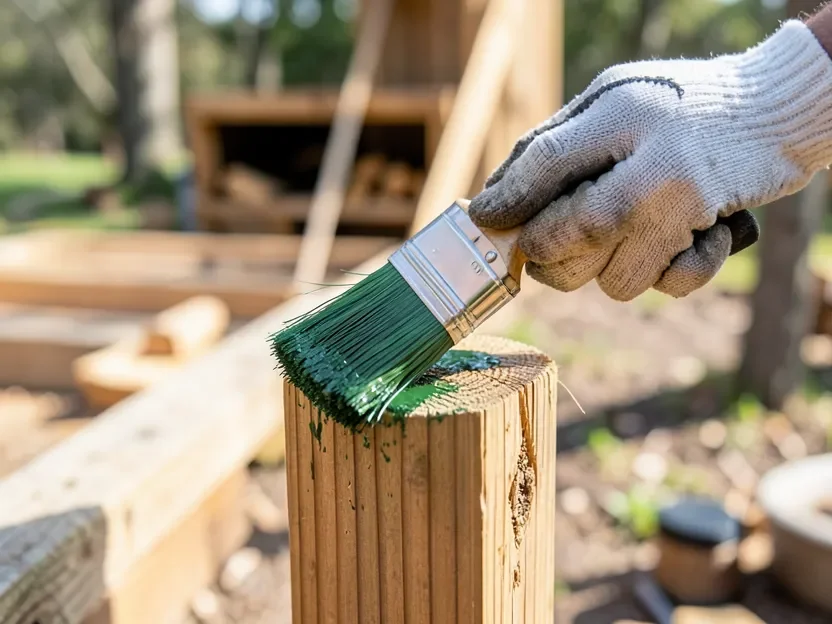
- Brush (or dip, for smaller pieces) copper naphthenate onto the entire cut face, plus a few inches up the sides where the cut meets the original treated surface.
- Reapply until the end grain stops visibly absorbing the preservative — end grain is thirsty and will often take two or three coats before it saturates.
- Do the same for any drilled holes: dip a small brush or a bent pipe cleaner in preservative and coat the inside of the hole, not just the surface around it.
- Let it dry per the product label before installing the piece against soil, concrete, or another surface it’ll be in contact with.
Match the product to where the cut ends up: copper naphthenate at 2% copper metal (or higher) for anything going into ground or fresh-water contact, oxine copper for above-ground exterior cuts, and a borate product only for interior, permanently dry applications. Using an above-ground product on a post base that’s about to go into concrete footing is a common shortcut that undercuts the whole point of the step.
Frequently Asked Questions
Is treating cut ends of pressure-treated wood actually required by code?
In most U.S. jurisdictions, yes — IRC Section R317.1.1 requires field-cut ends, notches, and drilled holes in preservative-treated wood to be treated per AWPA M4 or the manufacturer’s instructions. The IRC is the base model code for residential construction in most states, though local amendments can vary, so check with your local building department if you need certainty for your specific area.
Will a building inspector actually check that I sealed a cut end?
Not reliably. Inspections tend to focus on structural connections and safety items, and a missed end-cut treatment on a non-structural piece is unlikely to be caught line by line. That doesn’t remove the code requirement or the separate warranty condition — it just means enforcement isn’t the reason to do it.
Does skipping end-cut treatment void my treated-wood warranty?
It can. Most preservative-treated lumber producers list field treatment of cut ends as a condition of their limited warranty. If rot starts at an untreated cut and you file a claim, the missing field treatment is grounds for denial regardless of local code enforcement. Check the warranty card that came with your specific lumber for its exact wording.
What product should I use to treat a cut end?
AWPA M4 specifies copper naphthenate (minimum 2% copper metal) for ground contact and fresh-water contact, oxine copper for above-ground exterior use, and a borate preservative for interior, dry applications only. Match the product to where the cut ends up rather than using one product for everything.
Bottom Line
Treating a field cut on pressure-treated wood is code text in most U.S. jurisdictions (IRC R317.1.1), a warranty condition on most treated lumber independent of any code enforcement, and cheap, well-documented best practice on top of both. What it usually isn’t is something a building inspector walks the site checking cut by cut — so the honest reason to do it is the exposed, largely untreated core underneath every crosscut and drilled hole, not the odds of getting caught if you skip it.
Sponsored / affiliate links. As an Amazon Associate I earn from qualifying purchases. I may earn additional commission from eligible campaigns.