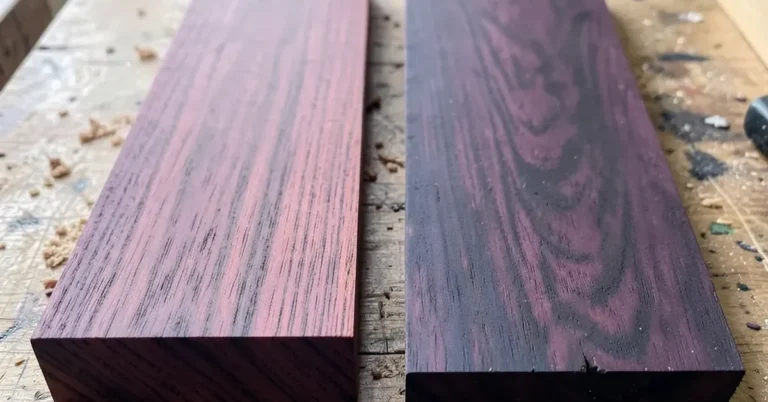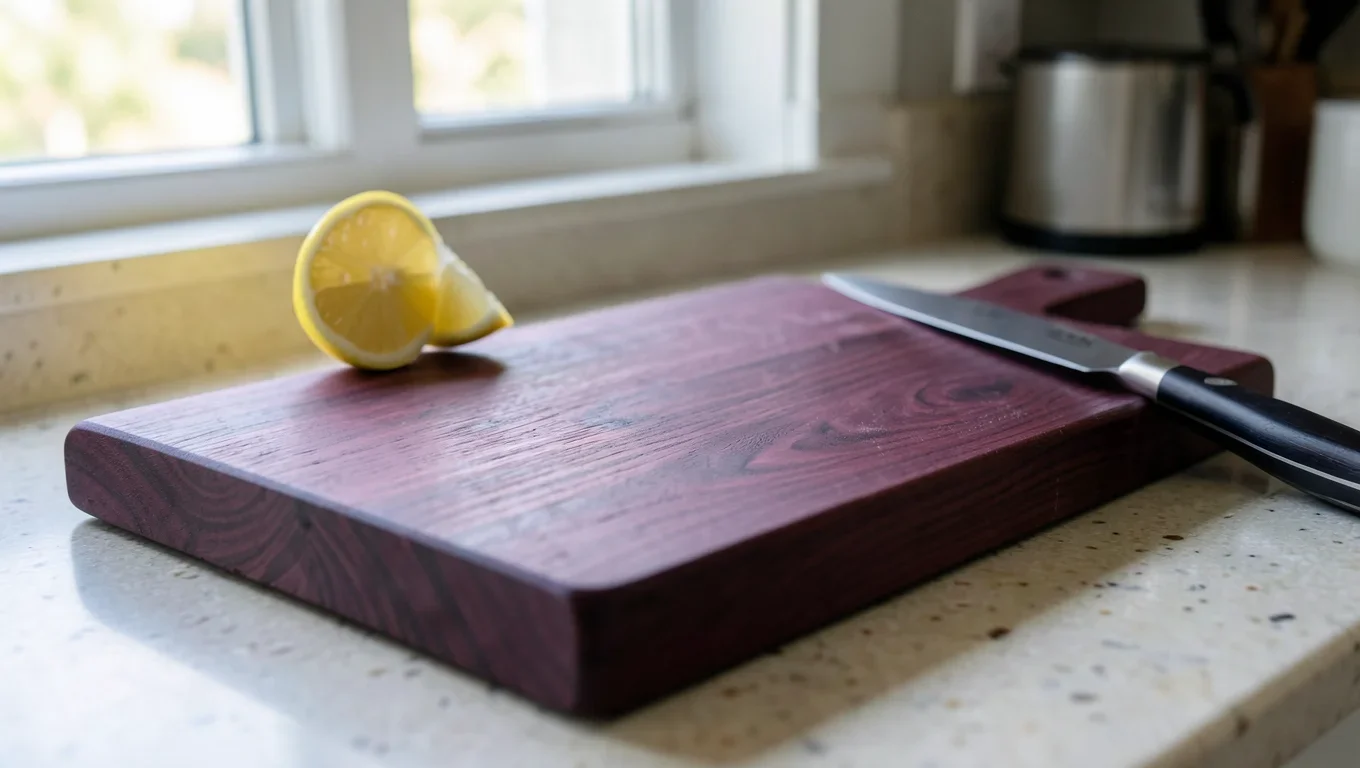
Is Purple Heart Good for Cutting Boards? Yes, Once Finished
Yes, purpleheart is a good wood for a cutting board once it’s properly sealed with a food-safe oil or wax — but it’s not the all-around best choice most articles make it out to be. At roughly 2,520 lbf on the Janka hardness scale, purpleheart is nearly twice as hard as the woods professional cutting-board makers actually recommend, which means it holds up to abuse but dulls your knives faster than a softer board would.
That tradeoff — extreme durability against edge-friendliness — is the real story with purpleheart, and it’s the part most “is purpleheart good for cutting boards” articles skip. Below is what the hardness numbers actually mean for your knives, why the wood is safe for food once finished (and why the “antibacterial wood” claim you’ll see everywhere is only half true), and why that famous purple color won’t stay purple forever.
Is Purpleheart Actually Good for a Cutting Board?
Best Conditioner For Purpleheart Boards
 |
Howard Butcher Block Conditioner – $9.18 A food-grade mineral oil and beeswax blend built for exactly the maintenance a dense wood like purpleheart needs to stay sealed and resist drying/cracking.
|
Purpleheart (Peltogyne) checks the two boxes that actually matter for a cutting board: it’s a closed-pore hardwood, so it doesn’t have the open grain that lets moisture and food particles work their way in, and it’s dense enough that knife cuts stay shallow instead of gouging deep grooves where bacteria could hide. Where it falls short of the “ideal” cutting-board wood is knife friendliness — and that’s a real tradeoff worth knowing before you build or buy one.
How Hard Is Purpleheart, Really?
Per The Wood Database, purpleheart rates at 2,520 lbf on the Janka hardness scale. For comparison, the woods that show up again and again in professional cutting-board recommendations — hard maple (1,450 lbf), teak (1,070 lbf), and black walnut (1,010 lbf) — all sit inside roughly a 900-1,500 lbf range. That range isn’t arbitrary: it’s hard enough to resist denting from normal chopping, but soft enough that the wood fibers “give” slightly under a blade instead of fighting it edge-on. Purpleheart is nearly double the top of that range.
In practice, that means a purpleheart board will outlast almost anything else in your kitchen — it resists dents, scratches, and warping better than softer woods — but it will take the edge off your knives measurably faster, since the blade is doing more of the work instead of the wood absorbing it. It’s also a wood that can gum up planer and sander blades with a resinous residue if you’re working it with dull tools, which is a shop consideration more than a kitchen one, but it explains why so many woodworkers use purpleheart as a colorful accent strip between more knife-friendly woods rather than milling an entire board out of it.
| Wood | Janka Hardness | Knife-Friendliness |
|---|---|---|
| Black walnut | 1,010 lbf | Excellent |
| Teak | 1,070 lbf | Excellent |
| Hard maple | 1,450 lbf | Good (industry standard) |
| Purpleheart | 2,520 lbf | Fair — dulls blades faster |
Is Purpleheart Food Safe? The “Antibacterial Wood” Claim, Corrected
Yes — once a purpleheart board is assembled and sealed with a food-safe finish, it’s safe for direct food contact. But it’s worth correcting a claim that gets repeated on nearly every purpleheart cutting-board page: purpleheart isn’t “naturally antibacterial.” No common cutting-board wood actually kills bacteria on contact. What purpleheart (and other closed-pore hardwoods) actually does is deny bacteria the open pores and rough end-grain pockets that an unsealed or open-pore wood would offer as places to multiply. Wash it, dry it promptly, and keep it oiled so the surface stays sealed, and there’s nothing for bacteria to hold onto — that’s a structural property, not an antimicrobial one.
There’s a separate, legitimate caution that does apply to purpleheart, and it has nothing to do with the finished board: purpleheart is a known sensitizer during machining. Sanding or cutting it can produce dust that irritates the eyes, skin, or respiratory tract in sensitive people — the reason woodworkers are told to wear a dust mask when milling it. That risk applies to raw sawdust in the shop, not to eating off a sealed, finished board. If you want the deeper breakdown of that distinction, we cover it in our full look at purpleheart’s toxicity and dust risks.
Why Do Purpleheart Cutting Boards Fade From Purple to Brown?
If you’ve seen an older purpleheart board that looks more like chocolate brown than purple, that’s not damage or a bad finish — it’s UV exposure doing exactly what it does to this species. Freshly milled purpleheart actually starts out a dull grayish-brown, then oxidizes into that vivid eggplant-purple within a few days of air exposure. From there, ongoing sunlight (and to a lesser extent, just time and air) slowly shifts it toward a darker brown with only a hint of the original purple left.
You can’t stop that shift entirely, but you can slow it down significantly with a finish that includes a UV inhibitor, and by keeping the board out of direct sunlight when it’s not in use — a cutting board that lives in a drying rack next to a sunny window will brown out noticeably faster than one stored in a cabinet between uses. If keeping the color vivid matters more to you than just keeping the wood conditioned, look specifically for a “UV-inhibiting” or “UV-stabilized” food-safe finish rather than plain mineral oil, which does nothing to block UV.
Purpleheart vs. Maple, Walnut, and Teak
Maple is the industry-standard cutting-board wood for a reason: at 1,450 lbf it’s the hardest wood still inside the knife-friendly range, it has a tight, fine grain that resists staining, and it’s usually the cheapest of the four. If you want one board that does everything reasonably well, maple is still the safer buy.
Black walnut, at 1,010 lbf, is the gentlest of the four on your knife edges and brings a rich dark-brown color without any stain or finish tricks — the tradeoff is that walnut dents and scratches more easily than maple or purpleheart over years of heavy use.
Teak‘s natural oil content (1,070 lbf) gives it a built-in water resistance the other three woods don’t have, which is why it shows up so often in outdoor and boat-adjacent kitchenware — but that same oiliness can make glue-ups trickier if you’re building your own board.
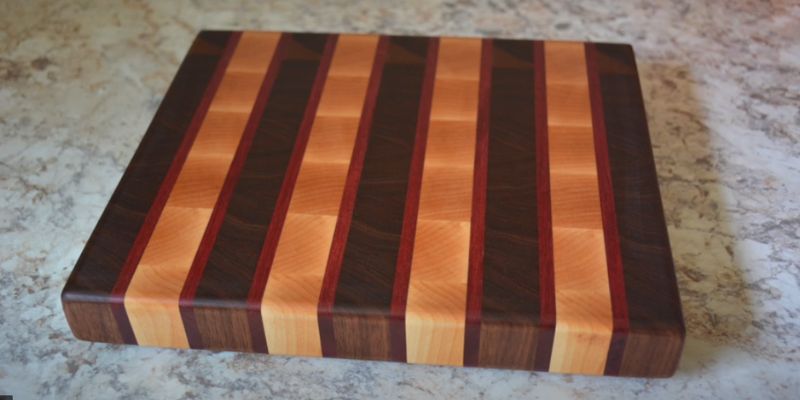
Purpleheart wins on looks and outright toughness, but as covered above, it’s the one wood on this list that will dull your knives fastest. Most experienced board-builders split the difference: a maple or walnut body with purpleheart used as thin accent strips, which gets you the color without turning the entire cutting surface into the hardest option on the list.
How to Care for a Purpleheart Cutting Board
Hand wash only, with warm water and mild dish soap — never a dishwasher, and never a long soak. Purpleheart resists moisture better than most woods, but “resists” isn’t “immune,” and standing water will eventually work its way into the seams of a glued-up board and cause warping or the glue joints to fail. Dry it immediately with a towel and stand it on edge (not flat) so air can reach both faces while it finishes drying.
Condition it with a food-safe mineral oil monthly, or as soon as the surface starts looking dry or pale. A conditioner that blends mineral oil with beeswax (like the one above) goes a step further than plain oil, adding a water-resistant top layer and a light UV-blocking effect that helps slow the purple-to-brown fade. Apply a generous coat, let it soak in for a few hours or overnight, then wipe off anything the wood didn’t absorb.
Pros and Cons of Purpleheart Cutting Boards
Pros: exceptional resistance to dents, scratches, and warping; closed-pore structure that’s genuinely hygienic once sealed; a striking color no other common cutting-board wood matches; naturally moisture-resistant.
Cons: dulls knife edges faster than maple, walnut, or teak; the signature purple color fades toward brown with UV exposure over time; raw sawdust can irritate skin, eyes, or airways during machining (not a concern once the board is finished); typically pricier per board foot than maple or walnut.
Frequently Asked Questions
Is purpleheart wood durable enough for a cutting board?
Yes, more than enough — at roughly 2,520 lbf on the Janka scale it’s about 70% harder than hard maple, the industry-standard cutting-board wood. The tradeoff is that this extra hardness dulls knife edges faster than a softer board would, which is why most builders use it as an accent strip rather than the whole cutting surface.
Is purpleheart wood food safe?
Yes, once it’s assembled and sealed with a food-safe oil or wax finish. It isn’t “antibacterial” in the sense of killing germs, but its closed-pore structure gives bacteria nowhere to hide the way an open-pore wood would, which is the real reason it’s considered a safe cutting-board material.
Why does purpleheart wood turn brown over time?
UV exposure oxidizes the wood’s surface and shifts its color from vivid purple toward brown over months and years. It’s a normal property of the species, not a defect, and a UV-inhibiting finish plus keeping the board out of direct sunlight will slow the fade considerably.
How do I maintain a purpleheart cutting board?
Hand wash with warm water and mild soap, dry immediately, and never soak it or run it through a dishwasher. Apply a food-safe mineral oil or oil-and-beeswax conditioner about once a month, letting it soak in for several hours before wiping off the excess.
Final Verdict
Purpleheart is a genuinely good cutting-board wood, not just a pretty one — but it’s not the best all-around choice, and any article that tells you otherwise is skipping the knife-dulling tradeoff that comes with a 2,520 lbf hardness rating. If you want a single board that’s easy on your knives day to day, maple or walnut is still the smarter pick. If you want the durability and the color, and you’re fine sharpening your knives a bit more often, purpleheart earns its reputation — especially finished as accent strips alongside a softer wood, and kept sealed and out of direct sun to hold onto that purple as long as possible.
Sponsored / affiliate links. As an Amazon Associate I earn from qualifying purchases. I may earn additional commission from eligible campaigns.